OpenMicro
Health Gecti
- License — License: MIT
- Description — Repository has a description
- Active repo — Last push 0 days ago
- Community trust — 40 GitHub stars
Code Uyari
- network request — Outbound network request in src/client.ts
Permissions Gecti
- Permissions — No dangerous permissions requested
Bu listing icin henuz AI raporu yok.
🎮 Codex Micro functionality using any Gaming Controller on any Coding Harness!
One controller. Your agent workflow.
Bring Codex Micro to any gaming controller and coding harness
Start in 60 seconds
You need macOS, Node.js 22 or newer, Claude Code or Codex CLI, and a connected controller. OpenMicro is macOS-first; other platforms are not yet tested.
npm i -g openmicro

openmicro claude # or just: openmicro
openmicro codex
OpenMicro installs its lifecycle hooks automatically. If Codex reports that its hooks changed, open /hooks in Codex and trust the OpenMicro hooks.
Controller support depends on the exact device and connection. Check the controller compatibility guide before you start, or run openmicro doctor to test your controller.
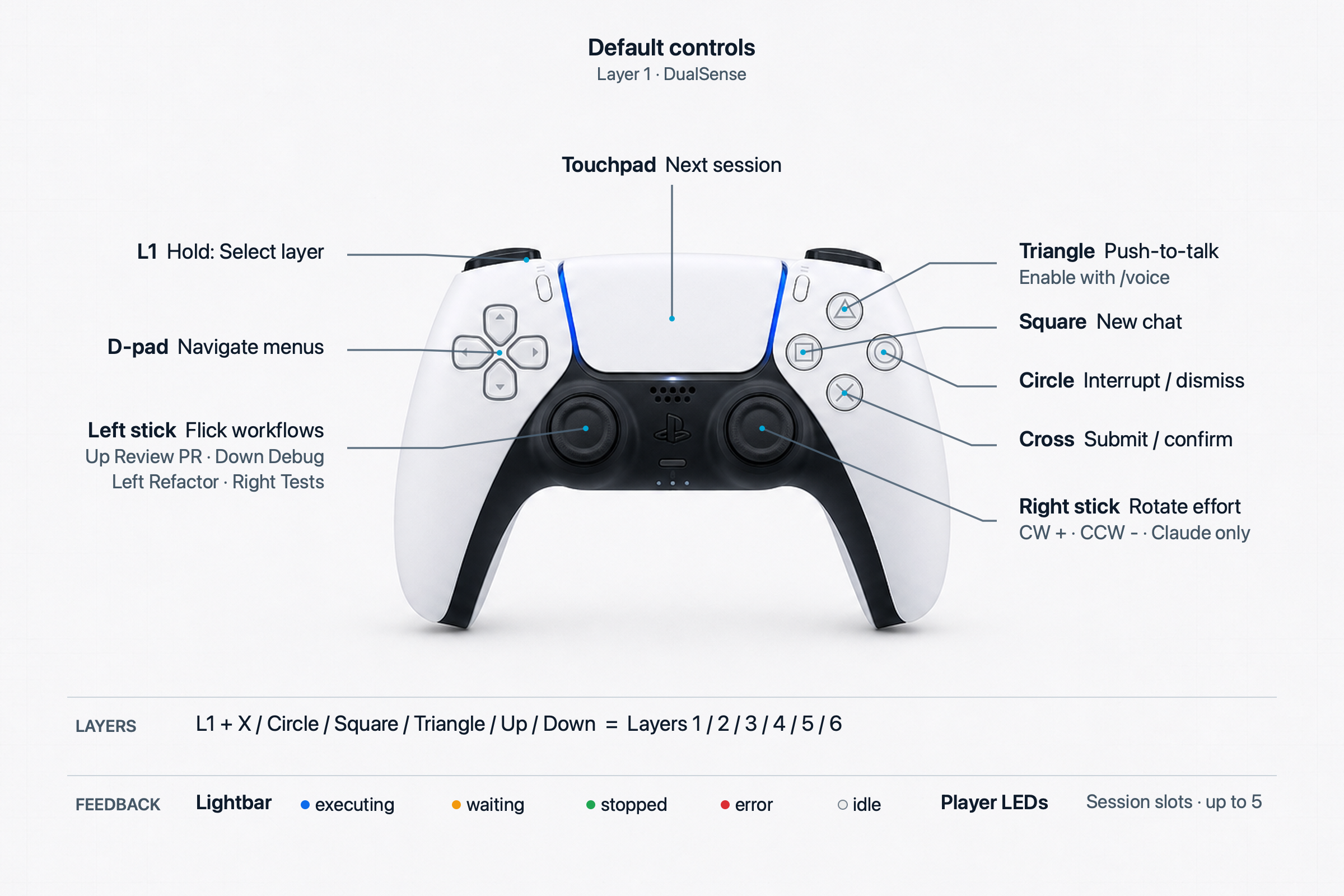
Default DualSense controls
Text control reference
| Control | Action |
|---|---|
| south (✕ / A) | Submit or confirm |
| east (○ / B) | Interrupt or dismiss |
| north (△ / Y) | Push-to-talk |
| west (□ / X) | Start a new chat |
| d-pad | Navigate TUI menus; repeats while held |
| left stick flick up / down / left / right | Review PR / debug / refactor / write tests |
| right stick rotate clockwise / counterclockwise | Increase / decrease thinking depth |
| touchpad click | Focus the next session by default, where supported |
Stick flicks fire after returning to center; each quarter-turn steps thinking depth once. Hold L1 with south, east, west, north, d-pad up, or d-pad down to select one of six layers. The first layer ships with these defaults; the other five start empty. Other controls are unbound by default and remappable.
Voice and thinking-depth support varies by harness; see OpenMicro feature parity.
What it gives you
- Respond to agents without hunting through terminal tabs.
- Launch review, debug, refactor, and test workflows with a stick flick.
- Switch among active sessions from one controller.
- See focused-session state on DualSense.
- Remap six layers for project-specific workflows.
OpenMicro feature parity
✅ supported · ⚠️ setup required or best-effort · — no verified equivalent
| Capability | Claude Code | Codex CLI |
|---|---|---|
| Launch and forward CLI arguments | ✅ openmicro claude |
✅ openmicro codex |
| Submit / confirm | ✅ Enter | ✅ Enter |
| Interrupt / dismiss | ✅ Escape | ✅ Escape |
| Start a new chat | ✅ /clear |
✅ /new |
| D-pad TUI navigation | ✅ Arrow-key passthrough | ✅ Arrow-key passthrough |
| Stick-triggered workflow prompts | ✅ Supported | ✅ Supported |
| Push-to-talk | ✅ Enable with /voice |
— No equivalent |
| Thinking-depth dial | ✅ /effort, low → max |
— No deterministic binding |
| Six remappable control layers | ✅ Supported | ✅ Supported |
| Multi-session focus switching | ✅ Supported | ✅ Supported |
| Executing status | ✅ Prompt and tool hooks | ✅ Prompt and tool hooks |
| Waiting-for-input status | ✅ Questions and notifications | ✅ Permission requests |
| Stop status | ✅ Stop hook | ✅ Stop hook |
| Error status | ⚠️ Notification-text matching | — No error hook signal |
| Hook installation | ✅ Automatic | ⚠️ Trust changes in /hooks |
Layers, workflows, navigation, and session switching are handled by OpenMicro itself. Harness-specific gaps are left unmapped instead of sending guessed keystrokes. A Stop event means the agent stopped; it does not guarantee success.
Configure controls and workflows
OpenMicro creates ~/.openmicro/config.json on first run. Edit bindings, layer colors, and workflow prompt text there. Invalid configuration stops startup without overwriting the file.
{
  "layers": [
    {
      "name": "Layer 1",
      "color": { "r": 255, "g": 255, "b": 255 },
      "bindings": {
        "south": { "type": "accept" },
        "lstick_up": { "type": "workflow", "presetId": "review-pr" },
        "rstick_cw": { "type": "thinking_depth", "delta": 1 }
      }
    },
    { "name": "Layer 2", "color": { "r": 160, "g": 32, "b": 240 }, "bindings": {} },
    { "name": "Layer 3", "color": { "r": 0, "g": 255, "b": 255 }, "bindings": {} },
    { "name": "Layer 4", "color": { "r": 255, "g": 140, "b": 0 }, "bindings": {} },
    { "name": "Layer 5", "color": { "r": 255, "g": 20, "b": 147 }, "bindings": {} },
    { "name": "Layer 6", "color": { "r": 255, "g": 255, "b": 0 }, "bindings": {} }
  ],
  "workflows": {
    "review-pr": "Review this PR for correctness, security, and style issues."
  }
}
Binding keys can be buttons such as south and dpad_up, or gestures such as lstick_up and rstick_cw. Actions include accept, reject, push_to_talk, new_chat, thinking_depth, workflow, prompt, focus_session, layer, and raw keys.
Sessions and status
The first OpenMicro process owns the controller and becomes the host. Later processes register as clients, so one controller can drive several terminal sessions. On supported pads, touchpad click cycles focus by default.
On DualSense, the lightbar follows the focused session: blue while executing, amber while waiting, green when stopped, red on a detected error, and dim white while idle. The five player LEDs show occupied session slots.
Test or contribute a controller
openmicro doctor
The diagnostic checks controller input and, on DualSense, lightbar/player-LED output. It writes a <vid>-<pid>-<transport>.json report that can be added unchanged to test/fixtures/controllers/; CI then replays the captured inputs as a regression test. See CONTROLLERS.md for supported devices, connection-specific notes, and contribution steps.
Hardware notes
- DualSense is the only controller with lightbar and player-LED output. DS4 and Xbox controllers are input-only; generic HID input is best-effort because report layouts vary.
- DualSense has five player LEDs, so feedback represents at most five active session slots.
- Xbox parsing currently supports its wired USB report layout, not Bluetooth.
Add another harness
The public openmicro/harness API exposes the Harness contract and registerHarness(). Implement the contract, return null for actions without a verified CLI equivalent, and register it before OpenMicro resolves the harness.
import { registerHarness } from 'openmicro/harness'
import type { Harness } from 'openmicro/harness'

const myHarness: Harness = {
  kind: 'my-cli',
  command: 'my-cli',
  buildArgs: (args) => args,
  installHooks: () => ({ changed: false, trustNotice: null }),
  stateForHookEvent: () => null,
  resolveAction: (action) => {
    if (action.type === 'accept') return { bytes: '\r' }
    if (action.type === 'reject') return { bytes: '\x1b' }
    if (action.type === 'prompt') return { bytes: `${action.text}\r` }
    if (action.type === 'keys') return { bytes: action.bytes }
    return null
  },
}

registerHarness(myHarness)
The binary does not load harness plugins from configuration yet, so a third-party registration currently needs a small custom entry point.
Troubleshooting
Controller is connected but OpenMicro cannot open it
Another process probably owns the device exclusively. Quit other controller tools, Steam, browser tabs using Gamepad/WebHID, and PS Remote Play, then retry.
On macOS, this command lists processes with the DualSense open:
ioreg -r -n "DualSense Wireless Controller" -l -w0 | grep IOUserClientCreator
Current macOS versions do not require Input Monitoring permission for game controllers.
Yorumlar (0)
Yorum birakmak icin giris yap.
Yorum birakSonuc bulunamadi