stet-cli
Health Uyari
- License — License: NOASSERTION
- Description — Repository has a description
- Active repo — Last push 0 days ago
- Low visibility — Only 5 GitHub stars
Code Basarisiz
- exec() — Shell command execution in docs/scripts/validate-content-contract.mjs
- rm -rf — Recursive force deletion command in install.sh
- rm -rf — Recursive force deletion command in stet_harbor_agents/codex_auth.py
Permissions Gecti
- Permissions — No dangerous permissions requested
Bu listing icin henuz AI raporu yok.
Evaluate coding agents (Claude Code, Codex, Cursor) on your own repo's merged PRs. Installer and agent skill for the Stet CLI.

Evaluate coding agents on your own repo
Test Claude Code, Codex and Cursor on your repo's merged PRs
Stet turns your merged PRs into replayable tasks, runs each agent setup on the
same tasks, and grades the patches above pass/fail: tests, a checklist of
required behaviors and code review, with cost and time alongside. Use it to
pick a model or reasoning effort, or to A/B test an AGENTS.md, CLAUDE.md or
skill change before it reaches every agent session.
Get started · See an example result ·
Understand how Stet works · Leaderboard
What do you want to improve?
A/B test an AGENTS.md change
Compare current and proposed instructions on the same retained repository
tasks, with the model fixed across both arms. Stet returns a scoped promote,hold, or inspect recommendation for the selected corpus and recorded
harness.
Use the Stet skill to A/B test my proposed
AGENTS.mdchange. Keep the model
fixed, plan before launch, and return the canonical Trial Result with its
recommendation, evidence limitations, and next action.
Improve AGENTS.md iteratively — Advanced
Let your coding agent change one allowed instruction lever at a time while Stet
persists loop state, measures each candidate, and protects holdout and promotion
boundaries. The coding agent edits; Stet records, compares, selects, and gates.
Use the Stet skill to improve
AGENTS.mdwithin a bounded search space and
stop rule. Test one change at a time and ask before using holdout evidence or
promoting a finalist.
Test whether a skill helps
Compare behavior with and without a new skill, or compare a committed skill
with a revision, using replayable tasks and behavior-relevant graders. A new
skill needs a true skill-absent baseline; a revision uses the committed skill.
Use the Stet skill to test whether this repo-managed skill helps. Plan before
launch, use the right baseline, and reportpromote,hold, orinspect.
Choose a model or reasoning effort
Compare models on the same retained tasks, or hold the model fixed and compare
reasoning-effort arms. Read correctness, quality, cost, uncertainty, validity,
and residual risk separately; unavailable or incomparable dimensions stay
visible.
Use the Stet skill to compare these configurations on the same repository
tasks. First ask whether I want a cheap diagnostic read or a gateable rollout
decision. Keep diagnostic evidence labeled directional; for a gateable choice,
use matched runs and return the canonical Trial Result.
How Stet works
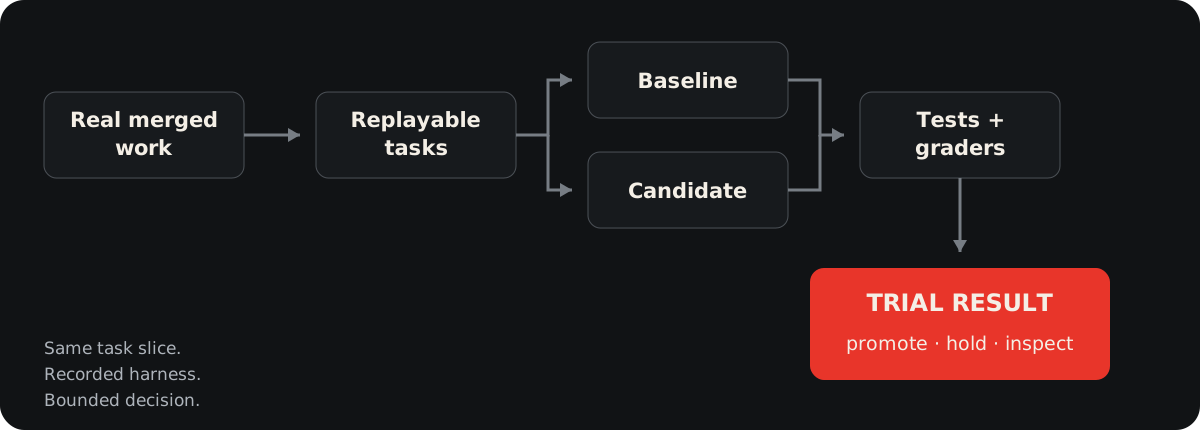
Stet packages selected history as replayable tasks. It declares the treatment
being tested and its intent, runs a baseline and candidate against the same task
slice while controlling the other harness settings that are relevant, evaluates
both with tests and declared graders, and writes a canonical Trial Result with
one scoped recommendation and next action.
Example Trial Result
A real decision from repository work
Historical April 2026 model comparison across 28 paired Zod tasks, with Opus
4.6 and Opus 4.7 at identical high reasoning.
| Observed measure | Opus 4.6 | Opus 4.7 |
|---|---|---|
| Test pass rate | 42.9% | 42.9% |
| Equivalence rate | 32.1% | 46.4% |
| Observed cost per task | $19.96 | $8.11 |
| Mean agent duration | 7m 58s | 3m 12s |
Historical receipt: PROMOTE candidate Opus 4.7, high confidence.
On this task corpus, the historical receipt recommended Opus 4.7 after it held
the observed test pass rate steady, improved observed equivalence, and used less
observed cost and time. These are selected observations; the receipt also used
declared grader evidence not reproduced here.
Historical April 2026 result, scoped to this 28-task Zod corpus and recorded
harness. The legacy report predates Stet's current calibration and
claim-readiness fields, so the displayed metric values are observations, not
generalized or uncertainty-calibrated improvement claims.
Install and get a first result
The CLI ships for macOS and Linux on x86_64 and arm64, and for Windows on amd64.
The documented end-to-end Docker-backed evaluation workflow is currently for
macOS and Linux.
macOS and Linux:
curl -fsSL https://raw.githubusercontent.com/Stet-AI/stet-cli/main/install.sh | sh
Windows PowerShell:
irm https://raw.githubusercontent.com/Stet-AI/stet-cli/main/install.ps1 | iex
Sign in to commercial Stet workflows, then install the Stet agent skill:
stet auth login
stet auth status
npx skills add https://github.com/Stet-AI/stet-cli.git --skill stet --all
stet --version
npx skills list
The default evaluation path also needs a running Docker daemon, Python 3.12+,uv, and authentication for the model provider you plan to evaluate. The
beta quickstart covers platform setup and verification.
In the repository you want to evaluate, ask your coding agent:
Use the Stet skill to onboard this repo. First ask what work and decision I
want Stet to track. Read CI and repository history, propose a starter slice
from real merged work, prove which retained tasks are build-ready, and report
the slice rationale, coverage, gaps, and confidence. Stop with an onboarding
receipt before model evaluations; do not claim the slice is automatically
representative.
Why trust the result?
Stet keeps correctness, quality, cost, uncertainty, validity, and grader
coverage separate. Recommendations apply only to the declared change, selected
task corpus, and recorded harness. Missing, stale, partial, invalid, or
under-graded evidence cannot support promotion; Stet preserves the actual
blocker status and exact next action instead of presenting it as rollout proof.
Evaluation artifacts normally remain in local Stet output roots, and the
audited Stet control-plane client path does not upload repository contents or
evaluation artifacts. Configured coding-agent and grader providers can receive
task instructions, repository context, patches, tests, and grading context.
When you are signed in, the CLI also sends best-effort command-category and
status events associated with the authenticated user. Those events are
persisted server-side. Event metadata may include the root command, selected
model or models, mode, output-directory basename, generic failure
classification, and entitlement status or reason. A first-evaluation success
or failure can enqueue customer outreach. The CLI currently exposes no
telemetry opt-out. Stet does not claim a universal network sandbox.
Learn more
The install script and agent skill are available under the MIT License.
The distributed Stet binary is governed by the Stet Binary Terms.
Yorumlar (0)
Yorum birakmak icin giris yap.
Yorum birakSonuc bulunamadi