hookstack
Health Uyari
- License — License: MIT
- Description — Repository has a description
- Active repo — Last push 0 days ago
- Low visibility — Only 5 GitHub stars
Code Basarisiz
- execSync — Synchronous shell command execution in .claude/hooks-timeline.mjs
- exec() — Shell command execution in .claude/hooks-timeline.mjs
- execSync — Synchronous shell command execution in .claude/hooks/a11y-jsx-guard.mjs
- exec() — Shell command execution in .claude/hooks/a11y-jsx-guard.mjs
- process.env — Environment variable access in .claude/hooks/a11y-jsx-guard.mjs
- process.env — Environment variable access in .claude/hooks/agents-md-loader.mjs
- process.env — Environment variable access in .claude/hooks/audit-log.mjs
- execSync — Synchronous shell command execution in .claude/hooks/autoformat.mjs
- exec() — Shell command execution in .claude/hooks/autoformat.mjs
- process.env — Environment variable access in .claude/hooks/bash-command-log.mjs
- execSync — Synchronous shell command execution in .claude/hooks/block-destructive.mjs
- rm -rf — Recursive force deletion command in .claude/hooks/block-destructive.mjs
- execSync — Synchronous shell command execution in .claude/hooks/block-push-closed-pr.mjs
- exec() — Shell command execution in .claude/hooks/block-push-closed-pr.mjs
Permissions Gecti
- Permissions — No dangerous permissions requested
Bu listing icin henuz AI raporu yok.
The community catalogue for Claude Code hooks. Browse → select → npx install in 60s.
HookStack
Your AI agent runs fast. Hooks keep it honest.
Production-ready hooks — for Claude Code, OpenAI Codex, and GitHub Copilot.
Only in one command — your agent gets guardrails in under a minute.









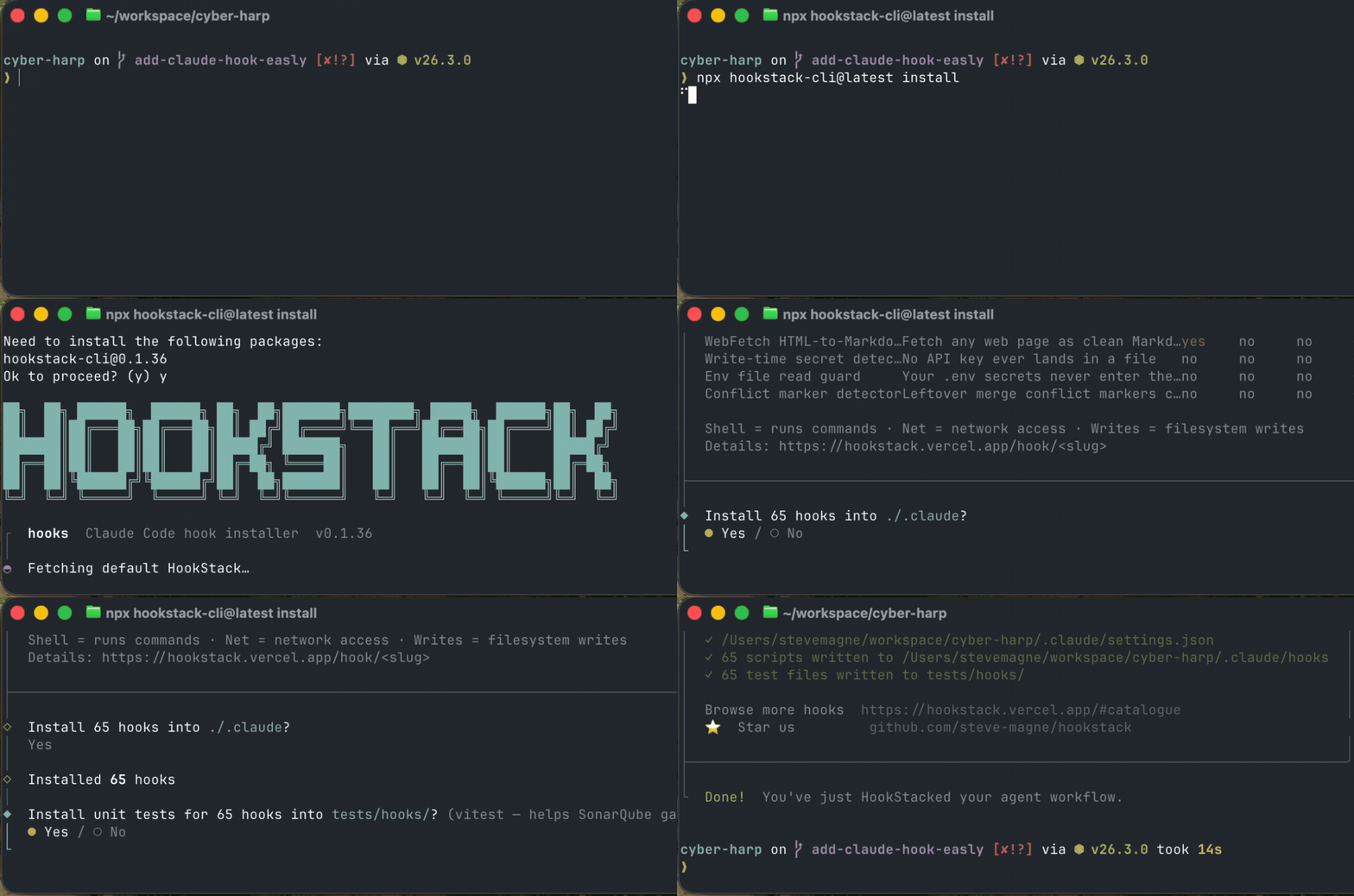
Installation
Installation takes under a minute.
npx hookstack-cli@latest install
That's it. The CLI walks you through picking hooks, writes the .mjs scripts, and patches the right config file — no manual copy-paste, no JSON editing. The interactive menu lets you pick your target agent.
Want to fine-tune your Hookstack? Go to hookstack.app — browse the full catalogue, select exactly what you need, copy the generated command and paste it in your terminal
The HookStack evolution
102 hooks and counting — every one dogfooded on this repo, unit-tested, and shipped in public.
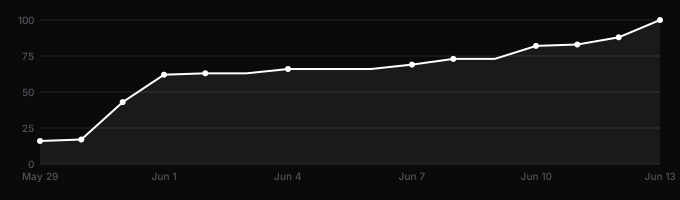
First hook 2026-05-29 · latest 2026-06-13 · explore the live timeline → hookstack.app/evolution
Latest additions
| Hook | Category | Added |
|---|---|---|
| PII redactor for display | security | Jun 13, 2026 |
| Force implementation doc at stop | documentation | Jun 13, 2026 |
| Dead link checker | documentation | Jun 13, 2026 |
| Single H1 heading guard | validation | Jun 12, 2026 |
| SEO structure gate | validation | Jun 12, 2026 |
| SEO page metadata guard | validation | Jun 12, 2026 |
| Next.js image guard | validation | Jun 12, 2026 |
| JSX accessibility guard | validation | Jun 12, 2026 |
→ Full timeline on hookstack.app/evolution
Promise
Install a production-ready HookStack in one command — up and running in 60 seconds, on Claude Code, OpenAI Codex, or GitHub Copilot.
How it works
The moment your agent starts a session, it knows absolutely nothing about your environment. It doesn't know which branch you're on, doesn't know your .env has secrets, doesn't know that rm -rf / is a terrible idea. It just runs.
Hooks change that.
A hook is an ordinary Node.js script wired into the agent lifecycle via a config file. No SDK, no plugin system — just events. When the agent is about to run a shell command, a PreToolUse hook fires first. It reads the full command, and it can block it. When the agent writes a file, a PostToolUse hook can reformat it automatically. When a long task finishes, a Stop hook can ping your phone.
Hookstack is the catalogue of these scripts — written, tested, and ready to install. You pick the ones you want, run one npx command, and your project gets a hooks folder and a patched config file. Done.
Agent-agnostic by design. Claude Code, OpenAI Codex, and GitHub Copilot share the same lifecycle event model, so the hook code is identical across all three — only the config file format differs (.claude/settings.json vs .codex/hooks.json). Write a hook once, deploy it on whichever agent you (or your team) run.
The result: your agent still moves fast. It just can't do the dumb things anymore.
Sponsorship
If Hookstack has saved your production secrets or stopped a runaway rm -rf, I'd love it if you'd give the repo a star or sponsor the work.
Thanks!
— Steve
The Lifecycle
Hooks fire at 25 distinct points in the Claude Code agent loop. Here is how the most important ones fit together:
1. SessionStart — set the stage
Fires the instant a session opens. Use it to inject context: current branch, recent commits, open issues. Your agent starts informed instead of cold.
2. PreToolUse — intercept before it's too late
Fires before any tool executes and can block it outright. The right place for security: secrets in commands, destructive filesystem ops, pushes to main, writes to .env. The agent sees your reason and adjusts — it doesn't just get a wall.
3. PostToolUse — observe and react
Fires after a tool completes, non-blocking. Run ESLint + Prettier after every file write. Record what the agent touched. Validate that the file it wrote actually parses. The agent keeps moving; the hook handles the cleanup.
4. Stop / StopFailure — close the loop
Fires when the agent finishes (success or failure). Ping Slack. Send a push notification. Write a session summary to disk. The work is done — now you find out about it.
5. WorktreeCreate — bootstrap new environments
Fires when a new worktree is created. Copy .env, assign a free port, run pnpm install. Every worktree starts ready, not broken.
What's Inside
Security
- pre-bash-secret-detection — Catches API keys, tokens, and passwords before any shell command runs
- pre-write-secret-detection — Blocks the agent from hardcoding a secret into any file it writes
- pre-bash-block-destructive — Blocks
rm -rf /,DROP TABLE, direct disk writes, and other foot-guns - pre-edit-protect-paths —
.envand key files stay untouched by the agent, always - pre-read-env-guard —
.envsecrets never enter the model context in the first place - pre-bash-guard-git-push-main — Hard stop on any
git pushtargetingmainormaster
Context
- session-start-load-git-context — Injects current branch, status, and last commit at session start
- session-start-github-context — Open PRs and CI check status loaded before you ask
- worktree-create-setup-env — Copies
.env, assigns a free port, runs install — every worktree, every time - pre-read-file-to-markdown — Read any PDF, DOCX or PPTX as clean Markdown — slash token usage
Validation
- stop-per-file-coverage — After each session, flags any file touched without test coverage ≥ 80 %
- stop-per-file-lint — ESLint runs on every file the agent modified before Stop fires
- post-write-autoformat — Prettier auto-formats silently after every Write or Edit
- pre-bash-enforce-package-managers — Blocks
npmoryarncommands when the project usespnpm - post-edit-typecheck — Runs
tsc --noEmiton touched TypeScript files right after an edit - post-edit-conflict-marker-check — Leftover merge conflict markers caught the moment a file is written
Notification
- notification-slack — Pings your Slack when the agent needs you mid-session
- stop-sound — A completion chime the moment Claude finishes
- stop-tts-completion — Get told out loud the moment work is done
Workflow
- session-start-worktree-if-main — Start a session on
mainand you're moved to a fresh worktree - post-bash-command-log — A full history of every command Claude ran
- registry-changed-auto-sync — Re-syncs
registry.jsonwhenever a hook.mjsis edited (meta: powers this repo)
Documentation
- stop-generate-changelog — An automatic changelog of what the agent shipped, session by session
Philosophy
- Hooks are not plugins. They are ordinary shell scripts. No SDK, no agent modification — just events and
settings.json. - Block early, not late. A
PreToolUsehook that stops a bad command costs nothing. A runawayrm -rfcosts everything. - Zero overhead by default. Hooks that don't match exit in milliseconds. A
PostToolUsehook that can't find ESLint is silent, not crashing. - Tested like production code. Every hook in the catalogue ships with a Vitest unit test. The CI gate rejects any hook without coverage ≥ 80 %.
- Dogfooded. The hooks in this catalogue are active on this very repository. They run on every Claude Code session that touches
hookstack. Bugs surface fast.
Contributing
Via a pull request
- Fork the repository
- Write your hook as
.claude/hooks/<slug>.mjsfollowing the conventions below - Add a test in
tests/hooks/<slug>.test.mjsand verifypnpm testpasses - Add the metadata entry to
registry/registry.json(see the schema in CLAUDE.md) - Run
node .claude/sync-hooks.mjsto propagate the code intocode_snippet - Submit a PR — CI runs
pnpm typecheck,pnpm test, and a drift check
Hook conventions (short version)
- One file, one responsibility. No catch-all hooks.
- Export
run(input, deps = {})— pure logic, injectable fakes, returns a result ornull. - The entry-point guard reads stdin, calls
run, marshalls — nothing else. PreToolUsehooks must provide an actionablereason, not just "blocked".PostToolUsehooks must be non-blocking: tool-absent errors are silent.- Timeout every
execSynccall — no hook should hang indefinitely.
Full conventions: CLAUDE.md → Conventions hooks.
Run locally
git clone https://github.com/steve-magne/hookstack.git
cd hookstack
pnpm install
pnpm dev          # → http://localhost:3000
# pnpm typecheck   \
# pnpm lint         > Don't need those — Hookstack does it for you.
# pnpm test        /
pnpm build        # Production build
| Layer | Technology |
|---|---|
| Framework | Next.js 15 — App Router, Server Components |
| Language | TypeScript 5.x |
| Styling | Tailwind CSS v4 |
| Animations | Motion (ex-Framer Motion) — springs, split-flap, FLIP |
| State | Zustand — persisted selection |
| CI enrichment | GitHub Actions + Claude Code (ANTHROPIC_API_KEY) |
| Package manager | pnpm 9.x |
Updating
npx hookstack-cli@latest update
The CLI re-fetches each installed hook from the registry and overwrites the local .mjs. Your settings.json is not touched unless the config fragment changed.
Guides
Five short guides on Claude Code hooks — from first principles to production debugging:
- What are Claude Code hooks? — the concept explained in plain language: what an event is, how settings.json wires it, and when to reach for a hook vs a slash-command.
- PreToolUse vs PostToolUse — when to block (PreToolUse) vs when to observe and react (PostToolUse), with concrete examples of each.
- Claude Code hooks vs slash commands — the two extension points compared: trigger model, blocking capability, and the right choice for each use-case.
- Claude Code hooks not working? — a practical troubleshooting checklist: permissions, shebang, stdin parsing, exit codes, and the most common mistakes.
- Write your first Claude Code hook — a step-by-step walkthrough from an empty
.mjsto a tested, wired hook in under 10 minutes.
Community
Hookstack is built by Steve Magne with contributions from the Claude Code community.
- Catalogue: hookstack.app
- Guides: hookstack.app/guides — what hooks are, PreToolUse vs PostToolUse, hooks vs slash-commands
- About: hookstack.app/about
- Issues: github.com/steve-magne/hookstack/issues
- Contribute a hook: hookstack.app/contribute
- npm: npmjs.com/package/hookstack-cli
Yorumlar (0)
Yorum birakmak icin giris yap.
Yorum birakSonuc bulunamadi