N0xis
Health Uyari
- License — License: NOASSERTION
- Description — Repository has a description
- Active repo — Last push 0 days ago
- Low visibility — Only 5 GitHub stars
Code Basarisiz
- rm -rf — Recursive force deletion command in crates/n0xis-cli/tests/fixtures/imports/build.sh
- rm -rf — Recursive force deletion command in crates/n0xis-cli/tests/fixtures/imports/not_read/build.sh
Permissions Gecti
- Permissions — No dangerous permissions requested
Bu listing icin henuz AI raporu yok.
Reverse-engineering toolkit: disassembler, SSA decompiler, C++ class recovery and live-process analysis for PE and ELF. Scriptable CLI, every answer JSON. Source-available (PolyForm Noncommercial).
N0xis
A reverse-engineering toolkit: disassembler, SSA decompiler, C++ class recovery and live-process
analysis for PE and ELF. Static files and running processes go through one pipeline, and every
answer is JSON a script can act on.
Three front ends share that core: the CLI, where a command answers with one JSON object (a serve session with a ready envelope, then one per request); a
desktop GUI in its own repository, n0xis-gui; and
an MCP server, n0xis-mcp — 27 tools returning the same envelope over JSON-RPC on stdio.
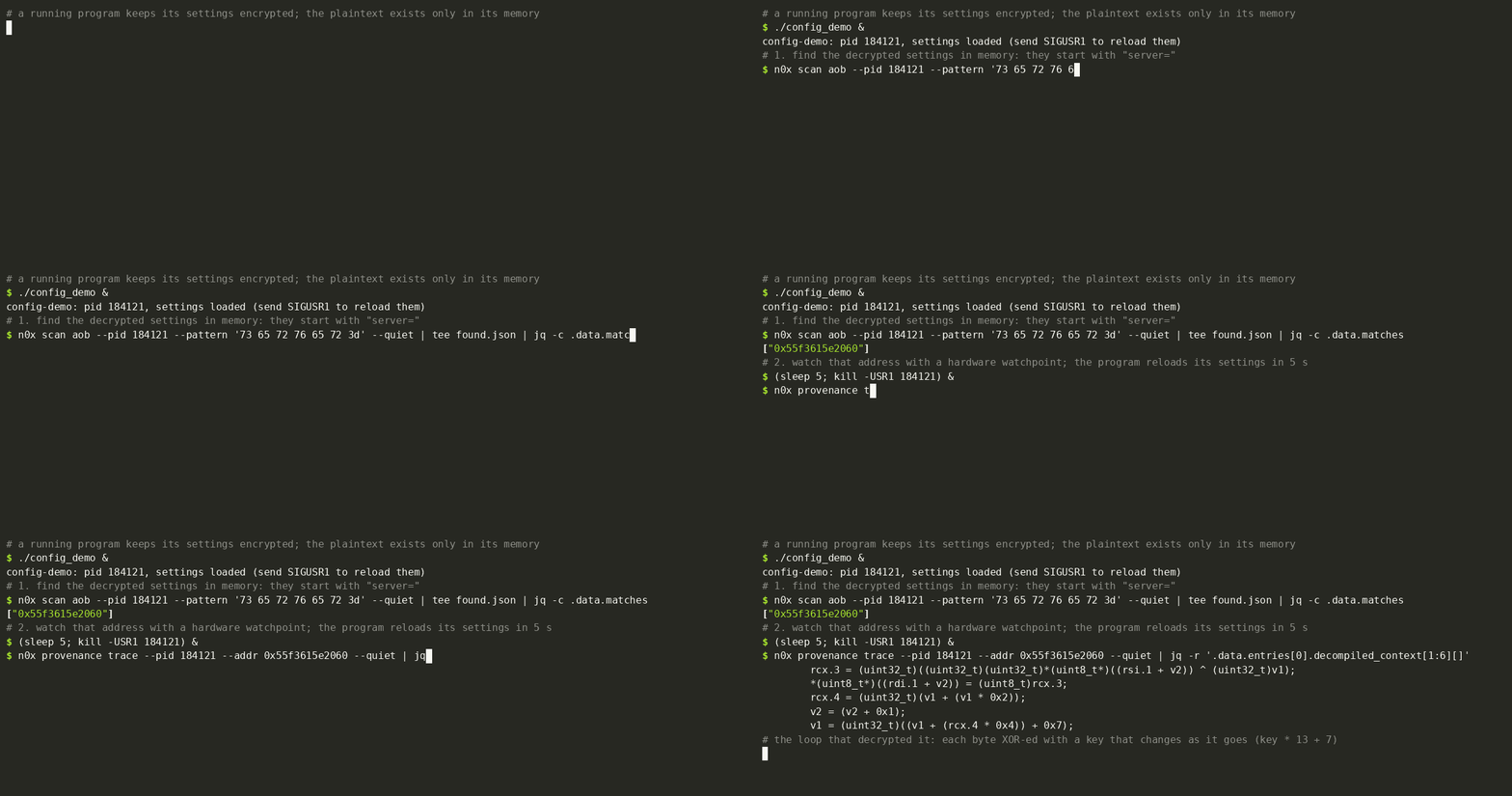
A real run of examples/config-demo: a program keeps its settings encrypted and decrypts them into memory; find the plaintext, arm a hardware watchpoint on it, and get the decompiled code that wrote it. Rerun it yourself with demo.sh.
$ n0xis provenance trace --pid 181529 --addr 0x564e32cb7060 --kind write
"instruction_va": "0x564e32cb4266",   // the byte store that wrote the watched address
"function_va": "0x564e32cb4230",      // the function it sits in, on this build (see below)
"decompiled_context": [
  "rcx.3 = (uint32_t)((uint32_t)(uint32_t)*(uint8_t*)((rsi.1 + v2)) ^ (uint32_t)v1);",
  "*(uint8_t*)((rdi.1 + v2)) = (uint8_t)rcx.3;",   // ← the write
  "rcx.4 = (uint32_t)(v1 + (v1 * 0x2));",
  "v2 = (v2 + 0x1);",
  "v1 = (uint32_t)((v1 + (rcx.4 * 0x4)) + 0x7);"
]
In the source this is config[i] = sealed[i] ^ key; key = key * 13 + 7;: the two statementsrcx.4 = v1 + v1 * 2 and v1 = v1 + rcx.4 * 4 + 7 together are v1 * 13 + 7. The answer gives
addresses, not the names config and decrypt_config: names from the binary's symbols are not
carried into it yet. This build is gcc -O2, where function_va is the function's start; on clang-O2 and gcc -O1 builds of the same source it is the loop head, answered ok:true with no note.
This run is on Linux; the last Windows run of provenance trace is in the ledger.
What runs where
yes: every check agreed · partial: usable, with the gaps below · wrong: ok:true with wrong
results on measured inputs · refused: a typed error · not yet: no code path. Measured in October
2026 on programs built from known source, against the processor and independent tools.
| Format | Static file | Live process |
|---|---|---|
| PE32+, PE32 (x86-64, x86, ARM64) | partial: the gaps and wrong answers below | Windows: not measured for this table |
| ELF64, ELF32 (x86-64, x86, AArch64, ARMv7) | partial: the gaps and wrong answers below; big-endian: decompile and RTTI refused | Linux x86-64: partial: the live entries below; other ISAs not measured |
| Mach-O, thin and universal | refused (load-failed) |
not yet |
| WebAssembly | partial: the function list, disassembly, calls to and from a function, imports, exports, profile and strings (with each string's place in linear memory) agreed with wasm-objdump on every module measured; decompile, IR and the other commands that need the lift refused (not-lifted: the lift is stage 3) |
not yet |
Raw bytes (--bytes) |
disassemble, cross-references, strings with a range; discover and decompile partial; profile and rtti scan refused |
— |
| ISA | Disassemble | Discover functions | Decompile |
|---|---|---|---|
| x86-64 | yes | yes with unwind tables; partial without | partial |
| x86 (i386) | yes | partial: even with .eh_frame, GCC's padding and .plt listed as functions, dots in names rewritten, an end missing |
partial |
| AArch64, little- and big-endian | yes | yes with .eh_frame, little- and big-endian; partial without; on PE --pdata is wrong |
partial; big-endian refused |
| ARMv7 A32 | partial: no NEON, data in code decoded as code | partial | wrong: jump tables, tail calls |
ARMv7 Thumb-2 (--arch thumb) |
wrong: branch targets, IT conditions | partial: no names or ends | wrong: an IT-predicated return ends the function |
| WebAssembly | yes; a branch's target is a label depth, not given until stage 3 | yes: every body, its extent, index and name | refused (stage 3) |
- Wrong with
ok:true: Itanium RTTI in a MinGW PE (reported absent),--pdataon ARM64 PE, long
MinGW section names inprofile(/4), the export list of an ELF shared object and the.localaliasnames it gives that object's functions, GCC's i386 padding and.pltblock listed as
functions, dots in symbol names printed as underscores (__x86_get_pc_thunk_bxfor__x86.get_pc_thunk.bx), and big-endian AArch64 discovery missing functions its.eh_framedeclares.
The decompiler drops pass-through arguments, prints arithmetic shifts unsigned and 64-bit multiplies
as 32-bit, can switch on or read a register it never assigns, on AArch64 can name the wrong string,
on A32 (and in the same shape on AArch64) runs a countdown loop one iteration short, and on 32-bit
x86 loses stack arguments and the high half of 64-bit results. Itsqualityfield is not a
correctness score. The full list, with counts, is in the ledger. - Missed, answered
okwith less: without unwind tables, functions reached only through vtables,
the MSVC-ABI entry point and most of an ELF shared object; references held in absolute immediates,
AArch64adrp+addoradr, or the i386 GOT; Itanium secondary vtables, and every Itanium class
of a stripped image; names that only the COFF symbol table holds. A PDB beside an x64 PE gave every
start, name and end on the two lld-link images measured (35 of 35, 18 of 18). - Live (Linux):
provenance traceprints a written address as a string literal when the bytes
there happen to be printable, and on some builds names the loop head as the function (above); the
byte-pattern scan (scan aob) needs--start/--sizeto get past an unreadable region;scan dissectguesses field types; Windows-only commands refuse elsewhere.
Install
Prebuilt binaries for Linux and Windows, the MCP server and sha256sums.txt: latest release.
curl -LO https://github.com/Structio-labs/N0xis/releases/latest/download/n0xis-linux-x86_64
curl -LO https://github.com/Structio-labs/N0xis/releases/latest/download/sha256sums.txt
sha256sum -c --ignore-missing sha256sums.txt
chmod +x n0xis-linux-x86_64 && mv n0xis-linux-x86_64 n0xis && ./n0xis --version
Or build it with stable Rust, on Linux or Windows: cargo build --workspace --release. rust-toolchain.toml
pins the channel only, and says how to build on Windows without the MSVC Build Tools.
Quickstart
Every command prints one JSON object, argument errors included: {"ok":true,"data":…,"meta":…} or{"ok":false,"error":…}. The two session servers are the exception: serve prints one envelope per
line, a ready envelope and then one for each request of its session, and remote-serve speaks its own line-by-line protocol to
the --remote-cmd side. Add --pretty to read it; the exit code is non-zero on failure. Only --help and--version print plain text. The reference docs call the binary n0x (ln -s n0xis n0x).
n0xis doctor                                         # environment check
n0xis profile --file app.exe                         # triage: sections, exports, runtime hints
n0xis function discover --file app.exe --pdata       # functions from the x64 unwind table
n0xis decomp pseudo --file app.exe --addr 0x140012a00 --style ssa --pretty
n0xis xref to --file app.exe --addr 0x140012a00      # what calls or references it
n0xis rtti scan --file app.exe                       # C++ classes from RTTI
n0xis provenance trace --pid 4821 --addr 0x1a2b3c40 --kind write --pretty   # live: what wrote it
A command names its target with --file, --pid, --snapshot, --remote-cmd or --bytes; its --help
lists the ones it takes. Output is Unix plumbing: n0xis function discover --file app.exe --pdata | jq -r '.data.functions[].va'
feeds the next command. n0xis guide lists all 120 commands, generated from the binary, and a test fails the
build if this README, MAP.md, CONCEPT.md or docs/CLI_COMMANDS.md states another count. On Linux, with Yama ptrace_scope=1, reading another process needs
root or CAP_SYS_PTRACE unless it allows tracing, as config-demo does.
What it does
- Read an image: disassembly, function discovery, cross-references, strings, section and export triage.
- Decompile: SSA, structured C-like output;
--explainlists the rewrites it records, each with the
pass that made it. - Recover names: C++ classes from MSVC and Itanium RTTI, PDBs, exports, ELF symbols, .NET NativeAOT method
maps, and a few runtime formats, LuaJIT 2.0 bytecode among them. - Work on a running process: read, write and map memory; search it for values, byte patterns, structures
and pointer paths, narrowing as values change; patch it through a journal that can undo each change. - Watch and explain: software and hardware breakpoints, a cross-process call stack (Linux), and
provenance trace, from a watchpoint hit to the statement that wrote the value. - Keep the work:
.n0xttables, versioned annotations, a content-addressed cache, function and version diffing.
There is no machine-learned component in the core.
How answers are checked
A claim counts only when a source outside N0xis agrees: a program built from known source and run on the
processor, the image's own tables, or an independent tool such as llvm-objdump, readelf or eu-stack.
docs/VERIFICATION.md is the one place the numbers live, open gaps included. Three of
them, from October 2026:
- the decoder read 10 498 instructions on 10 PE and ELF images (x86-64, x86, AArch64) as
llvm-objdumpor GNUobjdumpdoes, every difference a documented alias; - on Linux, 19 of 23 live operations matched
/proc/<pid>/mem,/proc/<pid>/maps,nm,objdump,eu-stackor the target's own printed values; the other four are in the live entry above: the string literal inprovenance trace,scan aobon its default regions,scan dissect's types and the Windows-only refusal (the loop head was measured onconfig-demo, not among the 23); - the decompiler's C, compiled beside its source and run on the same inputs, was right on 5 to 11 of 14 functions per image on 9 PE and ELF images, a first measurement: 33 of the 126 verdicts were not executed, because the output could not be run (24 read by hand, 9 judged incomplete from the placeholders the text holds), and a second pass did not reproduce the totals.
Docs
- docs/CLI_COMMANDS.md — every command and the schema each emits, generated from the
binary; arguments are inn0xis guideand--help, generated too. - docs/VERIFICATION.md — every check, its source and case count: proven, open, not claimed.
- oracle/README.md — targets whose answer is known before the question, and how to add one.
- CONCEPT.md (architecture) · ROADMAP.md (history, what is missing) ·
MAP.md (the 17-crate layout) · docs/COMMUNITY_ROADMAP.md ·
docs/PRODUCT_POLICY.md · CONTRIBUTING.md
License
N0xis is source-available software, developed under the Structio name.
- Free for noncommercial use — personal projects, research, education, CTFs, hobby reverse
engineering, and use by noncommercial organizations, under the
PolyForm Noncommercial License 1.0.0. - Commercial use requires a paid license — see COMMERCIAL.md.
Versions up to and including 0.2.1 were released under AGPL-3.0 and remain available under
those terms. This license applies to 0.3.0 and later.
Not sure whether your use case is commercial? Open an issue or email [email protected] —
I'd rather answer a question than chase a violation.
Yorumlar (0)
Yorum birakmak icin giris yap.
Yorum birakSonuc bulunamadi