submilli-runtime
Health Gecti
- License — License: Apache-2.0
- Description — Repository has a description
- Active repo — Last push 0 days ago
- Community trust — 28 GitHub stars
Code Gecti
- Code scan — Scanned 12 files during light audit, no dangerous patterns found
Permissions Gecti
- Permissions — No dangerous permissions requested
Bu listing icin henuz AI raporu yok.
Execute agent-generated TypeScript in isolated WebAssembly, with runtime-enforced semantic permissions.

Submilli
A code-execution runtime with a semantic permission model, for business agents that
generate code. Think about someone who wants to allow their customer support agent to issue a refund of up to $500 for platinum clients, and up to $100 for all other customer tiers. Currently, there's no elegant way to do this, (that we know of, at least).
They could try to add it as a safeguard to the prompt, but due to the nature of models, it will likely only work some of the time. By using the Submilli Runtime to execute the agent generated code, the owner of that agentic workflow can define these guardrails in advance, and they will be enforced by the runtime, outside the model's control.
Docs ·
Set up with your agent ·
Quickstart ·
Roadmap ·
Discord ·
Website







Demo
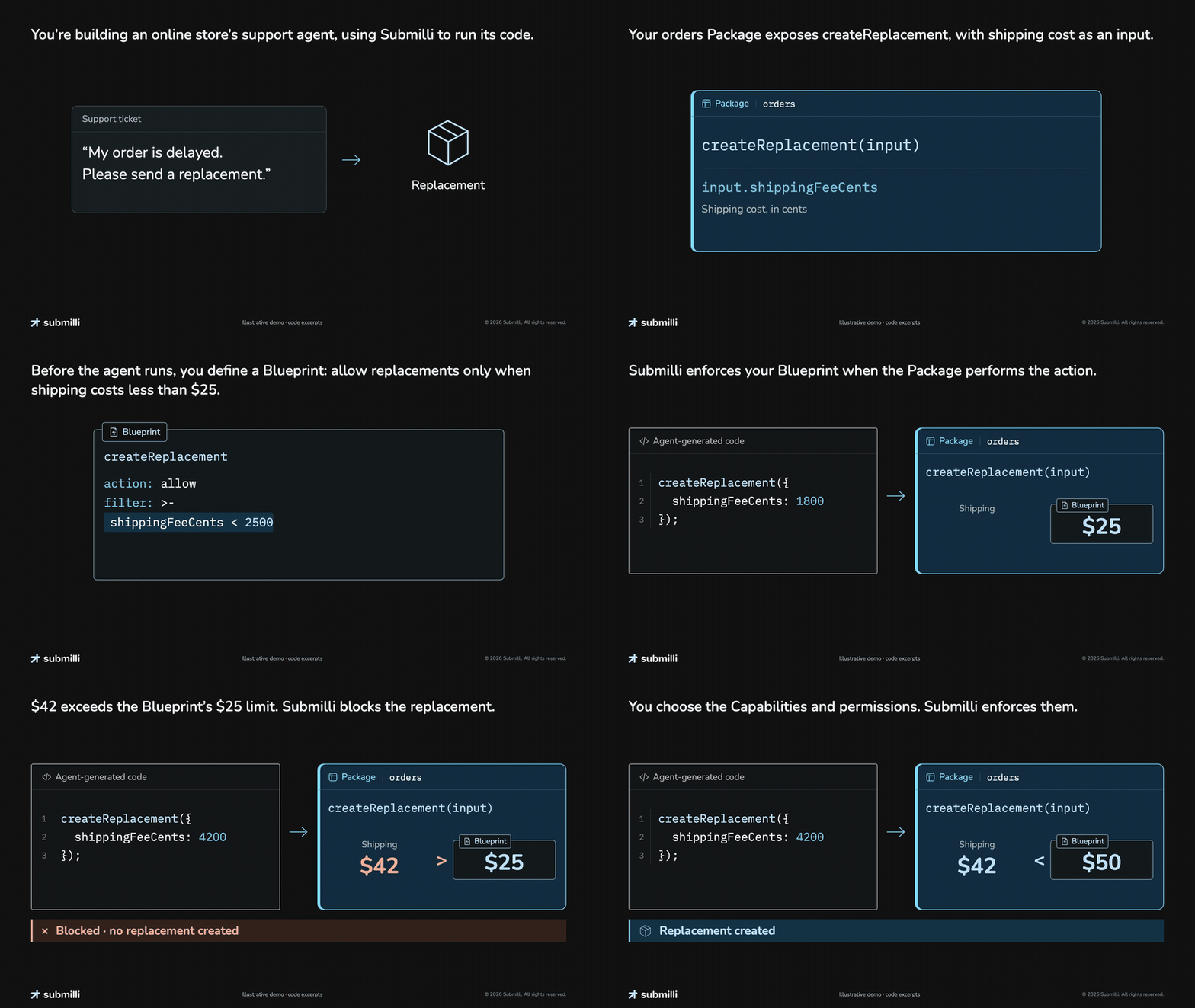
Code mode and programmatic tool calling started a movement toward agents
that write code, instead of calling tools one by one. There are many reasons for that movement and its growinf popularity - you can read more about it here.
We built Submilli to be the runtime for those agents. The agent submits TypeScript code,
and the Submilli runtime executes it in WebAssembly for isolation. We rebuilt
the runtime completely, so there is no node:http or node:fs. It is a new
runtime, built purposely for agents.
Submilli comes with governance, but from the inside out. Before any call to
the outside world, the Submilli runtime first checks the environment's permissions (the
Blueprint) to see if the call is allowed. It doesn't just check the IP,
domain, or port. The Package author defines a semantic language for each
operation, and that language allows you to control what your agent can do in those terms: "Allow a
refund up to $500, only for customer 123".
We also gave the ecosystem a reset. All the Packages for Submilli are written
from scratch, purposely for agents, with semantic permissions. We don't use npm
Packages, and while we do support MCP servers, Packages are the native way to
work with Submilli.
What a rule looks like
Blueprints are one of Submilli's main building blocks, together with
Packages. A Blueprint defines the environment the agent's code runs in. You
write it in YAML.
The permissions block in a Blueprint defines what the code can do, and you
fill it by adding capabilities. Package authors publish the capabilities the package supports, and you
grant them (or some of them) to the agent by declaring them in the Blueprint.
You may also define variables for a Blueprint, which is a very powerful concept. Now you control not only the
agent's capabilities, but also the context it can use them in. In the example
below, we allow the code to access billing operations, bot only for a specific customer (that is bound to the runtime by the host application), and to issue credits of up to $500. If the agent tries a different customer, or a higher amount, the operation fails.
variables:
  customerId:
    required: true

permissions:
  main:
  - capability: acme.com/charges.list
    filter: customerId == ${vars.customerId}
    action: allow
  - capability: acme.com/credits.apply
    filter: customerId == ${vars.customerId} and amount <= 50000  # cents
    action: allow
Install
macOS and Linux:
curl -fsSL https://submilli.ai/install.sh | sh
Windows (PowerShell):
irm https://submilli.ai/install.ps1 | iex
This installs the submilli CLI and submilli-server. To run the server in
production, use Docker Compose,
the Helm chart, or
systemd.
Connect your agent
Submilli keeps your harness. Your agent gets tools to run programs, over MCP
or HTTP. There are tutorials for
LangChain Deep Agents,
Mastra,
the OpenAI Agents SDK,
the Claude Agent SDK,
and plain HTTP.
Features
- Blueprints with rules on an operation's
arguments, bound per session, and everything denied by default. - Packages that wrap your APIs and hold the
credentials, so generated code never sees a secret. Curated Packages for
GitHub, Slack, Gmail, Google Drive and Calendar, Linear, Notion, Sentry, and
web search are included. - Limits on memory, time,
stack depth, model tokens and more. A failing run ends alone, and the rest of the
server keeps serving. - An audit trail of every
refusal, run, session, and admin change. - MCP servers as Packages, with rules on their tools.
- Checks for Package authors:
--deny-warningsin CI and an
agent security review. - HTTPS, API tokens with admin and user roles, and an encrypted secret store.
Missing an integration? Request a curated Package.
Status
Submilli is young and moving quickly. Releases are on the
releases page.
Breaking changes are called out in the release notes, and a Blueprint that
uses a removed feature fails to load with a message that says what to write
instead.
Our short term roadmap is published here. If you have ideas, suggestions, requests or questions, we'd love to chat.
Submilli is open source. If you’re thinking of using it, we’d love to talk to you! Contact us at [email protected].
Repository
| Path | What it holds |
|---|---|
crates/ |
The compiler, runtime, CLI, and server, in Rust |
packages/ |
The curated Packages |
charts/ |
The Helm chart |
docs/, docs-site/ |
The book at submilli.ai/docs |
skills/ |
The skill that teaches coding assistants to write Blueprints and Packages |
examples/ |
The quickstart and harness examples |
Contributing
Read CONTRIBUTING.md first. Contributions need the
CLA. Report security issues as described in
SECURITY.md, not in public issues. Questions are welcome on
Discord.
License
Yorumlar (0)
Yorum birakmak icin giris yap.
Yorum birakSonuc bulunamadi