openccu-loom
Health Uyari
- License — License: NOASSERTION
- Description — Repository has a description
- Active repo — Last push 0 days ago
- Low visibility — Only 5 GitHub stars
Code Basarisiz
- rm -rf — Recursive force deletion command in .github/workflows/chiptool.yml
Permissions Gecti
- Permissions — No dangerous permissions requested
Bu listing icin henuz AI raporu yok.
Standalone Go daemon bridging Homematic / HomeMatic IP CCUs to MQTT (with Home Assistant Discovery), a REST + WebSocket API, an MCP server, a Svelte config UI, and a native Matter bridge — multi-CCU, single static binary.

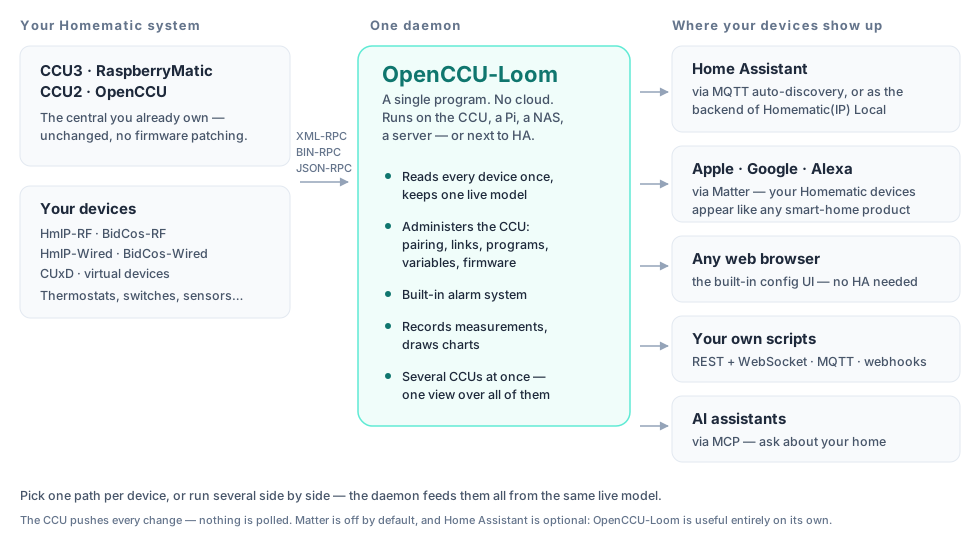
One daemon between your Homematic CCUs and the rest of your smart home.
OpenCCU-Loom
OpenCCU-Loom is a standalone Go daemon that talks to Homematic and
HomematicIP CCUs (CCU2, CCU3, RaspberryMatic, OpenCCU) over XML-RPC,
BIN-RPC and JSON-RPC — and exposes them through MQTT, a REST +
WebSocket API, a web Config UI, a native Matter bridge and an MCP
server. It runs several CCUs at once, administers them (pairing,
firmware, links, programs, system variables, groups), records
measurement history, and ships a complete local alarm system.
Single static binary, no CGo, no cloud, no Home Assistant required —
though it integrates with Home Assistant through MQTT Discovery,
Matter, and two ready-made add-ons.
Features
North-bound bridges
- MQTT — Home Assistant Discovery and a raw topic plane in
parallel, bidirectional control via/settopics, localized entity
names. Pure-Go MQTT 5.0 client (3.1.1 selectable).
→docs/mqtt-topic-schema.md - REST + WebSocket — OpenAPI 3.1 contract, RFC 9457
problem+json,
Idempotency-Key middleware, resumable WebSocket subscriptions with
typed broadcasts. →assets/openapi.yaml,assets/wsapi.json - Config UI — Svelte 5 SPA (Tailwind 4, embedded via
go:embed) as
the primary surface: login, OIDC and first-run onboarding all live in
the SPA. Fully localized (en + de), light/dark, and a Home-Assistant-
native visual skin. →docs/user/web-ui.md - Matter — native-Go bridge (no CHIP SDK): PASE/CASE, full
Read/Write/Invoke/Subscribe/TimedRequest, generic measurement and
bridge-core cluster servers, and projections for switch / light /
cover / climate / lock / siren / valve / button / text-display. One
Matter endpoint per physical device. Default off.
→docs/user/matter.md - MCP — Model Context Protocol server so AI clients can read (and,
optionally, write) the device model.
→ ADR 0025 - Webhooks — outbound HTTP fan-out for device, hub and alarm events.
CCU connectivity
- Multi-CCU from day one — one daemon, many CCUs, every store,
coordinator and topic scoped by central. No "the one CCU" anywhere.
→docs/user/multi-ccu.md - Push everywhere, no polling — XML-RPC + JSON-RPC for HmIP-RF,
BidCos-RF, BidCos-Wired, HmIP-Wired and VirtualDevices; native
BIN-RPC for CUxD, including our own BIN-RPC callback server. - Hot-plug — newly paired devices appear without a restart;
readiness-gated bring-up waits for a co-booting CCU instead of
serving half a device tree. - Reliability layer — circuit breaker, retry, throttle, request
coalescer and ping/pong per interface, with recorded default values
pinned by contract tests. - Device model — generated device profiles plus custom data points
(light, cover, climate, lock, siren, …), calculated and combined data
points, week profiles / schedules, and hub entities (system
variables, programs, service messages).
CCU administration
Everything below is driven from the Config UI and the REST/WS API —
no detour through the CCU WebUI:
- Devices — pairing inbox with first-time configuration, install
mode, HmIP teach-in via SGTIN + key (no internet needed), wired-bus
search, guided device replace, delete with factory-reset and
dependency check, per-device communication test, rename device and
channel, restore stored configuration. - Channels — MASTER paramset editor with session-based editing,
undo/redo and presets, "determine" for determinable values, AES
secured transmission, team assignment, and per-channel visibility /
operation lock. - Links — global direct-links overview, create / rename / delete /
test, plus central links (press-event forwarding) with live active
state. - Groups — Homematic heating groups: list, create, edit, delete,
member picker at scale. - Programs & system variables — run (optionally only when the
condition holds), delete, rename, create alarm and logic variables,
edit value lists, assign channels, and see where a variable is used
before deleting it. - Rooms, functions & areas — assign per channel, and group CCU
rooms into operator-defined areas (floors, outbuildings) that filter
every device list and picker. - Fleet health — firmware updates with duty-cycle warning, signal
quality, per-radio-interface duty cycle and carrier sense,
diagnostics artefacts, service-message acknowledge/suppress, backups,
CCU reboot, and a cache clear + re-pull.
Alarm system
A complete, local-first alarm system in the daemon — no cloud, no CCU
program spaghetti: zones with arm/disarm and delays, sensors with hold
time and cross-zoning, capability-derived outputs (sirens with tone /
pattern / sound file, sysvar mirrors, notifications), guided keyfob
bindings (e.g. HmIP-KRCA), PIN codes, journal, walk test and a
re-runnable setup wizard. Surfaces as a Home Assistantalarm_control_panel over MQTT.
→ docs/alarm-user-guide.md
Data & insight
- Measurement history — opt-in recorder with per-datapoint toggle,
persisted to SQLite, rendered as in-SPA charts. - Diagrams & energy — named multi-series diagrams with a guided
series editor, plus a dedicated energy view. - Audit log — every configuration change appended and queryable.
- Metrics & tracing — Prometheus collectors and an OTLP span
exporter.
Operations & security
- Authentication — HTTP Basic, Bearer tokens, session cookies with
CSRF, OpenID Connect (PKCE, JWKS-verified RS256, role mapping),
CCU-delegated login (ADR 0043)
and Home Assistant Ingress passthrough
(ADR 0044).
Role-based authorization across every north-bound surface
(ADR 0051). - Runtime configuration — almost every knob is editable in the SPA
and takes effect without hand-editing YAML (see below). - Discovery — the daemon announces itself via mDNS and finds CCUs
on the network via SSDP. - Packaging — single static binary (
CGO_ENABLED=0) for Linux
amd64 / arm64 / armv7, a multi-arch Docker image, two Home Assistant
add-ons (daemon + remote ingress proxy), and a CCU/RaspberryMatic
add-on that updates itself
(ADR 0057).
Status
All north-bound bridges work end-to-end against a real CCU and against
the godevccu simulator. CHANGELOG.md is the
authoritative release history — it carries the current version rather
than this page, which would re-drift every release; the shipped build
reports its own version and REST APIVersion on /about andGET /api/v1/info. notes/plans/roadmap.md
covers what is next.
Maturity: beta — the feature set is complete and in daily productive
use, but it has not been hardened across a wide range of installations
yet. Expect bugs, keep a CCU backup, and note that the daemon can not
only read your CCU but also change it (pairing, deleting, writing
paramsets).
The Matter bridge is alpha — considerably younger than the rest and
the least proven part. It is off by default; switching it on is an
explicit test decision, not something to build load-bearing automations
on. Production-grade Matter attestation additionally requires
vendor-supplied DAC/PAI/CD bundles configured by the operator; the
bundled CSA Test PAA chain is fine for development and for
Apple- / Google- / chip-tool-driven testing.
Quickstart
Docker
docker run -d --restart unless-stopped \
  -p 8119:8119 -p 8120:8120 -p 8129:8129 \
  -v $(pwd)/config.yaml:/app/config.yaml:ro \
  -v openccu-loom-data:/app/var \
  ghcr.io/sukramj/openccu-loom:latest run --config /app/config.yaml
--restart unless-stopped(already set indocker-compose.yaml) is
what makes the Config UI's Restart action work: the daemon exits,
Docker brings the container back.
Binary
make build
./bin/openccu-loom run --config config.yaml
Home Assistant add-ons
Add https://github.com/SukramJ/openccu-loom as a repository under
Settings → Add-ons → Add-on Store → ⋮ → Repositories, then install
OpenCCU-Loom. The Config UI appears as a sidebar panel (Ingress)
and on :8119; state persists in the add-on's /data. A second add-on,
OpenCCU-Loom Remote (ADR 0054),
proxies a daemon running elsewhere into the same sidebar.
→ packaging/ha-addon/README.md
CCU / RaspberryMatic add-on
Runs the daemon directly on the CCU, defaults to CCU-delegated login,
and can update itself from the project's GitHub releases.
→ packaging/ccu-addon/README.md
First run
- Start the daemon with no user configured.
- Open
http://localhost:8119/— the SPA renders the onboarding
wizard and creates the first admin. - Add your CCUs, then enable the bridges you want.
The full walkthrough is docs/getting-started.md
and docs/user-guide.md.
Configuration model
Configuration lives in three tiers so the SPA can drive almost
everything at runtime:
| Tier | Lives in | What goes there | Edit via |
|---|---|---|---|
| Bootstrap | config.yaml |
data_dir, north.rest.listen, logging.{level,format}, bootstrap.allow_first_run_setup, env_file |
Edit the YAML + restart |
| Live | SQLite (<data_dir>/openccu-loom.db) |
Everything else — CCUs, MQTT, Matter, mDNS, CORS, OIDC, rate limits, reliability tunables, users, API tokens | SPA settings, or PUT /api/v1/config/sections/{section} |
| Secrets | Environment (process or .env file) |
CCU passwords, MQTT password, OIDC client secret | Operator-owned; the daemon never writes them back |
The daemon overlays the live tier on top of the YAML: an empty database
starts from the YAML (that's the seed), SPA edits win from then on, andDELETE /api/v1/config/sections/{section} reverts a section to its YAML
fallback — so GitOps + restart stays a valid workflow.example.config.yaml is intentionally short;GET /api/v1/config/schema returns the complete field schema with each
field's classification (basic / expert / secret) — the same endpoint the
SPA builds its editors from.
Passwords never have to touch config.yaml. Type them into the SPA
(stored encrypted at rest, redacted from backups unless--include-secrets is passed), or keep them in your own secret store
and reference the variable name — centrals[].password_env per CCU,OPENCCU_LOOM_MQTT_PASSWORD, OPENCCU_LOOM_OIDC_CLIENT_SECRET.
Docker env_file: and Kubernetes envFrom: work the same way; details
and the plaintext escape hatch for test rigs are indocs/user-guide.md anddocs/SECURITY.md.
Why "OpenCCU-Loom"?
OpenCCU (openccu.de) is the cloud-free,
Buildroot-based smart-home OS for the HomematicIP CCU that this project
extends — and, via openccu-data,
the upstream the daemon's embedded metadata is derived from.
A loom is the bundled cable harness running through a car or an
aircraft: many conductors, one routed path. That is the daemon's job —
many CCU wire protocols come in on one side, the standard north-bound
protocols come out on the other. The mark shows that cross-section.
Relationship to Home Assistant
OpenCCU-Loom does not need Home Assistant, and Home Assistant does not
need OpenCCU-Loom — they overlap, so the useful question is which one
owns the CCU connection and how devices travel from there.
- HA only, one CCU, everything fine? Keep Homematic(IP) Local
talking to the CCU directly; the daemon adds nothing. - Want one CCU connection, several CCUs as one fleet, CCU
administration outside the CCU WebUI, a local alarm system or
measurement history? Let the daemon own the CCU and feed HA over
MQTT Discovery. - Only a third system (Node-RED, InfluxDB, evcc, …) needs the data?
Run the daemon with the raw topic plane and Discovery off —
no HA entities, no duplicates. - Matter mainly pays off without HA; with HA you would usually
publish to Apple/Google/Alexa from HA itself. - The Homematic(IP) Local loom backend (integration talks REST/WS
to the daemon) is wired but not yet user-selectable — a preview.
MQTT Discovery, the loom backend and the Matter bridge each create their
own HA entities, so exactly one of them per device. Wherever that
lands, the recommended place to run the daemon is on the CCU
(CCU / RaspberryMatic add-on): the chatty XML-RPC/BIN-RPC hop stays on
loopback, callback addressing resolves itself, and HA restarts stop
touching the Homematic side. The full scenario catalogue, combination
matrix, anti-patterns and migration paths are indocs/user/home-assistant.md.
Relationship to aiohomematic
OpenCCU-Loom began as a Go port ofaiohomematic and now
develops independently. aiohomematic remains the Python library
powering the Home Assistant integration Homematic(IP) Local — and the
reference implementation for CCU-side semantics, cross-checked by a
scoped model-snapshot regression gate. It is a reference, not a
dependency, and no longer a parity target.
| Area | aiohomematic | OpenCCU-Loom |
|---|---|---|
| Language | Python 3.14 (asyncio) | Go 1.26+ |
| Primary consumer | Home Assistant integration | Standalone daemon (MQTT / REST / UI / Matter / MCP) |
| CUxD transport | JSON-RPC via CCU facade + MQTT workaround | Native BIN-RPC + BIN-RPC callback server |
| Multi-CCU | one CentralUnit per process |
many CentralUnits per process |
| Configuration | programmatic (Pydantic) | YAML seed + live SQLite tier, edited in the SPA |
| Persistence | JSON files | SQLite (WAL) + filesystem under data_dir/ |
| UI / CCU administration | none (HA provides the UI) | built-in Svelte 5 SPA, administration first-class |
On the Matter side the gold standard is
matter.js HEAD: cluster
IDs, revisions, constraints and wire shape are mirrored from it and
locked by parity tests.
Building
make build        # ./bin/openccu-loom
make test         # unit + contract tests
make integration  # godevccu + Mosquitto (Mosquitto needs Docker)
make lint         # golangci-lint (zero findings required)
make docker       # multi-arch image via buildx
Prerequisites: Go 1.26+, golangci-lint v2, gofumpt, goreleaser,
Docker (+ buildx) for the Mosquitto-backed integration tests.
Integration runs use godevccu,
a pure-Go CCU simulator consumed as a regular module dependency — no
Python toolchain required. Four structural pillars guard against
architecture drift — reachability (make reachability), wiring pin
tests, wire snapshots (make wire-snapshots) and E2E smoke
(make e2e).
Documentation
docs/getting-started.md— install and
first CCU in a few minutes.docs/user-guide.md— the operator manual;docs/user/covers concepts, the web UI, multi-CCU
and Matter.docs/user/home-assistant.md— which
integration path to run when Home Assistant is in the picture, and
which combinations are mutually exclusive.SPECIFICATION.md— design intent, hard
constraints, resolved decisions;docs/adr/— the
architecture decisions behind them, e.g. Matter
(0012), MQTT topics
(0011) and
multi-CCU (0002).docs/SECURITY.md— threat model and audit
checklist;docs/caching.md— every cache layer
and its boot-time radio cost.docs/external-clients/— the wire
contract for Python / TypeScript / Rust clients; start at the
topic hierarchy.CLAUDE.md— entry point for fresh contributors and
AI assistants.
Contributing
CONTRIBUTING.md covers local setup, PR
expectations and the release workflow. Please open an issue first so we
agree on scope — especially for changes to the wire layer or the device
profile catalogue. AI_POLICY.md sets the rules for
AI-assisted contributions: AI as a tool is welcome, autonomous agent
submissions are not. Parts of OpenCCU-Loom are developed with agentic AI
assistance, primarily Claude Code
— but every change is reviewed by a human maintainer and has to pass the
full test, contract and parity suites before it lands.
License
The source code is MIT, aligned with the rest of the
aiohomematic ecosystem.
The binary distribution additionally ships CCU metadata archives
sourced from openccu-data via
the versioned go-openccu-data
module (ADR 0053). Those
archives are governed by the eQ-3 HomeMatic Software License — free
for private and non-commercial use; commercial redistribution requires
written permission from eQ-3 AG. See
the module's NOTICE.md
and ADR 0003. Operators with
commercial use-cases can point cfg.CCUData.{translations_path,easymode_path}
at self-licensed equivalents — the daemon degrades gracefully.
Third-party prior art and module dependencies with their licenses and
verbatim copyright notices are recorded inTHIRD-PARTY-NOTICES.md; full license texts
live under licenses/.
Acknowledgements
Narrative credits are in docs/attribution.md.
With particular thanks:
- aiohomematic (MIT) — the
reference implementation for wire behaviour and the device profile
catalogue, by SukramJ and Daniel Perna; plus
aiohomematic-config
(MIT) for the form-schema, grouping and label logic in the Config UI. - pydevccu (MIT, Daniel
Perna & SukramJ) — the CCU simulator that
godevccu is a Go port of. - matter.js (Apache-2.0) —
the gold standard for the entire Matter bridge. - homematicip-local-frontend
(MIT) and the Home Assistant frontend
(Apache-2.0) — UI interaction and control-primitive references. - The Homematic / HomematicIP community and eQ-3, for the devices and
the protocol knowledge that make any of this possible.
Yorumlar (0)
Yorum birakmak icin giris yap.
Yorum birakSonuc bulunamadi