shrike
Health Gecti
- License — License: MIT
- Description — Repository has a description
- Active repo — Last push 0 days ago
- Community trust — 19 GitHub stars
Code Basarisiz
- exec() — Shell command execution in apps/desktop/e2e/agent-surface.test.ts
- process.env — Environment variable access in apps/desktop/e2e/agent-surface.test.ts
- network request — Outbound network request in apps/desktop/e2e/agent-surface.test.ts
- process.env — Environment variable access in apps/desktop/e2e/agent.test.ts
Permissions Gecti
- Permissions — No dangerous permissions requested
Bu listing icin henuz AI raporu yok.
The open source debugger for people who build web apps with AI. Click the thing that breaks; see the whole trip to the exact line; your agent fixes it after you say OK.
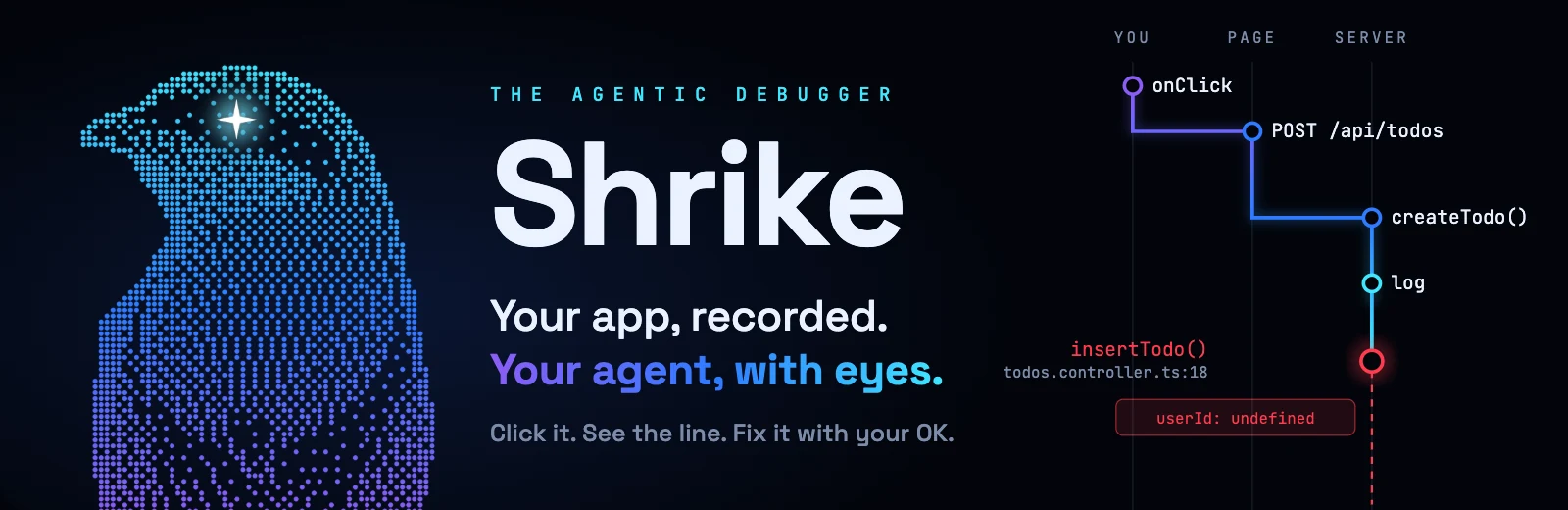


The open source debugger for people who build web apps with AI.
Run your app inside Shrike and click the thing that breaks.
Shrike records the whole trip, from the button to the database, and your own coding agent
finds the line, fixes it after you say OK, and clicks again to prove it works.
Works with Node backends (Express, Next.js, NestJS, Hono, Remix), Python 3.12+ backends (FastAPI, Flask, Django) and Vite or Next frontends. Any other backend that speaks OpenTelemetry (.NET, Go, Java, older Python) gets basic tracing.
Download for Mac · Quick start · Walkthrough · How it works · Docs
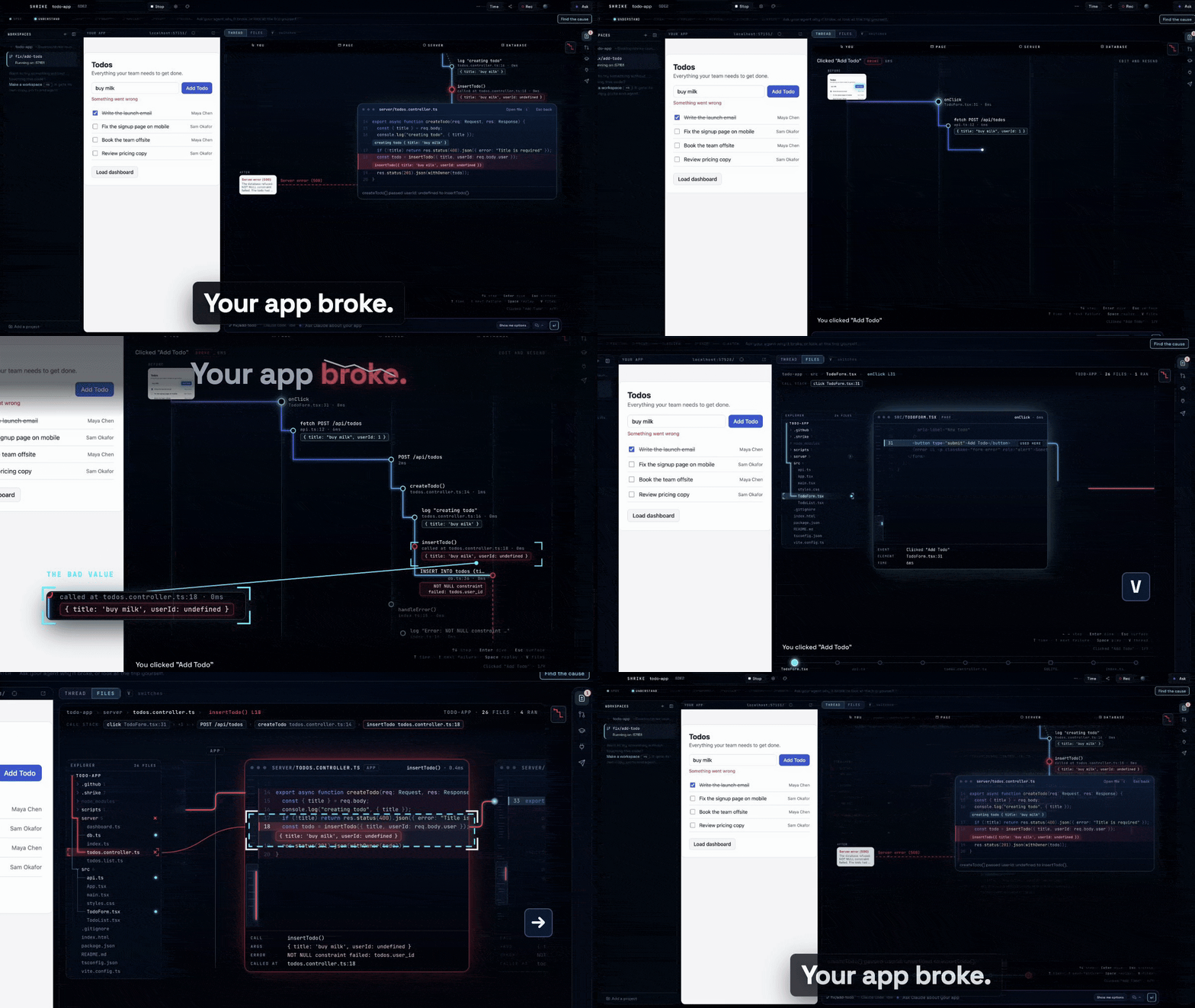
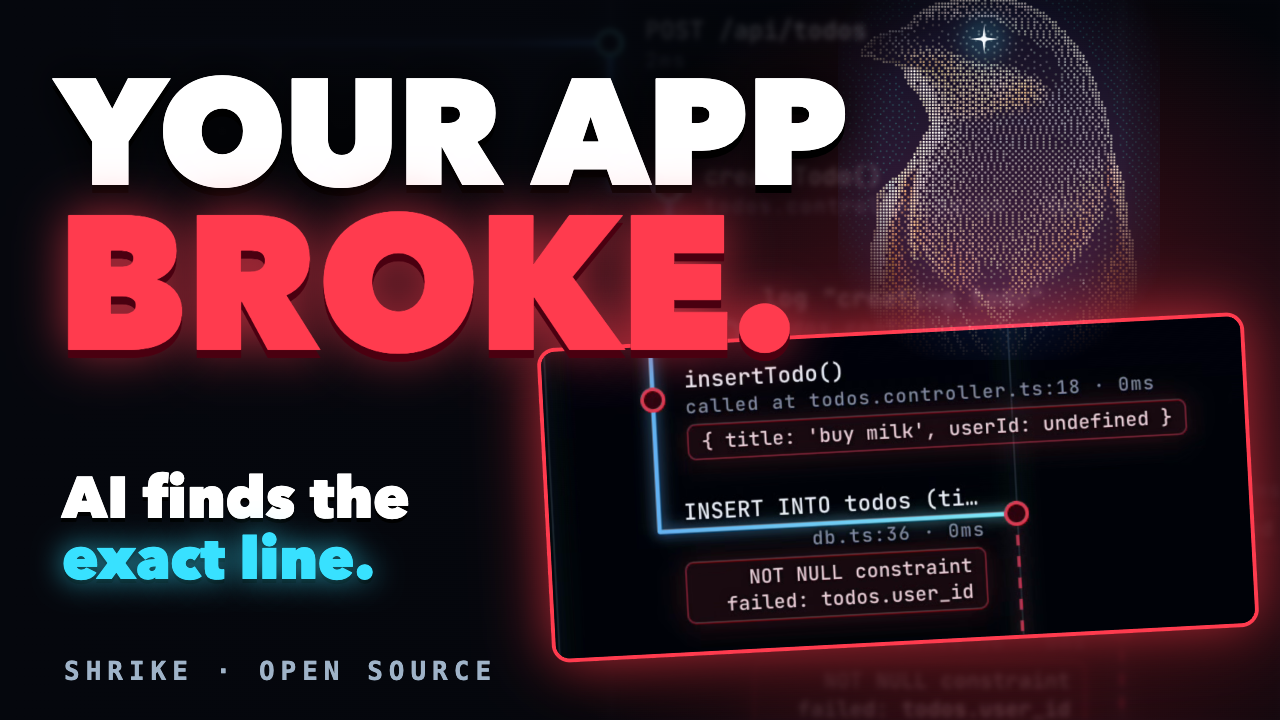
Watch the 40 second launch video on YouTube
Why Shrike
You built an app with Cursor, Claude Code, Lovable or Bolt. It works until it doesn't. A button does nothing, so you paste the error into a chat and the model guesses from the code.
| Without Shrike | With Shrike |
|---|---|
|
|
Shrike is for you if
- You build with AI and can run
npm run dev, but stack traces still feel like guesswork - You want to see what your code did when you clicked, not read 40 files to find out
- You want your agent to fix things with proof, and never touch a file without asking
What happens when you click
1. Click. The trip draws itself and stops where it broke.
Every click becomes a trip across lanes: you, page, server, database. The step that failed turns red, and Shrike dives into the code with the real value inline, like userId: undefined on line 18.
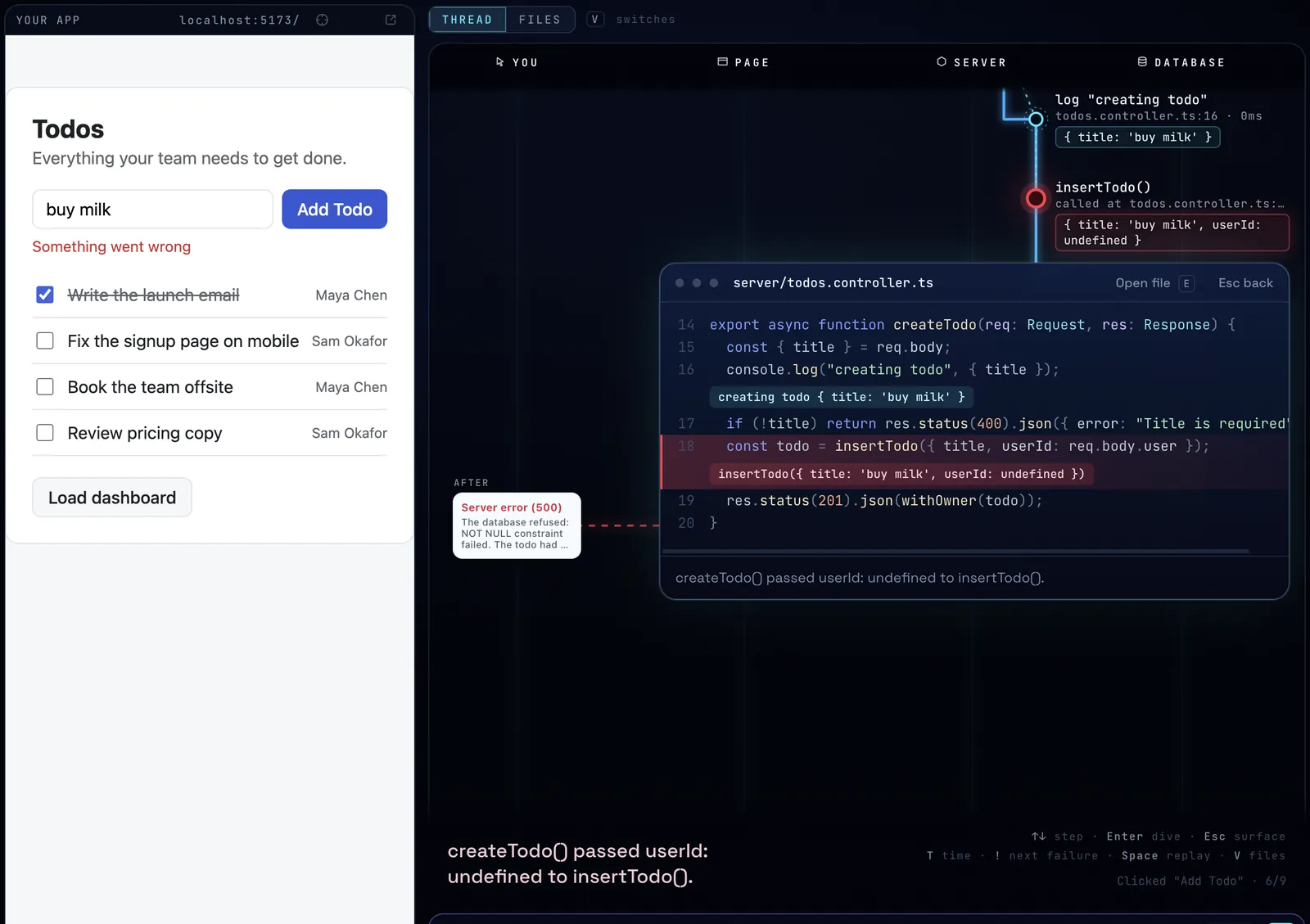
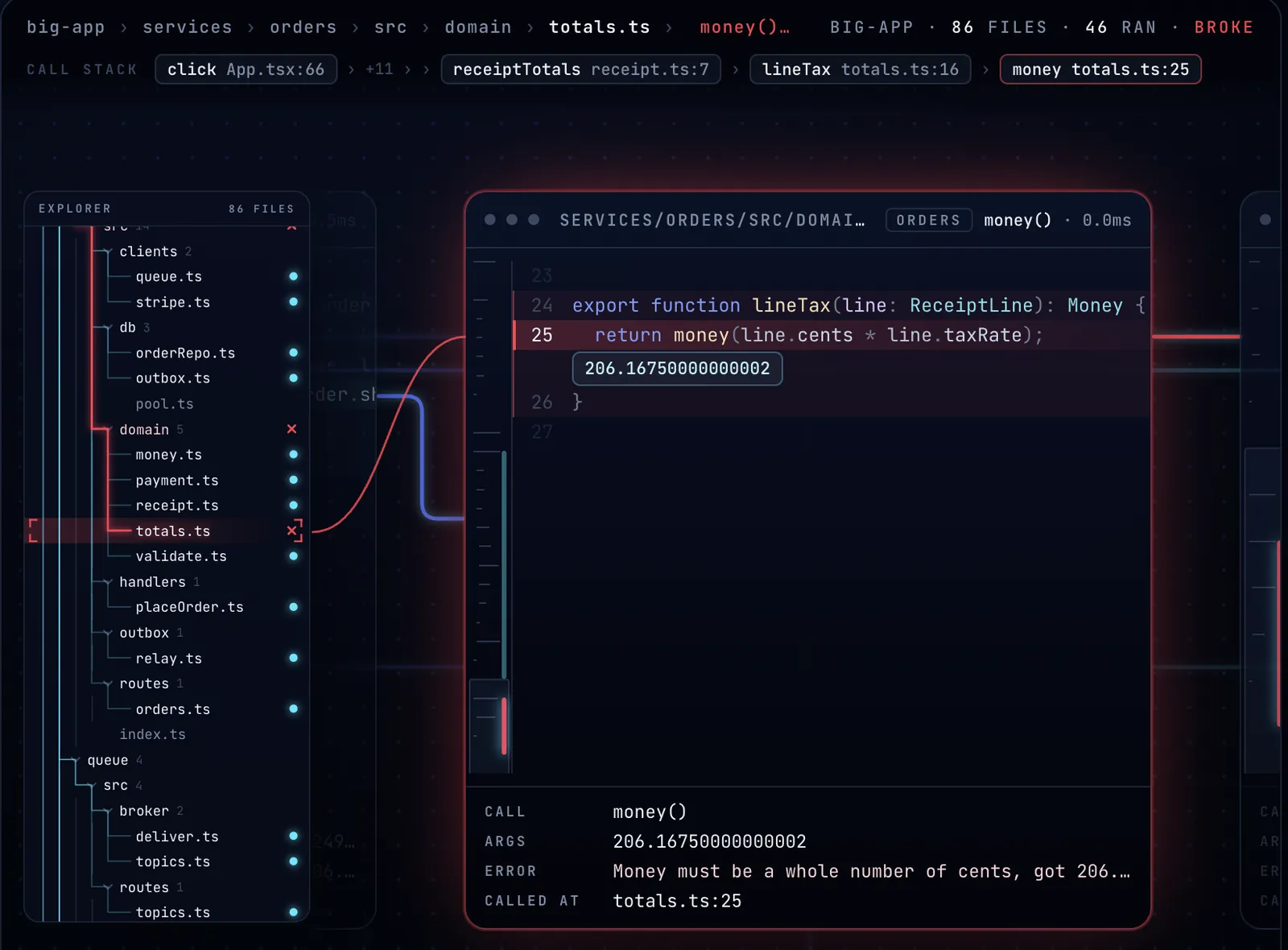
2. Press E. See the whole file, and every file the click touched.
The Files view opens on the line that ran, next to a tree of every file in the trip. Hot rows ran, red rows broke. The strip at the bottom is the call path you can scrub.
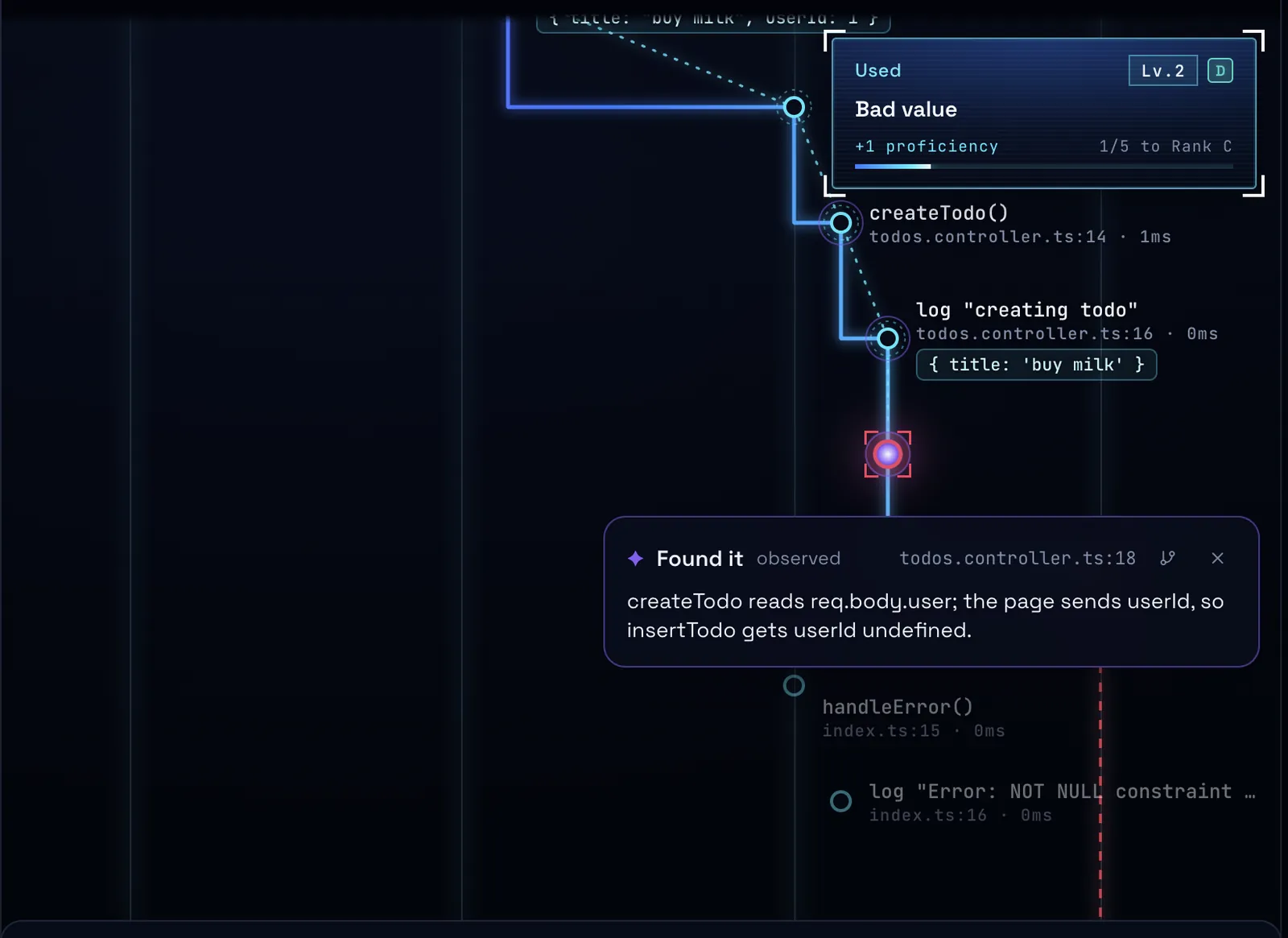
3. Ask in plain words. Your agent says "Found it".
Type "when I click Add Todo nothing shows up". The agent walks the recorded trip, pins the cause on a line, and says why in one sentence. You see which playbook it used.
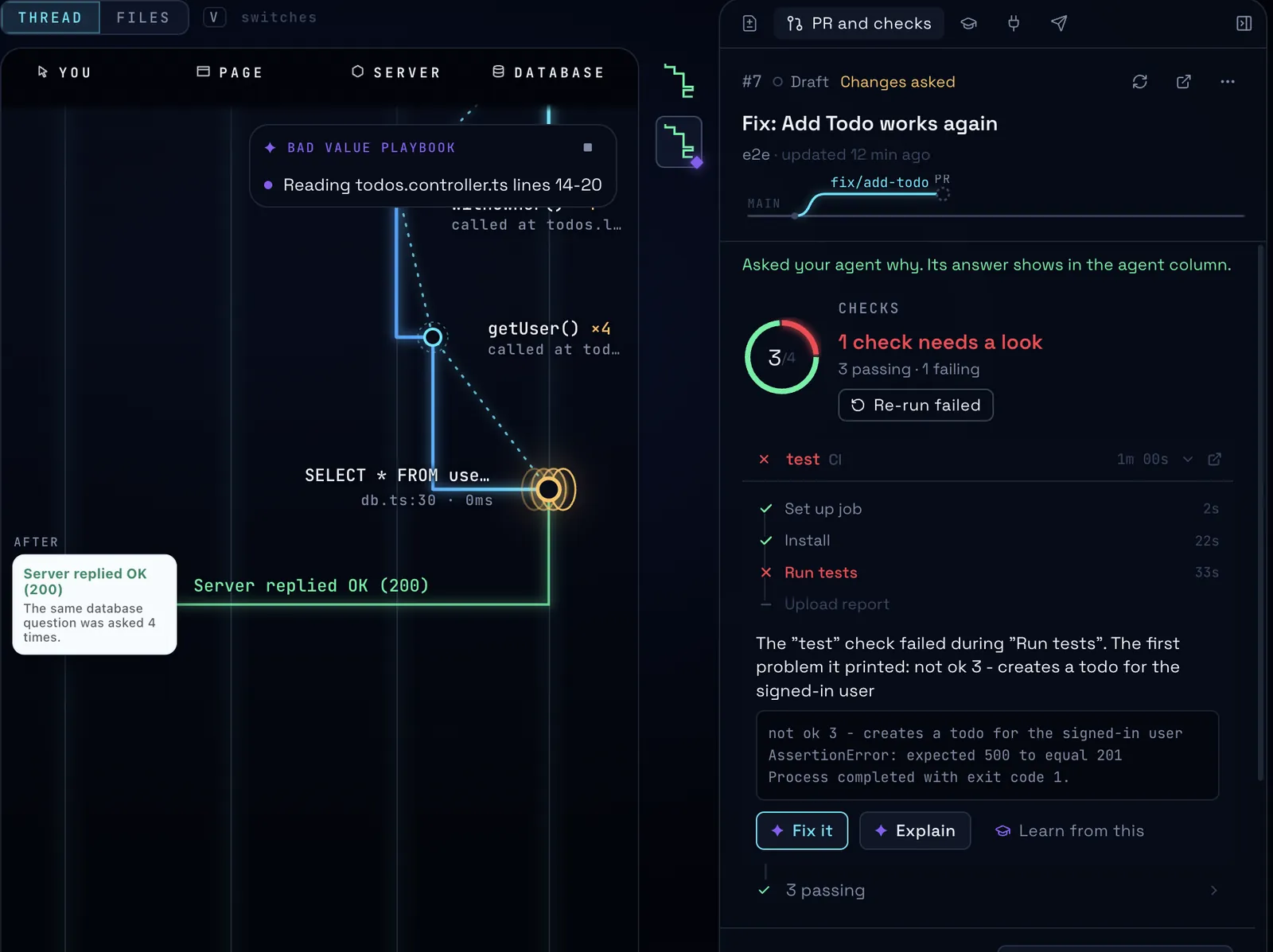
4. Approve the diff. Then ship it.
The fix lands only after your click, and Shrike replays the same click to show it passes. Commit, open a pull request, and read CI failures and review comments in the same window.
Features
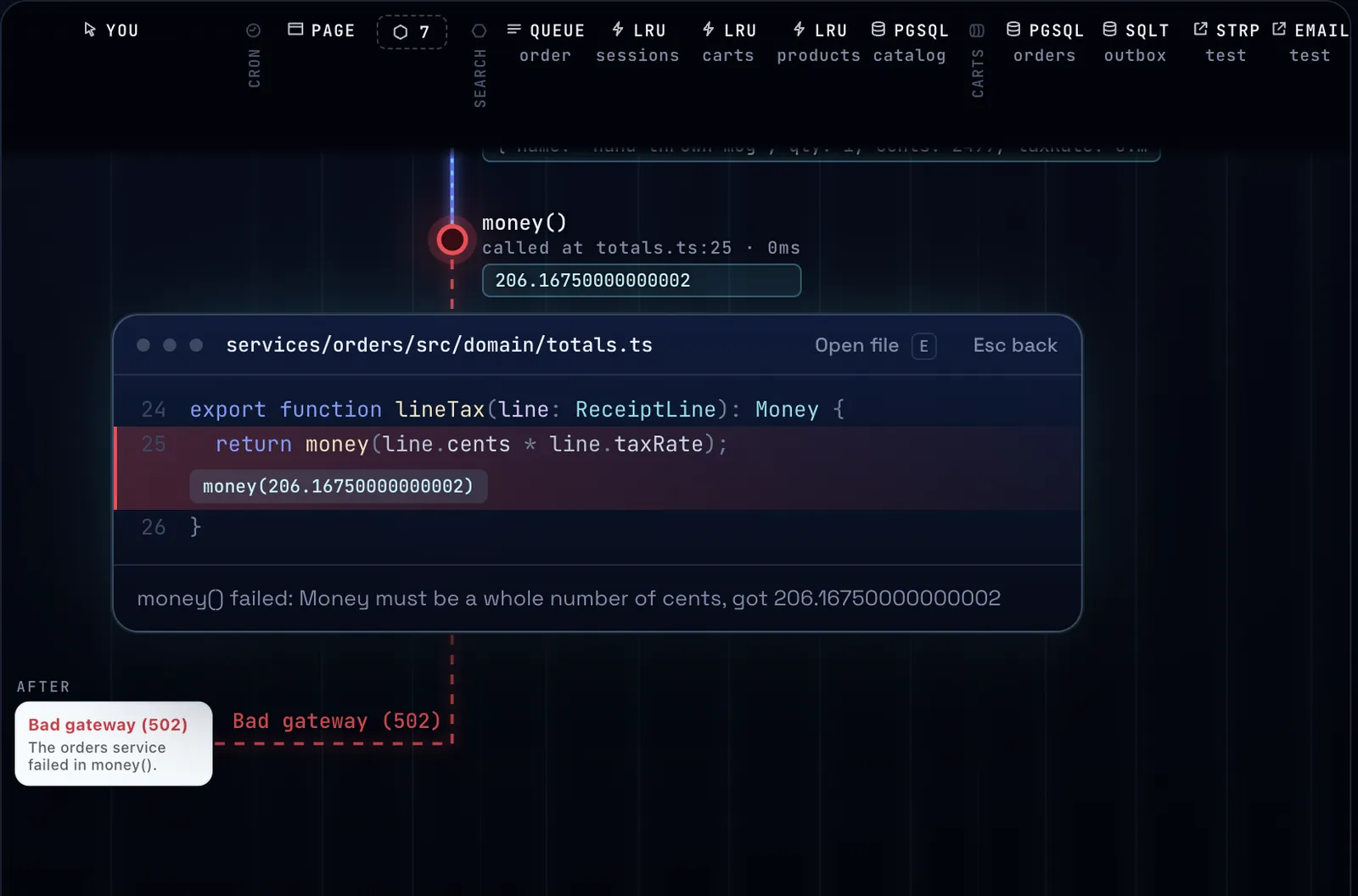
Any stack, any sizeA click in Bazaar, the big sample app, crosses 8 services, 3 Postgres databases, an SQLite outbox, 3 LRU caches, a queue, Stripe and an email provider. Shrike finds the lanes by itself and still stops on the one bad line. Postgres, MySQL, SQLite, MongoDB, Redis, DynamoDB, Firestore, Supabase. Tested projects → |
 |
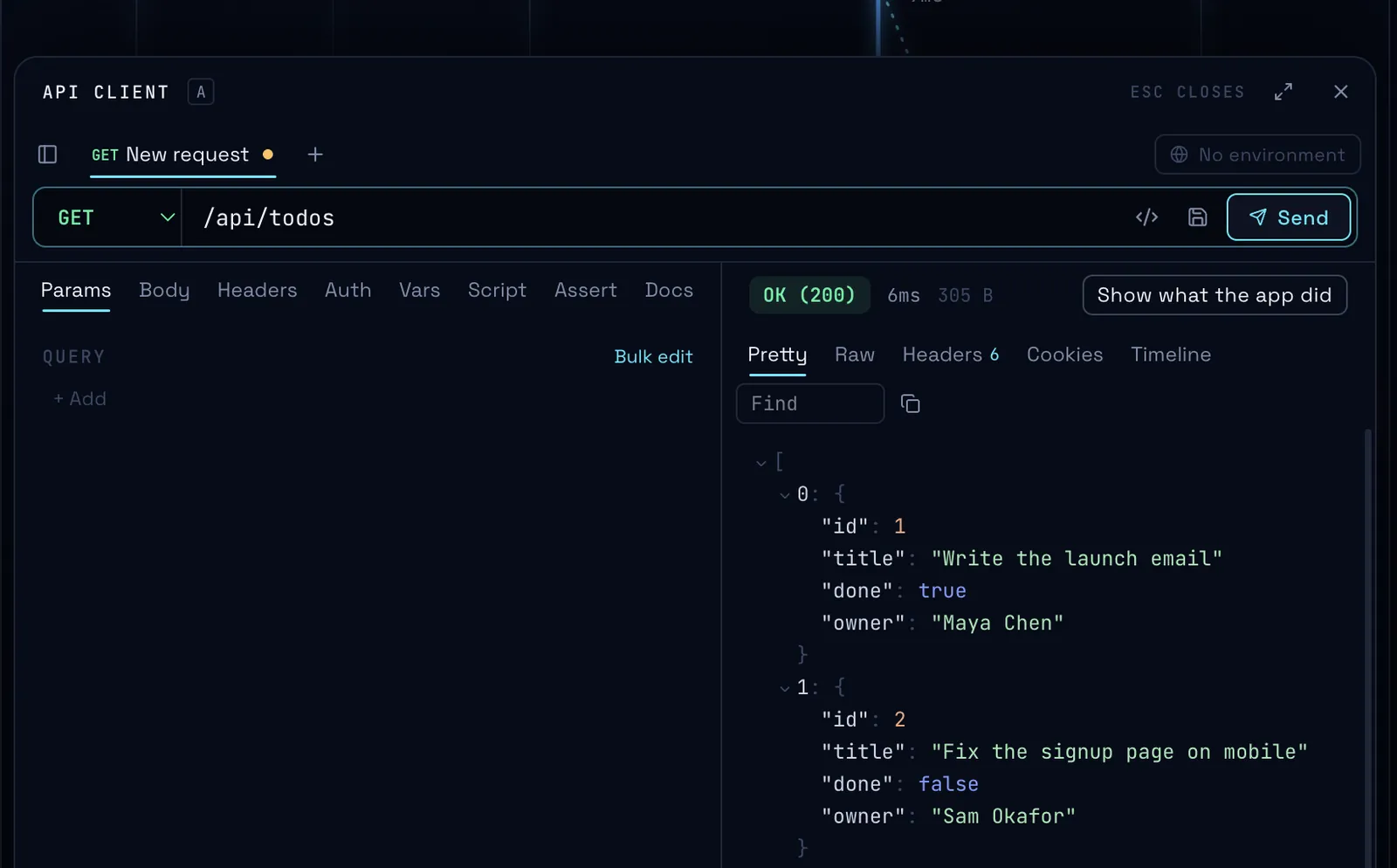
API clientA Bruno-style request editor. Routes are found for you, collections are plain files in your repo, and you can import from Bruno, OpenAPI and cURL. Every request you send becomes a trip, so you see what the server did with it. |
 |
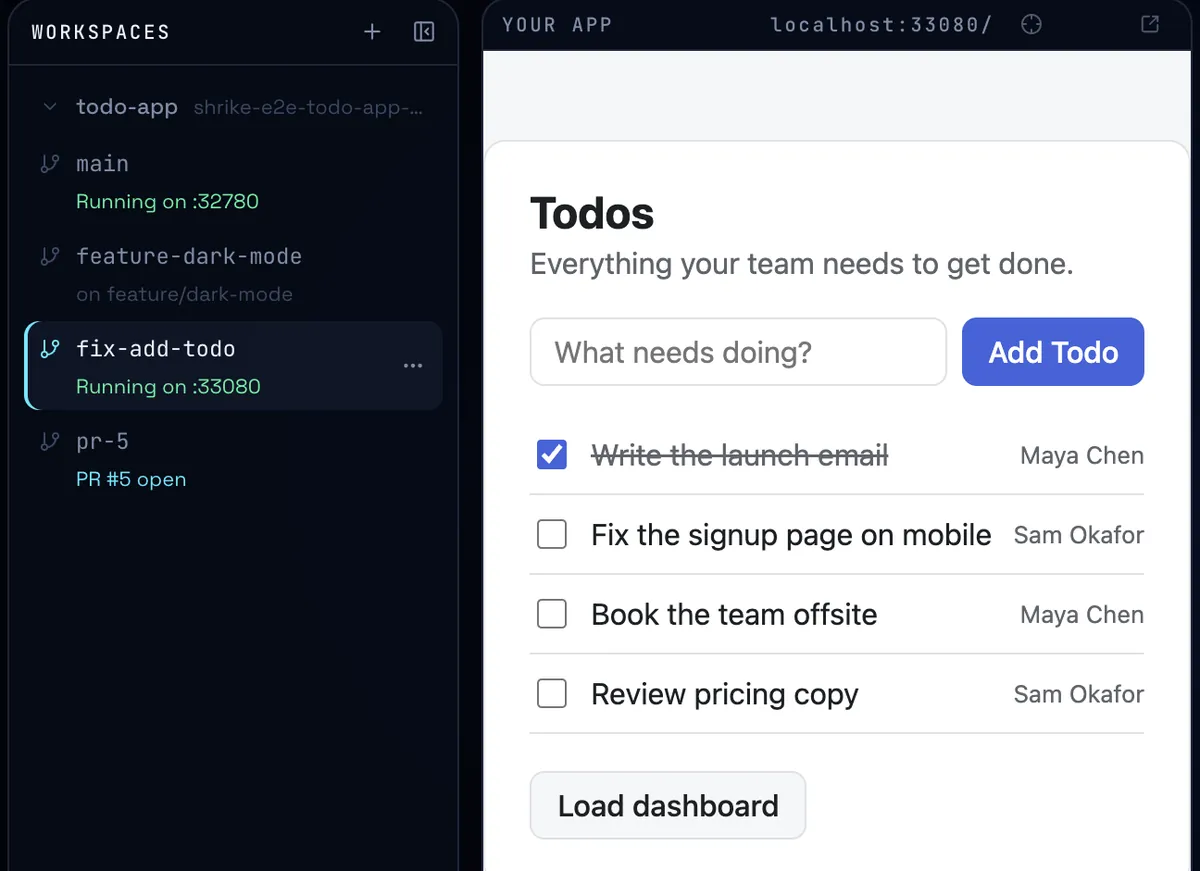
Workspaces and worktreesTry a fix in a git worktree copy with its own ports and its own agent. Race two fixes side by side and keep the one that passes. Many projects, one rail. |
 |
|
The Thread |
Files view |
Agent fix, with approvals |
|
Skills that evolve |
PR and CI |
MCP hub |
|
Voice |
Look inside your data |
Local and private |
Works today with Node servers (Express, Next.js, NestJS, Hono, Remix), Python 3.12+ servers (FastAPI, Flask, Django) and Vite or Next frontends. On Python, Shrike records every call into your own code with its arguments, what it returned and its file and line, nested under the request that caused it, plus its sqlite3 queries, with no change to your code (packages/python-agent). Any backend that speaks OpenTelemetry (.NET, Go, Java, Python before 3.12) works with basic tracing: its requests, queries and outside calls show up, but not per-function values. Shrike points the app's OpenTelemetry SDK at itself when it runs the app; see fixtures/py-app for FastAPI, Flask and Django examples.
Quick start
Download
- Get
Shrike-<version>-arm64.dmgfrom Releases and drag Shrike to Applications. - Open Shrike. The build is signed and notarised by Apple, so it opens like any other app.
- Click Open the sample project, press Run, add a todo, and watch it break.
Linux (x64, arm64): there is no released build yet. Build an AppImage or .deb with scripts/release/build-linux.sh (see docs/RELEASING.md), or take the AppImage from the shrike-linux-x64 artifact of a CI run. Voice is macOS only. On NixOS, run the AppImage with appimage-run. Windows builds from the same config but hasn't been run on a Windows machine yet (docs/14-compatibility.md).
Run from source
git clone https://github.com/SumantxD/shrike.git
cd shrike
pnpm i
pnpm dev
- macOS on Apple Silicon (voice needs macOS 15 or later). Linux runs from source or a CI build, without voice
- Node 24 (any Node from 22.18 runs your app; Shrike's own build uses 24)
- pnpm 10 for running from source, plus Xcode if you want voice (the helper builds on first use)
- Claude Code is optional. Shrike uses it on your own subscription when it's installed. Without it, the built-in agent runs on your own Anthropic API key, and the recording, Thread and API client work with no agent at all.
How it works
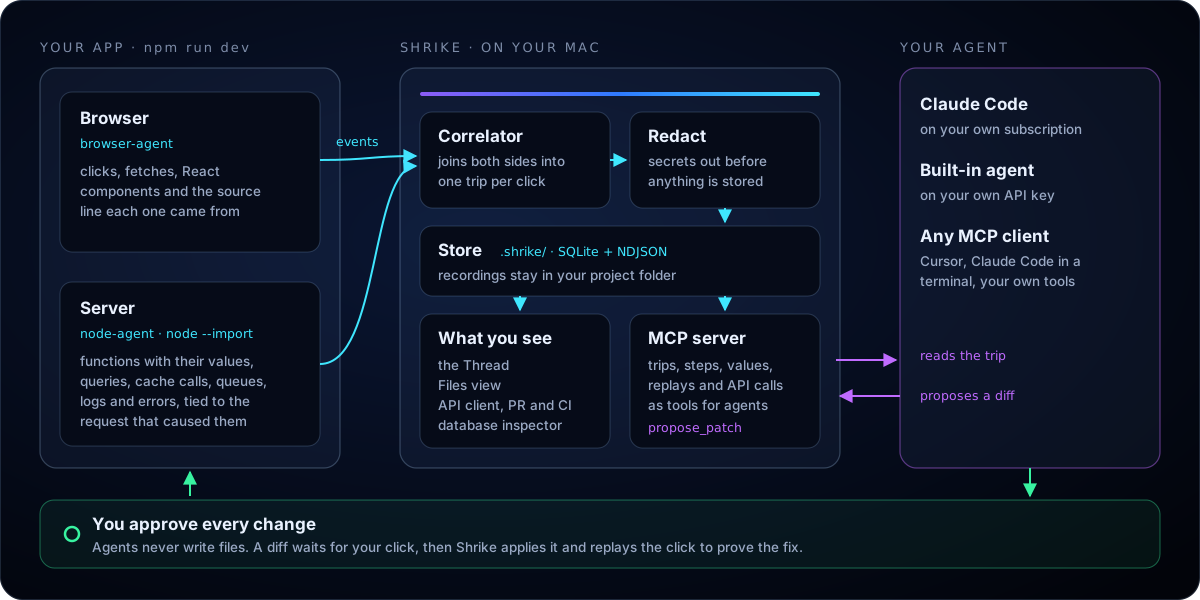
packages/browser-agentruns in your page: clicks, fetches and React components with their source lines.packages/node-agentloads into your server with--import: functions, queries, logs and errors, tied to the request that caused them.packages/correlatorjoins both sides into one tree per click.packages/mcp-serverhands it to agents as tools, with an approval gate on anything that changes code.apps/desktopis the Electron app.apps/desktop/native/voiceis the Swift voice helper.
More in docs/02-architecture.md and docs/05-agent.md.
How it compares
| Shrike | Browser devtools | Sentry | Postman / Bruno | Claude Code on its own | |
|---|---|---|---|---|---|
| Page, server and database in one trip per click | ✅ | Page only | Traces, with an SDK | Request only | ❌ |
| Real values on the line that ran | ✅ | Page, with breakpoints | On errors | ❌ | ❌ |
| Agent fix you approve, then a replay to prove it | ✅ | ❌ | Paid AI add-on | ❌ | Fixes from reading code |
| Runs on your machine, no account | ✅ | ✅ | Cloud or self-host | Bruno yes, Postman needs an account | ✅ |
| Production monitoring | ❌ | ❌ | ✅ | ❌ | ❌ |
Shrike is for building and debugging on your Mac. For errors in production, keep Sentry.
Privacy
- No telemetry, no account. Your code, recordings and secrets stay on your Mac.
- Secrets are stripped from every recording before it is stored, shown, sent to an agent or exported.
- Agents can't edit files directly. Every change is a diff you approve.
- Shrike connects out only when you ask: your agent's own API, voice model downloads from Hugging Face, and GitHub through your
ghlogin.
Details in docs/07-security-privacy.md.
Roadmap
- Notarised builds
- Auto-update
- Windows and Linux releases (Linux builds from source today)
- Codex and OpenCode as agent brains
- Shareable recordings (
.shriketrace) and a read-only web viewer - Function steps for Python 3.12+ (FastAPI, Flask, Django)
- More stacks: Vite SSR, SvelteKit, Nuxt, function steps for other OpenTelemetry backends
The full plan is in docs/08-roadmap.md.
Contributing
Shrike is built in the open and contributions are welcome, from a bug report to a new stack.
- Start here: CONTRIBUTING.md covers setup, the rules and how pull requests are reviewed.
- Pick something up: good first issues and help wanted.
- Ask, share or propose: Discussions.
- Found a bug or need your stack? Open an issue.
What changed in each version is in CHANGELOG.md. Everyone follows the Code of Conduct, and security problems go through SECURITY.md.
Star history
License
MIT. Copyright (c) 2026 Sumant Tirkey.
A shrike finds the bug and pins it to the thorn.
Yorumlar (0)
Yorum birakmak icin giris yap.
Yorum birakSonuc bulunamadi