human-readable-reports
Health Pass
- License — License: MIT
- Description — Repository has a description
- Active repo — Last push 0 days ago
- Community trust — 13 GitHub stars
Code Pass
- Code scan — Scanned 1 files during light audit, no dangerous patterns found
Permissions Pass
- Permissions — No dangerous permissions requested
No AI report is available for this listing yet.
Agent skill: make AI-written analysis/report docs easy for humans to read and share (fights AI verbosity/slop).
human-readable-reports
Your coding agent writes reports that are technically correct and unreadable. Walls of jargon, file:line dumps, telegraphic bullets, invented terms. The team stops reading. This skill fixes that — deep content, easy reading.




The problem (you're not imagining it)
"AI verbosity" and "AI slop" are now common complaints — LLMs are trained to write long, thorough, hedged answers, so their reports default to something only the author's other agent could love. When the doc is unreadable, the human becomes the bottleneck.
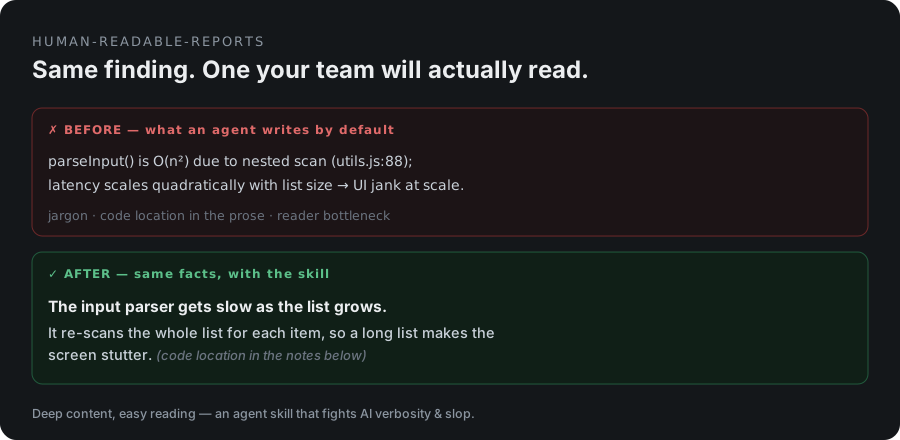
The fix, in one look
Before — what an agent writes by default:
parseInput() is O(n²) due to nested scan (utils.js:88);
latency scales quadratically with list size → UI jank at scale.
After — same finding, with this skill:
The input parser gets slow as the list grows. It re-scans the whole
list for each item, so a long list makes the screen stutter.
(code location in the notes below)
Same facts. One of them your team will actually read.
The 13 rules
- Reader-first — name the reader before writing; by default, a junior dev who wasn't there.
- Point first — each section opens with the takeaway in one plain sentence.
- Concrete before abstract — one plain picture for a new concept; the real sequence of events for a cause or change.
- Full sentences, not fragments — bullets for parallel items, sentences for cause and effect.
- Explain or drop jargon — no bare formulas, no coined terms.
- Evidence to the back — no
file:linein the prose; put it in end-notes. - Table cells read as phrases, not code.
- Cut the slop — no throat-clearing, no needless caveats, no padding.
- Progressive disclosure — hide depth behind expandable sections.
- Tone: teammate, not lecture.
- Numbers match the evidence — nothing unmeasured, no claim stronger than the data.
- Shared-document hygiene — no decoration or emoji; follow the last version's format.
- Articles and talks may open with a scene, but never invent the author's experience.
Full rules, checklist, and the "when NOT to use it" boundary are in SKILL.md.
This README follows its own rules. That's the demo.
Install
Claude Code / Claude agents — clone into your skills directory:
# personal (all projects)
git clone https://github.com/SummerRiversound/human-readable-reports \
  ~/.claude/skills/human-readable-reports

# or project-shared
git clone https://github.com/SummerRiversound/human-readable-reports \
  .claude/skills/human-readable-reports
The agent loads it automatically when you ask for a report or analysis doc.
Cursor / other agents — paste the rules from SKILL.md into your system
prompt or rules file. They're framework- and language-agnostic.
When NOT to use it
Writing a spec or plan an agent executes step-by-step? Then precision beats
plainness — keep exact file:line, signatures, and code inline. This skill is
for the human-facing report.
Contributing
Issues and PRs welcome — especially better before/after examples and rules that
catch failure modes not covered here.
Support
If this skill saves you time, you can buy me a coffee — it helps keep the project moving. Thank you!

License
MIT — see LICENSE.
Reviews (0)
Sign in to leave a review.
Leave a reviewNo results found