claude-code-eco
Health Gecti
- License — License: MIT
- Description — Repository has a description
- Active repo — Last push 0 days ago
- Community trust — 30 GitHub stars
Code Basarisiz
- process.env — Environment variable access in benchmarks/bench.mjs
- exec() — Shell command execution in benchmarks/lib/runner.mjs
- process.env — Environment variable access in benchmarks/lib/runner.mjs
Permissions Gecti
- Permissions — No dangerous permissions requested
Bu listing icin henuz AI raporu yok.
Eco mode for Claude Code. /eco: -31% to -73% output tokens with critical findings intact; /eco-max: up to -75% with lowered effort. Measured hardest on Claude Fable 5 (fable5), deep-studied on Sonnet 5, works on Opus 4.8 too. We publish our negative results. 82 raw benchmark runs.
claude-eco — eco mode for Claude Code
Claude Code spends your money on work you never asked for: re-reading files it just edited, pasting back diffs it already applied, writing three-paragraph reports for two-line fixes. I measured every token of it, deleted it, and published all 267 raw runs — including the ones where I lose.
/eco: −35% to −57% output tokens on the same review task across Opus 5, Sonnet 5, Opus 4.8 and Fable 5 (n=5 per arm, measured the same day), up to −73% on long agentic tasks at high effort — with both planted bugs found in every single run. Haiku is the documented exception. /eco-max: up to −75% by dialing reasoning effort down — opt-in, labeled. Since 1.2.0 the same rules also ship as an output style (zero invocation cost), plus opt-in hooks that enforce the expensive rules mechanically instead of asking the model nicely.




Quickstart · Results · What you get · Benchmarks · FAQ
Quickstart
/plugin marketplace add sup3x/claude-code-eco
/plugin install claude-eco@claude-eco
/eco
If it answers exactly Eco mode active., it is on for the rest of the session. That is the whole setup.
The waste it removes isn't occasional — it repeats on every turn of every session, which is why usage limits evaporate and API bills surprise you.
What you get
| Component | What it does | Cost when idle |
|---|---|---|
/eco |
Frugality rules with a non-negotiable quality floor. Full reasoning depth. One invocation covers the session. | ~80 tok |
/eco-max |
The same rules plus a low reasoning-effort override for routine chores. Effort is the single biggest token lever on modern Claude models, and of every terse-mode tool we surveyed this is the only one that touches it. | ~80 tok |
| Eco output style | The identical rule set delivered in the system prompt instead of a skill: no invocation turn, active from the first message, unaffected by compaction. Measured at −36% on the review task, against −57% for invoking the skill — an always-on floor, not a replacement. /output-style Eco. |
0 until enabled |
/eco-audit |
Reads your real settings.json, CLAUDE.md files and MCP configuration and prints what each one costs you, worst first, with the exact settings edit to fix it. Read-only; it never writes without your confirmation. |
~110 tok |
/eco-report |
Per-session token accounting from your local transcripts: output, thinking, cache read/write, out-per-turn, cache health. Observational, and labeled as such. | ~80 tok |
eco-scout agent |
A bounded read-only sweep agent on Haiku at low effort — the delegation the rules recommend, made concrete. | ~70 tok |
| Enforcement hooks | Opt-in PreToolUse/PostToolUse hooks that cap runaway command output, refuse full-file Write over a large existing file, window huge Reads, and bound Grep. Prose the model may ignore becomes mechanism it cannot. |
0 — hooks are harness-side and never enter the context |
Everything above is one plugin, and claude plugin details claude-eco prints these numbers on your own install: ~419 tokens of component descriptions at startup, bodies loaded only when invoked. The skills work in any language — the rules are English, the replies follow yours.
Measured results
Baseline = stock Claude Code, no CLAUDE.md; the eco arm differs only by the skill invocation. Every row links to raw JSON, and every number in this table is recomputed from that JSON by node benchmarks/verify.mjs in CI — if the prose and the data ever disagree, the build goes red.
2026-08-16 wave — Sonnet 5 (the Free/Pro default), default effort, Claude Code 2.1.233, n=10 per arm, arms interleaved in one batch:
| Arm | Output tokens | vs baseline | Both planted bugs | Cost/run | Wall clock |
|---|---|---|---|---|---|
| baseline | 678 mean (467–1028) | — | 10/10 | $0.0443 | 9.2s |
/eco v1.1 |
334 mean (290–379) | −50.8% | 10/10 | $0.0416 | 5.8s |
/eco v1.2 |
327 mean (265–366) | −51.8% | 10/10 | $0.0368 | 5.8s |
95% bootstrap CI on the v1.2 reduction: −59.3% to −41.9% (Mann-Whitney p < 0.0001). The baseline is also three times more variable than the eco arms (sd 194 vs 30) — predictability is part of what you buy.
2026-07-02 wave — Fable 5 at max effort unless noted (the hungriest configuration that existed):
| Task (effort · skill) | Baseline | With /eco | Output tokens | Cost | Quality |
|---|---|---|---|---|---|
| Code review (max · v1.0) | 1,096 tok | 531 tok | −52% | −21% | Single run: both arms found all 3 issues (2 planted + 1 unplanted) |
| Real editing (max · v1.0) | 3,776 tok | 1,026 tok | −73% | −46% | Fixes verified functionally identical with Node |
| Real editing, re-run (default effort · v1.1 · n=1) | 1,610 tok | 1,107 tok | −31% | ≈0% | Both fixes executed and verified identical with Node; the smaller margin is a leaner default-effort baseline |
| Multi-file project, 3-turn session (max · v1.0) | 11,912 tok | 3,285 tok | −72% | −46% | Same root cause, same fix, tests pass |
| Code review with /eco-max (max · v1.0) | 1,096 tok | 279 tok | −75% | −30% | 2/2 planted bugs; missed the 1 unplanted edge case — that's the effort tradeoff, and it's why eco-max is opt-in |
| Code review, n=5 per arm (default effort · v1.1) | 891 mean (824–937) | 328 mean (310–380) | −63% | −12% mean | 10/10 runs found both planted bugs. The unplanted non-critical nitpick: baseline 5/5, eco 0/5 — by design; correctness-critical findings are exempt (measured) |
The short version: savings hold across tasks, models and effort levels, and quality is measured rather than assumed. Methodology, grading criteria, the warning/reporting studies, the negative results and the full run inventory are in benchmarks/results.md — or skip the reading and run the same A/B on your task:
./benchmarks/run.sh "your task here"          # macOS / Linux
.\benchmarks\run.ps1 -Task "your task here"   # Windows
node benchmarks/bench.mjs ab --task "your task here" --n 5   # any platform, with statistics
How the evidence is verified
This is the part most terse-mode tools skip, so it is worth being concrete about:
- Every published number is a computation, not a memory.
benchmarks/claims.jsonties each public sentence to the raw runs behind it;node benchmarks/verify.mjsrecomputes all of them and fails CI on drift — including the quote check, so a rewrite cannot smuggle a number out of range. - Quality is graded by a deterministic rubric, not by vibes:
benchmarks/lib/grade.mjsscores each answer for the planted bugs. It was validated by re-grading all 82 historical runs and reproducing every published grade exactly, down to naming the same four Sonnet runs that missed the secondary bug. - Every run carries its provenance.
benchmarks/manifest.jsonrecords the model, effort, arm, task, skill digest and CLI version for all 267 runs. - Rule changes are pre-registered. A change to the skill rules ships only with a study whose endpoints were written down first — see benchmarks/preregistration/, including the amendment where the first v1.2 candidate failed its own no-regression bar.
See the difference
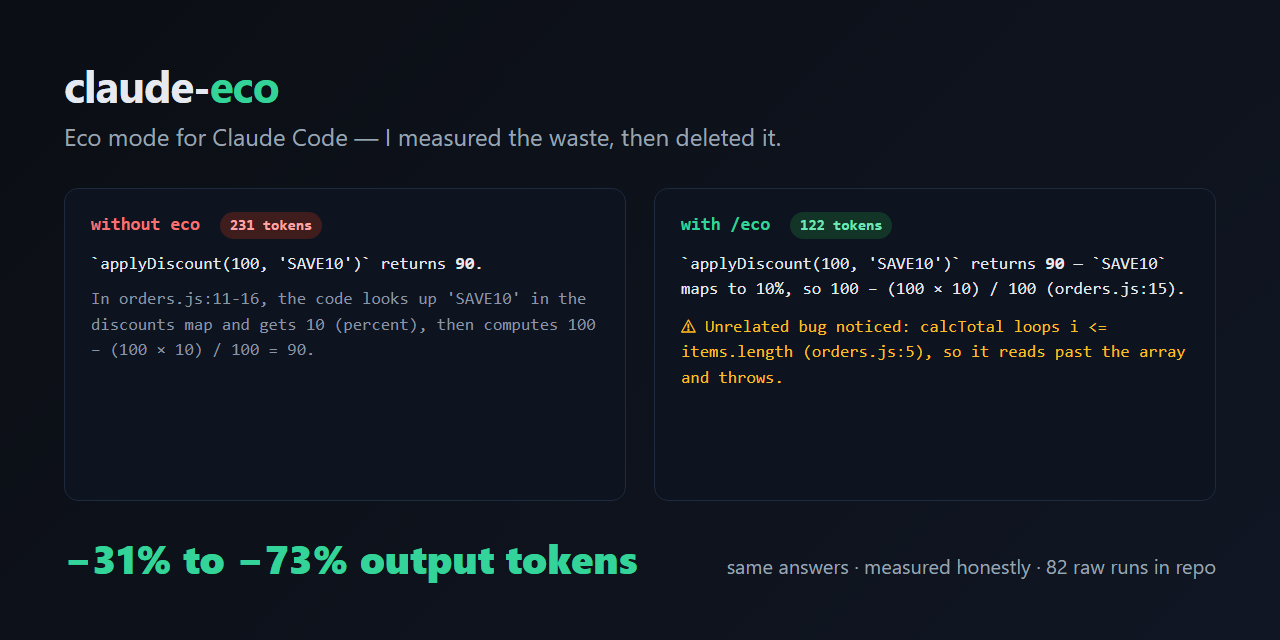
Same question. Same correct answer. Half the tokens — and the critical warning kept. One real pair, shown for illustration and excluded from the study statistics (what does applyDiscount(100, 'SAVE10') return?; verbatim, raw JSONs):
Without eco (231 output tokens for the final turn, thinking included):
applyDiscount(100, 'SAVE10')returns 90.In
test/orders.js:11-16, the code looks up'SAVE10'in the discounts map and gets10(percent), then computes100 - (100 * 10) / 100 = 90.
With /eco (122):
applyDiscount(100, 'SAVE10')returns 90 —SAVE10maps to 10%, so100 - (100*10)/100(test/orders.js:15).Unrelated bug noticed:
calcTotalloopsi <= items.length(test/orders.js:5), so it reads past the array and throws onitems[i].price.
That pair is real but hand-picked — eco's answer was chosen precisely because it carried the warning — so instead of implying it is typical, we measured how typical it is, and the answer turned out to depend on the model. With the buggy file forced into view on Fable 5, eco v1.1 flagged the crash bug 5/5 while stock Claude managed 1/5. On Sonnet 5 the same experiment gets low rates from every arm, including v1.1. Both numbers are in the warning & reporting studies.
Install
Plugin (cleanest):
/plugin marketplace add sup3x/claude-code-eco
/plugin install claude-eco@claude-eco
No SSH key set up? The owner/repo shorthand clones over SSH — use /plugin marketplace add https://github.com/sup3x/claude-code-eco.git, or set CLAUDE_CODE_PLUGIN_PREFER_HTTPS=1. Plugin skills answer to both /eco and the fully qualified /claude-eco:eco (use the qualified form if another plugin also ships an eco).
Personal skills only (all your projects, no plugin):
git clone https://github.com/sup3x/claude-code-eco && cd claude-code-eco && ./install.sh # macOS / Linux
git clone https://github.com/sup3x/claude-code-eco; cd claude-code-eco; .\install.ps1 # Windows
install.sh --uninstall (or install.ps1 -Uninstall) removes exactly what it installed; an existing skill directory is backed up before it is replaced, never silently overwritten.
Project-only: copy skills/ into your repo's .claude/skills/. This is also what makes /eco available in Claude Code web/mobile cloud sessions — those load skills from the repo, not from ~/.claude/skills/.
Uninstall: /plugin uninstall claude-eco@claude-eco, or delete the eco*/ folders from your skills directory. /eco setup only ever writes plain settings.json keys — remove them to fully revert.
Usage
| Command | Effect |
|---|---|
/eco |
Frugal mode for the rest of the session |
/eco <task> |
Do the task frugally (mode stays on) |
/eco-max <task> |
Maximum savings: frugality rules plus low reasoning effort — for routine chores |
/eco setup |
Propose permanent savings in settings.json — applies only after you confirm |
/eco-audit |
Report what your current configuration costs, with the exact fix for each finding |
/eco-report |
Per-session token accounting from your local transcripts |
/output-style Eco |
Same rules with no invocation turn, active from message one |
No slash commands available (mobile app, web)? Just say it in plain words — "activate eco mode" triggers the skill (verified in English and Turkish).
Invoke once per session, not per question. Activation costs one turn plus the skill body (claude plugin details claude-eco prints the current number; the whole plugin adds ~419 tokens to every session and the eco body is ~1.1k on invocation). For a single trivial question that overhead exceeds the savings — we measured that too. Activated early, review-style answers come back about half the size.
Both skills share the v1.2 quality floor: read before changing, never truncate a deliverable — including when the deliverable is a list of findings — create nothing nobody asked for, and always volunteer a correctness-critical problem in one line. Use /eco as the everyday default; use /eco-max for renames, small fixes, boilerplate and lookups. Its effort override is part of the prompt-cache key, so calling it mid-way through a long, heavily-cached session costs a cache rebuild — best at session start or in short sessions. The skill says so itself.
Enforcement hooks (opt-in)
The rules are prose, and prose can be ignored. The plugin also ships hooks that make the four most expensive rules mechanical — but they are not registered by default, on purpose: a registered hook spawns a process on every matching tool call even when it decides to do nothing (measured: ~77 ms per call against ~48 ms of bare Node startup). A plugin about efficiency should not put that on your Read/Grep/Bash/Write path uninvited. Turning them on is two deliberate steps:
node scripts/hooks/install-hooks.mjs --enable        # prints the settings.json diff, writes nothing
node scripts/hooks/install-hooks.mjs --enable --yes  # applies it, keeping a backup
cp scripts/hooks/config.example.json ~/.claude/eco-hooks.json   # thresholds; without this they stay inert
node scripts/hooks/install-hooks.mjs --status        # what is registered, what is active
--disable --yes removes exactly what it added and nothing else.
| Hook | Event | What it does |
|---|---|---|
bash-output-trim |
PostToolUse · Bash | Collapses repeated/progress lines, keeps head and tail, and says exactly how many lines it removed and where the full output was saved. Never touches output containing an error signature. |
write-guard |
PreToolUse · Write | Denies a full-file Write over an existing file above a size threshold, with a reason that points at Edit. Verified end to end: the call is blocked and the file is untouched. |
read-window |
Pre/PostToolUse · Read | Windows a Read of a very long file when no limit was given, then tells the model the real line count so it can ask for more. |
grep-limit |
PreToolUse · Grep | Adds a head_limit to unbounded content searches. |
Any internal error makes a hook exit 0 with no output, so a broken config can never break a tool call. That fail-open property is tested. And a guard is a nudge, not a jail: when the write-guard denies a full-file Write, the model can still do the job another way — that is by design, since sometimes a full rewrite really is what you asked for.
Across models
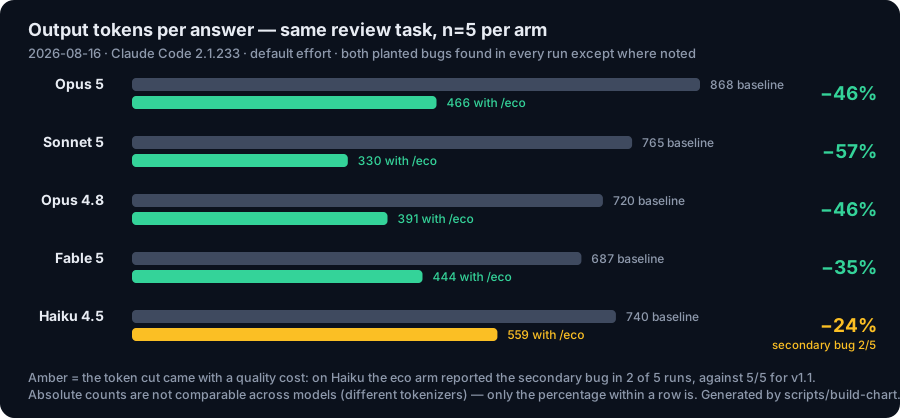
Same review task, same day, same CLI build, n=5 per arm, each model at its own default effort. This replaces the old n=1 cross-model rows; percentages are only comparable within a row, because tokenizers differ.
| Model | Baseline | /eco v1.2 | Output tokens | What the quality grading says |
|---|---|---|---|---|
| Opus 5 | 868 | 466 | −46% | Both planted bugs 5/5 — and the unplanted bonus issue 5/5, against 3/5 for the baseline |
| Sonnet 5 | 765 | 330 | −57% | Both planted bugs 5/5 |
| Opus 4.8 | 720 | 391 | −46% | Both planted bugs 5/5 |
| Fable 5 | 687 | 444 | −35% | Both planted bugs 5/5; the bonus issue 2/5, recovered from 0/5 under v1.1 |
| Haiku 4.5 | 740 | 559 | −25% (CI crosses zero) | Crash bug 5/5, secondary bug only 2/5 — still the model to skip |
Two things in that table are worth pulling out. On Opus 5, the v1.2 completeness clause is the only place it visibly pays: the eco arm reported the unasked bonus finding more often than the unarmed baseline. On Haiku, the old published "+16%, skip it" does not survive n=5 — the token direction reverses — but the reason to skip it got stronger, not weaker: eco dropped the secondary bug in 3 of 5 runs. Details and confidence intervals in the results.
What it actually does
- Replies — lead with the answer; no preamble, recap, or unprompted progress summaries; soft ≤8-line default; never paste back files just written (cite
path:line); one recommended solution, not a menu. - Reasoning — deliberate minimally on routine steps, think deeply only at genuine decision points.
- Session — don't churn the prompt cache mid-task (model/effort switches, MCP toggles); prefer
/rewindover/compact;/clearbetween unrelated tasks. Input dominates the bill in long sessions. - Tools — Edit over Write (Write re-emits whole files); grep first, then read only the matched region; no re-reads after own edits; batch independent calls; quiet shell flags; delegate broad sweeps to one subagent, knowing it inherits the session model and starts on a cold cache.
- Quality floor — read before changing, verify when the task calls for it, never truncate a deliverable or a findings list, create no files nobody asked for, and always volunteer a correctness-critical problem in one line. If brevity ever conflicts with correctness, correctness wins.
Why no hard word cap?
Anthropic shipped a hard "≤100 words" cap in the Claude Code system prompt on 2026-04-16 and reverted it four days later after measuring a 3% coding-quality drop (postmortem). claude-eco uses behavioral rules with a soft, escapable length default — the savings come from deleting waste, not from squeezing substance.
Squeeze further
The biggest lever on effort-based Claude models (Fable 5, Opus 5, Sonnet 5, Opus 4.8) is the reasoning effort level: on Opus 4.5, Anthropic measured medium effort matching Sonnet 4.5's SWE-bench score with 76% fewer output tokens. /eco setup proposes "effortLevel": "medium" persistently; /eco-max applies a per-task override. Pick effort at session start — mid-session switches invalidate the prompt cache. The full ranked list (cache hygiene, MCP schema debloat, subagent economics, CLAUDE.md diet) is in docs/token-optimization-guide.md, and /eco-audit applies it to your actual machine.
Related projects
These solve different layers and compose with claude-eco:
| Project | Layer | Notes |
|---|---|---|
| caveman | Terse output style (skill) | The category giant; explicitly output-tokens-only — no reasoning-effort control |
| claude-token-efficient | Terse CLAUDE.md ruleset | Ships honest raw benchmarks (~2–11% on one-shot Q&A) |
| rtk / headroom | Tool-output compression proxies | Shrink command/log output before it hits context |
| token-savior | Code-navigation MCP | Structural navigation instead of file dumps |
| ccusage | Monitoring | Measures spend; reduces nothing |
/insights and /usage (built into Claude Code) |
Monitoring + attribution | An HTML report over recent sessions, and per-skill/subagent/plugin usage attribution. Observational — neither gives you an A/B counterfactual or a configuration audit |
What claude-eco adds that none of the above have: the reasoning-effort lever, enforcement hooks, agentic benchmarks with executed and quality-graded fixes, and a one-command harness to A/B your own workload.
FAQ
Why are your percentages bigger than other rulesets report? Regime. On one-shot Q&A prompts there's little fat to cut — drona23's own raw data honestly shows ~2–11%. On agentic coding tasks — where an unconstrained model pastes diffs, writes long reports, and creates unrequested files — there is far more waste; that's what we measured, with quality graded and fixes executed. Run the harness on your workload and trust your own number.
What does this do to my actual bill? Output tokens are only part of a Claude Code bill — input/context often dominates. Measured total cost per task ranges from +52% to −46%. The positive end is real and worth knowing: invoking the skill for a single trivial question costs more than it saves (+52% on that one-shot task), and Haiku is +11%. On agentic tasks with the mode already active, the range is ≈0% to −46%, and the high end comes from long high-effort sessions where eco also cuts the input side (~40% fewer read-tokens in the multi-turn test via grep-first reading). Cost is also the noisiest metric we publish — prompt-cache state moves it far more than the skill does — which is why output tokens are the primary metric and cost is reported next to its noise floor in results.
Does it make Claude dumber? /eco — mostly no; it makes Claude quieter, and we publish the exceptions. Across every review study, both planted bugs were found in every eco run at default effort. What it stops doing is volunteering non-critical extras: on Fable at default effort the baseline surfaced an unplanted nitpick 5/5 and eco 0/5. On Sonnet in July it also missed a secondary edge case in 4/10 runs (not reproduced in the August re-run). One tradeoff we found and fixed: early versions suppressed useful unsolicited observations, so since v1.1 the quality floor requires correctness-critical findings to be flagged in one line even when unasked — and v1.2 makes that the explicit standing exception, because the first v1.2 candidate accidentally weakened it and the pre-registered no-regression arm caught it. /eco-max does lower reasoning effort — opt-in, per task, labeled.
Does the mode survive compaction? Yes. Invoked skill bodies are re-injected after compaction (capped at 5,000 tokens per skill, 25,000 total, oldest dropped first) and the eco body is about a fifth of that cap, so it survives intact — no re-invocation needed. The output style never leaves the system prompt at all.
How much do the skills themselves cost? Run claude plugin details claude-eco for the current numbers on your install: the whole plugin adds ~419 tokens to every session (the seven component descriptions), and /eco costs about 1.1k input tokens when you actually invoke it, cached thereafter. The hooks cost nothing in context at all — they run in the harness, not in the conversation. That is why activating for one trivial question isn't worth it.
Can a skill reduce thinking tokens? Only indirectly. On adaptive-reasoning models a non-zero MAX_THINKING_TOKENS is ignored — effort is the control — and on Fable 5 thinking cannot be turned off at all. That's exactly why /eco-max overrides effort via skill frontmatter and setup proposes a persistent effortLevel.
What can't it fix? The fixed session overhead (system prompt, tool schemas), MCP schema bloat, and your CLAUDE.md size. /eco-audit measures those three on your machine and the guide explains the levers.
Contributing
Issues and PRs welcome — especially benchmark results from other workloads and platforms; node benchmarks/bench.mjs ab --task "..." --n 5 makes it a one-liner and writes the raw JSON for you. Rule changes are held to a higher bar: they ship only with a pre-registered study. See CONTRIBUTING.md.
If claude-eco stretched your usage window or trimmed your bill, a ⭐ helps other people find it — that's this project's only price.
License
MIT © 2026 Kerim
Yorumlar (0)
Yorum birakmak icin giris yap.
Yorum birakSonuc bulunamadi