Logic-Loop
Health Uyari
- License — License: GPL-3.0
- Description — Repository has a description
- Active repo — Last push 0 days ago
- Low visibility — Only 8 GitHub stars
Code Basarisiz
- rm -rf — Recursive force deletion command in deploy/logic-loop.yaml
- process.env — Environment variable access in dsh-terminal-app/src/index.js
- network request — Outbound network request in dsh-terminal-app/src/index.js
Permissions Gecti
- Permissions — No dangerous permissions requested
Bu listing icin henuz AI raporu yok.
Effortlessly switch between multiple concurrent AI coding agent terminal sessions (Agy, Claude, Codex, OpenCode, Dsh, and Pi) — a macOS app by Super Logic AI (early testing for Linux and Windows now available!))
 Logic Loop
Effortlessly switch between multiple concurrent AI coding agent terminal sessions — a macOS app.
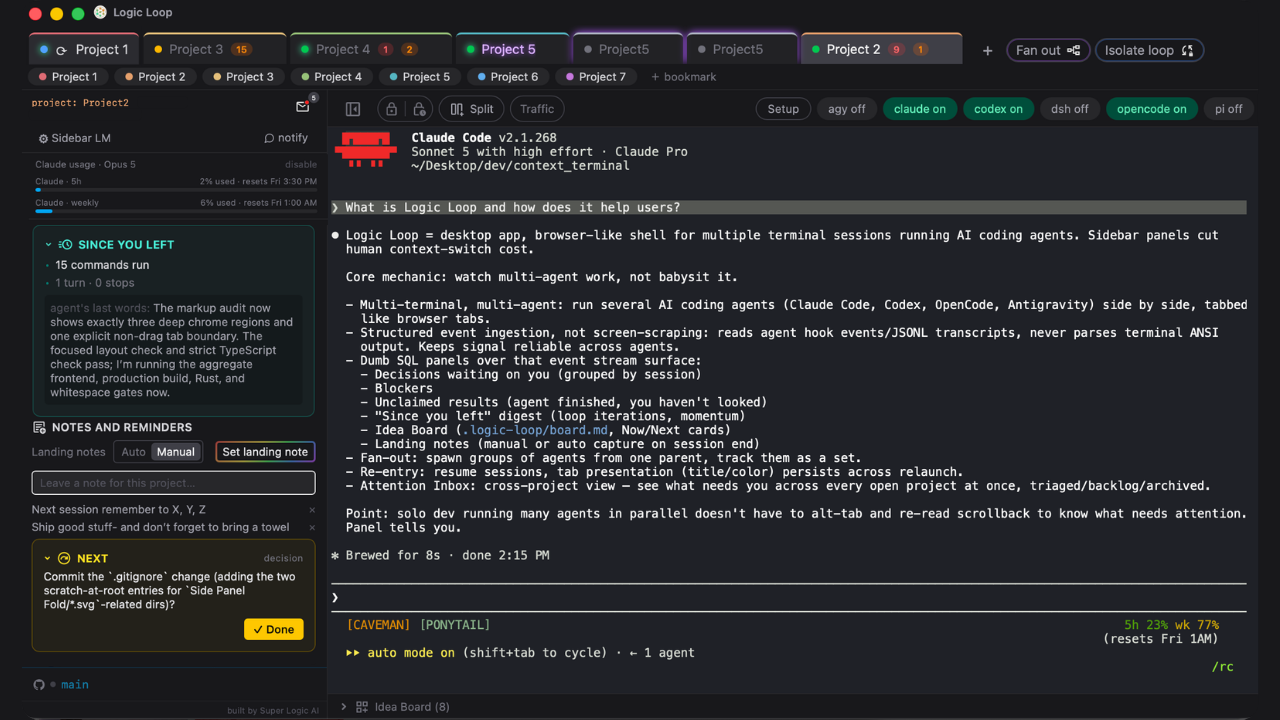
Logic Loop is an open-source macOS app, built by Super Logic AI,
that aids the human's context-switching limits while running several AI coding
agent terminal sessions at once — Claude Code, OpenCode, Codex, Antigravity,
Pi Agent and DeepSeek Harness today, more adapters planned. Every competing
tool tells you what your agents are doing. Logic Loop tells you what you need to do — and remembers
everything you'd otherwise lose in the switch.
Agent viewers manage the agents' context. Logic Loop manages yours.
Why
The bottleneck in multi-agent development is no longer the model's context
window — it's the operator's working memory. Run four Claude Code sessions and
the cost isn't watching them; it's the tax you pay every time you switch: lost
open questions, forgotten state, re-reading a terminal to remember where you
were.
Each panel in Logic Loop counters a documented failure mode of human task
switching:
| Panel | What it counters |
|---|---|
| Decision Tracker | Missed forks — the agent asks two questions, you answer one, the second silently dies and the agent decides for you. |
| Accomplished | Progress blindness — re-entry starts with "where was I?" instead of "what's next?" |
| Since You Left | Catch-up cost on a long unattended run — a deterministic digest (files touched, bash runs/errors, turns, decisions opened) of everything that happened while a tab was out of view, loop ticks collapsed to ×N no change so a long autonomous run reads as one line instead of a scrollback. |
| Blockers | Non-viable switches — switching into a project only to find it's waiting on something external. |
| Landing Note | State reconstruction cost — rebuilding mental state on return can take 15–25 min; a written next action collapses it. Auto (default) drafts on departure; Manual, toggled from Notes and reminders, skips the popup/draft/countdown and lets a rainbow-bordered capture action save your own note inline. |
| Attention Residue | Attention residue — part of your mind stays on the task you left; externalize the loop to return clean. |
| Momentum Builder | Re-entry friction — surfaces the single lowest-friction next action to convert staring into motion. |
| Idea Board | Where did that idea go — a per-project kanban dock (idea → planned → building → later → done) living in a git-committed .logic-loop/board.md; star up to 3 cards as "Now" and Momentum Builder prefers them over the plain top-of-column pick. |
| Attention Inbox | Which of my N projects needs me — a cross-project, keyboard-driven (Cmd/Ctrl+K) rollup of every open decision, unclaimed result, unresolved blocker, and stalled-quiet session across all tabs, ranked actionability-first with searchable per-row jump-to-tab. |
Two supporting controls round out re-entry and focus: a folded/compact side
rail — collapse any expanded panel down to icon-only, click an icon to jump
back to its section — for when screen space matters more than detail, and
Lock-in (Do Not Disturb, indefinite or a 1-hour timer) — the side panel
goes neutral and OS notifications/dock badge stay silent while every panel,
hook, and background session keeps updating underneath, so nothing is missed,
just not pushed at you. A header Split control opens a second ordinary
terminal in the focused project's directory and keeps two independently
tethered tabs visible side by side; the project panel follows whichever pane
has focus.
Decision debt
The failure mode Logic Loop was built around, and the one no amount of agent
visibility fixes: an agent hits a fork, and the fork never reaches you.
It looks like this. You ask for a change. The agent has two reasonable ways to
do it, mentions both in passing, picks one, and keeps going. Or it asks two
questions in one message, you answer the first, and the second quietly
becomes whatever the model assumed. Or you say "ask me before editing" and it
answers the question itself, because it was confident. The terminal shows a
finished task. Nothing shows the choice that was made for you.
Every one of those is a small debt. Each is cheap to repay in the moment
(one line from you) and expensive later, when the assumed answer has been
built on for twenty turns and you find out at review, or in production. Run
four agents in parallel and the debt compounds faster than you can read.
Logic Loop's answer is the Decision Tracker, and the design rule behind
it matters more than the panel:
- Forks are observed, not self-reported. Asking the agent to flag when it
needs you only catches the forks it noticed. The ones it resolved silently
are exactly the ones it did not notice. So the tracker reads the agent's
own transcript after each turn and extracts open questions from what was
actually said, including questions the agent raised and then answered for
itself, and questions embedded in a paragraph you skimmed past. - Extraction leans conservative. A card for a question that was never a
real fork wastes your attention. A missed fork costs a rework. The prompt,
the model choice, and the golden test set are all tuned toward fewer
cards, higher precision. Over-extraction is treated as the worse bug. - Answering is one action, not a context switch. Each card carries the
question and an Answer now control that lands your reply in the right
tab. Answering closes the card deterministically. Dismissing is one click.
Stale clusters bulk-dismiss by session. - Debt is visible across projects. Open decisions roll up into the
Attention Inbox with unclaimed results and blockers, so "which of my
projects is waiting on a choice I never made" is one keystroke. - The app never answers for you. It observes and displays. It never
writes into a running session on its own. That is an architectural
invariant, not a setting.
The rest of the side panel exists to make coming back cheap. This panel
exists so that when you come back, the decisions are still yours.
How it works
Logic Loop never scrapes the terminal screen. Semantic events come from
structured agent protocols only — an agent's lifecycle hooks (Claude Code,
Codex, Antigravity), its JSONL session transcripts, or its own
plugin/event API where one exists (OpenCode) — deterministic, structured, no
ANSI parsing. Raw PTY bytes pass through untouched. Panels are plain SQL views
over an append-only event log; the only place an LLM is used is the ambiguous
10% (did your reply address every question the agent asked?), and even that
fails open — if extraction breaks, the terminals keep working.
Every adapter normalizes to one wire shape, so a tab running any of them gets
the same state dots, rollups and fan-out tracking. Each installs itself into
that agent's own global config only after an explicit click, and removes itself
byte-identically when switched off. On first run, the Setup checklist shows
which supported CLIs are detected, explains each adapter's actual depth, and
waits for the first structured event before calling a connection live. Setup
can be skipped and reopened from the header at any time. Notification permission
is likewise requested only from the checklist after its purpose is explained.
AGENTS.md is this repo's own
shared contract for coding agents working on Logic Loop itself — repo map,
verify commands, and invariants in one place, readable by OpenCode and Codex
alongside Claude Code.
Supported agents
| Agent | Activity, state & fan-out | Decision / blocker extraction | Notes |
|---|---|---|---|
| Claude Code | ✅ | ✅ | Hooks + JSONL transcript tailing. The reference adapter. Resume/re-entry supported. |
| OpenCode | ✅ | — | In-process plugin translating native events; no transcript file to tail. |
| Codex | ✅ | ✅ | Hook contract is near-identical to Claude's; registers into ~/.codex/hooks.json. Carries its own adapter marker, resumes via codex resume, handles Interrupt/SessionEnd lifecycle events, and can back the Sidebar LM extractor. |
Antigravity (agy) |
✅ | — | Structured hooks and session re-entry via agy --conversation <id>; quit/relaunch and prior-context recall verified with agy 1.2.4. See caveats below. |
Pi Agent (pi) |
✅ | — | In-process global TypeScript extension (~/.pi/agent/extensions/logic-loop.ts) translating lifecycle events; no separate config file or transcript to tail. Session re-entry via pi --session <id>, live-verified (Plan 026). |
DeepSeek Harness (dsh) |
✅ | — | Runs as dsh --profile logic-loop. No first-party terminal UI ships upstream, so the adapter installs Logic Loop's own profile patch at ~/.dsh/profiles/logic-loop rather than wrapping something DeepSeek provides. Session re-entry via --resume <sessionId>, proven cross-process. |
Decision and blocker extraction is available for Claude Code and Codex. The
Sidebar LM chooser supports Claude CLI (default), Codex CLI, and LM Studio
(local); Codex CLI uses its configured default model unless an optional model
override is supplied. A submitted Claude/Codex reply can conservatively close
older open questions from that same session; Answer now only focuses and
prefills the bound terminal, so cancelling the draft never creates false
answer state. The Decisions panel groups open questions into
per-session, collapsible clusters (newest expanded, one "dismiss all" per
cluster) instead of one flat list, and its empty state now says why nothing's
showing rather than one generic "nothing waiting" —
confirmed-empty, blind session (no transcript), unbound fan-out child, or
"not available for this agent" are each called out distinctly.
Antigravity's tool activity (file edits, commands run) now shows real detail
in the Accomplished panel and Since-you-left digest, and a second turn in the
same session correctly returns the tab to "working" instead of freezing on
"idle" — both were Logic Loop-side gaps, now fixed.
Antigravity session re-entry was completed in Plan 025.agy 1.2.4 restored a disposable conversation in a new CLI process; the
Logic Loop dev app then restored a ghost tab with its title and color and
re-entered the same conversation with prior context intact. Setup now labels
re-entry supported. Decision extraction remains unavailable for Antigravity.
One Antigravity-specific limit remains, upstream in agy and not fixable
from this side (full derivation in docs/TESTING.md §21):
- A tool call that exits non-zero is indistinguishable from one that
succeeded —agystrips the field carrying that status before the hook
sees it, so anagytab shows "working" rather than "error" on a failed
command. Everything else still lands.
agy's separate PostToolUse named-hook merge bug (present through earlieragy releases) is confirmed fixed upstream as of agy 1.1.27. Logic Loop
now also detects a foreign PostToolUse hook in ~/.gemini/config/hooks.json
at setup time and surfaces a warning strip if one is found, so an older or
regressed agy install fails loud instead of silently dropping every tool
event.
Account and usage meters
The active Claude Code tab's sidebar can show which model the session is on
plus two account allowance bars — 5-hour and weekly — with used percentage and
reset time. The source is Claude Code's own documented statusLine JSON, not
a local token count. Logic Loop wraps an existing statusLine.command
after an explicit click: your original command still runs and renders exactly
as before, and switching the wrapper off restores the original byte for byte.
A tab with no status line configured is told so rather than having one created
for it.
Codex tabs get the equivalent from Codex's own app-server — session model plus
each named rate-limit bucket it reports, shown separately rather than summed,
because the response does not map buckets to the active model.
Both are read-only gauges of an account-wide number that happens to be visible
because that tab is bound and active. Neither is joined across tabs, persisted
to the database, or turned into a dollar figure.
Model traffic (optional)
Logic Loop can also read the metadata log written by
Safe Router, a headless,
local-first model router from the same project. Safe Router keeps designated
clients on approved local backends, brokers explicitly authorized remote
requests, and records what was requested, served, and reported as used —
never prompts or responses.
If your agents route through it, a header Traffic control opens a global
list of the latest 100 routed requests: time, client key ID, requested versus
served model, backend, plane, disposition and status, token counters, and
whether usage was fully recorded. That answers something no single agent's own
interface can — which model tier actually served this request — across every
agent and project at once.
It is strictly a read. Logic Loop opens ~/.safe-router/log.db read-only
(mode=ro plus PRAGMA query_only=1) on its own connection, never creates the
file, never writes to it, and selects only from the versioned v_requests_v2
view, never the underlying table. Safe Router remains a separate process and
the sole writer.
Entirely optional: with no Safe Router installed, the control simply reports
that no log was found, and nothing else in Logic Loop depends on it. No cost
or dollar figure is shown — the counters are provider-reported metadata, not a
bill, and a NULL reads as unknown while a recorded 0 reads as 0. Theclient_tag field is client-supplied text, so no row is attributed to a tab
or project.
Shipped in Plan 022. Its manual macOS
matrix (docs/TESTING.md §57) has not been run yet.
Status
Early, actively built, dogfooded daily. Shipped:
- ✅ Terminal shell — tabs, real PTYs, per-session state dots
- ✅ Event spine — hook ingestion + transcript tailing
- ✅ Accomplished + Blockers panels (deterministic)
- ✅ Decision Tracker with fork detection
- ✅ Landing Note · Attention Residue · Momentum Builder
- ✅ Re-entry, unclaimed-result tracking, desktop nudges
- ✅ Fan-out spawn groups — launch and track several agents from one session
- ✅ OpenCode adapter — first non-Claude ingestion pipeline
- ✅ Codex adapter — adapter identity marker, resume/re-entry, Interrupt/SessionEnd lifecycle
- ✅ Isolated loops (git worktree–backed tabs)
- ✅ Antigravity (
agy) adapter — multi-turn tracking fix, normalized tool detail, foreign-PostToolUse-hook detection - ✅ Decisions grouped by session with per-cluster bulk-dismiss
- ✅ Decisions empty-state clarity — distinguishes confirmed-empty from
blind/unbound/non-Claude-agent - ✅ Idea Board — per-project kanban dock with a starred "Now" set
- ✅ Cross-project Attention Inbox —
Cmd/Ctrl+Ksearchable rollup of
decisions, unclaimed results, blockers, and stalled sessions across all
open projects, with archive/backlog triage for unavailable rows - ✅ Folded/compact side rail — icon-only panel mode, width and mode persist
- ✅ Blockers bulk clear — resolve every open blocker for a project in one
action - ✅ Lock-in (Do Not Disturb) — indefinite or 1-hour-timed, mutes
notifications/dock badge without pausing ingestion - ✅ First-run agent setup — detection, capability depth, explicit hook install,
first-event confirmation, and contextual notification consent - ✅ Two-terminal split view — a second ordinary tab in a fixed vertical split,
each pane independently tethered - ✅ Commit & Push footer — drafts a commit message, stages, pushes and opens a
PR without leaving the tab; untracked files are always opt-in, and the tab is
checked back out to the branch it started on - ✅ Pi Agent adapter — in-process extension, activity and session re-entry
- ✅ DeepSeek Harness adapter — Logic Loop's own profile patch, activity and
cross-process re-entry - ✅ Claude usage meter — 5-hour and weekly account bars from Claude Code's own
statusLineJSON, wrapping an existing status line reversibly - ✅ Codex account meter — session model and each reported rate-limit bucket,
read from Codex's app-server - ✅ Safe Router traffic view — optional, read-only list of recent routed
requests and which model tier served them - ⏳ Crash recovery, public release polish
Stack
Tauri v2 (Rust core) · portable-pty · React + TypeScript + Tailwind ·
xterm.js · SQLite (tauri-plugin-sql) · localhost hook-ingest server.
Requirements
- macOS (Apple Silicon) — primary, daily-dogfooded platform.
- Windows — early testing build, see below.
- A packaged app or installer does not require Rust or Node on the machine
where it runs. Building from source does; see the macOS steps below. - For agent activity, install at least one supported CLI: Claude Code,
OpenCode, Codex,
Antigravity (agy),
Pi Agent (pi), or
DeepSeek Harness (dsh).
Each is detected independently —PATH, Homebrew prefixes, and the usual
install locations. You can open a plain terminal tab without an agent CLI.
macOS (build from source)
The Windows installer workflow does not produce a macOS app. To build Logic Loop
on an Apple Silicon Mac, install Rust and Node 18+ first,
then run:
git clone https://github.com/SuperLogicAI/Logic-Loop.git
cd Logic-Loop
npm ci
npm run tauri build
open "src-tauri/target/release/bundle/macos/Logic Loop.app"
The Rust installation prompt is expected for this build path, not when opening
an already-built .app.
Windows (early testing)
CI compiles and tests the Rust core on windows-latest on every push, but the
macOS build is what's dogfooded daily — treat Windows as early/unverified.
To get an installer:
- Go to Actions → Windows build
in this repo. - Run the workflow (
Run workflowbutton,mainbranch), or grab the
artifact from the latest run if one already exists. - Once it finishes, open the run and download the
logic-loop-windows-unsigned
artifact — it's a zip containing a*-setup.exeNSIS installer. - Run the installer. It's unsigned, so Windows SmartScreen will warn —
click More info → Run anyway.
The installer includes the app; Rust and Node are not needed on the test PC.
No installer is published automatically; each run builds from whatever's onmain at the time.
Before testing an agent, check the basic terminal flow: click + to open a
tab, run echo hello, then add a bookmark for an existing folder and click the
new bookmark to open another tab. A Windows tester has reported that + and
bookmark opening did nothing; this has not yet been reproduced or fixed. If
either action fails, report it via GitHub Issues with your Windows version, the
workflow run or installer artifact used, what you clicked, and any visible
error. Please also report crashes, PTY quirks, and missing agent detection;
include the agent CLI and version when relevant.
Development
npm install
npm run tauri dev     # run the app
npm run build         # tsc + vite build
Contributing
Bug reports, adapter requests and PRs welcome — see
CONTRIBUTING.md for setup, the merge gates, and the
architecture rules that aren't up for debate.
License
Built and maintained by Super Logic AI — AI automation
for small businesses.
Also from Super Logic AI: Safe Router,
a headless, local-first model router. It keeps designated clients on approved local
backends, brokers explicitly authorized remote requests, and writes a private
metadata log of what was requested, served, and reported as used — prompts and
responses are never stored in it.
Yorumlar (0)
Yorum birakmak icin giris yap.
Yorum birakSonuc bulunamadi