open-dynamic-workflows
Health Warn
- License — License: MIT
- Description — Repository has a description
- Active repo — Last push 0 days ago
- Low visibility — Only 5 GitHub stars
Code Fail
- os.homedir — User home directory access in .agents/plugins/odw/skills/odw/scripts/daemon-bridge.js
- process.env — Environment variable access in .agents/plugins/odw/skills/odw/scripts/daemon-bridge.js
- fs module — File system access in .agents/plugins/odw/skills/odw/scripts/daemon-bridge.js
- network request — Outbound network request in .agents/plugins/odw/skills/odw/scripts/daemon-bridge.js
- os.homedir — User home directory access in .agents/plugins/odw/skills/ultracode/scripts/daemon-bridge.js
- process.env — Environment variable access in .agents/plugins/odw/skills/ultracode/scripts/daemon-bridge.js
- fs module — File system access in .agents/plugins/odw/skills/ultracode/scripts/daemon-bridge.js
- network request — Outbound network request in .agents/plugins/odw/skills/ultracode/scripts/daemon-bridge.js
- os.homedir — User home directory access in .agents/skills/odw/scripts/daemon-bridge.js
- process.env — Environment variable access in .agents/skills/odw/scripts/daemon-bridge.js
- fs module — File system access in .agents/skills/odw/scripts/daemon-bridge.js
- network request — Outbound network request in .agents/skills/odw/scripts/daemon-bridge.js
- os.homedir — User home directory access in .agents/skills/ultracode/scripts/daemon-bridge.js
- process.env — Environment variable access in .agents/skills/ultracode/scripts/daemon-bridge.js
- fs module — File system access in .agents/skills/ultracode/scripts/daemon-bridge.js
- network request — Outbound network request in .agents/skills/ultracode/scripts/daemon-bridge.js
- os.homedir — User home directory access in .cursor/skills/odw/scripts/daemon-bridge.js
- process.env — Environment variable access in .cursor/skills/odw/scripts/daemon-bridge.js
- fs module — File system access in .cursor/skills/odw/scripts/daemon-bridge.js
- network request — Outbound network request in .cursor/skills/odw/scripts/daemon-bridge.js
- os.homedir — User home directory access in .cursor/skills/ultracode/scripts/daemon-bridge.js
- process.env — Environment variable access in .cursor/skills/ultracode/scripts/daemon-bridge.js
- fs module — File system access in .cursor/skills/ultracode/scripts/daemon-bridge.js
- network request — Outbound network request in .cursor/skills/ultracode/scripts/daemon-bridge.js
Permissions Pass
- Permissions — No dangerous permissions requested
No AI report is available for this listing yet.
Open-source dynamic multi-agent workflows for AI coding agents - the script-as-orchestrator engine behind Claude Code dynamic workflows & ultracode, for OpenCode, Codex, Antigravity & VS Code. Local-first, bring your own model (Anthropic/OpenAI/Ollama), MIT.
The model plans the swarm. A local script runs it. Your chat only sees the answer.
An open-source engine for dynamic, multi-agent workflows where a script is the orchestrator, not the model — the pattern behind Claude Code's dynamic workflows and ultracode, for OpenCode, Cursor, OpenAI Codex, Google Antigravity, and VS Code. Bring your own model, run a local daemon, keep everything on your machine.
Quick start · How it works · Topologies · Compare · FAQ






What it is
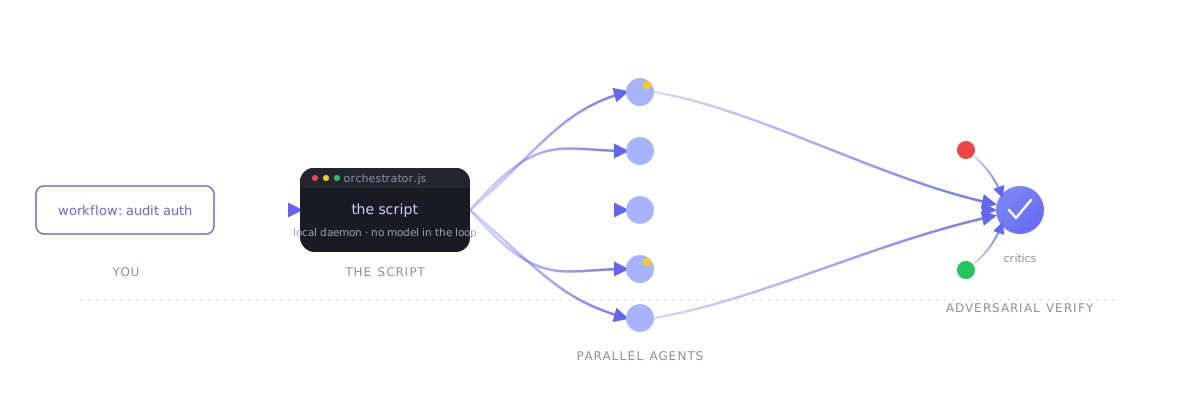
When you ask one LLM to coordinate fifty agents, it spends its context window keeping track of the other forty-nine. The fix is to have the model write a plan once — a plain JavaScript execute() function — and then step out of the loop while a runtime executes it. The model is the author. The script is the orchestrator. That capability had been locked to one proprietary tool; this is the same idea, MIT-licensed, on your machine.
| Script-as-orchestrator | It verifies its own work | Runs on your machine |
|---|---|---|
| The model writes a plan once. A local daemon runs the swarm. | Adversarial critics catch false positives before you see them. | Bring your own model. No telemetry. Nothing leaves your box. |
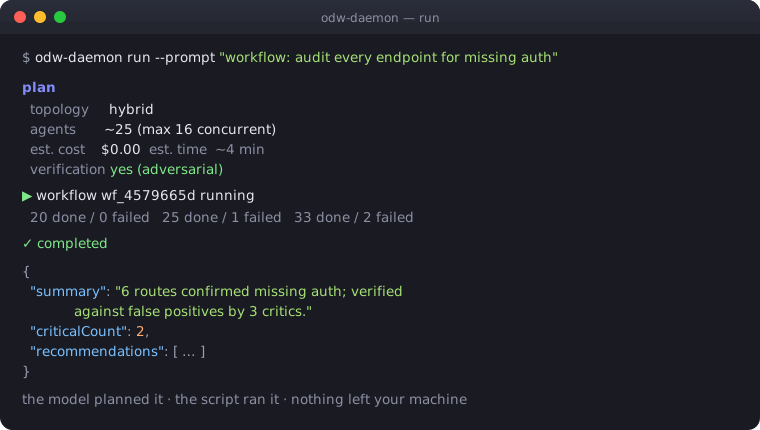
you ──▶ "workflow: audit every endpoint for missing auth"
        │
        ├─ plan      25 agents · adversarial verification · ~$0.30 · ~4 min
        ├─ confirm   [run] [view script] [edit]
        └─ run       ▶ wf_9f3c2a  → 200 endpoints checked, 6 real issues, report written
How it works
The model never babysits the swarm. It writes one execute(context) function and hands it to the daemon, which runs it inside a WASM-isolated QuickJS sandbox where the only things in scope are the workflow primitives — agent, parallel, pipeline, verify, loop, checkpoint. Every agent() call becomes one HTTP request to your model provider, scheduled through a concurrency queue. Your chat window only sees the final answer.
%%{init: {'theme':'base','themeVariables':{'primaryColor':'#6366f1','primaryTextColor':'#ffffff','lineColor':'#818cf8','primaryBorderColor':'#a5b4fc'}}}%%
flowchart LR
    you([you: a one-line workflow]) --> script[local daemon<br/>plans + schedules]
    script --> a1((agent)) & a2((agent)) & a3((agent))
    a1 & a2 & a3 --> critics{adversarial<br/>critics}
    critics --> answer([one verified answer])
    script -.checkpoint.-> db[(sqlite + WAL)]
- It survives. State lives in SQLite with write-ahead logging. Kill the daemon mid-run, start it with
--resume, and completed agents come back from cache — only unfinished work re-runs. A failed agent is dropped, not fatal; the run keeps going. Node identity issha1(workflow | phase | role | prompt), so replay is exact. - It doesn't trust its own agents. A finding isn't a finding until a panel of skeptics has tried to knock it down. The
verifyprimitive runs critics that hunt false positives, challenge severity, and look for what's missing, then keeps only what survives a quorum. - It won't blow the context window. Each agent gets a fresh window and only its distilled result crosses back — the same isolation big harnesses use to run huge tasks. On top of that, every call is measured against the model's real context window and, if it would overflow, the input is compacted by dropping whole structural elements (never a mid-JSON cut). A provider "context too long" error is caught and self-healed with a bounded compact-and-retry instead of crashing the run — so it holds up on small and free models, not just 200K-token ones.
Quick start
Install from GitHub — not on the npm registry yet, so install by cloning. (An unrelated package happens to sit at the name
open-dynamic-workflowson npm — that isn't this project.) Same steps on macOS, Linux, and Windows.
git clone https://github.com/Suraj1235/open-dynamic-workflows
cd open-dynamic-workflows
npm install
npm run setup
npm run setup writes ~/.odw/config.json. Add one key and you're done:
{
  "apiKeys": { "anthropic": "sk-ant-..." },
  "models": { "planning": "gpt-4o-mini", "default": "claude-sonnet-4-6" }
}
Then drive it from a shell — no editor required:
odw-daemon start
odw-daemon run --prompt "workflow: find every TODO that hides a real bug" --cwd ./my-project
Or wire it directly into your agentic coder from the clone:
odw-daemon integrate all          # one command for every supported adapter below
odw-daemon integrate mcp          # writes .mcp.json + AGENTS.md instructions
odw-daemon integrate codex        # Codex plugin + MCP + ODW/ultracode skills
odw-daemon integrate cursor       # writes MCP + rule + /odw + /ultracode skills + subagent + dashboard
odw-daemon integrate kimi         # writes ~/.kimi-code/mcp.json + /flow:odw + /flow:ultracode
odw-daemon integrate gemini       # writes ~/.gemini/settings.json + /odw + /ultracode
odw-daemon integrate zed          # writes .zed/settings.json + /odw + /ultracode Agent Skills
odw-daemon integrate zcode        # generic MCP + zcode guidance + Zed-compatible settings/skills
odw-daemon integrate opencode     # local OpenCode plugin wrapper + /odw + /ultracode + /workflows
odw-daemon integrate vscode       # installs the local VS Code dashboard extension
odw-daemon integrate antigravity  # Antigravity plugin bundles + MCP configs + ODW/ultracode skills + workflow
odw-daemon integrate openclaw     # OpenClaw skill folder
odw-daemon doctor all             # verify configs and daemon readiness
odw-daemon doctor all --json      # machine-readable readiness for agents/CI
npm run smoke:hosts               # temp install + live workflow + MCP bridge + host CLI probes
After that, open the target agent and say workflow: ..., ultracode ..., or /deep-research ....
If a model has no key or route, odw-daemon run tells you up front — before planning — exactly which line of the config to fix. No silent first-run failures.
No cloud key? Run a local model with Ollama and pay nothing — point all three roles at it so planning and fallbacks stay free too:
{ "models": { "planning": "ollama:llama3", "default": "ollama:llama3", "fallback": "ollama:llama3" } }
Any OpenAI-compatible endpoint works — OpenCode Zen, Azure OpenAI, vLLM, LM Studio, Together, Groq:
{
  "baseURLs": { "default": "https://opencode.ai/zen/v1" },
  "apiKeys":  { "default": "your-key" },
  "models":   { "planning": "minimax-m3-free", "default": "minimax-m3-free", "fallback": "minimax-m3-free" }
}
Prefer not to install globally? Every command also runs from the repo: npm start, npm run status, npm run odw -- run --prompt "...".
Model routing is automatic:
| Model id | Routes to |
|---|---|
claude-* |
Anthropic |
gpt-*, o* |
OpenAI |
ollama:* |
local Ollama (free) |
provider:model |
a named baseURLs.<provider> |
| anything else | baseURLs.default |
Topologies
The planner picks the simplest shape that fits the task instead of throwing a swarm at everything.
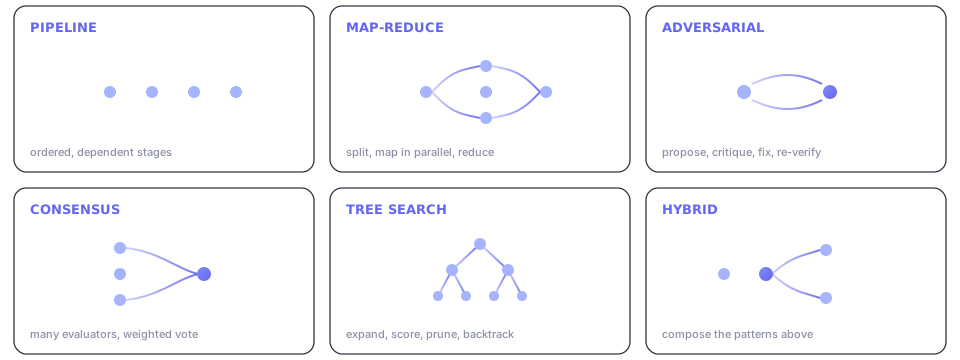
| Topology | Shape | Good for |
|---|---|---|
| MapReduce | split → map in parallel → reduce | auditing 500 files, the same check across many items |
| Pipeline | stage → stage → stage, per item, no barrier | migrate → test → fix, where item A streams ahead of item B |
| Adversarial | propose → critique → fix → re-verify | anything that has to be correct, not just plausible |
| Consensus | many evaluators → weighted vote | uncertain facts, research, judgement calls |
| Tree search | expand → score → prune → backtrack | root-cause hunts, branching exploration |
| Hybrid | the above, composed | real features that have several phases |
Inside your agent
For broad agent support, start with odw-daemon integrate mcp. It writes a project .mcp.json using the common mcpServers shape and adds a managed AGENTS.md block that tells MCP-capable agents when to use odw_run, odw_plan, odw_status, and odw_result. Host-specific installers sit beside it: integrate codex installs a local Codex plugin bundle under ~/.codex/plugins/odw, registers it in the personal marketplace at ~/.agents/plugins/marketplace.json, and keeps the fallback ~/.codex/config.toml MCP block plus the ~/.agents/skills/odw and ~/.agents/skills/ultracode skills; integrate cursor adds Cursor MCP config, a project rule, project-local .cursor/skills/odw and .cursor/skills/ultracode skills invokable as /odw and /ultracode, a Cursor-native .cursor/agents/odw-orchestrator.md subagent, and the dashboard extension under ~/.cursor/extensions; integrate kimi writes Kimi Code's ~/.kimi-code/mcp.json, AGENTS.md, and project-local .kimi/skills/odw plus .kimi/skills/ultracode flow skills invokable as /flow:odw, /skill:odw, /flow:ultracode, or /skill:ultracode; integrate gemini writes Gemini CLI's ~/.gemini/settings.json, GEMINI.md, and project-local .gemini/commands/odw.toml plus ultracode.toml slash commands; integrate zed writes Zed context_servers, AGENTS.md, and project-local .agents/skills/odw plus .agents/skills/ultracode Agent Skills invokable with /; integrate zcode writes generic MCP plus zcode-facing AGENTS.md guidance and retargeted .agents/skills/odw plus .agents/skills/ultracode skills over the same Zed-compatible context-server config; integrate opencode writes the local plugin wrapper plus /odw, /ultracode, and /workflows commands; integrate vscode installs the local dashboard extension into ~/.vscode/extensions; and integrate antigravity installs official-layout Antigravity plugin bundles at ~/.gemini/config/plugins/odw, ~/.gemini/antigravity-cli/plugins/odw, and .agents/plugins/odw while preserving direct MCP configs at ~/.gemini/config/mcp_config.json, ~/.gemini/antigravity-cli/mcp_config.json, and .agents/mcp_config.json.
Run odw-daemon doctor <agent> after setup to check both sides of the handshake: the expected agent config files exist and point at this checkout, and the local daemon is reachable. It exits non-zero with a specific missing file or daemon-start hint when something is not ready.
Add --json to integrate or doctor when an agent, CI job, or installer UI needs stable machine-readable output instead of colored text.
For release and support checks, run npm run smoke:hosts. It creates a temporary full install, verifies the combined AGENTS.md guidance covers generic MCP hosts, Kimi Code, Zed, and zcode, starts a temporary daemon against a zero-cost mock provider, completes a real workflow, completes a real odw_run through the MCP bridge, parses odw-daemon doctor all --json so every named adapter is checked explicitly, and probes installed host CLIs. Missing proprietary hosts are reported as skipped instead of faking coverage.
Use npm run smoke:hosts -- --require-host opencode when a release machine is expected to prove a specific host is runnable.
The adapters are how your existing tool drives the engine. The easiest default is MCP: odw-daemon integrate codex and odw-daemon integrate cursor point the host at the local odw-mcp bridge, so the host gets odw_plan, odw_run, odw_status, odw_result, and odw_control tools without the compiled orchestration script entering chat context. Codex now also gets the official plugin packaging path, so the same skill and MCP server can be surfaced from Codex's plugin browser. Native adapters sit beside that where the host exposes better hooks. On OpenCode the engine runs inside the plugin, on your already-configured model — no daemon and no second API key. Everywhere else the engine runs in the local daemon (its own key) and the adapter is a thin client over its localhost API.
| Editor / agent | How it connects | No-key, no-daemon native mode? |
|---|---|---|
| Generic MCP hosts | odw-daemon integrate mcp writes .mcp.json plus managed AGENTS.md instructions for clients that import the common mcpServers JSON shape |
No - MCP is a tool bridge, not host-model execution |
| Kimi Code CLI | odw-daemon integrate kimi writes ~/.kimi-code/mcp.json, managed AGENTS.md, and .kimi/skills/odw plus .kimi/skills/ultracode so /flow:odw, /skill:odw, /flow:ultracode, or /skill:ultracode opens the workflow playbook in Kimi |
No - same MCP bridge |
| Gemini CLI | odw-daemon integrate gemini writes ~/.gemini/settings.json mcpServers.odw, managed GEMINI.md, and .gemini/commands/odw.toml + ultracode.toml so /odw and /ultracode route through ODW |
No - same MCP bridge |
| Zed / zcode-style clients | odw-daemon integrate zed writes .zed/settings.json context_servers, managed AGENTS.md, and .agents/skills/odw plus .agents/skills/ultracode so /odw or /ultracode opens the workflow playbook in Zed Agent; integrate zcode writes both generic .mcp.json and zcode-specific guidance/skills over the same Zed-compatible settings layout |
No - same MCP bridge |
| Codex | odw-daemon integrate codex installs an official local plugin bundle (~/.codex/plugins/odw) with ODW and ultracode skills, registers the personal marketplace entry (~/.agents/plugins/marketplace.json), writes plugin-scoped MCP (~/.codex/plugins/odw/.mcp.json), and keeps fallback MCP/skill installs (~/.codex/config.toml, ~/.agents/skills/odw, ~/.agents/skills/ultracode) |
No — Codex exposes plugins, MCP/tools, and skills, but no documented extension API to invoke the host model directly; full ODW uses the daemon |
| Cursor / MCP hosts | odw-daemon integrate cursor writes .cursor/mcp.json, a Cursor project rule, .cursor/skills/odw and .cursor/skills/ultracode so /odw or /ultracode opens the workflow playbook, .cursor/agents/odw-orchestrator.md so Cursor Agent can delegate workflow/ultracode work to an ODW specialist, and the dashboard extension into ~/.cursor/extensions; other MCP clients can use the same node packages/mcp-server/src/index.js command |
No — MCP is a tool bridge, not host-model execution |
| OpenCode | odw-daemon integrate opencode writes a local plugin wrapper plus /odw, /ultracode, and /workflows; /odw <task> expands to the plugin's workflow trigger, so embedded keyless execution is tried before daemon fallback |
Yes — validated live on OpenCode 1.2.27: runs ODW's real engine through OpenCode's own model via the plugin SDK (session.prompt); a full multi-agent run completed in 93 real round-trips. No daemon, no extra key. Native embedded runs default to a 20-agent cap; the daemon remains available for higher fan-out (default 16, raise the config.daemon.maxConcurrency ceiling toward 100+ on capable hardware) + crash-resume. (ODW_MAX_AGENTS=N overrides the embedded cap, ODW_HOST_MODEL=provider/model pins the agent model, ODW_DEBUG=1 enables diagnostics.) |
| Antigravity | odw-daemon integrate antigravity installs official-layout plugin bundles (~/.gemini/config/plugins/odw, ~/.gemini/antigravity-cli/plugins/odw, .agents/plugins/odw) with plugin.json, plugin-scoped MCP, odw and ultracode skills, and a routing rule; it also keeps direct MCP configs, config-scoped/legacy skill installs, and saved /odw-run workflow fallbacks |
No — Antigravity exposes MCP/tools, plugins, skills, and saved workflows, but no documented model API to invoke the host model; full ODW uses the daemon |
| OpenClaw | odw-daemon integrate openclaw installs the ClawHub-format skill |
No — the skill is a thin client over the daemon API |
| VS Code | odw-daemon integrate vscode installs the local extension into ~/.vscode/extensions; it adds a sidebar of live workflows, a dashboard webview, and a status bar that spins while agents run |
n/a (UI client over the daemon API) |
OpenCode native detail: both the chat trigger and the explicit odw_run tool try the embedded host-model engine before daemon fallback. Embedded runs default to ODW_MAX_AGENTS=20 for first-run safety; set ODW_MAX_AGENTS=N to raise or lower that cap, and ODW_HOST_MODEL=provider/model when you want embedded agents pinned to a specific OpenCode model.
Honest note: ODW runs keyless-and-seamless — the real engine on the host's own model, no second key — two ways today. Natively on OpenCode (its plugin exposes session.prompt), and on any MCP client that advertises the sampling capability via the opt-in engine-hosting server (ODW_MCP_SAMPLING=1), which runs the engine in-process and calls back to the client's own model for every agent (proven end-to-end, including request-during-request reentrancy over stdio). Codex and Antigravity don't advertise MCP sampling yet — OpenAI closed Codex's sampling PR (openai/codex#5116) to prevent subscription-credit arbitrage, and Antigravity's MCP client implements only tools + roots — so today they run the full engine through the local daemon (its own key, or genuinely keyless via local Ollama), and auto-upgrade to keyless with zero further config the instant either ships sampling. Every adapter uses the extension points those tools actually have — plugins, MCP, skills, AGENTS.md, GEMINI.md, saved workflows — and says so out loud rather than pretend to be keyless.
The script the model writes
You never write one of these by hand, but it's worth seeing what the planner compiles — there's no magic underneath:
async function execute(context) {
  phase("Discovery");
  const files = await context.tools.glob("src/routes/**/*.{js,ts}");

  phase("Audit");
  const findings = await parallel(
    files.map(f => () => agent({
      role: "security-auditor",
      prompt: `Check ${f} for missing auth. Return JSON {findings, confidence}.`,
      schema: { findings: "array", confidence: "number" },
      tools: ["read_file"],
    })),
    { maxConcurrency: 16 }
  );
  await checkpoint({ phase: "audit", findings });

  phase("Verification");
  const verified = await verify({
    target: findings,
    mode: "adversarial",
    critics: [
      { role: "false-positive-hunter", prompt: "Find false positives." },
      { role: "severity-validator",    prompt: "Challenge every severity rating." },
    ],
    consensusThreshold: 2,
  });

  phase("Synthesis");
  return agent({ role: "report-writer", prompt: `Write the report from ${JSON.stringify(verified)}` });
}

module.exports = { execute };
Runnable examples live in examples/workflows/: a security audit (MapReduce + adversarial), a JS→TS migration (pipeline), deep research (consensus), and studio-prime.workflow.js — an autonomous 6-phase product pipeline (Blueprint → Link → Architecture → Implement → Stylize → Release) where every phase is gated by an adversarial review. Run any of them with odw-daemon run --script examples/workflows/<file> --cwd <project>.
How it compares
| Open Dynamic Workflows | Proprietary dynamic workflows | A plain agent loop | |
|---|---|---|---|
| Orchestrator | a generated JS script | a generated JS script | the LLM, turn by turn |
| Runs on | your machine | a vendor's cloud | your machine |
| Works in | OpenCode, Cursor, Codex, Gemini CLI, Kimi Code, Zed/zcode, Antigravity, VS Code, shell | one vendor's tool | wherever it's built in |
| Parallel agents | up to your hardware (default 16) | yes | a handful before context fills |
| Crash-resume | yes (SQLite + WAL) | yes | no |
| Adversarial verification | built in | built in | you bolt it on |
| Bring your own model | Anthropic, OpenAI-compatible, Ollama, local | vendor's models | varies |
| Cost | $0 + your tokens (or free local) | subscription + tokens | your tokens |
| License | MIT | proprietary | varies |
Safety, briefly
| Layer | What it means | Guarantee |
|---|---|---|
| Sandboxed | the orchestration script runs in QuickJS compiled to WebAssembly | no fs, process, require, or network — only the primitives (we picked WASM-QuickJS over vm2, abandoned in 2023 with critical escape CVEs) |
| Approval-gated | file writes, shell, and git need approval; reads run free | nothing mutates without you, by default |
| Local-only | binds 127.0.0.1, keys live in ~/.odw/config.json |
keys never hit logs, workflow rows, or HTTP errors; telemetry none |
| Budgeted | every run has a hard token + dollar ceiling | warns at 80%, stops at 100% |
FAQ
Is this an open-source alternative to Claude Code's dynamic workflows / ultracode?Yes. It replicates the same script-as-orchestrator architecture — the model writes one orchestration script, a runtime executes it — and makes it work outside any single vendor, MIT-licensed, on your own machine. Which AI coding agents does it work with?
OpenCode (plugin), Cursor (MCP + rule + Agent Skill), OpenAI Codex (plugin + MCP + skill), Gemini CLI (MCP + GEMINI.md), Kimi Code (MCP + AGENTS.md), Zed/zcode (MCP/context server + AGENTS.md), Google Antigravity (MCP + skill + saved workflow), VS Code (extension), and any shell via the
odw-daemon CLI. The daemon is the engine; each adapter is a thin client over its local HTTP API.
Do I need an API key or a subscription?
No subscription, ever. Bring an Anthropic or OpenAI key, point at any OpenAI-compatible endpoint (Azure, vLLM, LM Studio, Groq, OpenCode Zen), or run a fully local model with Ollama for $0. Does anything leave my machine?
Only the LLM API calls you configure. No telemetry, no hosted backend, no account. The daemon binds to localhost only and your keys never leave
~/.odw/config.json.
What makes it reliable at scale?
Deterministic crash-resume (SQLite + WAL), per-item-resilient fan-out, self-correcting structured-output retries, hard token/cost budgets, and a WebAssembly-isolated sandbox for the orchestration script.
Project layout & local dev
packages/
  core/                 planning, topology selection, script generation  (zero I/O, pure)
  daemon/               the engine — sandbox, queue, providers, sqlite, http/ws, cli
  opencode-plugin/      OpenCode plugin + custom tools + slash commands
  codex-adapter/        Codex plugin bundle, ODW/ultracode skill folders, and daemon bridge
  antigravity-adapter/  Antigravity plugin bundle + MCP configs + ODW/ultracode skills + saved workflow
  gemini-adapter/       Gemini CLI custom /odw and /ultracode commands
  cursor-adapter/       Cursor Agent ODW/ultracode skills, subagent, MCP rule, and dashboard extension
  kimi-adapter/         Kimi flow skills installed into .kimi/skills/odw and .kimi/skills/ultracode
  zed-adapter/          Zed Agent skills installed into .agents/skills/odw and .agents/skills/ultracode
  openclaw-adapter/     OpenClaw skill (ClawHub-publishable) + daemon bridge
  vscode-extension/     tree view, dashboard webview, status bar
examples/workflows/     runnable orchestration scripts
git clone https://github.com/Suraj1235/open-dynamic-workflows
cd open-dynamic-workflows
npm install
npm test          # unit + integration + a real crash-resume test
npm run lint
License
MIT — take it, fork it, ship it. See LICENSE.
Open-source multi-agent orchestration / dynamic workflows engine for AI coding agents — a local-first, MIT-licensed alternative to proprietary "dynamic workflows" and "ultracode", for OpenCode, Cursor, OpenAI Codex, Gemini CLI, Kimi Code, Zed/zcode, Google Antigravity, and VS Code. Script-driven agent swarms · QuickJS-WASM sandbox · adversarial verification · bring-your-own-model (Anthropic, OpenAI, or local via Ollama).
Reviews (0)
Sign in to leave a review.
Leave a reviewNo results found