chronos
Health Pass
- License — License: MIT
- Description — Repository has a description
- Active repo — Last push 0 days ago
- Community trust — 17 GitHub stars
Code Warn
- process.env — Environment variable access in examples/counter/counter.test.ts
Permissions Pass
- Permissions — No dangerous permissions requested
No AI report is available for this listing yet.
The Deterministic Simulation Testing (DST) framework for Node.js & TypeScript. Find, reproduce, and debug race conditions, heisenbugs, and network chaos bit-for-bit from a single integer seed.
 Chronos
The Deterministic Simulation Testing (DST) Framework for Node.js & TypeScript






Find 1-in-a-million race conditions in concurrent & distributed systems and replay them bit-for-bit from a single integer seed. Inspired by FoundationDB & TigerBeetle, built natively for TypeScript & Node.js.
Explainer Video
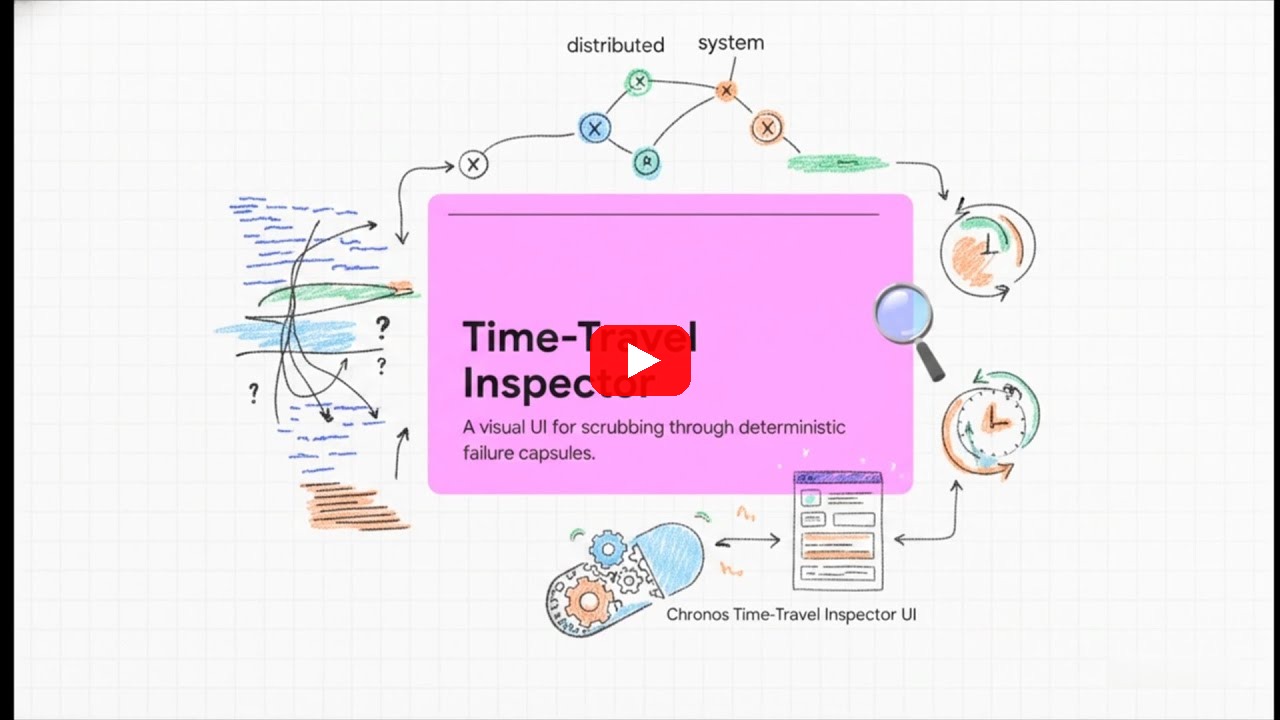
Table of Contents
- Why Chronos?
- The Magic Moment
- Key Features
- Quickstart & Installation
- Architecture & System Flow
- How Deterministic Simulation Testing (DST) Works
- Simulated Environment vs Real Environment
- Packages Overview
- CLI Reference
- Examples & Reference Implementations
- Comparison: Chronos vs Traditional Testing vs Madsim / Turmoil
- Contributing
- License
Why Chronos?
Async bugs, heisenbugs, and network race conditions in Node.js microservices, Raft consensus nodes, CRDTs, and distributed databases are notoriously hard to debug. They manifest once in CI, log an intermittent timeout, and disappear when you try to attach a debugger.
Chronos solves this by replacing real-world entropy with deterministic virtual primitives. It executes your concurrent code on a single controlled thread using:
- Virtual Clock: Fast-forwards time instantly (milliseconds or hours in fractions of a second).
- Seeded PRNG:
xoshiro256**generator for 100% reproducible random choices. - Simulated Network: Configurable latency, packet drops, duplication, network partitions, and node crash/restarts.
- Entropy Safety Guards: Fails fast if non-deterministic methods like
Date.now(),Math.random(), or realsetTimeoutescape into your simulation.
If a failure occurs across 10,000 randomized simulation runs, Chronos outputs a failure capsule containing the exact seed. Running chronos replay <capsule> recreates the exact execution path, bit-for-bit, every single time.
The Magic Moment
import { simTest, expectInvariant } from "@sx4im/chronos-vitest";

// Run 100 seeds across 3 simulated nodes under network drops & partitions
simTest("distributed counter never loses increments", {
  seeds: 100,
  nodes: 3,
  network: { dropProb: 0.05, dupProb: 0.01 },
  chaos: { partitionProb: 0.05, crashProb: 0.02 },
}, async (sim) => {
  // Interact with injected SimEnv on each simulated node
  for (const node of sim.nodes) {
    node.env.net.send(/* ... messages ... */);
  }

  await sim.settle();
  expectInvariant("no lost increments", () => total === expected);
});
When an invariant breaks, Chronos isolates the failure:
✗ seed 8273461 violated "no lost increments" — total=99, expected=100
  → Failure capsule saved: .chronos/failures/8273461.json
  → Replay command: npx chronos replay .chronos/failures/8273461.json
Key Features
- 100% Deterministic Execution: Zero non-determinism.
Same Seed ⇒ Byte-Identical Event Trace. - Simulated Fault-Injecting Network: Simulates latency jitter, packet loss, reordering, duplicate delivery, network split-brains (partitions), and crash/restart node lifecycles.
- Vitest Native Integration: Drop
simTestright into your standard Vitest or Jest test suite. - Time-Travel Inspector: Serve an interactive web UI (
chronos open) to scrub timeline events, inspect message state, step through logs, and generate sequence diagrams. - AI Failure Diagnostics: Integrated
chronos explainprovider menu supporting OpenAI, Anthropic, Gemini, DeepSeek, xAI Grok, Ollama, and local models. - Zero Runtime Dependencies:
@sx4im/chronos-coreis lightweight, ultra-fast, and has zero external dependencies.
Quickstart & Installation
Install the Vitest integration and CLI tool:
# Using pnpm
pnpm add -D @sx4im/chronos-vitest @sx4im/chronos-cli

# Using npm
npm install --save-dev @sx4im/chronos-vitest @sx4im/chronos-cli

# Using yarn
yarn add -D @sx4im/chronos-vitest @sx4im/chronos-cli
Running Your First DST Test
Add a test file system.test.ts:
import { simTest, expectInvariant } from "@sx4im/chronos-vitest";

simTest("cluster reaches consensus under chaos", { seeds: 500, nodes: 5 }, async (sim) => {
  // Access node environments via sim.nodes[i].env
  //   env.now()          -> Deterministic virtual clock time
  //   env.random()       -> Seeded PRNG random number (0..1)
  //   env.sleep(ms)      -> Virtual time sleep
  //   env.setTimeout()   -> Virtual timer handle
  //   env.net.send()     -> Simulated fault-injecting network

  await sim.settle();
  expectInvariant("single leader per term", () => countLeaders(sim) <= 1);
});
Run tests with Vitest:
npx vitest run
If a bug is found, inspect it with the Chronos CLI:
npx chronos replay .chronos/failures/<seed>.json    # Replay reproduction
npx chronos trace  .chronos/failures/<seed>.json    # View execution timeline
npx chronos open   .chronos/failures/<seed>.json    # Open Visual Time-Travel Inspector
Architecture & System Flow
Chronos coordinates virtual time, seeded PRNG, discrete event scheduling, simulated fault-injecting networks, entropy guards, test execution, and visual inspection in a unified ecosystem:
flowchart TB
    subgraph CoreEngine["@sx4im/chronos-core (Zero Runtime Dependencies)"]
        Seed["Integer Seed (e.g. 8273461)"] --> SplitMix["SplitMix64 Initializer"]
        SplitMix --> PRNG["xoshiro256** PRNG"]

        PRNG --> Clock["Virtual Clock (advance on event tick)"]
        PRNG --> Latency["Network Latency / Chaos Jitter"]

        Clock --> MinHeap["MinHeap Priority Event Queue\nOrdered by (time, seq)"]

        MinHeap --> MicrotaskBarrier["Microtask Barrier\n(setImmediate drain per tick)"]

        MicrotaskBarrier --> SimEnv["SimEnv Injected Interface\n• env.now()\n• env.random()\n• env.sleep / setTimeout\n• env.net.send"]

        SimEnv --> StrictGuards["Strict Safety Guards (installGuards)\nThrows on Date.now, Math.random, native timers"]
    end

    subgraph NetLayer["@sx4im/chronos-net (Fault Injection & Network)"]
        SimEnv --> NetFactory["SimNetwork Delivery Engine"]
        NetFactory --> LatencyJitter["Latency Jitter Simulator"]
        NetFactory --> LossEngine["Packet Drop & Duplicate Engine"]
        NetFactory --> Partitions["PartitionManager (Split-Brain Splits)"]
        NetFactory --> Lifecycle["Crash & Restart Lifecycle Manager"]
    end

    subgraph VitestRunner["@sx4im/chronos-vitest (Test Execution & Invariants)"]
        NetLayer --> SimTestRunner["simTest Seed Sweeper (1..N seeds)"]
        SimTestRunner --> SafetyInvariants["expectInvariant Evaluator"]
        SafetyInvariants -->|Invariant Failed| Shrinker["Delta-Debugging Trace Shrinker"]
        Shrinker --> CapsuleWriter["Failure Capsule Storage\n(.chronos/failures/<seed>.json)"]
    end

    subgraph DevTools["Developer Experience & Visual Tooling"]
        CapsuleWriter --> CLI["@sx4im/chronos-cli"]
        CLI --> ReplayCmd["chronos replay (Bit-for-bit reproduction)"]
        CLI --> TraceCmd["chronos trace (ASCII timeline export)"]
        CLI --> InspectorServer["@sx4im/chronos-inspector (chronos open)"]
        CLI --> AIExplainer["chronos explain (Multi-Provider LLM Diagnostics)"]

        InspectorServer --> ReactUI["React + Vite Time-Travel Dashboard\n• Timeline scrubber\n• Sequence diagrams\n• State & event metrics"]
        AIExplainer --> LLMProviders["AI APIs: OpenAI, Anthropic, Gemini,\nDeepSeek, Grok, Ollama"]
    end

    subgraph ProductionDual["Production Runtime Seam"]
        RealEnv["RealEnv (Production Seam)\n• Date.now()\n• Math.random()\n• Real TCP/HTTP transport"]
        SimEnv -. Same API Interface .- RealEnv
    end
How Deterministic Simulation Testing (DST) Works
JavaScript runtimes (V8 / Node.js) are naturally single-threaded and deterministic for synchronous logic. Non-determinism enters through:
- System Clocks:
Date.now(),performance.now(),process.hrtime() - Entropy Sources:
Math.random(),crypto.getRandomValues() - Async Event Scheduling: Non-deterministic OS socket I/O, timer scheduling, and microtask interleaving.
Chronos strips out these sources of non-determinism and wraps your system inside a single-threaded discrete event simulator:
- Seeded PRNG: All randomness derives from a single
xoshiro256**generator seeded bySplitMix64. - MinHeap Priority Queue: Events (timers, network packet deliveries, node crashes) are ordered by
(time, insert_sequence). - Microtask Barrier: Microtasks drain deterministically between discrete scheduler ticks.
Simulated Environment vs Real Environment
Chronos provides a unified Environment contract (SimEnv in tests, RealEnv in production):
| Code Pattern | In Simulated DST (SimEnv) |
In Production (RealEnv) |
|---|---|---|
| Clock | env.now() |
Date.now() |
| Randomness | env.random() |
Math.random() |
| Sleep | await env.sleep(ms) |
await new Promise(r => setTimeout(r, ms)) |
| Timer | env.setTimeout(cb, ms) |
setTimeout(cb, ms) |
| Networking | env.net.send(to, msg) |
Real TCP / HTTP / WebSocket transport |
The strict safety guards (installGuards()) automatically throw an exception if code inside a simulation attempts to call native non-deterministic APIs directly.
Packages Overview
Chronos is organized as a modular TypeScript monorepo:
| Package | Version | Description |
|---|---|---|
@sx4im/chronos-core |
 |
Core DST Engine (PRNG, VirtualClock, MinHeap, Scheduler, SimEnv, RealEnv, strict guards). Zero dependencies. |
@sx4im/chronos-net |
 |
Simulated network layer (latency, drop, duplicate, partition splits, crash/restart lifecycle). |
@sx4im/chronos-vitest |
 |
Vitest & Jest runner integrations (simTest, expectInvariant, replayTest, state shrinker). |
@sx4im/chronos-cli |
 |
Command-line toolkit (replay, trace, sweep, shrink, open, explain, stats, check, export, doctor). |
@sx4im/chronos-inspector |
 |
Web-based time-travel visual debugger (React + Vite + Tailwind UI). |
CLI Reference
The @sx4im/chronos-cli binary provides comprehensive tools for managing simulations and failure capsules:
npx chronos <command> [options]
Main Commands:
chronos doctor: Check system Node.js environment compatibility and DST readiness.chronos check [paths...]: Statically analyze TypeScript/JavaScript source files for non-deterministic leaks.chronos replay <capsule>: Re-execute a failure capsule to verify bit-for-bit reproduction.chronos trace <capsule>: Output an ASCII execution timeline of events, network delivery, and state mutations.chronos sweep <scenario> [seeds]: Run a test scenario across $N$ seeds to discover hidden race conditions.chronos shrink <capsule>: Shrink a complex failure trace into the minimal reproducing steps.chronos open <capsule>: Launch the web-based time-travel inspector preloaded with the capsule data.chronos explain <capsule>: Get AI-powered failure analysis and root-cause explanations (supports Ollama, OpenAI, Anthropic, Gemini, Groq, DeepSeek, and more).chronos stats <capsule>: Print execution statistics, network packet metrics, and event distributions.chronos export <capsule> --format markdown|csv: Export trace timelines to Markdown documents or CSV reports.
Examples & Reference Implementations
Explore ready-to-run examples in the repository:
counter: A distributed counter with intentional race condition bugs. Demonstrates how Chronos catches non-idempotent duplicate messages and writes failure capsules.raft-lite: A complete implementation of the Raft consensus algorithm (Leader Election, Log Replication, Term Validation) tested under intense chaos (drops, duplicates, partitions, node crashes) across 2,000 seeds.
Comparison: Chronos vs Traditional Testing vs Madsim / Turmoil
| Feature / Capability | Traditional Unit / Integration Tests | Jepsen / Chaos Mesh | Madsim / Turmoil (Rust) | Chronos (Node.js & TypeScript) |
|---|---|---|---|---|
| Language | Any | Clojure / Java | Rust | TypeScript / JavaScript |
| 100% Deterministic Replay | No | No | Yes | Yes (Bit-for-Bit) |
| Virtual Clock Fast-Forward | Real time wait | Real time wait | Yes | Yes (Instant) |
| Single-Thread Execution | No | No | Yes | Yes (Single-Thread V8) |
| Vitest / Jest Native | Yes | No | No | Yes |
| Visual Time-Travel Inspector | No | No | No | Yes (chronos open) |
| AI Failure Explainer | No | No | No | Yes (chronos explain) |
Contributing
We welcome contributions from the open-source community!
Please read CONTRIBUTING.md before submitting pull requests.
The Golden Rule of Chronos: Determinism is the product. Any change that causes a given seed to generate a different execution trace is considered a breaking bug.
Review our Code of Conduct for community guidelines.
License
MIT License © Saim Shafique
Reviews (0)
Sign in to leave a review.
Leave a reviewNo results found