Software-Engineer-AI-Agent-Atlas
Health Uyari
- No license — Repository has no license file
- Description — Repository has a description
- Active repo — Last push 0 days ago
- Community trust — 298 GitHub stars
Code Basarisiz
- child_process — Shell command execution capability in .claude/hooks/ask-user-input.js
- exec() — Shell command execution in .claude/hooks/ask-user-input.js
- fs module — File system access in .claude/hooks/ask-user-input.js
- child_process — Shell command execution capability in .claude/hooks/task-complete.js
- exec() — Shell command execution in .claude/hooks/task-complete.js
- fs module — File system access in .claude/hooks/task-complete.js
- exec() — Shell command execution in .claude/skills/algorithmic-art/templates/generator_template.js
Permissions Gecti
- Permissions — No dangerous permissions requested
Bu listing icin henuz AI raporu yok.
ATLAS: a senior-engineer layer for Claude Code. Explore with wireframes & prototypes, clarify the essentials, capture it in living HTML then let Claude Code's native plan/goal/workflow loop build. Fewer tokens, less ceremony, faster to what people pictured. KISS/YAGNI/DRY, context decides. No overengineering. Clean architecture that works.
SWE-ATLAS
The senior-engineer layer for Claude Code. Explore before you build, clarify only what matters, capture it in living HTML — then hand it to Claude Code's native plan / goal / workflow loop. Fewer tokens, less ceremony, faster to the thing people actually pictured.
npx swe-atlas@latest new-project
One command. Full setup. No copy-pasting prompts every session.
Claude Code already builds. ATLAS decides what to build.
Claude Code now plans before it edits, works toward a goal across turns, runs autonomously with safety checks, and orchestrates fleets of subagents — natively, in the box:
| Native capability | What it does |
|---|---|
| Plan mode | Reads the codebase and proposes a plan; touches no files until you approve |
/goal |
Keeps working across turns until a checked completion condition holds |
| Auto mode | Approves its own safe tool calls, blocks destructive ones |
| Dynamic workflows | Writes a script that fans out dozens of subagents and cross-checks their findings |
That is the execution loop, and it keeps getting better. So ATLAS doesn't try to rebuild it.
What Claude Code still won't do for you is decide what's worth building, prove the shape works before you spend tokens generating it, and leave behind a document you can actually trust. That part is on you — and that part is ATLAS.
Auto mode and dynamic workflows are in research preview at the time of writing; plan mode and /goal are generally available.
Why not another spec framework
The popular answer to "make the AI build the right thing" has been Spec-Driven Development (SDD): write exhaustive specifications first, then generate the code from them. A constitution. A spec. A plan. A task breakdown. Five to seven Markdown files and a multi-phase pipeline — most of it produced before a single screen has been seen.
Four things go wrong:
- You plan before you've learned. The requirements, the task breakdown — most of it is a guess made before anyone has seen the thing work. You pay full freight to formalize guesses, build to them task by task, and find out at the end it isn't what anyone pictured. That's premature investment: detailed plans and guardrails poured around an idea nobody has validated yet.
- Text leaves room to disagree. A written spec is open to interpretation — you and the model can read the same paragraph and picture two different screens, and the gap only surfaces once the code exists. Prose is the wrong medium for "do we mean the same thing?"
- Markdown drifts. Keeping
spec.md,plan.md, andtasks.mdconsistent with each other and with the code is its own tax — and plain.mdcan't even render the wireframe, flow, or matrix it's straining to describe. - The loop is already native. Spec → plan → tasks → implement is precisely what plan mode,
/goal, and workflows now do on their own. Wrapping a framework around the model to make it loop reinvents what ships in the box — at a heavy token premium, and slower, because every step waits on ceremony.
ATLAS takes the opposite bet: do the minimum upfront thinking that actually de-risks the build, make it cheap, fast, and visual — so a human and the model can look at the same thing and agree before a line is written — then hand a clean artifact to the native loop.
What ATLAS does instead
1. Explore before you commit
Cheap, throwaway-friendly artifacts that let you see the thing before generating code for it:
/brainstorm:wireframe— a low-fi wireframe as one self-contained HTML file/brainstorm:prototype— a clickable, multi-screen React prototype/design:create-design-md— three real design variants you compare in a browser, then lock asDESIGN.md
You validate the shape for the price of a sketch, not the price of a spec — in minutes, not phases. And a picture is the fastest way for a human and a model to agree on what to build: text invites interpretation, a wireframe pins it down.
2. Clarify only the essentials
/plan:create-phase resolves the load-bearing unknowns through targeted Q&A — and stops there. No constitution, no task ledger. The ambiguity that would actually derail the build gets surfaced and answered; the rest stays out of your way.
3. Document in HTML, not Markdown sprawl
A phase is captured as one self-contained HTML document — wireframe, data flow, clarifications, and decision matrices in a single file that opens in any browser. HTML is a far richer canvas than Markdown: real tables, SVG diagrams, annotated code, even sliders you tweak and copy back into a prompt. And people actually read it — a 100-line Markdown plan goes unopened; a shareable HTML link gets clicked. One robust artifact instead of a drift-prone pile of .md, and plan mode builds straight from it.
The Claude Code team makes this exact case in The Unreasonable Effectiveness of HTML. The honest tradeoff — HTML costs more tokens and time to generate than .md — is one ATLAS takes gladly: spend it on the one document that matters, not on seven that drift.
4. Bring senior judgment to every turn
A persistent engineering identity — principles, roles, and conventions — plus a library of skills and agents that load automatically. The model stops reaching for generic defaults and starts behaving like someone who has shipped before.
Where ATLAS fits
flowchart LR
    subgraph ATL["ATLAS · decide what to build"]
        direction TB
        a1["Explore<br/>wireframe + prototype"]
        a2["Clarify essentials<br/>self-contained HTML phase doc"]
        a1 --> a2
    end
    subgraph CC["Claude Code · build it (native)"]
        direction TB
        b1["Plan mode"]
        b2["goal + auto mode"]
        b3["Dynamic workflows"]
        b1 --> b2 --> b3
    end
    a2 --> b1
    b3 --> v["Verify<br/>ATLAS QA agents + skills"]
    v -.lessons learned.-> a1
ATLAS owns the front of the loop (explore, clarify) and the judgment that runs through all of it; Claude Code owns execution. No overlap, no reinvention.
Getting Started
Quick start
# Scaffold into an existing project
cd your-project
npx swe-atlas@latest new-project

# Or scaffold into a new folder
npx swe-atlas@latest new-project my-workspace
The CLI asks for your name, project type, context templates, and MCP servers, then scaffolds everything.
Manual setup
git clone --recurse-submodules https://github.com/syahiidkamil/Software-Engineer-AI-Agent-Atlas
cd Software-Engineer-AI-Agent-Atlas
Then run /atlas:get-to-know inside Claude Code.
A typical first loop
/atlas:get-to-know                  # Configure ATLAS for your project
/design:create-design-md            # Lock visual identity via HTML variant prototyping
/brainstorm:prototype               # Validate the idea as a clickable prototype
/plan:create-phase "phase-01-mvp"   # Capture the essentials as a self-contained phase.html
# → switch to plan mode and let Claude Code build from it
What's in the Box
ATLAS (Adaptive Technical Learning and Architecture System) operates as seven roles: Software Engineer, Solution Architect, Software Architect, Tech Lead, Business Analyst, Product Owner, and UI/UX Designer.
19 Skills
| Skill | Command | What it does |
|---|---|---|
| Abstraction Power | /abstraction-power |
Pattern recognition — spot repetition, extract reusable abstractions |
| Learning From Mistakes | /learning-from-mistakes |
Record a hard-won lesson after a bug is cracked, so it's never relearned |
| Frontend Design | /frontend-design |
Production-grade web UI with anti-AI-slop methodology |
| shadcn | /shadcn |
shadcn/ui components, presets, registries, and project init |
| Theme Factory | /theme-factory |
10 professional themes for any artifact |
| Canvas Design | /canvas-design |
Visual art and posters as PNG/PDF |
| Algorithmic Art | /algorithmic-art |
Generative art using p5.js |
| Human Writing | /human-writing |
Prose indistinguishable from a skilled human in any language (English + Bahasa Indonesia built in; add via languages/{iso}.md) |
/pdf |
Read, merge, split, watermark, OCR, fill forms | |
| PPTX | /pptx |
Create and edit slide decks |
| DOCX | /docx |
Create and edit Word documents |
| XLSX | /xlsx |
Spreadsheets with formulas, charts, data cleaning |
| PostgreSQL Code Review | /postgresql-code-review |
Review SQL/migrations for correctness and safety |
| PostgreSQL Optimization | /postgresql-optimization |
Diagnose slow queries, suggest indexes and rewrites |
| Supabase Postgres Best Practices | /supabase-postgres-best-practices |
Idiomatic Supabase + Postgres patterns (RLS, auth, storage) |
| MCP Builder | /mcp-builder |
Guide for creating MCP servers |
| Find Skills | /find-skills |
Discover and install skills from the Anthropic library |
| Skill Creator | /skill-creator |
Scaffold a new skill following the canonical format |
| Docs Anthropic | /docs-anthropic |
On-demand index of official Claude Code / Anthropic docs — fetches the right page when you need it |
6 Agents
| Agent | Model | What it does |
|---|---|---|
| code-architect | Opus | Feature architecture with implementation blueprints |
| code-explorer | Opus | Trace execution paths, map architecture layers |
| code-review | Sonnet (×5) | Multi-agent PR review with confidence scoring |
| code-simplifier | Opus | Refine code for clarity while preserving functionality |
| qa-manual-tester | Inherit | Browser-based QA testing via Playwright |
| commit | Sonnet | Git commits following ATLAS convention |
Commands
Commands are namespaced by domain folder under .claude/commands/ — a file at brainstorm/prototype.md becomes /brainstorm:prototype. The domains: atlas: (onboarding), plan: / plandev: (planning & building), design: / brainstorm: (UX & visuals), qa: (testing), start: (run), git: (version control).
| Command | What it does |
|---|---|
/atlas:get-to-know |
Initialize project context — understand the project, configure conventions, set up project rules |
/plan:create-phase "phase-01-mvp" |
Ambiguity-driven, wireframe-first phase — resolve unknowns via Q&A, then produce a self-contained phase.html (low-fi wireframe + clarifications + matrices) to build from in plan mode |
/plandev:feature |
Guided feature development with codebase exploration |
/design:create-design-md |
Lock visual identity — prototype 3 distinct HTML variants for browser comparison, then write .claude/rules/DESIGN.md in Stitch format |
/brainstorm:wireframe |
Quick standalone low-fi wireframe as self-contained HTML (gray boxes, no framework) |
/brainstorm:prototype |
Clickable multi-screen React prototype for idea validation (misc/prototypes/) |
/qa:create-test-cases |
Author human-readable manual test cases (markdown) into docs/living-test-cases/ |
/qa:manual-test-run |
Execute living test cases via the qa-manual-tester agent + Playwright MCP; results land in misc/test-runs/ |
/start:be-fe |
Run backend and frontend in the background |
/git:commit |
Commit what's already staged (commit subagent, runs in background) |
/git:stage-commit |
Stage and commit all working-directory changes (commit subagent) |
/git:log |
Recent commits with a brief summary + continual context |
Integrations
Pre-configured MCP servers in .mcp.json:
- Playwright MCP — browser automation for QA testing and UI verification; rich page snapshots, best when an agent needs to reason over page structure across a session
- PostgreSQL — database access for queries and schema inspection
Token-efficient browser alternative — Playwright CLI. @playwright/cli drives the browser through ~50 purpose-built commands the agent calls directly via Bash (playwright-cli click "#submit"), instead of loading large tool schemas and page data into context. Better for high-throughput QA under token pressure; the MCP stays the better fit for stateful agentic loops. Wire it into Claude Code as a skill:
npm install -g @playwright/cli@latest
playwright-cli install --skills
How It Works
Neuron activation through structure
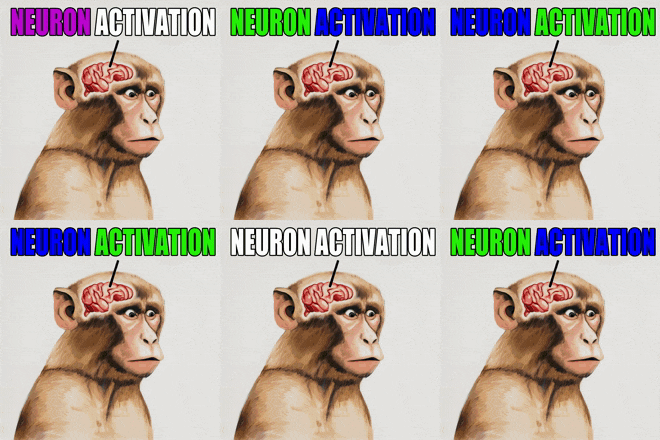
AI coding assistants keep deep engineering capability locked behind generic defaults. Ask "write a function" and you get code. Give the same model structured context, engineering principles, and a persistent identity, and you get architected solutions — proper abstractions, error handling, scalability considered. The difference is neuron activation: the right instructions firing the right capabilities. ATLAS supplies those patterns by default, every session.
Ground truth over guesswork
ATLAS treats its own output as something to verify, not assert. It reads the file before describing the code, runs the thing before calling it done, and looks at the screen before reporting the UI. A confidence hierarchy puts direct observation and your confirmation above inferred behavior and untested assumptions — so "it works" means it was checked, not hoped. It's the discipline a spec can't give you: you can't specify your way out of a wrong assumption, you can only test it.
Vibecoding with guardrails
Roughly a quarter of recent YC startups report 95%-AI-generated codebases. Without engineering discipline, that code turns unmaintainable fast. ATLAS keeps the conversational speed but anchors it to production-grade, industry-appropriate defaults — KISS, YAGNI, and DRY applied in balance, not as an excuse to under-build.
Repository Structure
├── CLAUDE.md                        # ATLAS identity & entry point
├── NOTES.md                         # Regular notes and must-follow rules
├── repos/                           # Your projects (multi-repo mode)
├── .claude/
│   ├── skills/                      # 19 specialized skills
│   ├── agents/                      # 6 task-specific agents
│   ├── commands/                    # Slash commands, namespaced by domain folder
│   │   ├── atlas/  brainstorm/  design/
│   │   ├── plan/   plandev/     qa/
│   │   └── git/    start/
│   ├── hooks/                       # Task completion & input hooks
│   └── rules/                       # Project rules — conventions + DESIGN.md (auto-loaded)
├── docs/
│   ├── external-information/        # Git submodules (Anthropic plugins & skills)
│   ├── phases/                      # Phase docs (self-contained HTML)
│   ├── living-spec-docs/            # Living specs, maintained as the product evolves
│   ├── living-test-cases/           # Manual test cases (markdown)
│   └── learning-from-mistakes/      # Captured engineering lessons
├── misc/
│   ├── self/                        # ATLAS identity & principles (atlas.md, engineering.md)
│   ├── prototypes/                  # Clickable React prototypes
│   ├── test-runs/                   # QA test-run results
│   └── context-templates/           # Convention templates
└── .mcp.json                        # MCP server configuration
npx swe-atlas@latest new-project and start building.
ATLAS — FAANG experience for scale. Startup experience for pragmatism.
Yorumlar (0)
Yorum birakmak icin giris yap.
Yorum birakSonuc bulunamadi