openvisio-oss
Health Uyari
- License — License: MIT
- No description — Repository has no description
- Active repo — Last push 0 days ago
- Low visibility — Only 6 GitHub stars
Code Gecti
- Code scan — Scanned 12 files during light audit, no dangerous patterns found
Permissions Gecti
- Permissions — No dangerous permissions requested
Bu listing icin henuz AI raporu yok.
OpenVisio — cut your AI coding agent's token usage with a code graph


Website: openvisio.io · npm · docs
Stop paying for tokens your coding agent wastes reading files. OpenVisio is
an MCP server that turns any repository into
a deterministic code graph and serves Claude Code, Cursor, Codex, Windsurf,
Cline, and VS Code a ranked, token-budgeted view — so the agent queries
structure (symbols, imports, call edges,path:lineanchors) instead of
crawling and re-reading whole files. Same answers, a fraction of the context.
Local-first, read-only, no LLM in the engine — your code never leaves your machine.
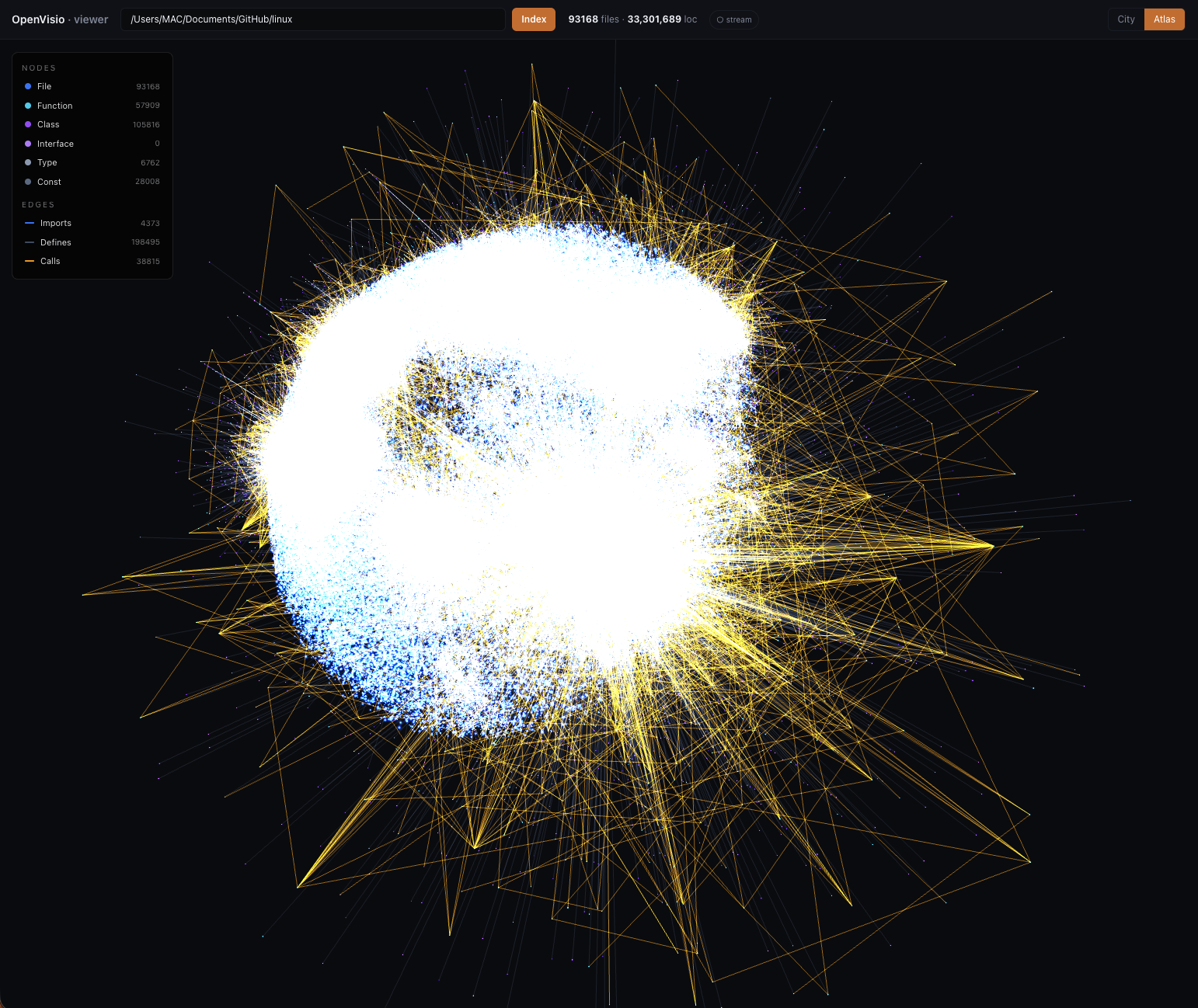
The viewer's Atlas view — every file and symbol as a constellation linked by imports, definitions, and calls (here: a 93K-file repo).
Why OpenVisio? Token savings, measured
AI coding agents explore a codebase the slow, expensive way: grep, open a file,
read it whole, follow its imports, re-read on a miss — and re-process all of it on
every agent-loop turn. On a real repo that's tens of thousands of tokens
burned before the agent writes a single line, and you pay for those tokens on
every request. OpenVisio replaces the crawl with one ranked, path:line-anchored
graph query, so the agent reads only the few lines it actually needs.
| To do this… | A no-graph agent | With OpenVisio | Leaner by |
|---|---|---|---|
| Build a whole-repo mental model | 92.1K tokens | 1.5K tokens | ~62× |
| Explore enough to start a task | ~78K tokens / task | ~2.4K tokens / task | ~30× |
Conservative projection on a sample 65-file repo (
bench/REPORT.frontend.md).
It under-counts the real win: it ignores re-reads, the per-turn tool-definition
tax, and Codex's ~3–5× agent-loop re-processing. Token savings concentrate in
large, structured repos. Measure it on yours:npm run bench.
Fewer tokens per turn means lower API bills, longer effective context windows,
fewer "context full" compactions, and faster responses — without giving up
correctness, because every graph result carries a path:line anchor the agent can
fall back to for a real read.
What it is
One deterministic code graph, two faces:
- For your agent — an MCP server (
openvisio
on npm) that gives Claude Code / Cursor / Codex / Windsurf a ranked, elided,
token-budgeted view of the repo, so they query structure instead of crawling files. - For you — a local viewer that draws the same graph as an Atlas (a
navigable structural map) and a City (a 3D treemap where size and weight
encode complexity), so you can see the shape of an unfamiliar repo at a glance.
OpenVisio parses any repository with tree-sitter into a symbol + import graph and
ranks it with PageRank. The graph is deterministic and LLM-free: same repo
bytes → same graph, same ids, every run. No network, no embeddings, no vector DB.
Quick start (60 seconds)
npm install -g openvisio
cd your-project
openvisio
openvisio writes the project-scoped MCP configs (.mcp.json for Claude Code,
plus .cursor/mcp.json / .vscode/mcp.json when present) and runs a first index.
Open your agent in the folder, approve the openvisio server, and it queries the
code graph instead of reading files blindly.
Full CLI + tool reference: mcp/README.md.
Works with your agent
OpenVisio speaks the Model Context Protocol (the open standard from
Anthropic), so it drops into any MCP-capable coding agent:
| Agent / editor | Maker |
|---|---|
| Claude Code | Anthropic |
| Cursor | Anysphere |
| Codex | OpenAI |
| Windsurf | Codeium |
| GitHub Copilot (Agent Mode / VS Code MCP) | GitHub / Microsoft |
| Cline | open source |
| Continue | Continue.dev |
| Zed | Zed Industries |
| JetBrains IDEs (via MCP) | JetBrains |
| any other MCP client | — |
Trademarks belong to their respective owners. OpenVisio is an independent,
MIT-licensed tool and is not affiliated with or endorsed by these companies — it
simply implements the open Model Context Protocol they support.
Why token cost matters whatever model you run
Whether your agent calls Anthropic Claude (Opus, Sonnet, Haiku), OpenAI
(GPT, Codex), Google Gemini, Meta Llama, Mistral, DeepSeek, or a
local model, you pay — in dollars or latency — for every input token of context.
OpenVisio cuts the biggest, most wasteful slice of that bill: the repeated
file-crawling an agent does just to find where the relevant code lives.
What the agent gets
| tool | what it does |
|---|---|
resolve_context |
task-ranked skeleton + neighborhoods of the most relevant files (call first) |
get_repo_skeleton |
the whole ranked repo map |
find_symbol |
locate a function/class/type → signature + path:line |
get_neighborhood |
local import subgraph around a file/symbol |
get_dependents |
who imports this (impact analysis) |
get_hotspots |
churn × centrality refactor/risk candidates |
Every line carries a path:line anchor, so agents read only the slice they need.
See bench/ for the token-savings methodology and an A/B protocol you can
run on your own repo.
Run the viewer — visualize any codebase
Once openvisio is installed, view indexes a repo and opens the bundled
Atlas and City views in your browser — zero install, served from127.0.0.1:
openvisio view            # index the current repo and open the viewer
openvisio view ../other   # …or any other local repo
The viewer ships in the openvisio-viewer package: the same React/Three.js
Atlas + City codebase visualization, as a self-contained static bundle. It opens
on the Atlas by default; switch to the 3D City with the view toggle
(top-right). Click Index to point it at any local repo — browse the filesystem
in the built-in folder picker (git repos are flagged) or type a path — and a staged
progress loader runs while the deterministic engine indexes. Click any node to focus
it. Nothing leaves your machine.
Watch your agent think. view defaults to the spotlight port (7077), so it
doubles as the live-highlight hub: leave it running, point your agent at the repo
with openvisio mcp . --spotlight, and each tool call focuses the file it's
looking at — in real time.
From a clone, build the workspace first (npm run build builds the engine, the
viewer, and the CLI), then node mcp/dist/cli.js view ..
Share a graph (transport)
view keeps everything on 127.0.0.1. When you want a shareable link — the
same Atlas/City map plus an AI narrator — without uploading your source,transport does the split: it indexes the repo locally (the heavy
tree-sitter scan stays on your machine, private and fast) and ships only the
computed graph JSON to a web server that renders it.
openvisio transport                 # index the current repo, upload the graph, open the link
openvisio transport ../other        # …or any other local repo
openvisio transport --no-open       # just print the URL, don't open a browser
openvisio transport --server=https://your-host   # send to your own deployment
What happens:
- Index locally → build the deterministic graph.
- Write a cached copy to
<repo>/.openvisio/graph.json(auto-added to.gitignore). POSTjust that graph JSON to<server>/api/import.- Open the rendered graph + narrator at
<server>/?g=<id>.
Your source never leaves your machine — only the symbol/import graph is sent. The
destination defaults to https://openvisio.io; override it per-run with--server or globally with the OPENVISIO_SERVER environment variable.
FAQ
How does OpenVisio reduce token usage in Claude Code / Cursor / Codex?
Instead of letting the agent grep and read whole files (and re-read them every
turn), OpenVisio answers exploration queries from a precomputed code graph: a
ranked skeleton, the relevant neighborhoods, and path:line anchors. The agent
pulls a few hundred tokens of structure rather than tens of thousands of raw source —
typically ~30× fewer exploration tokens, and ~62× to prime a whole-repo
model (projected; see bench).
Does my code get uploaded anywhere?
No. The engine is local-first and read-only — indexing and parsing happen on
your machine, and the MCP server never makes a network call. The optionaltransport command sends only the computed graph JSON (symbols + edges, no source)
to a viewer you choose, and even that defaults to off for normal use.
How is this different from embeddings / RAG / vector search over my code?
No embeddings, no vector database, no LLM in the indexer. OpenVisio is a
deterministic static analysis graph (tree-sitter parse + import resolution +
PageRank): same bytes → same graph, every run. It returns exact path:line
anchors, not fuzzy nearest-neighbor chunks — so there's nothing to hallucinate and
nothing to re-embed when the code changes.
Which languages are supported?
40+ via tree-sitter — TypeScript, JavaScript, Python, Go, Rust, Java, C/C++, C#,
Kotlin, Ruby, PHP, Swift, and more (full table below). Every other file still
becomes a graph node, so nothing in the repo is invisible.
Does it work on large monorepos?
Yes — that's where it pays off most. The token savings grow with repo size, and the
viewer has rendered 90K+ file graphs. Small/greenfield repos see smaller wins
(the explored set is already the whole repo).
Is it free and open source?
Yes — MIT licensed. openvisio and openvisio-viewer are on npm.
Languages
OpenVisio parses these into symbols and import/call edges (tree-sitter grammars).
Any other text file is still scanned as a graph node — templates (Twig, Blade),
Markdown, and EDA/hardware files (KiCad, Gerber) get a language label without
parsed symbols, so nothing in the repo is invisible.
| Language | Extensions |
|---|---|
| TypeScript | .ts, .mts, .cts |
| TSX | .tsx |
| JavaScript | .js, .jsx, .mjs, .cjs |
| Python | .py, .pyi |
| Go | .go |
| Rust | .rs |
| Java | .java |
| C | .c, .h |
| C++ | .cpp, .cc, .cxx, .hpp, .hh |
| C# | .cs |
| Kotlin | .kt, .kts |
| Ruby | .rb |
| PHP | .php |
| Swift | .swift (disabled by default) |
| Scala | .scala |
| Dart | .dart |
| Zig | .zig |
| Lua | .lua |
| R | .r, .R |
| Elixir | .ex, .exs |
| Elm | .elm |
| OCaml | .ml, .mli |
| ReScript | .res |
| Solidity | .sol |
| TLA+ | .tla |
| Objective-C | .m, .mm |
| Bash | .sh, .bash |
| Vue | .vue |
| HTML | .html, .htm |
| CSS | .css |
| JSON | .json |
| YAML | .yaml, .yml |
| TOML | .toml |
| Embedded Template | .erb, .ejs |
| SystemRDL | .rdl |
| QL | .ql |
| Emacs Lisp | .el |
Swift's grammar is heavy enough to crash V8's WASM compiler on some machines,
so it's off by default — enable it withOPENVISIO_ENABLE_GRAMMARS=swift.
Repo layout
| Path | What it is |
|---|---|
core/ |
@openvisio/core — the deterministic code-graph engine (tree-sitter parse, import resolution, PageRank, token-budgeted skeletons). |
mcp/ |
openvisio — the published MCP server + CLI. Bundles core into a single self-contained binary. |
viewer/ |
openvisio-viewer — the bundled Atlas + City app that openvisio view serves (React + Three.js, built to a static bundle). |
ui/ |
Full Next.js web app (Atlas + City + AI narrator). |
bench/ |
Token-savings estimator + A/B measurement protocol. |
docs/ |
Engine, graph, and MCP integration notes. |
Develop
Requires Node 20+.
npm install          # installs the core + mcp workspaces
npm run build        # build @openvisio/core, then bundle the openvisio CLI
npm run typecheck
npm run smoke        # end-to-end CLI smoke test
The viewer (ui/) installs independently — see Run the viewer.
Contributions welcome — see CONTRIBUTING.md.
Keywords
MCP server · Model Context Protocol · Anthropic Claude · Claude Code · Cursor
(Anysphere) · OpenAI Codex · GPT · Google Gemini · GitHub Copilot · Microsoft
VS Code · Windsurf · Codeium · Cline · Continue · Zed · JetBrains · Meta Llama ·
Mistral · DeepSeek · reduce token usage · save LLM tokens · lower API cost ·
token-efficient context · context engineering · code graph · code knowledge graph ·
codebase visualization · 3D code map · dependency graph · call graph · import graph ·
tree-sitter · static analysis · AI coding agent · AI pair programmer · local-first ·
read-only · privacy-first code tooling.
License
MIT © OpenVisio contributors
Yorumlar (0)
Yorum birakmak icin giris yap.
Yorum birakSonuc bulunamadi