codeinspectus
Health Uyari
- License — License: MIT
- Description — Repository has a description
- Active repo — Last push 0 days ago
- Low visibility — Only 8 GitHub stars
Code Basarisiz
- eval() — Dynamic code execution via eval() in .github/workflows/ci.yml
- fs module — File system access in .github/workflows/ci.yml
- fs module — File system access in .github/workflows/pin-engines.yml
- eval() — Dynamic code execution via eval() in detection-db/opengrep-rules/security-baseline/injection.yaml
- new Function() — Dynamic code execution via Function constructor in detection-db/opengrep-rules/security-baseline/injection.yaml
- execSync — Synchronous shell command execution in detection-db/opengrep-rules/security-baseline/injection.yaml
- exec() — Shell command execution in detection-db/opengrep-rules/security-baseline/injection.yaml
- network request — Outbound network request in detection-db/opengrep-rules/security-baseline/ssrf.yaml
Permissions Gecti
- Permissions — No dangerous permissions requested
Bu listing icin henuz AI raporu yok.
Local-first MCP security scanner for AI-generated web apps.
CodeInspectus, by Synvoya




A local-first, privacy-preserving security MCP server. Any AI coding agent
(Claude Code, Cursor, Codex, Windsurf, Cline, Aider) can invoke CodeInspectus to
scan AI-generated / "vibe-coded" code for real vulnerabilities, map findings to
compliance frameworks as honest code-level coverage, and drive a scan → fix →
rescan loop — fully on your machine, with no account and zero network
egress at scan time.
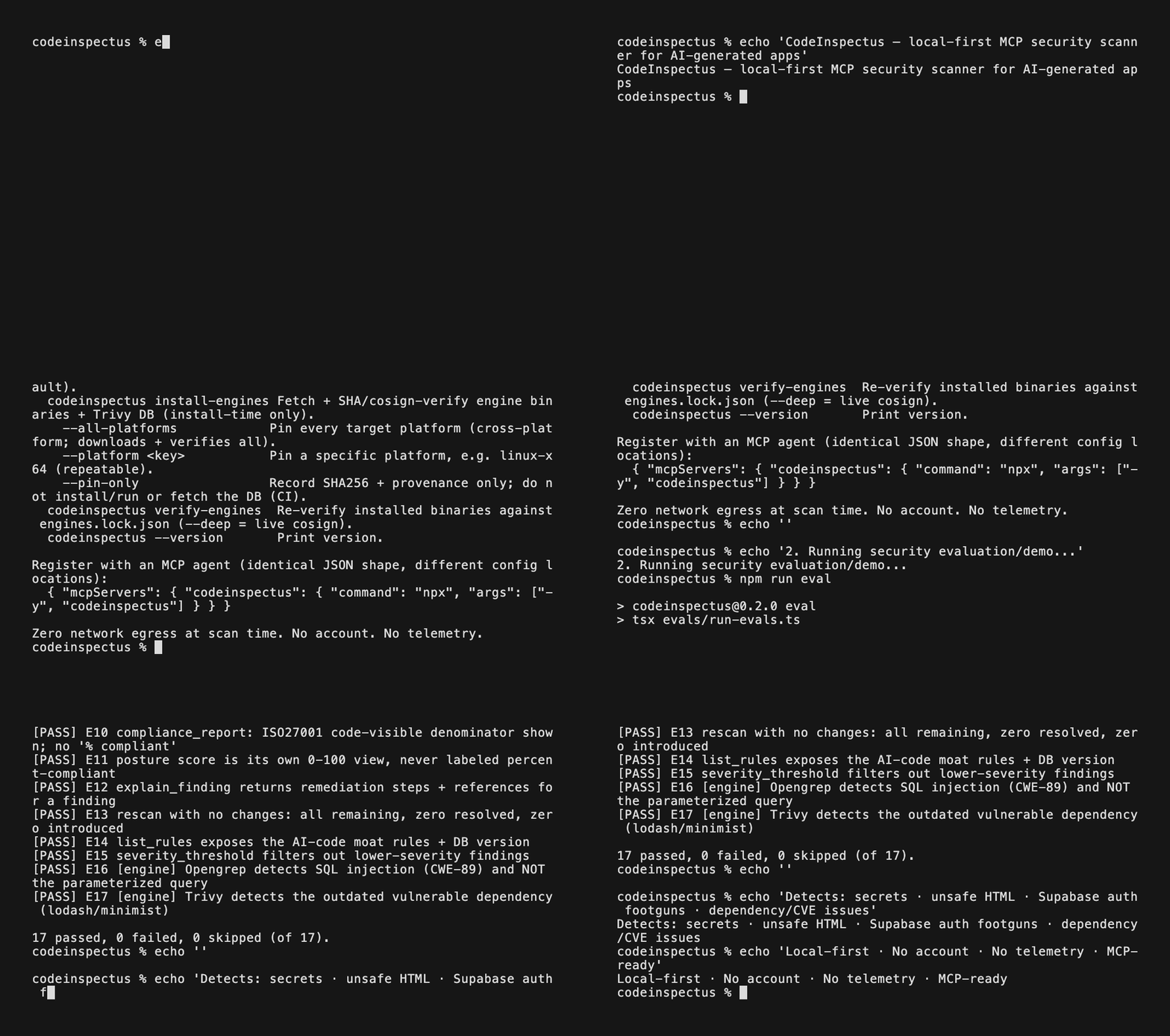
CodeInspectus orchestrates three best-in-class OSS engines behind one normalized,
CWE-keyed schema, and adds its own AI-code-specific checks that generic
scanners miss:
- Opengrep — SAST / OWASP Top 10 (SARIF)
- Gitleaks — secrets
- Trivy — dependency CVEs (SCA), IaC misconfig, secrets, license, SBOM
- CodeInspectus AI checks — client-side secret/bundle exposure, Supabase
RLS / inverted-auth (the CVE-2025-48757 class), prompt-injection sinks,
client-writableuser_metadataauthorization, and unsanitized model/user output
rendered viadangerouslySetInnerHTML(XSS / LLM05)
CodeInspectus bundles the official, SHA-pinned engine binaries and calls
them as local subprocesses. It does not fork them.
Why CodeInspectus?
AI-generated apps often ship with security mistakes that generic scanners miss: exposed
client-side secrets, weak Supabase auth patterns, unsafe HTML rendering, prompt-injection
sinks, and insecure agent/tool integrations.
CodeInspectus combines proven local scanners with AI-app-specific rules, then exposes the
workflow through an MCP server so coding agents can scan, explain, and help fix issues
before shipping.
Install
Prerequisites: Node.js ≥18, and cosign
on your PATH for install-engines. Signature verification is fail-closed: Opengrep
and Trivy will not pin without cosign — install-engines exits non-zero for them —
so install it first (brew install cosign). Gitleaks verifies by checksum and needs no
cosign.
# Register once per machine with your agent (see "Client registration"), then:
npx codeinspectus install-engines
install-engines is the only step that touches the network. It downloads the
engine binaries from their verified GitHub release URLs, checks the publisher
signature/checksum, computes each binary's SHA256, and records it inengines.lock.json. It also fetches the offline Trivy vulnerability-DB snapshot
into ~/.codeinspectus/. After this, scans perform zero network I/O.
Re-verify your pinned binaries any time:
npx codeinspectus verify-engines
An MCP server is installed once per machine and shared across all your
projects — it is not a per-repo npm install dependency.
Client registration
Same JSON shape everywhere; only the location differs.
{
  "mcpServers": {
    "codeinspectus": { "command": "npx", "args": ["-y", "codeinspectus"] }
  }
}
| Client | How |
|---|---|
| Claude Code | claude mcp add-json codeinspectus '{"command":"npx","args":["-y","codeinspectus"]}' |
| Cursor | add to ~/.cursor/mcp.json (or project .cursor/mcp.json) |
| VS Code | code --add-mcp '{"name":"codeinspectus","command":"npx","args":["-y","codeinspectus"]}' |
| Codex / Windsurf / Cline / Aider | add the same block to that client's MCP config |
Optional: drop in the ready-made agent-rules/ so your agent
auto-runs the scan → fix → rescan loop.
Tools
| Tool | Purpose |
|---|---|
codeinspectus_scan |
Full local scan of a path (engines + AI checks). Returns CWE-keyed findings, remediations, framework tags. |
codeinspectus_rescan |
Re-scan after fixes; diffs vs a prior scan → resolved / remaining / introduced. |
codeinspectus_compliance_report |
Per-framework code-level control coverage (not certification). |
codeinspectus_explain_finding |
Deep explanation + full remediation for one finding. |
codeinspectus_generate_sbom |
CycloneDX/SPDX SBOM (written to the managed dir by default, or a path you choose). |
codeinspectus_list_rules |
Active detectors, engine versions, detection-DB + Trivy-DB freshness. |
CodeInspectus never edits or deletes your source code or repository — it reads and
reports; your agent applies the fixes. It stores engine data and scan history under~/.codeinspectus; the only file it writes is an optional SBOM — to a managed directory
by default, or a path you choose (see codeinspectus_generate_sbom).
Each scan also reports a read-only git-safety state: if there's no git repo or
uncommitted changes, it recommends creating a checkpoint before fixes — your agent
runs git only with your approval; the tool never does.
Honest claims (please read)
- "No egress" is precise: zero egress at scan time. Engine binaries and the
initial Trivy DB are fetched at install time from verified sources, with
SHA256 verification. The scanner functions with the network unplugged. There is
no telemetry, ever. - Supply-chain pinning is mandatory. Trivy was supply-chain-compromised twice
in early 2026; every engine binary is SHA-pinned inengines.lock.jsonand its
hash is verified before execution. CodeInspectus refuses to run an unpinned or
mismatched binary. - Secret values are redacted in all output — type + location + a redacted
preview only. - Compliance = code-level control coverage, never certification. CodeInspectus
reports "X of N code-visible controls have findings", with the code-visible
subset as the explicit denominator, plus a standing disclaimer. It never emits
"you are X% compliant" or "you pass [framework]". The severity-weighted posture
score is a separate view and is not a percent-compliant figure. Essential
Eight especially: only ~1 of 8 mitigations (Patch Applications) is
code-evidenced — this is not an Essential Eight assessment. - Prompt-injection detection is heuristic and immature — those findings are
worded "potential …" and marked medium confidence. - Client-side authorization that trusts
user_metadatais flagged (ci-ai-client-metadata-authz).
CodeInspectus detects an authorization decision that reads client-writable Supabaseuser_metadata— e.g.if (user.user_metadata.role === 'admin')— at high severity,
medium confidence (CWE-639).user_metadatais editable by the signed-in user themselves
(Supabase's/auth/v1/userendpoint), so anyone can self-assignrole: 'admin'; gate
privileged logic on the server-controlledapp_metadata.roleinstead. Detection is intrafile
(inline + split-variable/destructured); it does not yet trace cross-file or whole-object-alias
flows (planned) — see the good-first-issue.
It also catches the related footgun: a Supabaseservice_rolekey value in client-reachable
code (critical), and aservice_rolekey behind a client-exposed env prefix such asNEXT_PUBLIC_…(high). - Unsanitized model or user output rendered as raw HTML is flagged (
ci-ai-llm-output-dangerous-html).
CodeInspectus detects untrusted request input or LLM/model output flowing intodangerouslySetInnerHTMLwithout sanitization — a direct XSS sink (CWE-79/116; OWASP LLM05 on
the model-output path), high severity, medium confidence; wrapping the value inDOMPurify.sanitize(...)silences it. It does not yet trace untrusted values arriving via
component props, database rows, or template data (planned).
Language support
Plainly, what runs on what. The commodity engines are broad; the CodeInspectus
AI-code checks (the moat) are JavaScript/TypeScript-focused today — more languages
are planned. So on a Python/Go/Rust/etc. repo you still get full secrets, dependency,
IaC and SBOM coverage (and Python SAST), but the AI-code-specific checks won't fire.
This is stated so you don't infer coverage that isn't there.
| Layer | What it covers | Language / ecosystem scope |
|---|---|---|
| Secrets — Gitleaks + CodeInspectus client-secret checks | hard-coded credentials, leaked keys | Any language. Detection is value/pattern-based, not language-parsed. |
| Dependencies (CVEs/SCA), IaC misconfig, SBOM, license — Trivy | vulnerable deps, infra misconfig, bill of materials | Many language & package ecosystems and IaC formats — see Trivy's docs. |
SAST — Opengrep + CodeInspectus security-baseline |
injection, XSS, SSRF, weak crypto, insecure deserialization | JavaScript, TypeScript, Python. CodeInspectus ships its own MIT ruleset and runs Opengrep with no network registry packs, so SAST coverage is exactly these languages — deliberately narrower than Opengrep's full engine. |
AI-code checks (the moat) — client-side secret/bundle exposure, Supabase RLS, prompt-injection sinks, client-writable user_metadata authz, unsanitized-output XSS |
the AI-code / vibe-coding failure modes the engines miss | JavaScript / TypeScript only (incl. .jsx/.tsx/.mjs/.cjs; the client-secret checks also read JS-framework files .vue/.svelte/.astro/.html). Supabase RLS analyzes .sql (plus .ts/.js Edge Functions). More languages are planned. |
Compliance frameworks (code-visible subset)
NIST CSF 2.0 · ISO/IEC 27001:2022 · SOC 2 · CIS Controls v8.1 · Essential Eight
(Patch Applications only) · OWASP Top 10 (2021) · OWASP LLM Top 10 (2025).
MITRE ATT&CK techniques are shown as related-adversary context only, never as a
coverage score.
Compliance mappings are AI-drafted, reviewed by a cybersecurity practitioner
(Synvoya) — code-level coverage only, not an audit or certification. Community review
welcome. The CWE→control mappings are self-audited with per-mapping confidence and an
open community-verification process — seedocs/COMPLIANCE-RATIONALE.mdandCONTRIBUTING.md. Essential Eight is not a coverage view: only
Patch Applications is code-evidenced (~1 of 8) — this is not an Essential Eight assessment.
How it works
agent → codeinspectus_scan → [Opengrep | Gitleaks | Trivy] + AI checks
      → SARIF normalize → dedup (incl. Trivy⨯Gitleaks secret overlap)
      → CWE-keyed findings → compliance map → compact JSON + summary
ALL LOCAL. NO NETWORK EGRESS AT SCAN TIME.
Example reports
Trademark
"CodeInspectus" is the name of this free, open-source project (npm codeinspectus,codeinspectus.com). "Code Inspect" is a descriptive phrase in a crowded namespace;
registry availability is not trademark clearance, and the name is not claimed as a
trademark.
Development
npm install
npm run build      # tsc --noEmit && tsup  (must compile clean)
npm run eval       # ≥10 evals against fixtures/vulnerable-app
npm run inspector  # npx @modelcontextprotocol/inspector node dist/index.js
How this repository is generated (an auditable, allow-list seed) and built end-to-end:docs/BUILD.md.
Contributing
CodeInspectus is a solo, free, open-source project, built and maintained by
one cybersecurity practitioner under the Synvoya name. There is no company
behind it and nothing to sell — which is exactly why outside eyes matter.
Independent review is genuinely wanted, not a courtesy line. If you work in
security, your scrutiny is the contribution.
Two areas where review helps most:
- Compliance CWE→control mappings. These are AI-drafted, then policy-reviewed
by the maintainer — they are NOT independently verified. Every mapping is
tracked through three explicit states: AI-drafted → maintainer-policy-reviewed →
community-verified. Today almost everything sits in the first two; the
community-verified count is 0 of 96, and that is reported honestly rather than hidden.
Moving a mapping to community-verified takes evidence (a quote from the control's
primary source + your basis) — the bar and process are inCONTRIBUTING.md; the per-mapping rationale and confidence live
indocs/COMPLIANCE-RATIONALE.md. - Detection rules (
detection-db/**,src/ai-checks/**). New rules, precision
fixes, and false-positive reports are all welcome. The merge bar is precision:
a fixture proving the true positive, and a near-miss fixture proving the rule does
not over-fire. Details inCONTRIBUTING.md.
What CodeInspectus claims — and what it deliberately does not — is written down so
you can check it before trusting a number: the standing compliance disclaimer (in the
Compliance frameworks section above and indocs/COMPLIANCE-RATIONALE.md) and the three-state
honesty metric. If something reads as over-claiming, that is a bug — please open an issue.
Workflow: fork → branch → PR; the maintainer reviews and merges (external
contributors don't push directly). — Synvoya (the maintainer, a cybersecurity
practitioner)
Good first contributions
- Add a fixture for the unsafe raw inner-HTML sink (
ci-ai-llm-output-dangerous-html) from component props. - Improve detection for Supabase
user_metadata.roleauthorization checks. - Add detection for exposed
NEXT_PUBLIC_OPENAI_API_KEYand similar client-side AI keys. - Add a rule for user-controlled URLs passed into server-side
fetch(). - Add a rule for model output passed into
eval,Function, shell commands, or unsafe tool calls. - Add a check for missing auth guards in Next.js
/api/admin/*routes. - Verify one CWE to OWASP Top 10 mapping.
- Verify one CWE to SOC 2 / ISO 27001 mapping.
- Add a vulnerable fixture and expected finding snapshot for an existing rule.
Changelog
Per-version release notes live in CHANGELOG.md. Current: v0.3.0.
Licenses
CodeInspectus: MIT. Bundled engines: Opengrep (LGPL-2.1), Gitleaks (MIT, CLI
only), Trivy (Apache-2.0) — all permissive for bundling the compiled binaries.
Yorumlar (0)
Yorum birakmak icin giris yap.
Yorum birakSonuc bulunamadi