agentrium
Health Gecti
- License — License: MIT
- Description — Repository has a description
- Active repo — Last push 0 days ago
- Community trust — 39 GitHub stars
Code Gecti
- Code scan — Scanned 12 files during light audit, no dangerous patterns found
Permissions Gecti
- Permissions — No dangerous permissions requested
Bu listing icin henuz AI raporu yok.
A Modern Multi-Instance Terminal Manager for Claude Code

Agentrium
Run Claude Code, Codex, Cursor, and Gemini side by side in one native desktop app.
Agents • Features • Installation • Usage • Shortcuts • Build • License



Overview
Agentrium (Agent Desktop Environment) is a cross-platform desktop app for developers who work with multiple coding-agent CLIs. Pick which agent each terminal launches, mix them freely in tabs or a grid, save per-profile setups, and get a native window with proper tabs, split view, session restore, git worktree lifecycle, and hunk review on top.
The app is Tauri-native (small binary, no Electron bloat) and ships to Windows and macOS.
Supported Agents
Each terminal you spawn can target any of the four agents below. Switch between them with a picker in the New Terminal dialog; the icon on each tab and grid cell tells you which agent is running.
| Agent | Binary | Install | Docs |
|---|---|---|---|
| Claude Code | claude |
npm install -g @anthropic-ai/claude-code |
docs.claude.com/claude-code |
| Codex | codex |
npm install -g @openai/codex |
github.com/openai/codex |
| Cursor | agent |
curl https://cursor.com/install -fsS | bash (or irm 'https://cursor.com/install?win32=true' | iex on Windows) |
cursor.com/cli |
| Gemini | gemini |
npm install -g @google/gemini-cli |
github.com/google-gemini/gemini-cli |
Only Claude Code is required to get started. The other three are opt-in and auto-detected once installed - Settings > Updates shows what's on your PATH.
Screenshots
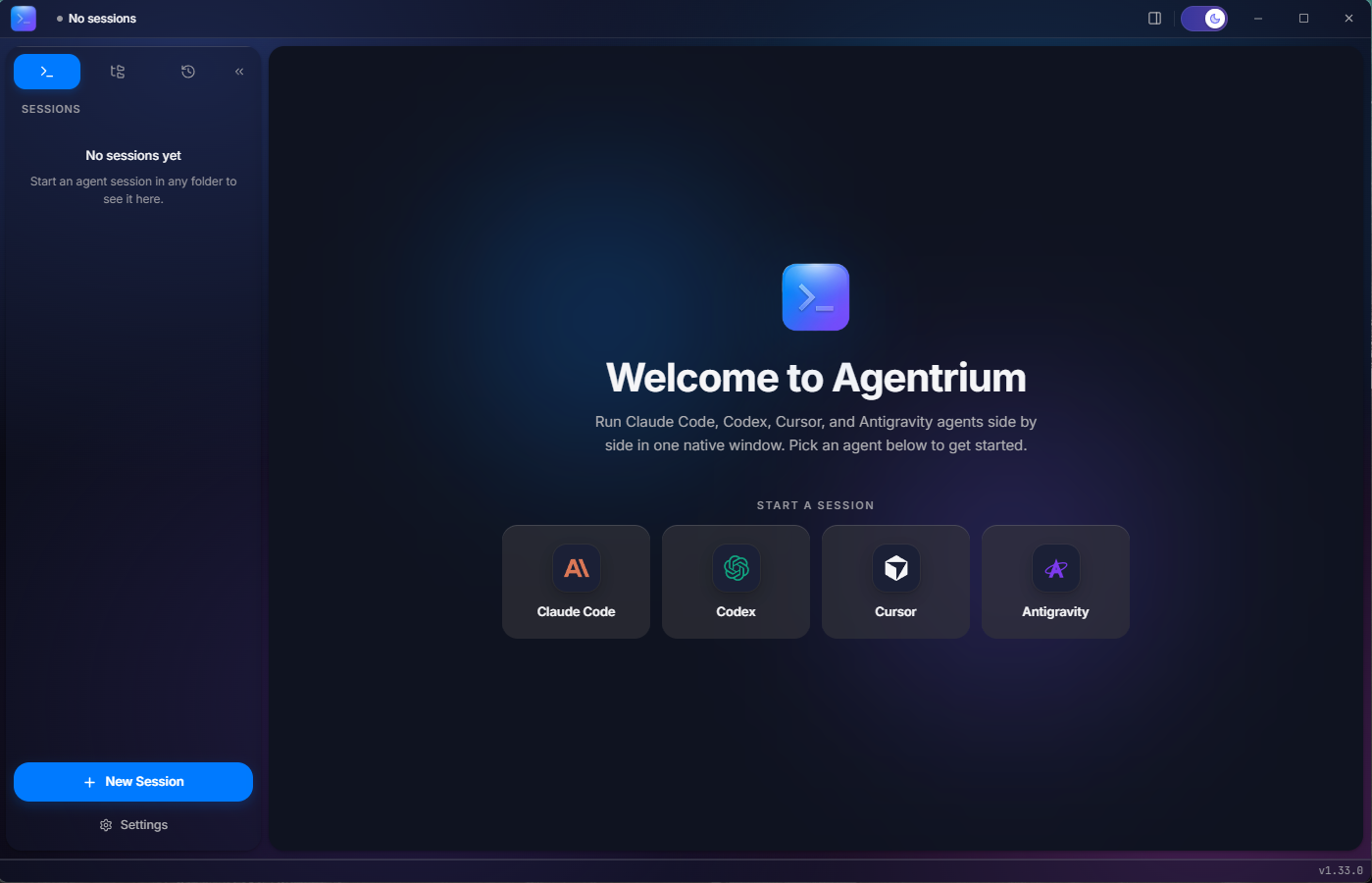
Main view - an active agent session with branch indicator, brand icon on the tab, and status bar
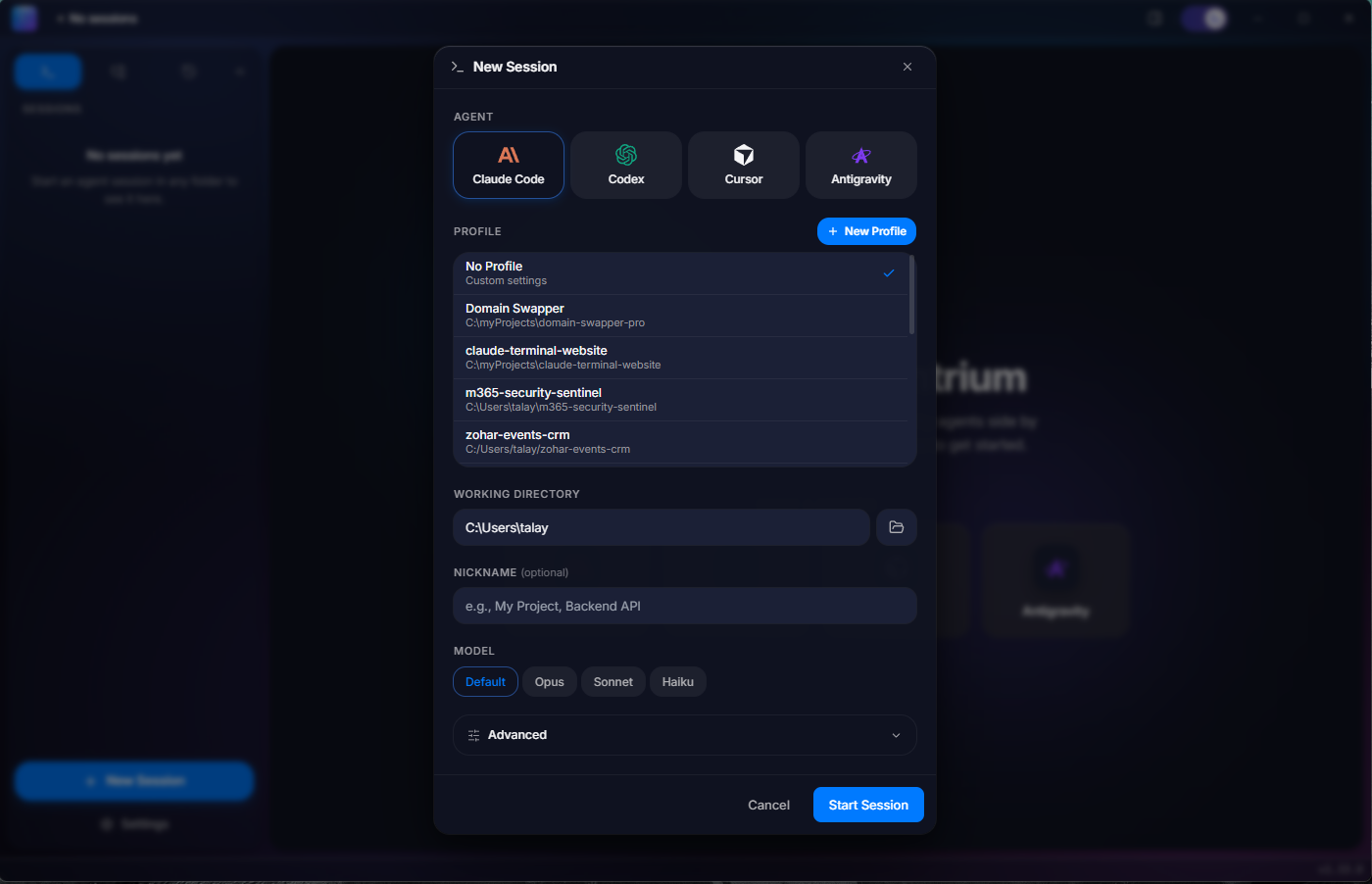
New Terminal dialog - pick the agent, then optionally a profile, working directory, and per-agent arguments
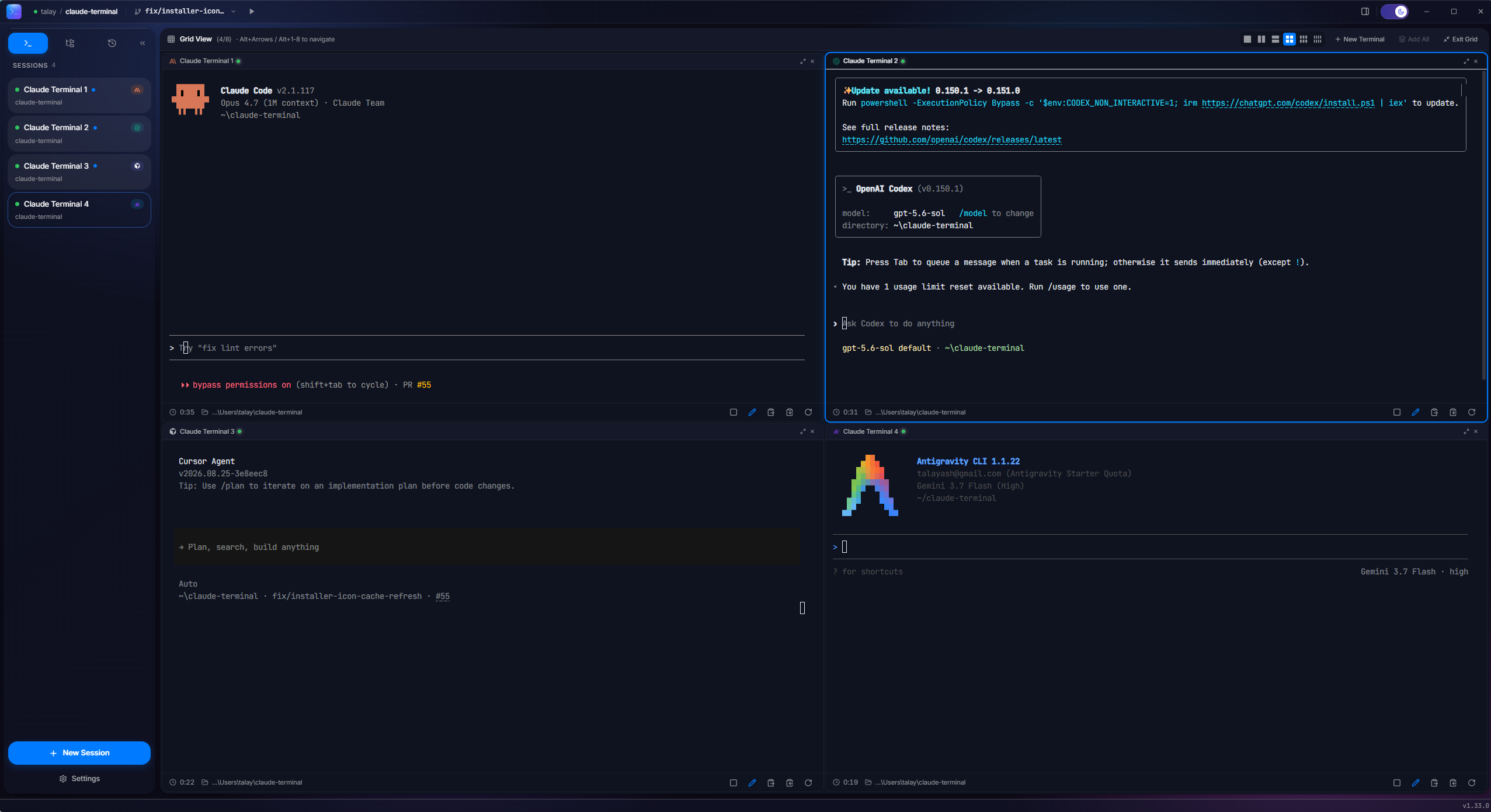
Grid view - up to 8 sessions at once with selectable layouts; the header icon on each cell shows which agent is running
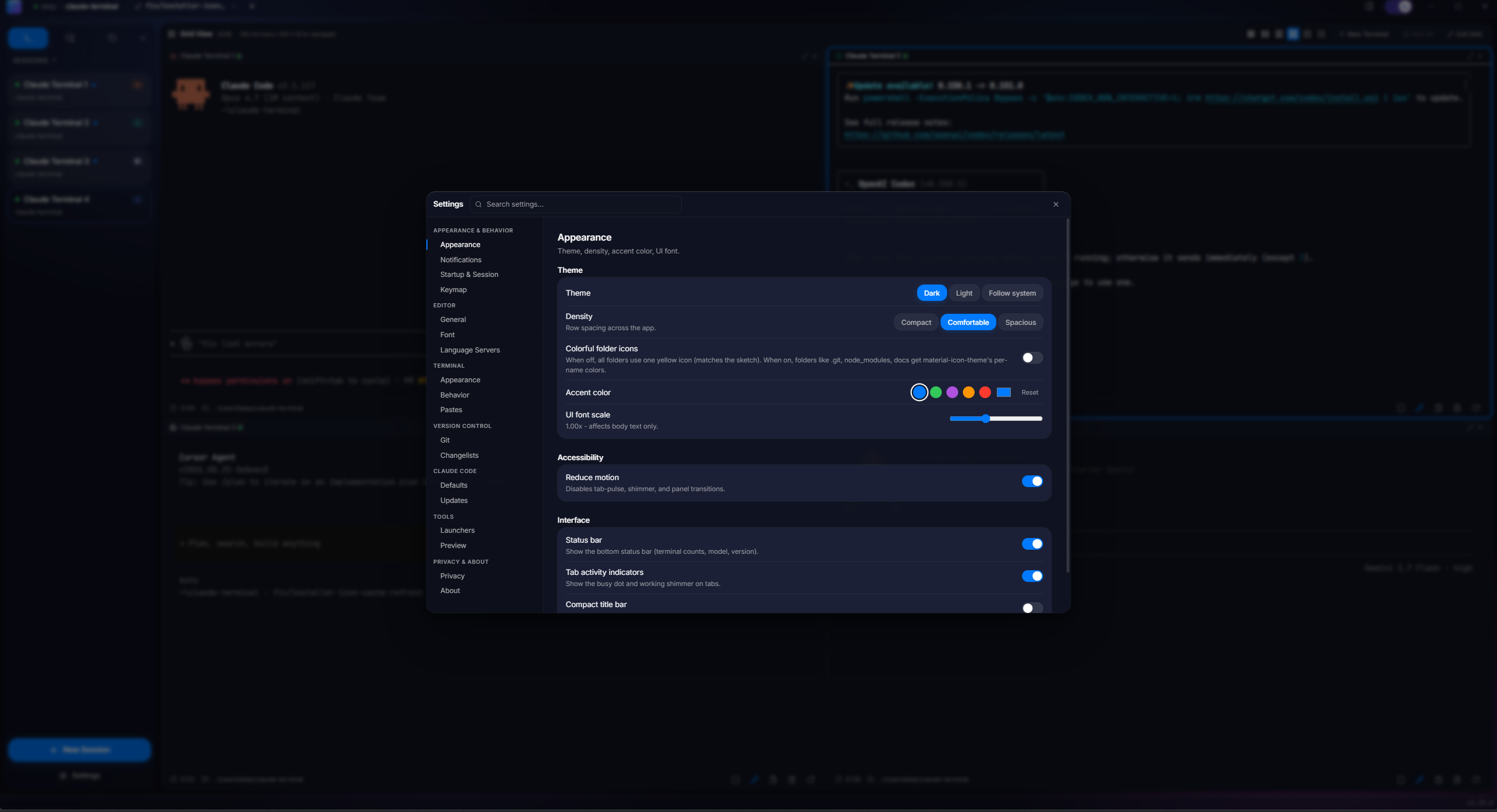
Settings - app version, per-agent CLI detection with docs links, and Claude Code auto-update
Features
Multi-agent architecture
- Pick per terminal between Claude Code, Codex, Cursor, and Gemini
- Brand icon on every tab and every grid cell so you always know what's running
- Per-agent default arguments in Settings; per-profile args stored in SQLite
- Claude-only flags (
--dangerously-skip-permissions,--model,--effort,--continue,--resume,--worktree) are stripped automatically when spawning other agents so profiles are portable - Per-agent version detection in Settings > About and Settings > Updates
- Agents are auto-detected via
<binary> --versionfirst, then a PATH probe fallback so CLIs without a semver flag still register as installed
Multi-terminal management
- Tabbed strip with drag-to-reorder, pin, and multi-select tear-off
- Brand icon prefix on every tab title
- Custom nicknames per terminal
- Session state persistence across restarts
- Overflow chevron with a hidden-tabs dropdown for busy workspaces
Smart grid view
- Up to 8 terminals in one window with mixable agents per cell
- Layout picker with schematic icons that match the actual grid shape (1x1, 1x2, 2x1, 2x2, 1x3, 3x1, 2x3, 3x2, 2x4, 4x2)
- Layout preserves your manual pick until it's actually full - adding a 3rd terminal to a 2x2 grid stays 2x2, not 1x3
- Click to focus, arrow keys to navigate,
Ctrl+Gto toggle - Cell headers auto-clean stale terminal references after a restart
Configuration profiles
- Save named profiles with a working directory, per-agent arguments, and env vars
- Profiles are agent-agnostic in the picker - the same profile appears whether Claude Code, Codex, Cursor, or Gemini is selected
- SQLite storage, transparent migration for existing profiles
Git worktree lifecycle
- Create, list, and switch worktrees from the New Terminal dialog
- Close a terminal that was on a worktree and choose merge (fast-forward), squash-merge, or discard from a dialog
- Branch chip in the tab strip shows current + upstream status
Hunk review
- IntelliJ-style verified review cockpit for staging individual hunks
- Diff view with hunk-level accept/reject
- Changelists for grouping related diffs
Session restore
- App-restart re-attaches Claude Code conversations by session id (
--resume <id>or--continue) - Workspace save/load for storing a named layout of terminals
- Ephemeral tab state survives a
/clear
Modern UI/UX
- Flat IntelliJ IDEA 2026.1 "New UI"-style design (dark and light themes, user-set accent color)
- WCAG AA text contrast, reduce-motion support that follows the OS setting
- Compact / comfortable / spacious density
- UI font scale
- Custom frameless window with a transparent titlebar
Auto-updates
- Automatic app update checks on startup with a background download
- Manual Recheck for each agent CLI in Settings > Updates
Command hints, snippets, prompt editor
- Built-in Claude Code command reference (Codex/Cursor/Gemini hint packs planned)
- Snippet manager with import/export
- Full prompt editor drawer for composing large multi-line prompts
Installation
Prerequisites
Before installing Agentrium, ensure you have:
- Node.js (v22 LTS or higher) - Download
- At least one of the following agents installed (see Supported Agents above for install commands):
- Claude Code (recommended - detected by the setup wizard)
- Codex
- Cursor
- Gemini
Download
Download the latest release for your platform from the Releases page:
| Platform | Installer | Description |
|---|---|---|
| Windows | Agentrium_1.32.0_x64-setup.exe | NSIS Installer (Recommended) |
| Windows | Agentrium_1.32.0_x64_en-US.msi | MSI Installer |
| macOS (Apple Silicon) | Agentrium_1.32.0_aarch64.dmg |
DMG for M1/M2/M3/M4 Macs |
| macOS (Intel) | Agentrium_1.32.0_x64.dmg |
DMG for Intel Macs |
Existing 1.31.x installs auto-update to 1.32.0 via the in-app updater. The bundle identifier is unchanged, so profiles, workspaces, and session history carry over. Pre-rebrand 1.31.x download artifacts are still available on the release history if you need an older build.
macOS builds are currently not code-signed/notarized - first launch will require right-click > Open or approval in System Settings > Privacy & Security.
First Launch
- Run the installer and follow the setup wizard
- Launch Agentrium from the Start Menu or Desktop
- The setup wizard detects Node.js and Claude Code; if either is missing it guides you through the install
- Click "New Terminal", pick your agent from the four brand buttons, and launch your first session
Usage
Creating a terminal
- Click New Terminal in the sidebar, or press
Ctrl+Shift+N - Pick the agent from the four brand buttons (Claude Code / Codex / Cursor / Gemini)
- Optionally pick a profile from the grid
- Optionally set a nickname for easy identification
- Choose the working directory for the session
- Add per-agent arguments in the textarea (placeholder text hints at typical flags per agent)
- Click Start Terminal
Managing terminals
- Switch: click a tab or a sidebar row
- Rename: double-click the terminal name or use the context menu
- Duplicate: right-click > Duplicate, or
Ctrl+Shift+D- the duplicate keeps the same agent - Restart: bottom status bar > Restart - the restarted terminal keeps the same agent
- Close: click X on the tab or use the context menu
- Search: use the sidebar search bar to filter terminals
Configuration profiles
- Click Manage Profiles in the sidebar footer (or click + Add Profile in the New Terminal dialog)
- Create a new profile with:
- Name and description
- Working directory
- Agent-flavored arguments (e.g.,
--model opusfor Claude,--dangerously-bypass-approvals-and-sandboxfor Codex) - Environment variables
- Save and use the profile for new terminals - it appears under every agent
Hints panel
Press F1 or click the lightbulb icon to open the Hints panel:
- Categorized Claude Code commands
- Click any hint to copy it to clipboard
- Search bar for filtering
- Codex/Cursor/Gemini hint packs are planned
Keyboard Shortcuts
| Shortcut | Action |
|---|---|
Ctrl+Shift+N |
New Terminal |
Ctrl+Shift+D |
Duplicate current terminal (keeps agent) |
Ctrl+W |
Close current terminal |
Ctrl+B |
Toggle sidebar |
F1 |
Toggle Hints panel |
Ctrl+, |
Open Settings |
Ctrl+P |
Search Everywhere |
Ctrl+Tab |
Next terminal |
Ctrl+Shift+Tab |
Previous terminal |
Ctrl+G |
Toggle Grid view |
Ctrl+Shift+G |
Add current terminal to grid |
Ctrl+C |
Copy selected text / send interrupt |
Ctrl+V |
Paste from clipboard |
Arrow keys |
Navigate grid (in grid mode) |
Building from Source
Prerequisites
- Node.js v22+
- Rust (latest stable)
- Visual Studio Build Tools (Windows)
Steps
Clone the repository
git clone https://github.com/talayash/agentrium.git
cd claude-terminal
Install dependencies
npm installRun in development mode
npm run tauri devBuild for production
npm run tauri buildInstallers land in:
src-tauri/target/release/bundle/nsis/(NSIS installer, Windows)src-tauri/target/release/bundle/msi/(MSI installer, Windows)src-tauri/target/release/bundle/dmg/(DMG, macOS)src-tauri/target/release/bundle/macos/(.app, macOS)
Tech Stack
| Layer | Technology |
|---|---|
| Framework | Tauri 2.x |
| Backend | Rust (edition 2021) |
| Frontend | React 18 + TypeScript |
| Styling | Tailwind CSS + Framer Motion |
| Terminal | xterm.js (@xterm/xterm + fit / search / web-links / webgl addons) |
| State | Zustand (persisted via zustand/middleware/persist) |
| Database | SQLite via rusqlite (bundled) |
| PTY | portable-pty |
| Notifications | notify-rust |
| Icons | Lucide React + inline brand SVGs (simple-icons for Anthropic / Cursor / Gemini, official OpenAI mark for Codex) |
| Build | Vite |
Project Structure
claude-terminal/
├── src/                              # React frontend
│   ├── components/                   # UI (TitleBar, TerminalTabs, TerminalGrid, ...)
│   │   ├── AgentPicker.tsx           # Four-button agent picker
│   │   ├── BrandIcon.tsx             # Shared per-agent brand SVGs
│   │   └── settings/                 # Settings modal + category pages
│   ├── lib/
│   │   └── agents.ts                 # AgentKind, AGENT_SPECS catalog, filterArgsForAgent
│   ├── store/                        # Zustand stores
│   └── hooks/                        # Custom hooks
├── src-tauri/                        # Tauri backend
│   ├── src/
│   │   ├── main.rs                   # App setup, plugin registration, IPC dispatch
│   │   ├── agents.rs                 # AgentSpec catalog (mirror of TS)
│   │   ├── config.rs                 # ConfigProfile + AgentKind enum
│   │   ├── terminal.rs               # PTY lifecycle, per-agent spawn routing
│   │   ├── commands.rs               # All Tauri #[command] handlers
│   │   └── database.rs               # SQLite (profiles, workspaces, session_history)
│   └── icons/                        # App icons
└── package.json
Troubleshooting
Security warnings on first launch
The installers are signed with code-signing certificates, but new releases may
still trigger OS-level warnings until trust reputation accumulates. The app is
not actually damaged or unsafe - these are platform-level checks against
unrecognized binaries.
Windows - "Windows protected your PC" (SmartScreen)
Windows SmartScreen blocks executables downloaded from the internet until they
build up reputation, even when correctly signed.
- When the blue SmartScreen dialog appears, click More info.
- Click Run anyway.
If you also see a yellow "Unknown publisher" UAC prompt, the installer was
likely downloaded from an older release before code signing was enabled - grab
the latest installer from the
Releases page.
macOS - "Agentrium is damaged and can't be opened"
This message is misleading: the app is intact, but the macOS .dmg is not yet
notarized through Apple's notary service, so Gatekeeper rejects it after the
browser tags the download with a quarantine attribute. Remove the attribute
from Terminal:
# Before opening the DMG
xattr -d com.apple.quarantine ~/Downloads/Agentrium_*.dmg

# Or, if you've already dragged the app to /Applications
xattr -cr /Applications/Agentrium.app
Then open the app normally. The right-click > Open workaround does not
work for the "damaged" variant of the error - only xattr does.
Proper Apple notarization is tracked in
#25; once it lands,
these steps will no longer be required on macOS.
An agent CLI shows "Not installed"
- Verify the binary is on PATH:
which claude/where claude(or the binary name for the agent you're checking). - Restart Agentrium so the app inherits the updated PATH.
- Click Recheck on that agent's row in Settings > Updates.
If the binary is on PATH but Agentrium still can't detect a version, the agent probably doesn't expose one via --version. Agentrium falls back to a PATH probe in that case and marks the agent as installed anyway.
Claude Code not detected during setup
- Ensure Node.js is installed:
node --version - Install Claude Code globally:
npm install -g @anthropic-ai/claude-code - Restart Agentrium
Terminal not responding
- Check that the agent CLI is authenticated (each agent has its own login flow)
- Try closing and reopening the terminal
- Check the agent's own logs for errors
Build errors
- Ensure Rust is installed:
rustc --version - Update Rust:
rustup update - Clean and rebuild:
cargo clean && npm run tauri build
Contributing
Contributions are welcome. Please open a Pull Request.
- Fork the repository
- Create your feature branch (
git checkout -b feature/amazing-feature) - Commit your changes (
git commit -m 'Add amazing feature') - Push to the branch (
git push origin feature/amazing-feature) - Open a Pull Request
License
This project is licensed under the MIT License - see the LICENSE file for details.
Acknowledgments
- Anthropic for Claude Code
- OpenAI for Codex
- Cursor for the Cursor CLI
- Google for the Gemini CLI
- Tauri for the framework
- xterm.js for terminal emulation
- simple-icons for the brand marks
Made for developers who juggle multiple coding agents.
Yorumlar (0)
Yorum birakmak icin giris yap.
Yorum birakSonuc bulunamadi