aidemo
Health Uyari
- License — License: MIT
- Description — Repository has a description
- Active repo — Last push 0 days ago
- Low visibility — Only 7 GitHub stars
Code Gecti
- Code scan — Scanned 12 files during light audit, no dangerous patterns found
Permissions Gecti
- Permissions — No dangerous permissions requested
Bu listing icin henuz AI raporu yok.
Your coding agent makes the demo video — a narrated, captioned MP4 from one storyboard.json. Deterministic replay re-renders it in CI (no key, ~$0). Open-source (MIT) alternative to Screen Studio / Clueso / Demosmith.
aidemo — your coding agent makes the demo video
aidemo.top · watch a real 51s output ▶ · authoring guide · render in CI
Tell your coding agent "record a 45s demo of the checkout flow" — get back a
polished MP4 with voiceover, synced captions, and auto-zoom. Any MCP-capable
agent (Claude Code, Codex CLI, Gemini CLI) writes one storyboard.json; the
headless engine drives a real Chrome, records a deterministic replay, voices
it, captions it, and trims the dead time. Because the replay is deterministic,
the demo re-renders itself in CI when the product changes — no re-recording,
no API key, about $0 a render. An open-source (MIT) alternative to Screen
Studio, Clueso, or Demosmith for when you'd rather your coding agent make the
demo.








Install: Claude Code /plugin marketplace add tandryukha/aidemo · CI uses: tandryukha/aidemo@stable · CLI npx -y @tandryukha/aidemo · Homebrew brew install tandryukha/aidemo/aidemo
Published on the GitHub Marketplace, npm, a Homebrew tap, and the MCP Registry.
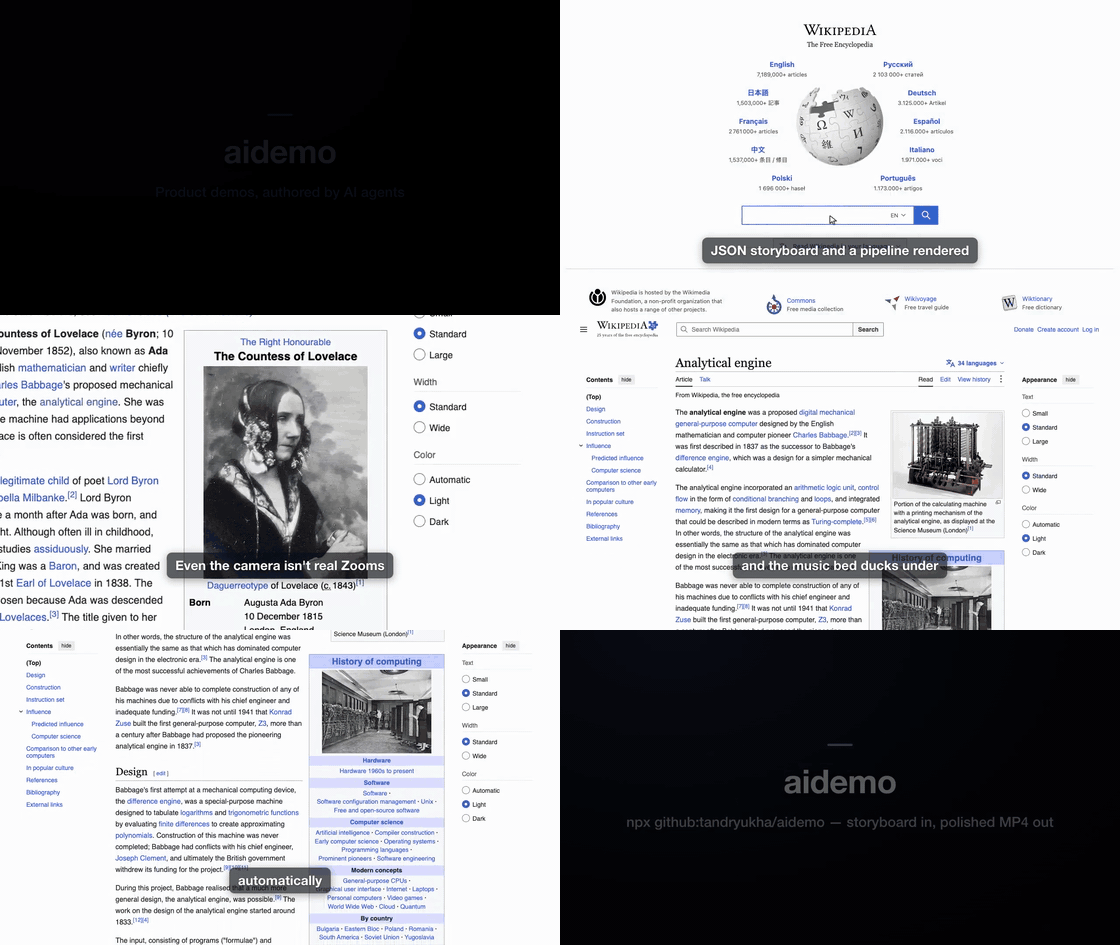
Real output — a ~51 s self-narrated tour of Wikipedia (portal search →
Ada Lovelace → focus-zoom → click through to the Analytical Engine → glide
scroll), authored by Claude from one storyboard.json and recorded as a
deterministic replay. The preview GIF is silent;
watch the full version with narration ▶.
Three ways to use it
- From your coding agent — the fastest path. In Claude Code:
/plugin marketplace add tandryukha/aidemothen/plugin install record-demo@aidemo(bundles the skill and the MCP
server). In Codex / Gemini / any MCP agent:npx -y github:tandryukha/aidemo#stable repo-init. Then just say
"record a 45s demo of <flow>" and the agent authors + renders it. - Locally, free & offline —
AIDEMO_TTS_PROVIDER=local aidemo render <dir> --headless. An in-process
voice model + script-timed captions mean no API key, ~$0, fully offline.
See docs/LOCAL_MODELS.md. - In CI, self-maintaining — drop
uses: tandryukha/aidemo@stableinto a
workflow. When the product changes, it replays the committed storyboard and
commits fresh media — no key, no LLM tokens, ~$0 on free runner minutes.
See docs/CI.md.
Free & open source. MIT-licensed. Runs on GitHub's free Actions tier, or
fully local at $0 with the in-process voice — no API key, no cloud upload, no
telemetry. Works against localhost and auth-walled apps (your own Chrome).
From one sentence to a narrated MP4
You type a sentence, the agent writes an artifact you can read and edit, the
engine records and cuts it:
1 · What you type — one line to any MCP-capable agent (Claude Code here):
claude "record a 45s demo touring Wikipedia: search for Ada Lovelace,
open the Analytical Engine, then glide down the article"
2 · What the agent authors — a plain, editable storyboard.json (excerpt:
narration + a fixed browser action-spec, side by side — no generated code):
{
  "title": "A quick tour of Wikipedia",
  "zoom": {},                                  // Screen-Studio-style auto-zoom
  "scenes": [
    { "id": "search",
      "narration": "Start at the Wikipedia portal and search for Ada Lovelace.",
      "actions": [
        { "op": "goto", "url": "https://www.wikipedia.org/" },
        { "op": "type", "target": { "selector": "#searchInput" }, "text": "Ada Lovelace" },
        { "op": "click", "target": { "selector": "button[type=submit]" } } ] },
    { "id": "engine",
      "narration": "Her notes on Babbage's Analytical Engine hold the first computer program.",
      "actions": [
        { "op": "focus", "target": { "selector": "#firstHeading" } },
        { "op": "click", "target": { "selector": "a[href*='Analytical_Engine']" } },
        { "op": "scrollBy", "dy": 900, "easing": "glide" } ] }
  ]
}
3 · How it's recorded + cut — aidemo render drives a real Chrome (smooth
animated cursor, human-cadence typing, auto-zoom), then trims the dead time and
syncs to the narration:
storyboard.json
   → voice     OpenAI / ElevenLabs / local TTS → audio/narration.mp3 + voice.json
   → record    drives Chrome, animated cursor  → recordings/raw.{webm,mp4} + timeline.json
   → captions  Whisper word timestamps         → generated/captions.{srt,vtt,cues.json}
   → compose   trim idle · sync · auto-zoom · cards · caption · mux → output/final-demo.mp4
4 · What you get — output/final-demo.mp4, plus a README-ready GIF
(aidemo gif) and named stills (aidemo stills) from the same take. UI changed?
Re-run against the same storyboard — no re-recording by hand.
The design goal: demos that look human-made and snappy, not like an AI
clicking around and waiting between screenshots — by separating authoring
(slow, one-time — figure out the flow) from recording (a fast deterministic
replay with a smooth animated cursor).
What teams render with it
- GitHub README demos —
aidemo gif demos/onboarding, drop the autoplaying
GIF into the readme (the GIFs on this page are exactly that). - Landing-page hero videos — the muted-autoplay MP4 on
aidemo.top is a rendered demo, poster frame and all. - Release / what-shipped demos — narrate the new feature, then
gh release upload v1.4.0 demos/whats-new/output/final-demo.mp4. - Customer & prospect demos — personalized flows against your real app:
localhost, auth walls, your own logged-in Chrome; nothing leaves the machine.
Render in CI (self-maintaining demos)
Commit a storyboard and the aidemo GitHub Action keeps its
demo media in sync — a fresh narrated, captioned MP4 (and GIF) on every relevant
change. Deterministic replay + a local voice mean no API key, no LLM tokens,
about $0 (just free runner minutes). It's the loop a screen recorder can't
run: your demo maintains itself.
# .github/workflows/demo.yml
- uses: actions/checkout@v4
- run: sudo apt-get update && sudo apt-get install -y ffmpeg   # ubuntu ships Chrome, not ffmpeg
- uses: tandryukha/aidemo@stable
  with:
    demos: demos/*
    tts: local        # in-process voice → no keys, no tokens
    gif: "true"
Full recipe, templates (auto-commit / PR-comment / cron-refresh), and the
always-fresh-embeds trick: docs/CI.md,
docs/EMBEDS.md, docs/recipes/.
Quick start (self-contained smoke test)
A bundled fixture store (search → results → cart → checkout) that renders a
finished demo with zero external dependencies:
npm install                                # Node 20+, system Chrome, ffmpeg on PATH
node examples/local-demo/serve.mjs         # terminal 1: fixture on :8787
node bin/aidemo.mjs render examples/local-demo --headless   # terminal 2
open examples/local-demo/output/final-demo.mp4   # xdg-open on Linux, start on Windows
Voice/captions need OPENAI_API_KEY in .env — or AIDEMO_TTS_PROVIDER=local
(no key, offline), or OPENAI_BASE_URL at a local server. See
docs/LOCAL_MODELS.md. No Playwright browser download is
needed — the engine uses your system Chrome (channel: "chrome").
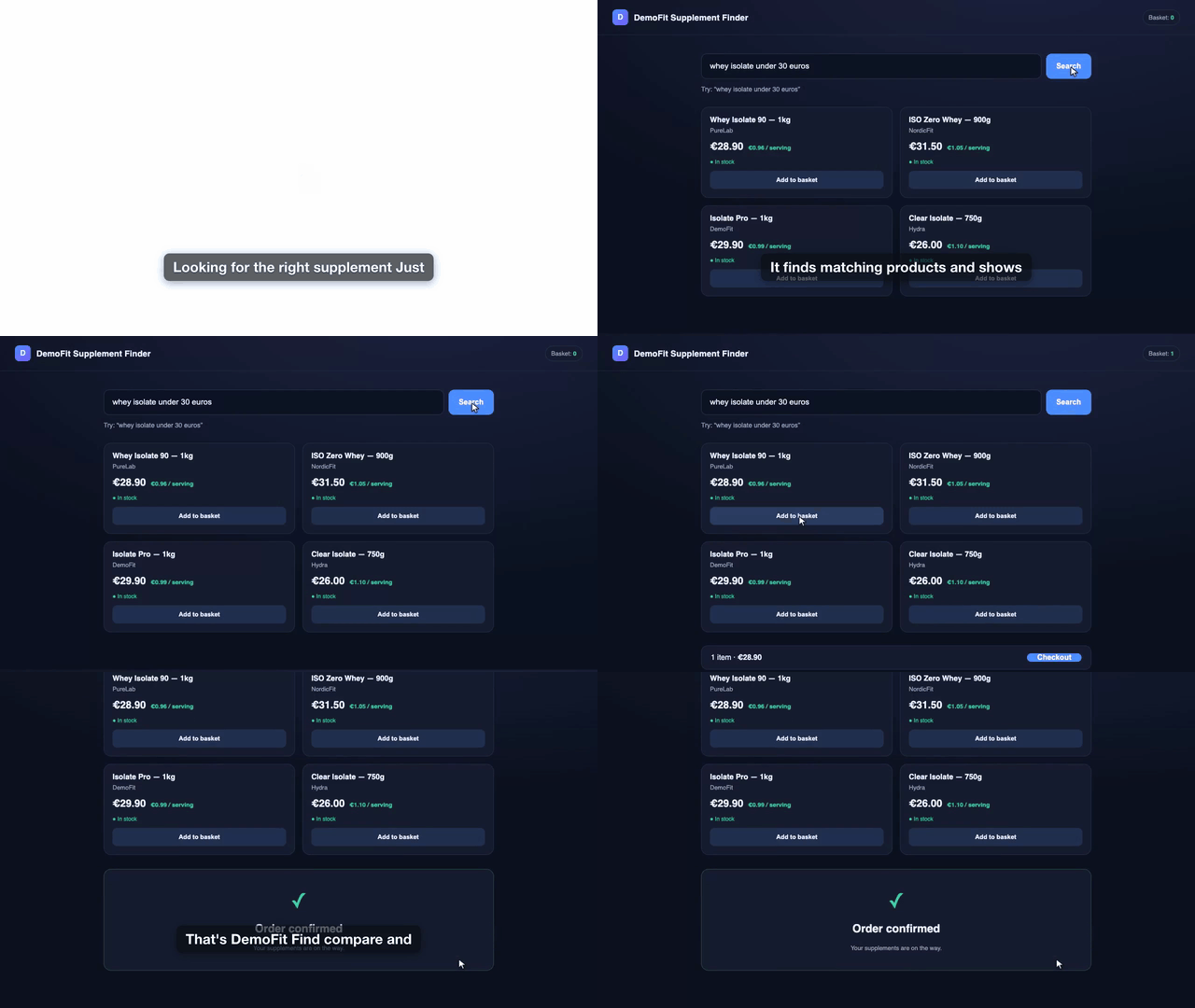
The bundled fixture rendered end-to-end — narrated, captioned, auto-trimmed.
Silent preview; full version ▶.
CLI
Each step is independently runnable and re-runnable — regenerate voice without
re-recording, recompose without re-transcribing, etc.
aidemo init <name>            # scaffold demos/<name>/ with a starter storyboard
aidemo voice   <dir>          # per-scene TTS → narration.mp3 + voice.json
aidemo record  <dir>          # drive Chrome → raw video + timeline.json
aidemo probe   <dir>          # record-only dry run (verify selectors), no key needed
aidemo captions <dir>         # Whisper → captions.{srt,vtt,cues.json} (--offline for no network)
aidemo compose <dir>          # trim + sync + zoom + cards + caption + mux → final-demo.mp4
aidemo gif     <dir>          # final-demo.mp4 → README-ready GIF (autoplays on GitHub)
aidemo render  <dir>          # voice → record → captions → compose
aidemo guide                  # print the canonical authoring guide
aidemo doctor                 # check Node, ffmpeg, Chrome, voice endpoint
Add --headless for CI/fixtures; omit it for real sites that need your
logged-in session. --profile <dir> picks the Chrome user-data dir;--capture native|obs switches to high-fidelity screen capture. voice/render
skip TTS for unchanged scenes, and record salvages a failed take (keeps
the footage + drops a screenshot/frame-dump in logs/).
Agent interface (MCP)
aidemo mcp runs a stdio MCP server (no network listener) exposing the engine
to any MCP client. The Claude Code plugin bundles it; aidemo repo-init registers
it agent-neutrally (.mcp.json for Claude Code, .gemini/settings.json for
Gemini; codex mcp add aidemo -- npx -y github:tandryukha/aidemo#stable mcp for
Codex).
- Authoring tools —
get_authoring_guideserves
docs/AUTHORING.md version-matched from the engine (can't go
stale);get_storyboard_schema,validate_storyboard,init_demo,doctor. - Pipeline tools run as jobs —
probe/record/render/voice/captions/compose/gifreturn ajobIdimmediately;job_statusreports stage,
per-scene progress, and (on failure) the screenshot/frame-dump paths.
Why it's built this way
- Deterministic replay, not an LLM in the loop. The recording runs a fixed
action-spec at full speed, so the video is smooth. The agent only authors the
storyboard (and confirms selectors once), never during capture. - Declarative action-spec + fixed player (not generated
spec.ts). Safer,
editable, and it emits a timeline for free — compose fits each scene's video
to its narration by trimming/speeding only the idle parts, freeze-holding a
static page for any remainder instead of ugly slow-motion. - Captions via overlaid PNGs, not libass. Many ffmpeg builds lack
subtitles/drawtext; aidemo rasterizes each caption with headless Chrome and
overlays it with time-gatedenable— works on any ffmpeg withoverlay. - Cinematic polish is compose-time, not record-time — a bad zoom is a
recompose, never a re-record. See docs/POLISH.md.
Deeper docs
- docs/AUTHORING.md — the canonical storyboard schema,
action vocabulary, and demo-director principles (served by the engine). - docs/LOCAL_MODELS.md — no-key rendering: in-process
Kokoro voice, local speech servers (speaches), ElevenLabs, offline captions. - docs/POLISH.md — auto-zoom, scroll easing, music ducking,
intro/outro cards, motion blur, cursor control, native/OBS high-fidelity capture. - docs/CHATGPT_APPS.md — recording ChatGPT Apps SDK
widgets (dedicated profile, nested iframes,waitForWidget). - docs/CI.md · docs/EMBEDS.md · docs/recipes/ — CI rendering, always-fresh embeds, agent-in-CI recipes.
Setup
Prereqs: Node 20+, Google Chrome, ffmpeg + ffprobe on PATH.
Developed and tested on macOS; Linux works for the default (Playwright) capture
and --capture obs. Run aidemo doctor to check your setup.
npm install
cp .env.example .env      # add OPENAI_API_KEY, or use AIDEMO_TTS_PROVIDER=local (no key)
Project layout (per demo)
demos/<name>/          ← your working area (untracked; scaffold with `aidemo init`)
  input/      brief.md
  generated/  storyboard.json  timeline.json  captions.{srt,vtt,cues.json}
  recordings/ raw.webm (or raw.mp4 for native/OBS capture)
  audio/      scene-*.mp3  narration.mp3  voice.json
  output/     final-demo.mp4
  logs/       <command>.log  fail-<scene>-<n>.{png,json} (on a failed action)
Security & trust
- No telemetry, no analytics, no install-time scripts (
package.jsonhas nopostinstall/preinstall). - Network is user-initiated only:
api.openai.com(onlyvoice/captions,
your key — or a local server viaOPENAI_BASE_URL),api.elevenlabs.io(opt-in),huggingface.co(download-only, once, forAIDEMO_TTS_PROVIDER=local), andgithub.com(your owngh, foraidemo feedback). Recording/composing are
fully local. The MCP server is stdio-only — no listener. - Small, auditable surface: ~20 source files, 7 runtime deps, MIT. Pin an
immutable ref if you're wary of the moving#stabletag:npx -y github:tandryukha/aidemo#v0.8.0. - Full detail: docs/LOCAL_MODELS.md
· report vulnerabilities privately per SECURITY.md.
Roadmap
- Comments on the video (pause & comment) and in-place transcript editing:
captions map to scenes, so editing a line marks that scene dirty andaidemo voice --scene <id>+composeregenerates only the delta. - Web UI, project history, brand kits, changelog integrations.
- Hosted public MCP (see docs/plans/public-mcp.md).
Shipped: the GitHub Action (CI re-render), cinematic polish (auto-zoom,
scroll easing, music ducking, intro/outro cards, motion blur, post-hoc cursor
control), native/OBS capture, the agent-neutral MCP server + authoring guide,
ElevenLabs and in-process local voice providers, and the Claude Code plugin.
Contributing
Issues and PRs welcome — see CONTRIBUTING.md for dev setup, the
smoke test, and the DCO sign-off requirement. Recording-session feedback has a fast
path: aidemo feedback demos/<name> pre-fills a structured issue.
License
MIT © Andrii Taran
Yorumlar (0)
Yorum birakmak icin giris yap.
Yorum birakSonuc bulunamadi