workflow-first
Health Uyari
- License — License: MIT
- Description — Repository has a description
- Active repo — Last push 0 days ago
- Low visibility — Only 5 GitHub stars
Code Gecti
- Code scan — Scanned 7 files during light audit, no dangerous patterns found
Permissions Gecti
- Permissions — No dangerous permissions requested
Bu listing icin henuz AI raporu yok.
Agent skill that interviews you about an AI project, writes a WORKFLOW.md design doc from your answers, and checks it with a plain-Python script. Start with plain code; move right only when measured.
workflow-first
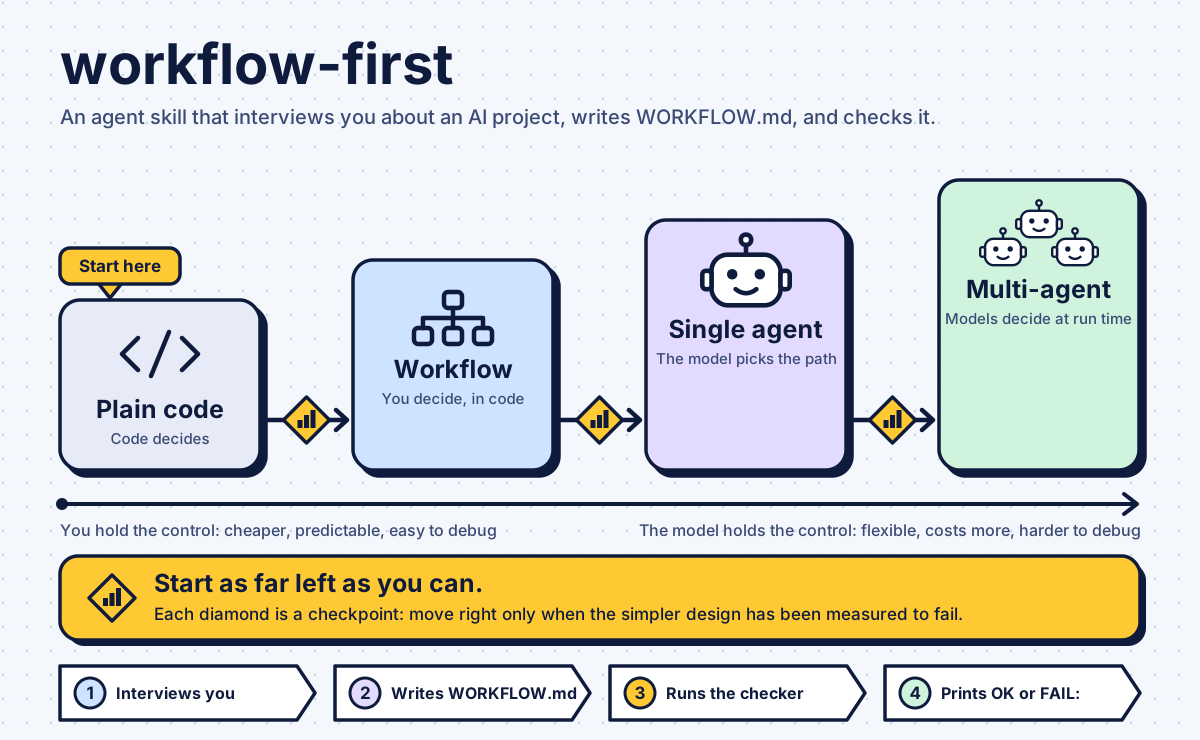
workflow-first is an agent skill that helps you decide how to build an AI-powered project before you build it. It interviews you, writes a WORKFLOW.md design document from your own answers, and a plain-Python script checks that document.
The skill is built around one rule: start as far left as you can, and move right only when the simpler design has been measured to fail.
plain code -> workflow -> single agent -> multi-agent
Status
Status: pre-release (v0.x). Evals in progress. Tested on a small number of runs with GLM 5.3 Flash.
- The checker was tested: a known-good document prints
OK, and a deliberately broken one gives exactly twoFAIL:lines. - All agent tests so far used GLM 5.3 Flash.
The idea
"Should I use an agent?" is not a yes-or-no question. It is a position on a spectrum: how much control do you write in code, and how much do you leave to the model at run time? Each step to the right gives more flexibility, but costs more, puts more into the model's context, and is harder to debug.
For every step in your design, the skill asks one question: who decides what happens next?
| Design | Who decides the next step |
|---|---|
| Plain code | Code |
| Workflow | You, in code, before it runs |
| Single agent | The model, choosing from paths and tools you defined |
| Multi-agent | Depends on the pattern: you (sequential), a classifier (dispatcher), or the models at run time (supervisor, peer-to-peer) |
Designs are compared on the same columns: context, reliability, cost, latency and adaptability. These are guidance, not laws. The skill says so, and asks you to measure your own system.
What it does
The skill runs an interview, one question at a time:
- Goal: what a correct result looks like.
- Position: walks a decision guide from plain code upward and stops at the first "yes". It also asks who the users are and what a wrong answer costs.
- Arrows: for each step, whether code, a classifier or a model decides what happens next.
- Models and tools: model choice, and tool design (clear names, read-only vs read-write, MCP and skills).
- Knowledge, memory and context: whether you need RAG or memory, and how context stays small.
- Routes (routers and dispatchers only): constrained labels and a "confused, ask the user" route.
- Stop conditions, errors and recovery: limits, what happens when one is hit, and error behavior.
- Guardrails: a 20-item checklist. Each item is ticked or marked n/a with a reason.
- Evals: pass/fail test tasks (20 to 50 for the full template, 10 or more for the light one).
- Measurements: a baseline first. Before moving right, both designs run on the same tasks, more than once.
It then writes WORKFLOW.md from your answers, runs the checker, and fixes failures by going back to you.
It does not invent answers. If it prepares a proposed answer (for example from your existing code or README), it presents it as a proposal, and only what you confirm goes into WORKFLOW.md. If it cannot ask questions (a headless run), it leaves unanswered fields as placeholders and reports the open questions.
Rules it applies
- No supervisor for dependent steps, FAQ bots or coding agents. Peer-to-peer is a last resort.
- Every loop needs a stop condition. Every agent system needs an error behavior ("return an error, not a half-finished answer") and something independent that verifies results.
- Plain code is preferred for validation gates and for aggregation.
- Reflection needs an external signal (tests, compiler, API error, human check), not a long self-critique prompt.
- Retrieved text and tool output are treated as data, not instructions.
- Moving right needs written evidence. If you want something fancier than the evidence supports, the skill tells you which rule it breaks, shows the cheaper option, and records your decision in the decision log.
When it is used
Use it when you start an AI-powered project, feature or automation (LLM, agent, tool calling, MCP, memory, RAG), when you ask things like "should I use an agent?", "design the workflow", "draw the arrows" or "which pattern?", when you want to move an existing design to a more complex pattern, or when you need to fix checker failures or edit an existing WORKFLOW.md.
Templates
- Light (
templates/WORKFLOW-light.md): 7 sections, for small, low-stakes projects that are plain code or a workflow. The checker rejects it if the position is an agent or a model decides any step. - Full (
templates/WORKFLOW.md): 14 sections, for anything with an agent, tools that change things, memory or RAG, routing, or real users depending on it.
templates/WORKFLOW-light.example.md is a filled-in light file that passes the checker.
The checkers
scripts/check_workflow.py validates a WORKFLOW.md. It requires Python 3 only, with no extra packages.
py scripts\check_workflow.py WORKFLOW.md
py scripts\check_workflow.py --early WORKFLOW.md
py scripts\check_workflow.py --allow-open WORKFLOW.md
It prints OK and exits 0 when the document passes, and prints FAIL: lines when it does not. If py is not found, use python or python3.
--early is for the start of a project. It downgrades to warnings all the eval-count minimums (the Eval tasks total and the No-tool, Tool-error, Model-error and Unsafe-request group minimums) and the Section 12 measurements table. It exists for project start, when no evals exist yet, so a design whose eval counts are all 0 can pass. It downgrades nothing else: a ticked guardrail 13 (evals done) with too few evals still fails, fields that are not numbers still fail, and all other rules apply.
--allow-open turns open guardrail items into one warning instead of a failure. It is draft/structural mode only; a design with open items is not ready.
scripts/check_evals.py validates the eval files against WORKFLOW.md and references/eval-schema.md. It needs PyYAML (pip install pyyaml); if PyYAML is missing it prints a clear message and exits 2. It reads the Eval folder field (or --evals PATH), checks every .yaml/.yml file, and cross-checks the Section 11 or light Section 6 counts.
py scripts\check_evals.py WORKFLOW.md
py scripts\check_evals.py WORKFLOW.md --evals evals
Both checkers verify structure, not truth. A passing checker is not proof that the design is right.
The checker also catches contradictions, for example a guardrail ticked while another section says n/a.
Running the tests
From the skill folder:
python -m unittest discover -s tests -v
If python is not found, use py.
Install
Copy the whole workflow-first folder into your agent's skills folder, for example .opencode\skills\workflow-first\. Other agents may use a different folder. This repository does not claim support for any agent that is not named here.
Folder layout
workflow-first/
  SKILL.md                      the skill itself (instructions for the agent)
  references/                   guides the skill reads while running
    anti-patterns.md
    build-order.md
    context-memory-rag.md
    decision-guide.md
    eval-schema.md
    evals.md
    glossary.md
    guardrails.md
    scorecard.md
    tool-design.md
  scripts/
    check_workflow.py           the workflow checker
    check_evals.py              the eval checker
  templates/
    WORKFLOW.md                 full template (14 sections)
    WORKFLOW-light.md           light template (7 sections)
    WORKFLOW-light.example.md   a filled-in light file that passes the checker
    eval-task.yaml              template for one eval task
  tests/
    helpers.py
    test_check_workflow.py
    test_check_evals.py
  assets/
    workflow-first-overview.svg the diagram at the top of this README
License
MIT. See LICENSE.
Yorumlar (0)
Yorum birakmak icin giris yap.
Yorum birakSonuc bulunamadi