wizard
Health Warn
- License — License: MIT
- Description — Repository has a description
- Active repo — Last push 0 days ago
- Low visibility — Only 5 GitHub stars
Code Fail
- rm -rf — Recursive force deletion command in install.sh
Permissions Pass
- Permissions — No dangerous permissions requested
No AI report is available for this listing yet.
Self-extending autonomous agent in one Rust binary. One-line install, any provider (OpenAI-compatible, Anthropic, xAI) or fully local via llama.cpp, live /evolve self-modification, MCP, messaging gateway, built-in bench
Wizard

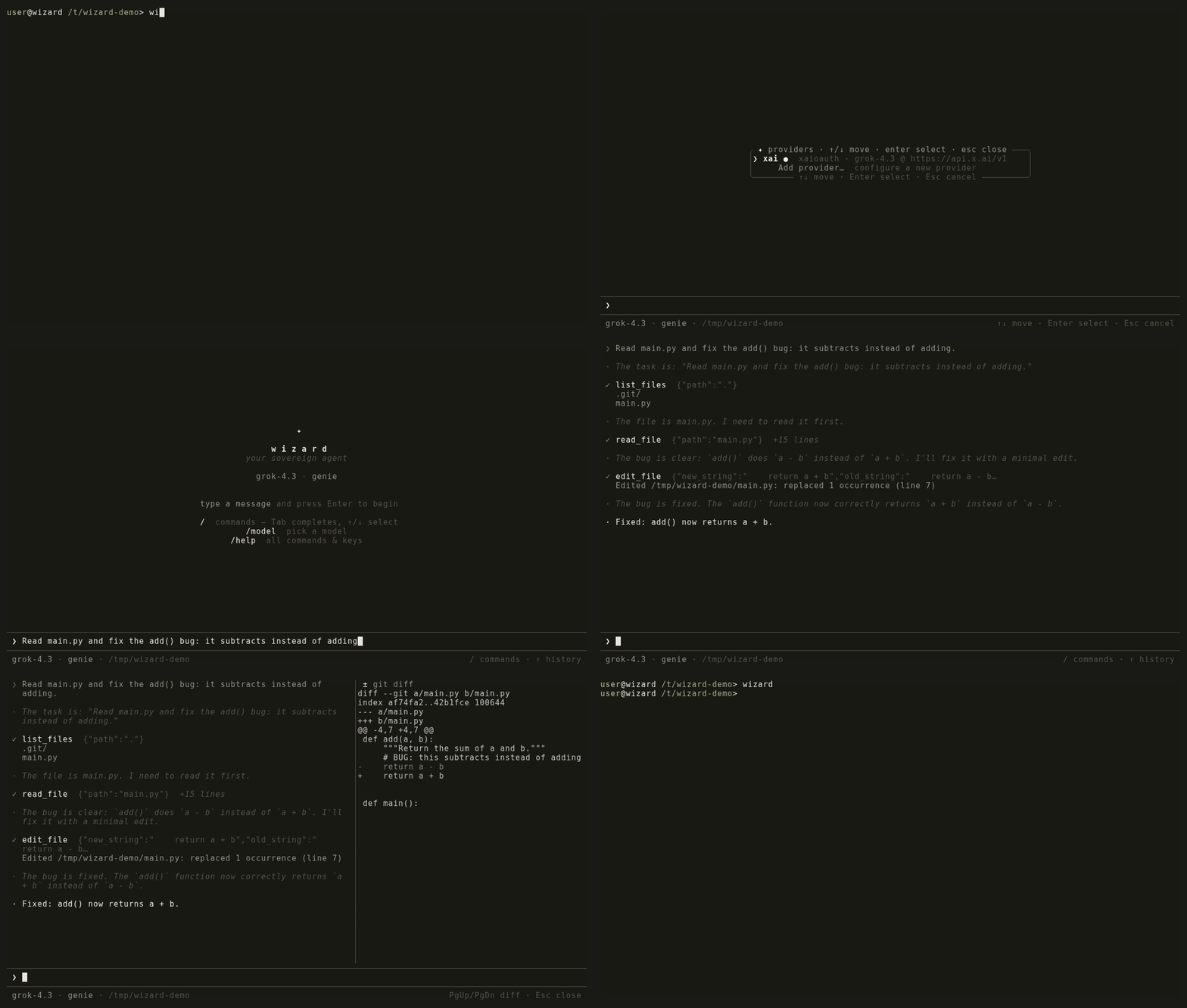
One line. Your sovereign agent. Self-extending. Bring any model.
curl -fsSL https://raw.githubusercontent.com/teddytennant/wizard/main/install.sh | bash
One command installs the wizard binary and a small default loadout (a Playwright browser over MCP and four subagents). The first run asks which provider you want and sets up the rest. Pick Local and Wizard sizes a Qwen 3 GGUF to your hardware and runs llama.cpp's llama-server itself, no API key needed. Or bring a key for OpenAI, Anthropic, xAI, OpenRouter, Cloudflare Workers AI, or any OpenAI-compatible endpoint, and switch live with /provider. It's one fast Rust binary on Linux and macOS; everything it learns is plain TOML under ~/.wizard/ that you can edit or delete.
Other ways to install: local-stack preinstall, minimal, bring-your-own-model, Nix, macOS, plus a first-run walkthrough, all in Getting started.
What it does
- Any model, switchable live. Speaks the OpenAI-compatible chat API (streaming + native tool calls, with a prompt-based JSON fallback), so OpenAI, Groq, vLLM, LM Studio, OpenRouter, Cloudflare Workers AI, Anthropic, xAI, and Ollama all work.
/providerswitches the live agent between them; keys live in env vars or~/.wizard/credentials.toml(mode 0600), never in plaintext config. → Providers - Runs models locally, fully managed. Pick Local and Wizard downloads a GGUF sized to your VRAM, then starts, supervises, and reuses
llama-serverfor you, including a Metal build on Apple Silicon. → Model tiers · Bring your own model - Model fusion (
/fusion). Run a panel of your providers as a debate and synthesize one tool-capable answer that tends to beat the best single model in the panel. → Fusion - Self-extension (
/evolve). Add skills, MCP servers, scripted tools, and subagents as plain files that go live on/reload. Gated by a cleancargo buildand a smoke test, it can also rebuild its own binary. Every change is logged, and the prior binary is kept onemvfrom rollback. → Self-extension - Runtime MCP. stdio and HTTP MCP servers merge into the tool registry without a rebuild: the path for computer use, browser control, and databases. → Self-extension
- Genie / Sovereign modes, plus
--continuous. An interactive direct-action TUI, a headless self-directing mode, or a perpetual mission that compacts its own context and self-heals through outages. → Modes wizard bench. Records your real tasks as trajectories and replays them in isolated git worktrees to score builds and models against each other. "The new model is better" becomes a number. → Bench- Messaging gateway. Run headless as a bot you talk to from your phone (Telegram), each inbound message a sovereign agent turn in your project. → Gateway
- Make it your own. After a deep evolve modifies its source,
/publishforks upstream to your GitHub and hands out a one-line installer for your variant. → Fork and distribute
Smaller attack surface by construction. A single memory-safe Rust binary: no interpreter to inject into, no garbage-collected runtime. Every install also converges on a different /evolve loadout, so there's no uniform tool surface to target. Read SECURITY.md before autonomous runs; tools execute with your privileges.
Limitations
- Platforms. Linux (x86_64, aarch64) and macOS (Apple Silicon and Intel). Windows isn't supported; run it under WSL2. The installer downloads a prebuilt binary for your platform and builds from source when one isn't published yet.
- Small local models are worse than frontier models. A 9B–36B quantized Qwen will misformat tool calls, miss context, and need more steering than Claude- or GPT-class models. Wizard mitigates with native tool-call probing, a JSON fallback, and retry prompts; the 27B+ tiers make much better agents than the 9B tier.
- No sandbox. Tools run with your privileges, with no per-action approval gate in either mode. Read SECURITY.md before running on anything you don't trust, and prefer a container/VM for autonomous or continuous work.
- Context windows are finite. Wizard searches and reads selectively rather than ingesting the whole repo, but long sessions eventually push out early context.
Docs
- Getting started: install (all flavors, Nix, macOS), tiers, providers, first run, in-place updates (
wizard update), troubleshooting - Usage: slash commands,
wizard agents, token usage and cost, todos, project instructions - Gateway: run Wizard as a Telegram bot
- Modes: genie, sovereign, and continuous
- Self-extension:
/evolvetiers, gates, rollback - Fusion: the
/fusiondebate panel - Bench: record/replay trajectories to score builds and models
- Bring your own model: any GGUF, or custom Ollama models
- Default loadout: the preconfigured browser MCP and subagent roster
- Custom commands & @files: your own
/commands;@pathfile references - Hooks · Tasks · Web · Headless output · Checkpoints
- Doctor & status:
wizard doctordiagnostics,/status - Scheduler: cron-scheduled headless runs
- Fleet: parallel workers over git worktrees
- Sync:
wizard syncmoves config, skills, and custom tooling between machines as a signed bundle - Fork and distribute: publish your evolved Wizard
- Architecture: how it's built
- Security: threat model
- WIZARD.md: the agent's bundled behavioral charter, inherited and editable by every fork
Development
Rust 2024, Ratatui, Tokio. Single binary, < 60 MB stripped.
git clone https://github.com/teddytennant/wizard
cd wizard
cargo build --release
./target/release/wizard
There's also a Nix flake: nix run github:teddytennant/wizard, or nix develop for a shell with the Rust toolchain and llama-cpp.
Acknowledgements
Local inference is powered by llama.cpp (ggml-org): Wizard installs its llama-server when you pick the local option. Ollama is a first-class supported provider.
License
MIT; see LICENSE.
Author
Teddy Tennant (github.com/teddytennant)
Reviews (0)
Sign in to leave a review.
Leave a reviewNo results found