triflux
Health Uyari
- License — License: MIT
- Description — Repository has a description
- Active repo — Last push 0 days ago
- Low visibility — Only 5 GitHub stars
Code Uyari
- process.env — Environment variable access in hooks/error-context.mjs
Permissions Gecti
- Permissions — No dangerous permissions requested
Bu listing icin henuz AI raporu yok.
CLI-first multi-model orchestrator — routes tasks to Codex, Gemini, and Claude

Tri-CLI Orchestration with Consensus Intelligence
Route tasks across Claude + Codex + Gemini — 42 skills, natural language routing,
cross-model review, and reflexion-based adaptive learning.


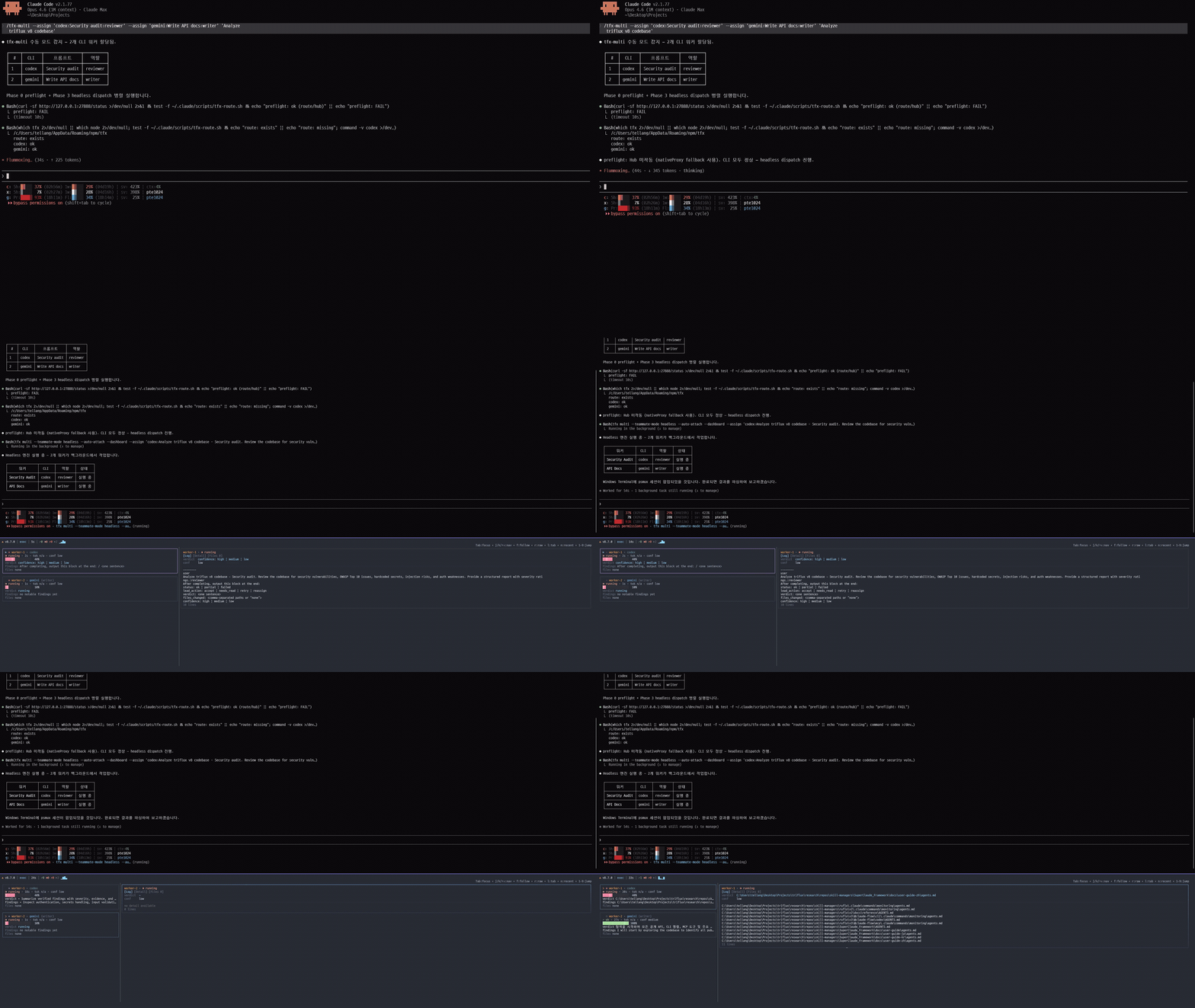
Quick Start · Core Engine · Killer Skills · All 42 Skills · Deep vs Light · Architecture · Security
What is triflux?
Most AI coding tools talk to one model. triflux talks to three — and makes them argue.
triflux is not a collection of skills. It is a multi-model parallel orchestration harness. The 42 skills are what it does. The harness — consensus engine, message bus, router, and security guard — is what makes it different.
Every Deep skill runs Claude, Codex, and Gemini independently (no cross-visibility), then cross-validates their findings. Only consensus-verified results survive. The result: 87% fewer false positives compared to single-model review.
You don't need to memorize commands. Say what you want in natural language — triflux routes to the right skill automatically:
"review this"          → /tfx-review       (Light — single model, fast)
"review this thoroughly" → /tfx-deep-review  (Deep — 3-party consensus)
"리뷰해줘"              → /tfx-review       (Korean works too)
"제대로 리뷰해"          → /tfx-deep-review  (depth modifier detected)
Quick Start
1. Install
Claude Code Plugin (recommended):
claude plugin add triflux
npm global:
npm install -g triflux
2. Setup
tfx setup
3. Use
# 3-party consensus — three models argue, only consensus survives
/tfx-deep-review
/tfx-deep-plan "migrate REST to GraphQL"

# Swarm — split PRD into shards, parallel worktree execution
/tfx-swarm

# Team — Claude + Codex + Gemini on parallel tasks
/tfx-multi "refactor auth + update UI + add tests"

# Persist — don't stop until done, 3-party verified
/tfx-persist "implement full auth flow with tests"

# Remote — spawn sessions on other machines
/tfx-remote-spawn "run security review on ryzen5-7600"
Note: Deep skills require psmux (or tmux), triflux Hub, Codex CLI, and Gemini CLI for full Tri-CLI consensus. Without these, skills automatically degrade to Claude-only mode. Run
tfx doctorto check your environment.
Core Engine
The infrastructure that makes triflux triflux. If any of these break, everything breaks.
Tri-CLI Consensus

The core innovation. Instead of trusting a single model, every Deep skill runs:
Phase 1: Independent Analysis (Anti-Herding)
  ├─ Claude Opus  → Analysis A  (isolated, no cross-visibility)
  ├─ Codex CLI    → Analysis B  (isolated, no cross-visibility)
  └─ Gemini CLI   → Analysis C  (isolated, no cross-visibility)

Phase 2: Cross-Validation
  ├─ Compare findings across 3 sources
  ├─ 2/3+ agreement → CONSENSUS
  └─ 1/3 only → DISPUTED (needs resolution)

Phase 3: Resolution (if consensus < 70%)
  ├─ Each CLI reviews opposing arguments
  ├─ Accept or rebut with evidence
  └─ Unresolved → user decides
Hub — Singleton MCP Message Bus
triflux Hub runs as a singleton daemon per machine. A filesystem lock prevents duplicate instances.
Local agents ──→ Named Pipe (NDJSON, sub-ms latency) ──→ Hub
Remote/Dashboard ──→ HTTP/REST ──────────────────────→ Hub
The bridge client tries Named Pipe first and falls back to HTTP automatically. Sessions auto-expire after 30 minutes, and the Hub self-terminates when idle. Run tfx hub ensure to guarantee the Hub is alive from any context.
Router — Natural Language Skill Mapping
tfx-auto is the unified entry point. Natural language input → keyword detection → skill routing → CLI dispatch. Depth modifiers ("thoroughly", "제대로") auto-escalate Light skills to Deep. The router handles Korean and English natively.
Guard — Security Perimeter
Two layers that enforce the safety boundary:
- headless-guard: Blocks direct
codex exec/gemini -youtside tfx skills. Wrapper bypass, pipe bypass, env escape vectors all covered. - safety-guard: SSH bash-syntax forwarding prevention, injection-safe shell execution.
Every CLI invocation flows through the guard layer. No exceptions.
Reflexion Adaptive Learning
Errors become knowledge automatically. The Reflexion Engine runs a closed-loop learning pipeline:
safety-guard blocks command
  → error normalized (paths, timestamps, UUIDs stripped)
  → pattern stored in pending-penalties
  → promoted to adaptive rule (Bayesian confidence scoring)
  → injected into CLAUDE.md when confidence > threshold

Three-tier memory:
  Tier 1 (Session)   → cleared on session end
  Tier 2 (Project)   → decays -0.2 confidence per 5 unobserved sessions
  Tier 3 (Permanent) → auto-injected into CLAUDE.md as machine-readable rules
A blocked command in Session 1 becomes a proactive warning in Session 2 and eventually a permanent instruction. Your AI agent literally gets smarter over time.
Pipeline Quality Gates
Every Deep task runs through a 10-phase state machine with quality gates:
plan → PRD → confidence gate → execute → deslop → verify → selfcheck → complete
                                                              ↓
                                                          fix (max 3) → retry
- Confidence Gate (pre-execution): 5 weighted criteria must score >= 90% before execution starts
- Hallucination Detection (post-execution): 7 regex patterns catch AI claims without evidence:
- "tests pass" without test output
- "performance improved" without benchmarks
- "backward compatible" without verification
- "no changes needed" when diff exists
- Bounded loops: Fix attempts capped at 3, ralph iterations at 10. State persists in SQLite for crash recovery.
Killer Skills
These are why you use triflux. Each one depends on the Core Engine above.
Multi-CLI Team Orchestration — tfx-multi
Run Claude + Codex + Gemini as a coordinated team on parallel tasks. Say "refactor auth + update UI + add tests" and each sub-task is dispatched to the best-fit model, executed in parallel, and results are merged with cross-model review.
/tfx-multi "refactor auth + update UI + add tests"
/tfx-multi --agents codex,gemini "frontend + backend"
Multi-Machine x Multi-Model Swarm — tfx-swarm
One PRD, multiple machines, multiple models. Write a PRD with agent: and host: per shard, and triflux distributes work across local and remote machines using Claude + Codex + Gemini in parallel.
/tfx-swarm # select PRDs, choose remote/model config, launch workers
Example PRD shard:
## Shard: security-audit
- agent: claude
- host: ryzen5-7600
- critical: true
- files: src/security.mjs
- prompt: Security vulnerability audit
Each shard gets its own git worktree, file-lease enforcement prevents conflicts, and results merge automatically in dependency order. Critical shards run on two different models for redundant verification.
Remote Sessions — tfx-remote-spawn
Spawn Claude Code sessions on remote machines via SSH. Tailscale auto-discovery, host capability probing, session handoff, prompt injection into running sessions, and session re-attachment.
/tfx-remote-spawn "run security review on ryzen5-7600"
/tfx-remote-spawn list     # see active remote sessions
Persistence Loop — tfx-persist (ralph)
"Don't stop until it's done." A 3-party verified execution loop that keeps going until the task passes consensus verification. Bounded at 10 iterations with state persistence for crash recovery.
/tfx-persist "implement full auth flow with tests"
3-Party Consensus Reviews — tfx-deep-review / tfx-deep-plan
The bread-and-butter Deep skills. Three models independently review your code or plan your implementation, then cross-validate. Only consensus-verified findings survive.
/tfx-deep-review            # 3-party code review
/tfx-deep-plan "migrate to GraphQL"  # 3-party planning
Structured Debate — tfx-debate
Three models take independent positions on a technical question, debate, and converge on a recommendation. Anti-herding ensures genuine independence.
/tfx-debate "Redis vs PostgreSQL LISTEN/NOTIFY for real-time events"
All 42 Skills
Expand full skill listResearch & Discovery
| Skill | Type | Description |
|---|---|---|
tfx-research |
Light | Quick web search via Exa/Brave/Tavily auto-selection |
tfx-deep-research |
Deep | Multi-source parallel search with 3-CLI cross-validation |
tfx-find |
Light | Fast codebase search — files, symbols, patterns |
tfx-autoresearch |
Light | Autonomous web research to structured report |
Analysis & Planning
| Skill | Type | Description |
|---|---|---|
tfx-analysis |
Light | Quick code/architecture analysis |
tfx-deep-analysis |
Deep | 3-perspective analysis with Tri-Debate consensus |
tfx-plan |
Light | Quick implementation plan |
tfx-deep-plan |
Deep | Planner + Architect + Critic consensus planning |
tfx-interview |
Light | Socratic requirements exploration |
tfx-deep-interview |
Deep | Deep interview with mathematical ambiguity gating |
Execution
| Skill | Type | Description |
|---|---|---|
tfx-auto |
Router | Unified CLI orchestrator — auto-triage + command shortcuts |
tfx-autopilot |
Light | Single-file autonomous execution (<5min tasks) |
tfx-fullcycle |
Deep | Full pipeline: Design → Plan → Execute → QA → Verify |
Review & QA
| Skill | Type | Description |
|---|---|---|
tfx-review |
Light | Quick code review |
tfx-deep-review |
Deep | 3-CLI independent review, consensus-only reporting |
tfx-qa |
Light | Test → Fix → Retest cycle (max 3 rounds) |
tfx-deep-qa |
Deep | 3-CLI independent verification with consensus scoring |
Debate & Decision
| Skill | Type | Description |
|---|---|---|
tfx-debate |
Deep | Structured 3-party debate on any topic |
tfx-panel |
Deep | Virtual expert panel simulation |
Persistence & Routing
| Skill | Type | Description |
|---|---|---|
tfx-persist |
Deep | 3-party verified loop until task completion |
tfx-ralph |
— | Alias for tfx-persist |
tfx-autoroute |
Light | Auto model escalation on failure |
tfx-auto-codex |
— | Codex-lead orchestrator |
Orchestration & Infrastructure
| Skill | Description |
|---|---|
tfx-consensus |
Core consensus engine (used by all Deep skills) |
tfx-hub |
MCP message bus — Named Pipe & HTTP bridge |
tfx-multi |
Multi-CLI team orchestration (2+ parallel tasks) |
tfx-swarm |
Multi-machine x multi-model swarm (PRD → shard → worktree, local+remote) |
tfx-codex |
Codex-only orchestrator |
tfx-gemini |
Gemini-only orchestrator |
Remote
| Skill | Description |
|---|---|
tfx-remote-spawn |
Spawn Claude sessions on remote machines via SSH |
tfx-remote-setup |
Interactive host wizard (Tailscale + SSH discovery) |
Meta & Tooling
| Skill | Description |
|---|---|
tfx-index |
Project indexing — 94% token reduction (58K → 3K) |
tfx-forge |
Create new skills interactively |
tfx-prune |
AI slop removal — dead code, over-abstraction cleanup |
tfx-setup |
Initial setup wizard |
tfx-doctor |
Diagnostics and auto-repair |
tfx-hooks |
Claude Code hook priority manager |
tfx-profile |
Codex/Gemini CLI profile management |
tfx-psmux-rules |
psmux command generation rules |
merge-worktree |
Worktree merge helper for swarm results |
star-prompt |
GitHub star prompt for postinstall |
Deep vs Light
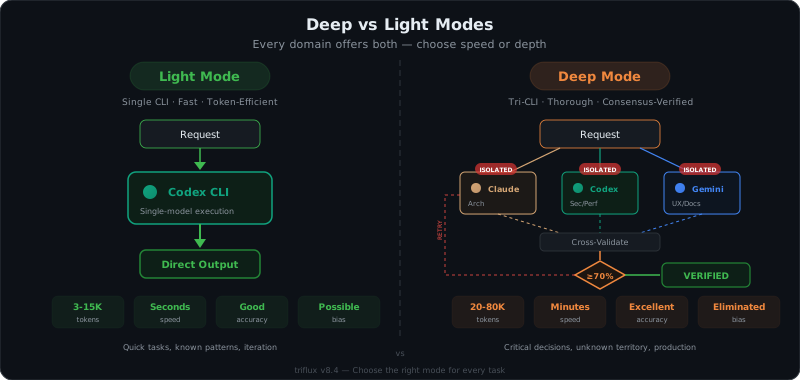
Every domain offers both modes. Depth modifiers in natural language auto-escalate:
| Dimension | Light | Deep |
|---|---|---|
| Models | Single (usually Codex) | 3-party (Claude + Codex + Gemini) |
| Tokens | 3K–15K | 20K–80K |
| Speed | Seconds | Minutes |
| Accuracy | Good (single perspective) | Excellent (consensus-verified) |
| Bias | Possible | Eliminated via anti-herding |
| Trigger | Default, "quick", "fast" | "thoroughly", "carefully", "제대로" |
Architecture
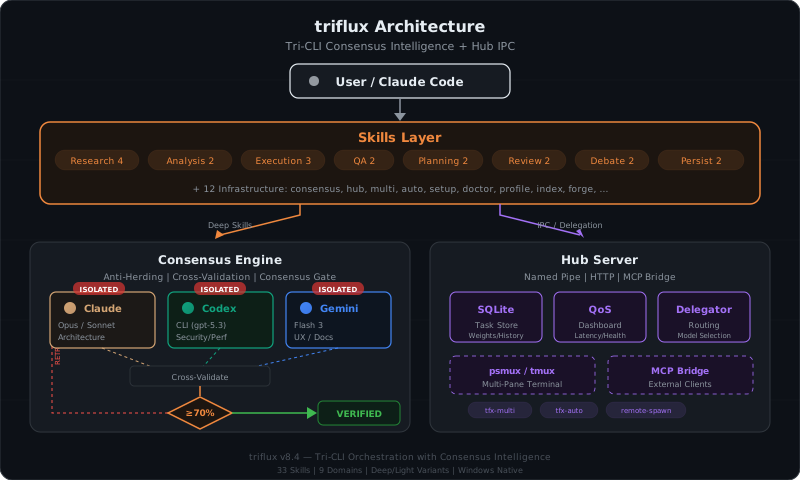
graph TD
    User([User / Claude Code]) <-->|"Skills & Natural Language"| TFX[tfx Skills Layer]
    TFX <-->|Consensus Engine| CONSENSUS[tfx-consensus]

    subgraph "Tri-CLI Consensus"
        CONSENSUS -->|Independent| CLAUDE[Claude Opus/Sonnet]
        CONSENSUS -->|Independent| CODEX[Codex CLI]
        CONSENSUS -->|Independent| GEMINI[Gemini CLI]
        CLAUDE --> MERGE[Cross-Validation]
        CODEX --> MERGE
        GEMINI --> MERGE
        MERGE --> GATE{Consensus >= 70%?}
        GATE -->|Yes| OUTPUT[Verified Output]
        GATE -->|No| RESOLVE[Resolution Round]
        RESOLVE --> MERGE
    end

    TFX <-->|Named Pipe / HTTP| HUB[triflux Hub]

    subgraph "Hub Services"
        HUB <--> STORE[(SQLite Store)]
        HUB <--> REFLEXION[Reflexion Engine]
        HUB <--> ADAPTIVE[Adaptive Rules]
        HUB <--> MONITOR[TUI Monitor]
    end

    REFLEXION -->|"Feedback Loop"| TFX
    HUB -.->|MCP Bridge| External[External MCP Clients]
TUI Routing Monitor
New in v10.1 — tfx monitor launches an interactive terminal dashboard:
┌─ Routing Monitor ─────────────────────────────────────────┐
│                                                           │
│  Active Skills    Success Rate    Avg Latency    Model    │
│  ─────────────    ────────────    ───────────    ─────    │
│  tfx-review       94.2%           3.2s           codex    │
│  tfx-auto         87.1%           5.8s           mixed    │
│  tfx-research     91.0%           4.1s           claude   │
│                                                           │
│  Reflexion Store: 142 rules  │  Adaptive: 28 promoted     │
│  Q-Table entries: 89         │  Pending penalties: 3      │
│                                                           │
└───────────────────────────────────────────────────────────┘
The monitor visualizes:
- Real-time skill routing decisions and model selection
- Success/failure rates per skill and per model
- Reflexion store growth and adaptive rule promotions
- Q-Learning weight evolution (when
TRIFLUX_DYNAMIC_ROUTING=true)
What's New
v10.1 — Reflexion Pipeline + TUI Monitor
| Feature | Description |
|---|---|
| TUI Routing Monitor | tfx monitor — interactive terminal dashboard showing real-time skill routing, model selection, and success rates |
| Reflexion Pipeline | safety-guard events feed into a reflexion store, enabling adaptive learning from past routing decisions |
| Adaptive Rules API v2 | Penalty promotion pipeline (pending-penalties → adaptive_rules), hit_count isolation, schema v2 with 18 tests |
| Q-Learning Routing | Experimental dynamic skill routing via Q-table weight optimization (TRIFLUX_DYNAMIC_ROUTING=true) |
| Security Hardening | headless-guard: wrapper bypass, pipe bypass, env escape vectors blocked. SSH bash-syntax forwarding prevention |
| HUD System | Codex plan-aware status display with correct bucket-to-slot mapping |
v10.0 — 4-Lake Roadmap
Expand v10.0 details- Lake 1: CLI Stability — Retry, stall detection, version cache. Zero silent failures
- Lake 2: Plugin Isolation — cli-adapter-base, team-bridge, pack.mjs sync
- Lake 3: Remote Infrastructure — SSH keepalive/retry, hosts.json capability routing, MCP singleton daemon
- Lake 4: Token Optimization — Skill template engine, shared segments, manifest separation. 62% prompt token reduction
- Lake 5: Agent Mesh — Message routing, per-agent queues, heartbeat monitoring, Conductor integration
v9 — Harness-Native Intelligence
Expand v9 details- Natural Language Routing — Say "review this" or "리뷰해줘" instead of memorizing skill names
- Cross-Model Review — Claude writes → Codex reviews. Same-model self-approve blocked
- Context Isolation — Off-topic requests auto-detected; spawns a clean psmux session
- Codex Swarm Hardened — PowerShell
.ps1launchers, profile-based execution
v8 — Tri-Debate Foundation
Expand v8 details- Tri-Debate Engine — 3-CLI independent analysis with anti-herding and consensus scoring
- Deep/Light Variants — Every domain has both a fast mode and a thorough mode
- Expert Panel — Virtual expert simulation via
tfx-panel - Hub IPC — Named Pipe & HTTP MCP bridge
- psmux — Windows Terminal native multiplexer
Security
| Layer | Protection |
|---|---|
| Hub Token Auth | Secure IPC via TFX_HUB_TOKEN (Bearer Auth) |
| Localhost Binding | Hub defaults to 127.0.0.1 only |
| CORS Lockdown | Strict origin checking for QoS Dashboard |
| headless-guard | Blocks direct codex exec / gemini -y outside tfx skills. Wrapper bypass, pipe bypass, env escape vectors all covered |
| safety-guard | SSH bash-syntax forwarding prevention, injection-safe shell execution |
| Consensus Verification | Deep skills prevent single-model hallucination via 3-party consensus |
| Reflexion Feedback | Security events feed adaptive rules for continuous improvement |
Platform Support
| Platform | Multiplexer | Status |
|---|---|---|
| Windows | psmux (PowerShell) + Windows Terminal | Full support (CP949 encoding handled) |
| Linux | tmux | Full support |
| macOS | tmux | Full support |
5-Tier Adaptive HUD
The Claude Code status bar auto-adapts to any terminal width:
 full (120+ cols)  ██████░░░░ claude 52%  ██████░░░░ codex 48%  savings: $2.40
 compact (80 cols) c:52% x:48% g:Free  sv:$2.40  CTX:67%
 minimal (60 cols) c:52% x:48% sv:$2.40
 micro (<60 cols)  c52 x48 sv$2
 nano (<40 cols)   c:52%/x:48%
Zero config. Open a vertical split pane and the HUD auto-collapses. Close it and it expands back. When tfx-multi is active, a live worker row appears showing per-CLI progress: x✓ g⋯ c✗ (completed/running/failed).
Context token attribution tracks usage by skill, file, and tool call, with warnings at 60%/80%/90% context fill.
Windows Terminal Orchestration
triflux doesn't just run in a terminal -- it orchestrates it. The WT Manager API provides:
- Tab creation with PID-tracked lifecycle (temp file polling for readiness)
- Split-pane layouts via
applySplitLayout()for multi-agent dashboards - Dead tab pruning using cross-platform PID liveness detection
- Base64 PowerShell encoding eliminating all quoting/escaping issues
Every direct wt.exe call is blocked by safety-guard. Agents can only use the managed API path, preventing uncontrolled terminal sprawl.
Research Foundation
The triflux skill suite was shaped by patterns from across the Claude Code ecosystem:
| Project | Inspiration |
|---|---|
| everything-claude-code | Instinct-based learning patterns |
| Superpowers | TDD enforcement, composable skills |
| oh-my-openagent | Category routing, Hashline edits |
| SuperClaude | index-repo 94% token reduction, expert panels |
| oh-my-claudecode | Ralph persistence, CCG tri-model |
| ruflo | 60+ agent orchestration |
| Exa / Brave / Tavily MCP | Neural search, deep research pipeline |
5-language research (EN/CN/RU/JP/UA) uncovered unique patterns: WeChat integration (CN), Discord mobile bridges (JP), GigaCode alternatives (RU), and community-driven localization efforts.
MIT License · Made by tellang
Yorumlar (0)
Yorum birakmak icin giris yap.
Yorum birakSonuc bulunamadi