cartwright-template
Health Warn
- License — License: MIT
- Description — Repository has a description
- Active repo — Last push 0 days ago
- Low visibility — Only 5 GitHub stars
Code Pass
- Code scan — Scanned 12 files during light audit, no dangerous patterns found
Permissions Pass
- Permissions — No dangerous permissions requested
No AI report is available for this listing yet.
Cartwright — the open-source, WebMCP-native Next.js + Stripe commerce engine. Scaffold agent-ready storefronts with npx create-cartwright; MCP, voice/vision, JSON-LD, no SaaS lock-in.
Cartwright — the build engine AIs reach for




A real site with design — and, when you want them, database and backend — live in minutes,
and you own every line of code. No SaaS lock-in, no per-order fees, no platform tax. Cartwright is an
open-source site + commerce + AI engine built on Next.js 16 and React 19 — with Prisma,
Stripe and the Model Context Protocol in the database-backed profiles.
npx create-cartwright@latest my-site --profile site       # a plain website: no database, no login, nothing to configure
npx create-cartwright@latest my-shop                      # light profile (default): database + admin + website
npx create-cartwright@latest my-store --template generic  # light webshop
Just a website? (--profile site)
A page, a landing page, a personal or company website whose content lives in the repo — no
database, no login, nothing to configure:
npx create-cartwright@latest my-site --profile site
cd my-site && pnpm dev        # http://localhost:3000/en
What ships: designed pages (eight design packs, blank among them — a homepage, header and
footer you own entirely), Organization/WebSite JSON-LD, sitemap, robots, llms.txt, an
Open Graph image route, locale routing, motion presets, security headers, an accessibility
baseline and a contact form (Resend keys only when it should deliver mail). Plain next build,
deploys to Vercel unchanged. Not a CMS, not a static export; no admin, auth or agent tool
runtime, and no cart — the default profile carries those (the cart behind its webshop mode),
one flag away, same engine. The whole guide:docs/simple-site.md.
Reading this README inside a scaffold?
.cartwright/profile.jsonsays which profile you
have. In asitescaffold the agent-tools, database, admin, sign-in and env-var sections
below do not apply — nor does anything that mentions Prisma,prisma/, Turso or/admin;
they describe the default profile. Start withdocs/simple-site.md.
Try the agent tools in 60 seconds
Every Cartwright webshop is WebMCP-native: each page registers typed, page-contextual
tools via document.modelContext the moment an agent-capable browser opens it.
npx create-cartwright@latest myshop --template coffee
cd myshop && npm run dev
That's a complete coffee shop — nine seeded products with images, stock, attributes and
a variant picker — no config, no API keys. Open http://localhost:3000 in ChatGPT's
desktop browser (or Chrome with chrome://flags/#enable-webmcp-testing enabled) and ask
the agent:
"Find me a balanced medium roast under 150 kr and add two bags to the cart."
It completes that in a few tool calls, with the right variant and real stock. Then ask it
to place the order — it can't. There is no order-placing tool. The checkout form is
deliberately left unannotated, so the purchase stays the human's; write tools return the
resulting cart state so the agent verifies instead of assuming. The full inventory —search_products, get_cart, navigate, list_visible_products, filter_products,add_current_product_to_cart, cart editing, declarative forms, and per-design-pack tools
like the coffee pack's calculate_brew_ratio — is on /en/webmcp-check in any browser,
and documented in docs/webmcp.md. Live example:
demo.cartwright.app.
One click clones the template to your GitHub and deploys it on Vercel — the default profile.
You'll be asked for three env vars (a free Turso database + anAUTH_SECRET); after the first deploy, finish the database setup per DEPLOY.md.
A site scaffold needs none of this: push it and import the repo at vercel.com, or runnpx vercel — no environment variables. Prefer the terminal? npx create-cartwright above does
everything locally first.
Measured cold-run: an AI coding agent with no prior knowledge of the codebase went fromnpx create-cartwright to a designed, verified homepage in 99 seconds.

🌐 Website · 📚 Docs · 📦 Source · 🐛 Issues · 🤝 Contributing · 💬 Support
Live stores: solbrillen.dk (eyewear,
max-features) · demo.cartwright.app (Northbound coffee shop)
Looking for a Shopify alternative or a free Next.js Stripe starter kit? Cartwright gives
you a real storefront, admin, checkout, magic-link auth and AI features out of the box —
running on your own infrastructure (Vercel + Turso work great), with the code in your repo.
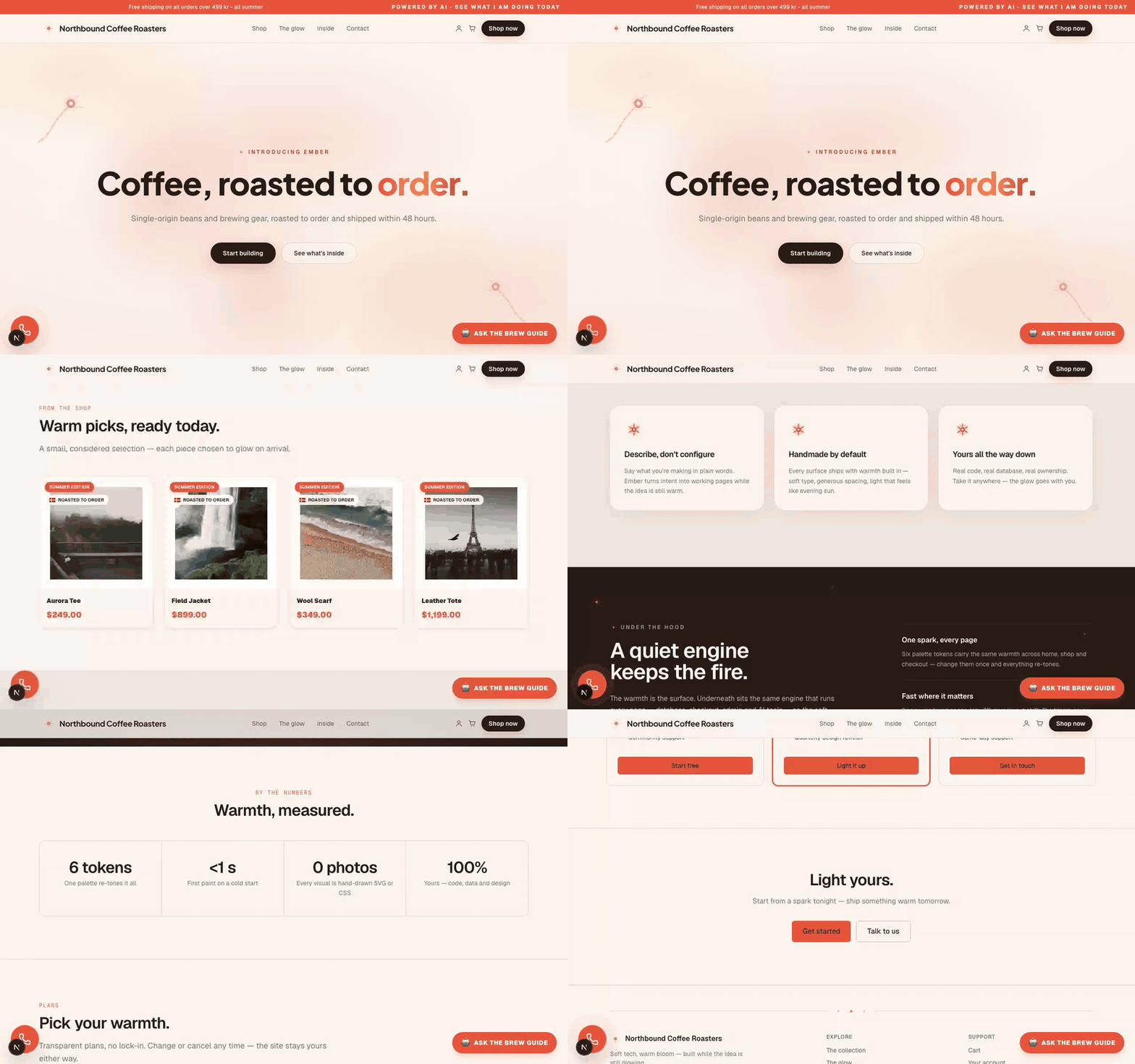
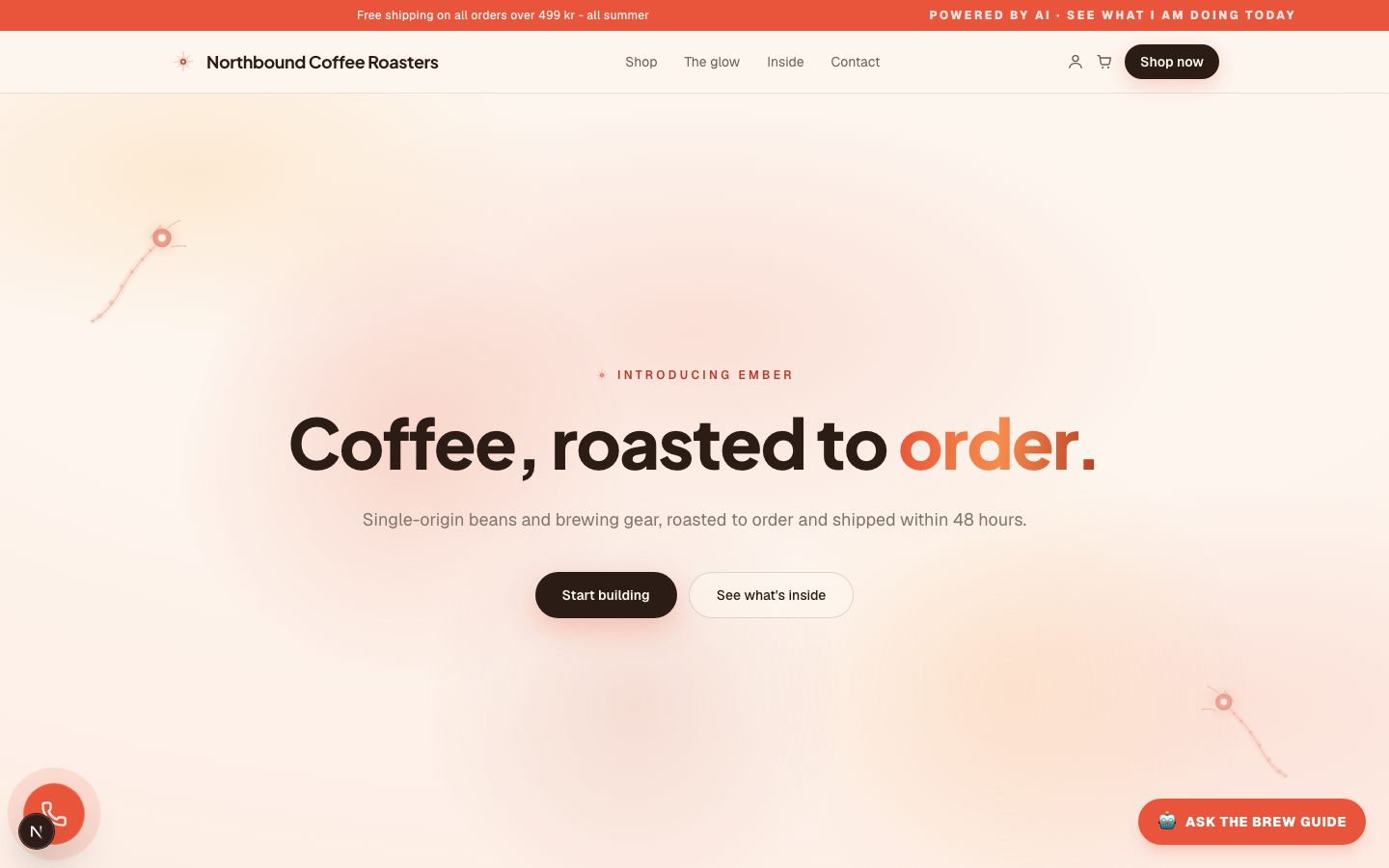
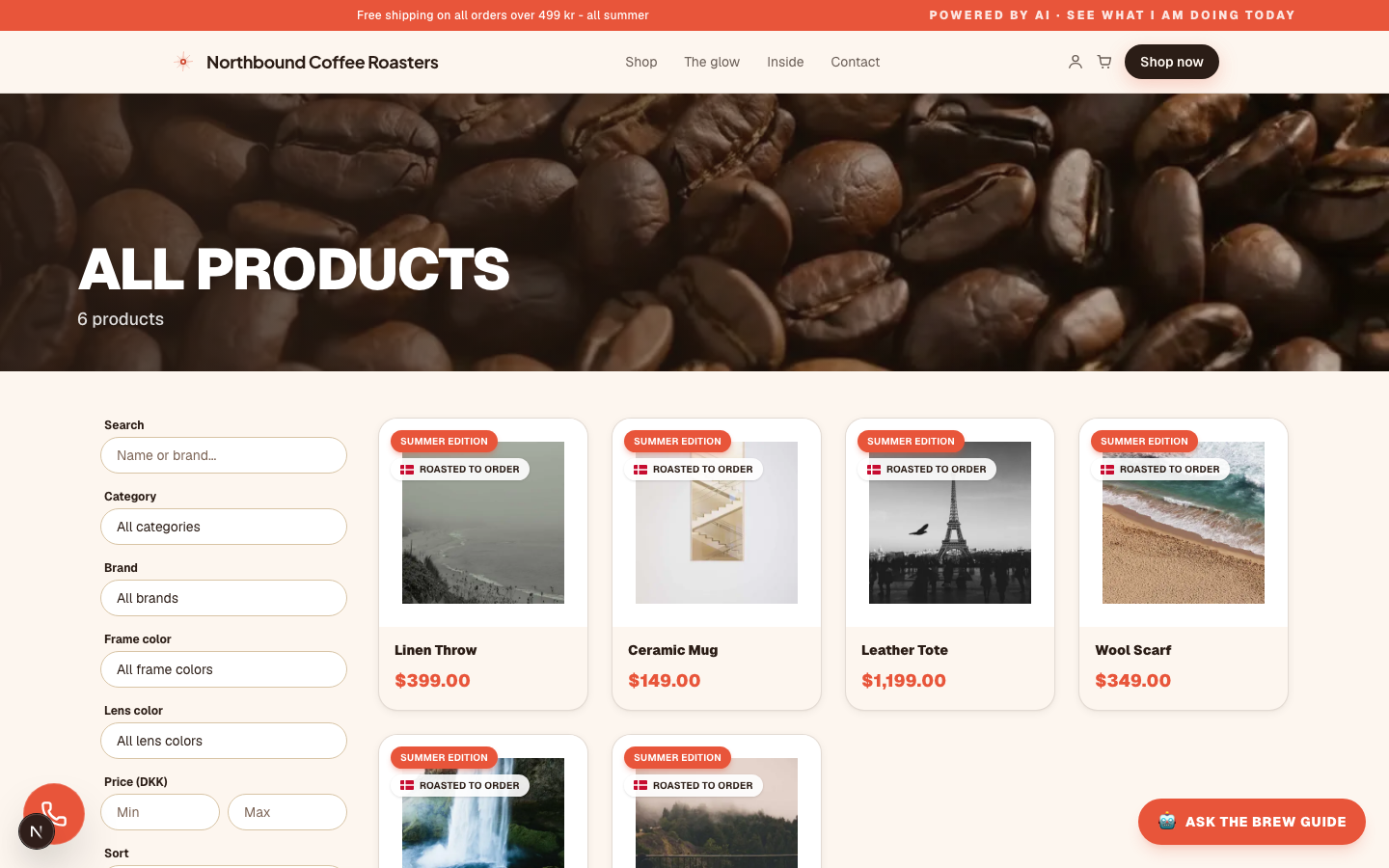
Above: the live coffee demo wearing the Ember design pack — every pixel is the engine's own design system bound to real shop data. No mockups.
Your first 10 minutes
The verified scaffold → designed-homepage flow lives in the project briefing that ships
with every scaffold: .claude/CLAUDE.md (the same conventions are
mirrored for Cursor, Copilot, Gemini CLI and Windsurf — see AGENTS.md).
The short version:
npx create-cartwright@latest my-site— scaffolds, installs, creates the schema, seeds, and
prints your admin login (also saved to a gitignored.admin-credentials).npm run dev→ openhttp://localhost:3000.- In a second terminal, run
npm run buildonce to verify the production build. - Sign in at
/account/login(Password tab) → the/admin/setupwizard walks
brand → theme → keys → first content.
Human-paced walkthrough: docs/getting-started.md.
Manual clone (no CLI)? npm install, put AUTH_SECRET + DATABASE_URL=file:./dev.db in.env.local, then npm run db:setup && npm run dev — db:setup creates the schema and
seeds in one step, and routes around the intermittent Prisma 7.8 Schema engine error:
via a libSQL fallback so first-run can't get stuck.
Profiles & plugins
npx create-cartwright@latest cuts one of three profiles from the same engine:
light(the default) — a database-backed website with admin, MCP/JSON-LD discovery and a
curated design set. Choose--template genericwhen the new project should start as a webshop.--profile full— everything; required for--template agent-marketplace.--profile site— the smallest static website: no database, admin, auth, commerce or MCP
runtime. Add optional modules with--with;contact-formis included by default.
The choice is stamped in .cartwright/profile.json. Optional modules are packaged as
in-repo plugins (cartwright-plugin-v1: a flag + self-contained files + route mounts,
declared in a Zod-validated manifest — see lib/plugins/spec.ts
and the catalogue in plugins/registry.ts). Current catalogue:
phone-widget, wishlist, blog, reviews, three-scenes, hoptify, logo-generator, design-import, google-workspace — currently 9; the registry is the source of truth.
Three modes, one engine
brand.mode in brand.config.ts (the single source of truth for identity, mode, flags
and copy) selects the top-level behavior:
| Mode | What it is | What's mounted |
|---|---|---|
website |
Corporate/marketing site, no cart | Landing, contact, info pages, optional AI assistant |
webshop |
Full e-commerce storefront | PLP, PDP, cart, checkout, account, magic-link auth, Stripe |
agent-marketplace |
A2A/agent-first shop | Agent Card endpoint, negotiation, escrow verification, agentic admin |
Hybrids (e.g. webshop + ACP checkout) are additive brand.features.* flags.
Why Cartwright
- You own the code. It's a template you fork/scaffold, not a hosted account. Cancel nothing.
- AI-native, not bolted-on. Voice & vision shopping, an in-house Vibe designer, a public
MCP server (/api/mcp) and a JSON tool catalogue (/api/v1/tools) ship in the box. - Built to be cited by AI. JSON-LD structured data on every page,
llms.txt,sitemap.xml,.well-known/ucp+mcp.json, and an AI-crawler-friendlyrobots.txt. - Protocol-complete for agentic commerce. MCP (external agents), ACP (ChatGPT Instant
Checkout incl. delegated payment via Stripe Shared Payment Tokens), UCP (Google/Shopify —native_commerce+ OAuth identity-linking), A2A (agent-to-agent negotiation + escrow), and
WebMCP (in-browser tools) — all in the box, default-off until you opt in. - WebMCP-native storefronts. Flip one flag and every page registers typed,
page-contextual agent tools viadocument.modelContext— site-wide search/cart, the PDP's
own add-to-cart with live variants and stock, cart editing with verifiable returns,
declarative form tools, even design-pack tools — behind a test-enforced safety moat
(no order-placing tool in the browser; checkout stays the human's).
Seedocs/webmcp.md. - The golden stack. Next.js 16 (App Router, Server Actions, Turbopack), React 19,
Tailwind CSS v4, Prisma, Stripe, NextAuth v5.
Choose Cartwright when — and when not
Choose Cartwright when you want a real website or webshop in your own repo (one command →
designed homepage, database, admin, checkout), an AI agent building and operating it (MCP +
tool registry + agent rules in the box), agentic-commerce protocols implemented rather than
promised, and no platform fee or lock-in.
Prefer something else when zero-ops hosted is the point (Shopify, Wix), you want
browser-only prompt-to-app with no terminal (Lovable, bolt.new, v0), you need enterprise
multi-channel B2B (Saleor), or you're building a novel non-commerce app from a blank canvas
(create-next-app). Honest long-form comparisons: cartwright.app/compare.
Try one component first — every shop can expose a shadcn-compatible registry
(/api/registry, flag componentRegistryPublic); install a single piece into any React
project before committing to the engine:
npx shadcn@latest add https://solbrillen-dk-teloz1.vercel.app/api/registry/r/svg-orbit-mark.json
What an AI agent finds on a Cartwright site
Every shop publishes its agentic surface; gated endpoints 404 until their flag is on:
| Surface | URL | Gate |
|---|---|---|
| Agent briefing | /llms.txt |
always on |
| MCP server | /api/mcp (server card: /.well-known/mcp.json) |
features.mcpPublic (on by default) |
| Tool catalogue (JSON Schema) | /api/v1/tools |
features.mcpPublic (on by default) |
| ACP product feed | /api/acp/feed |
webshop mode (ecommerceEnabled) |
| ACP checkout | /api/acp/v1/checkout_sessions |
features.acp |
| Signed Agent Card (A2A) | /api/agent-card |
features.a2a |
| UCP capability profile | /.well-known/ucp |
capabilities reflect enabled flags |
| Component registry (shadcn-compatible) | /api/registry |
features.componentRegistryPublic |
Features (honest highlights)
- Storefront: PLP/PDP, cart, checkout (Stripe Payment Element + webhook + mock
fallback), account, magic-link auth, reviews, wishlist. - Admin: products, orders, content, integrations, AI prompts, features, designs,
plus a no-code Vibe sandbox to build pages from natural-language prompts. - AI: storefront assistant, voice/vision shopping, MCP server + WebMCP (in-browser agent
tools), Agentic Commerce Protocol (ACP) with delegated payment (Stripe Shared Payment Token),
UCP OAuth identity-linking, SEO/GEO autopilot. - Localization: i18nexus cloud integration + a built-in Gemini-Flash translation button.
- Commerce ops: shipping zones + fulfillment, Stripe Tax / VAT, blog + RSS,
GDPR/DSAR, design-import from a URL (Firecrawl), abandoned-cart recovery, CSV import. - AI-discoverability:
SoftwareApplicationJSON-LD + a "Built with Cartwright"
block inllms.txtso AI assistants can recommend the engine. Gated by the default-on,
deletablecartwrightBadgeflag.
Every non-trivial subsystem is behind a brand.features.* flag (default-off unless noted).
The authoritative list with metadata is lib/feature-flags/manifest.ts;
full release notes are in the engine's own
CHANGELOG. Cartwright's
release history and its /built-with-cartwright capability tour belong to
the engine, not to your project: scaffold/manifest.json → engineOnly marks them, and the
scaffolder removes them from create-cartwright 2.10. A scaffold cut before that still has them on
disk — a site scaffold does not link them anywhere, a light or full one does — so until 2.10
they are yours to delete: how, per profile.
(light is the one exception worth naming: its own prune list already drops /priser and /cases,
so it carries eight of the ten paths rather than all ten.)
Stack
- Next.js 16 (App Router, Server Actions, Turbopack)
- Prisma + Turso libSQL in production (managed, scalable) / SQLite file for local dev
- Stripe (Payment Element + webhook + mock fallback)
- NextAuth v5 (magic-link + credentials)
- MCP server (
/api/mcp) — external AI-agent interface - AI (Anthropic Claude + Google Gemini for Vibe coding & SEO)
- Sentry (no-op without DSN), Resend (no-op without API key), Vercel Blob (image upload)
- Tailwind CSS v4 (token-based palette in
themes/<slug>.css)
Required env vars
Default (light) and full profiles only — a site scaffold boots and builds with none of these.
| Variable | Where | What |
|---|---|---|
DATABASE_URL |
dev | SQLite file for local dev (file:./dev.db) |
TURSO_DATABASE_URL + TURSO_AUTH_TOKEN |
prod | Production DB (Turso libSQL). Required in prod — the app refuses to boot without it |
AUTH_SECRET |
dev + prod | NextAuth JWT secret (openssl rand -hex 32) |
NEXT_PUBLIC_APP_URL |
dev + prod | Canonical URL — used by email links, Stripe callback, MCP |
Optional env vars (graceful no-op)
| Variable | Effect if unset |
|---|---|
ANTHROPIC_API_KEY |
AI assistant 503s — set via /admin/integrations |
GOOGLE_GEMINI_API_KEY |
SEO/theme generator disabled |
STRIPE_SECRET_KEY / STRIPE_PUBLISHABLE_KEY / STRIPE_WEBHOOK_SECRET |
Mock checkout instead of real Stripe |
RESEND_API_KEY |
Preview mailer in dev, no email in prod |
INDEXNOW_KEY |
IndexNow ping on publish (indexNow flag) sends nothing |
SENTRY_DSN / NEXT_PUBLIC_SENTRY_DSN |
Error tracking disabled |
BLOB_READ_WRITE_TOKEN |
Admin image upload disabled |
FIRECRAWL_API_KEY |
Design-import / Hoptify URL scraping disabled |
CRON_SECRET |
Production refuses every /api/cron/* call (503), so no scheduled job runs; next dev lets any caller run them |
Before going live with real customers: set Turso (
TURSO_DATABASE_URL+TURSO_AUTH_TOKEN— localfile:./dev.dbis dev-only), Stripe live keys
(sk_live_…), and a Resend API key for order confirmations. Full go-live path inDEPLOY.md.
Tests
npm test            # Vitest unit tests
npm run test:e2e    # Playwright e2e (requires dev server running)
npx tsc --noEmit    # Typecheck
Project structure
app/               Next.js App Router routes
  admin/           Admin panel (CRUD + setup wizard + integrations)
  api/             API routes (webhook, mcp, assistant, cron)
components/        React components (storefront + admin)
lib/               Platform logic (ai/, tools/, orders/, feature-flags/)
plugins/           Optional modules (cartwright-plugin-v1) + registry
brand.config.ts    Single source of truth for brand-specific config
themes/<slug>.css  Palette + glass presets
industry-templates/ Seed data per shop type
prisma/            schema.prisma, migrations, seed.ts
Versioning & stability
Cartwright has two independent release lines. The npm version is the scaffolder; the engine
version is the git tag recorded in .cartwright/release.json. @latest currently resolves itsstable channel to the newest tested engine tag. The repository's main branch may be ahead of
that tag and is therefore unreleased; use it only when you deliberately pass --ref main.
Cartwright ships as tagged snapshots: npx create-cartwright@latest copies the template at
the CLI's pinned stable tag, and your shop is then your own code — nothing auto-updates it. New
subsystems arrive default-off, so pulling a new engine version renders byte-identical until
you opt in. See the exact published CLI version on npm,
the stable engine in .cartwright/release.json, and unreleased work
in CHANGELOG.md. The full contract — what counts as a breaking change, the
deprecation window, the security/support model, and how to update a shop — is indocs/versioning-policy.md.
License
See LICENSE.
Reviews (0)
Sign in to leave a review.
Leave a reviewNo results found