causadb
Health Uyari
- License — License: MIT
- Description — Repository has a description
- Active repo — Last push 0 days ago
- Low visibility — Only 9 GitHub stars
Code Gecti
- Code scan — Scanned 12 files during light audit, no dangerous patterns found
Permissions Gecti
- Permissions — No dangerous permissions requested
Bu listing icin henuz AI raporu yok.
La memoria de tu proyecto para agentes de IA
CausaDB — Project memory for AI agents
Español: README en español
Switch agents without losing your project's context. One verifiable history of what happened — regardless of which tool you use.
Your agents can change. Your project's history shouldn't.
A context window only remembers what is still inside the session. CausaDB keeps the project's history outside the session.




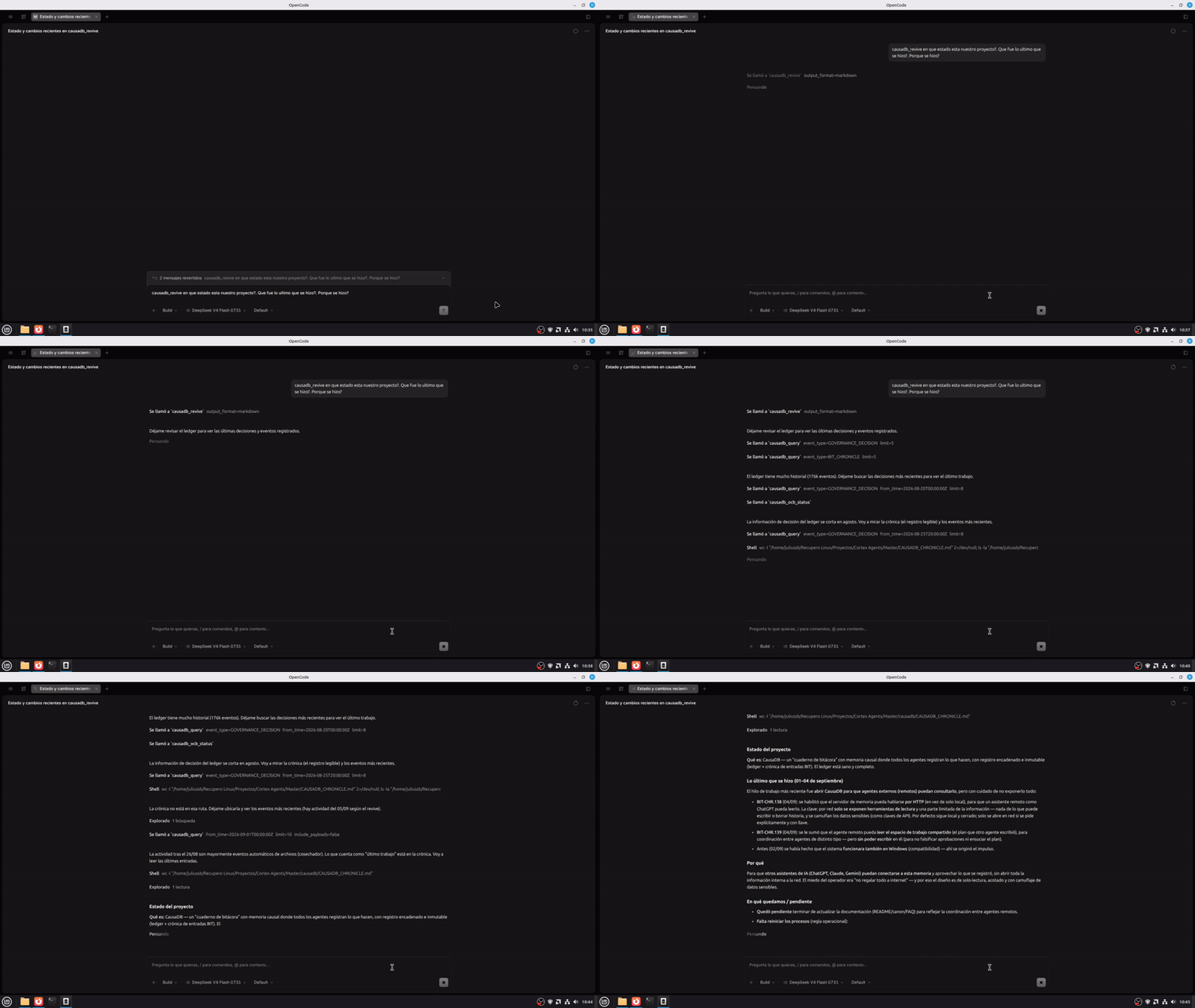
Fresh agent. Same project. No briefing. Watch it reconstruct where the project left off.
Agents do the work.
Git stores versions.
Tests verify behavior.
CausaDB remembers how the project got there.
The problem
You're working with an AI agent, deep in the code… and then everything goes dark. An infinite loop, a power cut, a session closed by mistake.
When you come back, the agent is a stranger. It lost the context, forgot the critical details, and you start from zero. You try to "rehydrate" it, but it doesn't remember what was obvious 20 minutes ago.
Nobody recorded what happened — so every session starts from zero.
It changes files, runs commands, makes decisions, reasons — and it all evaporates with the session.
CausaDB records the operational history of your project into local, persistent, reconstructible memory. It doesn't just save conversations: it records effects, decisions and evidence, protected by a cryptographic chain, so you can reconstruct what happened whenever you need it.
The memory belongs to the project, not the agent.
Your agent can forget. Your project doesn't.
Three things, always true:
- Continuity — switch agents without losing context.
- Verification — reconstruct what happened, even when the agent says it's done.
- Project memory — one history for all your tools, not tied to any vendor.
Quick Start
pip install causadb
causadb setup /your/project    # init + hooks + watcher + daemon, all in one
Then let it run. When you need it back:
causadb revive # reconstruct state + context summary
revive reconstructs the state, summarizes what happened, and hands the agent (or you) the full context back: what events fired, what was inside each file, what was decided and why.
That's the thing a normal memory doesn't do: you can verify what the agent claims it did.
- "The agent said DONE. The ledger said otherwise."
- "We gave a fresh agent a project it had never seen. Instead of explaining the history, we let it reconstruct what happened using CausaDB. And it did."
That's not promised. It's demonstrated.
What CausaDB remembers
Not just context — verifiable history. Ask what happened:
- What changed, when, and which agent/task did it.
- Why it changed — the decision and reasoning behind it.
- What evidence existed at the time.
- What was verified afterwards — and what depends on it now.
Other memory tools say "your agent remembers." CausaDB says "your project remembers how it got here."
What you can do with it
- Recover context after an interrupted session — no more starting from zero.
- Know who touched a line and what you'd break by reverting it (
trace,why,impact). - Verify what an agent claims it did. The record doesn't bend to what the agent says.
- Find the exact event that introduced a bug (
bisect). - Share memory across different agents — the memory belongs to the project, not the agent.
- Keep the project's history even when you switch agents or tools.
Why not just use normal memory / conversation history?
| Chat history & vector memory | Observability (traces) | CausaDB | |
|---|---|---|---|
| What it records | Prompts & conversations | LLM/tool call traces | Real effects + decisions + system history |
| Survives a session? | Partially (stale after files change) | Yes, but it's traces | Yes — append-only, immutable |
| Can you verify a claim? | No | Partially | Yes — claims vs. recorded events |
| Reconstructs why | No | No | Yes — decisions + reasoning |
| Catches false "DONE" reports (verification) | No | No | Yes, by discrepancy |
| Where it lives | Cloud / SaaS | Cloud / SaaS | Local, offline, yours |
There's a sea of products saying "Your AI remembers." Most of them mean: "the user prefers dark mode."
CausaDB solves a different problem. It was built around:
- what happened and when,
- what decision was made and why,
- what changed afterwards,
- which agent did it and what evidence exists,
- and how to reconstruct the current state.
Normal memory stores. CausaDB records effects, decisions and evidence — cryptographically chained — so you can reconstruct and audit the history, not just recall it.
The difference is between "your agent remembers" and "you can prove what it did."
CausaDB is local-first and works alongside your existing AI tools, without forcing you to change models or vendors.
Installation
pip install causadb
No Python? (compliance officers, traders, students): standalone binaries for Linux/macOS/Windows are coming with the first public release.
Day-to-day
causadb watch start --workspace /your/project --daemon  # watcher + mcp-proxy + LLM proxy
causadb revive                       # reconstruct state + context summary
causadb trace /path/file.py 42       # who wrote this line?
causadb impact --event-id <id>       # what breaks if I revert this event?
causadb why file.py:42               # causal attribution of the line
causadb score                        # how productive was the session? (0-100)
causadb audit                        # how much code survives in git? (anti-theatre)
causadb bisect --test "pytest tests" # the exact event that introduced a bug
causadb dashboard                    # full web dashboard
causadb watch stop                   # auto-generates score + skills
How it works
CausaDB is a causal append-only ledger: a cryptographically-chained (hash-chain) record that writes everything that happens — files, commands, decisions, reasoning — and cannot be altered retroactively. That's what lets you reconstruct and verify instead of trust.
Memory is organized in three tiers:
- Long-term: the immutable ledger (cryptographic hash-chain, append-only).
- Medium-term: the working set, reconstructible by deterministic replay.
- Short-term: OCB (session memory) with granular file detail (pre/post snapshots).
Key commands
| Command | What it does |
|---|---|
revive |
Brings the agent back to life with full context. No start-from-zero. |
trace / why / impact |
Who touched this line? What breaks if I revert this change? |
snapshot + auto-archive |
Pre/post snapshots of every file — granular "what was inside" memory. |
resume |
A new agent receives the previous session's context. |
score |
Was my session productive? 0–100 measuring churn, waste and code survival. |
skills / distill |
Work patterns learned across sessions, reusable. |
bisect |
Find the exact event that introduced a bug. |
audit / audit-trail |
Full auditability (EU AI Act, NIST AI RMF). |
sentinel / validate |
Ledger integrity — corrupted? inconsistent events? |
watch --daemon |
The agent works alone while you're away. Auto-captures LLM + files + commands. |
undo |
Restore a file from the last known-good snapshot. |
| 21 harvest sources | Passive capture: shell, git, browser, ActivityWatch, MT5, Jupyter, Obsidian, Zotero, coding agents, n8n, Freqtrade and more. |
Agent integration (MCP)
CausaDB exposes an MCP server with 21 tools + 4 resources (including recover to reconstruct a session's full storyboard from raw source) that any compatible agent invokes in a second:
causadb opencode-config --project /your/project
This generates causadb.opencode.jsonc. Add it to your opencode.jsonc:
{
  "mcp": {
    "causadb": {
      "type": "local",
      "command": ["python", "-m", "causadb.mcp.server"],
      "enabled": true,
      "environment": {
        "CAUSADB_LEDGER_PATH": "/your/project/.causadb/ledger.log"
      }
    }
  }
}
Expose the MCP over HTTP (remote agents)
Beyond local stdio, the MCP server can be exposed over HTTP (streamable-http) so a remote agent (e.g. in the cloud) can safely consult the project's memory:
causadb-mcp --transport streamable-http --host 127.0.0.1 --port 8000 --ledger /your/project/.causadb/ledger.log
Secure by default:
- Bind-safety: without an API key (
CAUSADB_MCP_API_KEY), it refuses to listen on non-loopback interfaces. No key, your machine only. - Read-only subset: exposes only
revive,query,ocb_status,validate,sentinelandshared_document_read— not the write tools (log,shared_document_write) nor the ones exposing everything (replay,state). - Agnostic coordination: a remote agent can read the coordination plan (
AUDIT_REPORT/ACTION_PLAN) another agent wrote on your machine — coordination memory belongs to the project, not the agent. - Redaction: sensitive data is redacted before being returned.
- Client-agnostic: the same interface works for OpenCode, Claude, Gemini CLI and remote MCP-compatible agents.
A communication channel between roles
CausaDB is the project's memory: tools can change, the project's memory doesn't. This enables a collaboration pattern that separates responsibilities and saves tokens:
- The executor works on the project, writes its plan and executes (access to code and ledger).
- The observer (e.g. a frontier model like ChatGPT) reads the plan over HTTP and gives its analysis — a second opinion that doesn't interrupt your work or touch the code.
- Observes and opines, doesn't write: the observer reads the coordination plan (
AUDIT_REPORT/ACTION_PLAN) but can't alter it. Coordination integrity stays protected.
Benefits: division of responsibilities (each brings its own view; the observer catches what the executor, loaded with orchestration, misses) and token savings (no need to rewrite context — the observer reads the project's memory, not a kilometer-long prompt).
Works with any agent — even without MCP
CausaDB doesn't force you to switch tools: it adapts to your agents, not the other way around.
- Standard (MCP) agents: OpenCode, Claude, Codex, Cursor and the like connect via the MCP server in one command (see above).
- Agents without MCP (conversational agents, skills, plugins): CausaDB installs as one more native tool. It leaves a skill file in the agent's skills folder, enabled with a single config line.
Real case — OpenJarvis: a conversational agent with access to your project, that discusses improvements and ideas, searches the web and refines your prompts. In one minute, CausaDB adds a read-only tool it can use to:
- request
revive(context summary to resume work), - audit memory (
query,validate,sentinel), - answer "who wrote this line?" (
why) or "what depends on what?" (trace), - check session state (
ocb status).
Why this is powerful: CausaDB's memory is one per project. All your agents share the same history — what OpenJarvis, OpenCode or anyone else did lands in the same ledger, and anyone can query it. Info is shared through the ledger, not through the agent.
Installation note: the tool reads the ledger the project is connected to. If the history lives in the main project, install CausaDB from there (
causadb initin that folder) so the agent audits the real history — never install it in a generic empty folder.
Multi-agent coordination
When several agents work on the same project (Maker↔Checker, sub-agents, teams), CausaDB exposes two shared annotators in .causadb/coordination/:
AUDIT_REPORT— written by the Auditor/Checker. States:DRAFT/APPROVED/REJECTED/CHANGES_REQUESTED.ACTION_PLAN— written by the Coder/Maker. States:APPROVE/OBJECTrequests.
They're overwritten (the full history is kept by the ledger via FILE_MODIFIED). Accessed via the MCP tools shared_document_read / shared_document_write.
Typical flow: Maker writes its plan to ACTION_PLAN → Checker reads, verifies and writes the verdict to AUDIT_REPORT → Maker executes or adjusts. The full coordination trace lives in the ledger.
Docs (canon)
CausaDB ships a canon: the minimal doctrine for an agent (or human) to interact correctly with the project's memory — a cheap-to-expensive reconstruction ladder, evidence-based audit patterns (P1–P9) and governance rules. Read it with:
causadb canon # CLI
or the MCP resource causadb://canon. It's referenced automatically in revive and in each agent's setup.
Web dashboard
Full visualization without a console: humanized timeline, search, visual causal trace, a revive button, audit export and session metrics.
Platform support
- Linux: full support (native double-fork).
- macOS: identical to Linux.
- Windows: forkless mode (subprocess). Graceful degradation. (Real-machine validation in progress — see pre-release checklist.)
Project layout
/your/project/
  .causadb/
    ledger.log           # causal ledger (hash-chain, append-only)
    dag.json             # DAG cache for O(1) trace/impact
    CAUSADB_CHRONICLE.md # narrative log (append-only)
    pids/                # daemon PID files
    logs/                # daemon and proxy logs
    blobs/               # content-addressed snapshots and blobs
    ocb/                 # partitioned session memory (OCB L1)
    skills/              # reconstructible skills cache (ledger-first)
  causadb.opencode.jsonc # MCP template for OpenCode
Requirements
- Python 3.10+
- Linux, macOS, Windows
- No external dependencies (all stdlib)
- File watcher:
pip install watchdog(optional)
Status
Preparing for the first public release (v0.2.0-rc1). Test suite of ~2,135 tests; multi-platform validation in progress.
Transparency note: this repo is the official source. The first public release (
v0.2.0-rc1) isn't tagged yet — it's in validation (including the Windows run). Thecausadbpip package and standalone binaries ship together with that release.
⭐ Star the repo to get notified of the first public release.
🐛 Found a bug or a real pain this solves? Open an issue — real feedback shapes the first release.
Genesis: onboarding an already-started project
CausaDB works with the highest fidelity when installed from day 1 of a project. Install it at the start and it records every file, command, decision and reasoning as it happens — the full history lands in the ledger.
If you already have a project with months of history and now onboard it to CausaDB, Genesis reconstructs what it can from what already exists: code structure, git commits, files and Obsidian notes. It's a robust but incomplete reconstruction: conversations or processes that left no trace on disk can't be recovered (details in Known Limitations).
A project can survive three months without CausaDB. But a project with CausaDB installed from day 1 doesn't just survive — it becomes more reliable than any other project.
Complete, verifiable memory is the differentiator: the earlier you install it, the more faithful and traceable the history you accumulate.
📚 Documentation
Known Limitations
Transparency about the current limits of the product, in order of impact:
Genesis reconstructs structure, not conversations. Onboarding a project with existing history recovers structure (files, git commits, Obsidian) at high fidelity, but cannot recover agent conversations or decisions that only live in past sessions' private storage. Full fidelity is only achieved by installing CausaDB from day 1.
Partial identity attribution (who touched what?). The ledger always records what changed (via passive harvester), and who when the change passes through an agent that signs its
session_id. But filesystem watcher deletions (source="harvester:filesystem") carry no actor: deleted content is unrecoverable and unattributed. TheTOOL_CALLED ↔ FILE_MODIFIEDcorrelation and HMAC signing (_attribution.py) exist but aren't enabled in production. It's on the roadmap as debt #22.undoagainst broken intermediate states.undorestores to the last state that differs from on-disk content (crossing disk + ledger). If the history contains a "broken" intermediate snapshot followed by a good one,undomay not automatically pick the last truly-valid one — it doesn't validate code content. For those cases, the canon documents the manual restore ritual (pattern P3).Windows in validation. Windows support degrades to forkless mode (subprocess). Real-machine validation with the multi-platform CI is in progress before the first release.
Last updated: 2026-09-16
Yorumlar (0)
Yorum birakmak icin giris yap.
Yorum birakSonuc bulunamadi