signet
Health Gecti
- License — License: BSD-3-Clause
- Description — Repository has a description
- Active repo — Last push 0 days ago
- Community trust — 16 GitHub stars
Code Gecti
- Code scan — Scanned 12 files during light audit, no dangerous patterns found
Permissions Gecti
- Permissions — No dangerous permissions requested
Bu listing icin henuz AI raporu yok.
The seal of approval for agents and skills: a graph-first semantic governance registry with signed, transparency-logged publication trust.
Signet


The seal of approval for agents and skills.
Signet is a graph-first semantic governance system for autonomous
agents and computational skills. Most registries are catalogs: metadata
in, search out. Signet governs meaning, release state, and evidence —
and stamps every trusted publication with the proof to back it up.
What makes it different:
- Logical identity ≠ publication snapshot. Durable
AGENT/SKILL
identities are separated from immutableAGENT_VERSION/SKILL_VERSION
snapshots, with real lifecycle semantics: supersession, revocation,
archival. - Five-layer validation, not single approval. Every version passes
W3C SHACL graph-shape and policy validation, ontology validation,
advisory LLM semantic analysis, and human review before it can be
certified — with machine-readable evidence stored at each layer. - Cryptographic trust, not vibes. Publication envelopes are
canonicalized twice — operational JSON (RFC 8785 JCS) and semantic RDF
(RDFC-1.0) — digested, and signed with detached signatures verified
against trusted keys. Tampering is detected, not hoped away. - Transparency-logged governance. Every lifecycle operation emits a
canonical governance event into an append-only Merkle log with
inclusion proofs and verifier replay; events anchor to a Tessera-backed
external transparency log with checkpoints, witnesses, quorum, and
split-view detection. - Dual ontologies. Normative
registry_shapeandskill_area
ontology packages govern what claims are publishable; unmapped claims
are captured as de facto vocabulary candidates and promoted only
through human review. - Certification is a pipeline, not a flag. Versions move through
draft → validated → published → certified(withrejected,deprecated,revoked,archived) with evidence requirements and
policy/ontology binding at each stage. - Provenance you can replay. PROV-O modeling links every snapshot to
the activities, agents, policies, and ontologies that produced it —
with traversal and audit-replay endpoints.
Signet is valuable when humans and AI agents can:
- discover useful capabilities quickly
- load the real implementation artifacts
- understand provenance and trust
- use approved data and process skills safely
Why this exists
Inside the company, useful agent files, skills, runbooks, and process knowledge tend to proliferate faster than governance.
That creates three problems:
- people do not know what already exists
- agents cannot tell which artifacts are current and trustworthy
- operational knowledge becomes stale or duplicated
Signet is the answer we are building:
- metadata that is discoverable
- artifacts that are linked and loadable
- lifecycle and certification signals that make trust visible
- MCP and API planes that let humans and agents use the same source of truth
Trust model
This project is not only about metadata.
It is about:
- discoverability
- artifact availability
- provenance
- currentness
- certification
- operator confidence
The skill happy path should be:
- discover
- inspect
- load
- trust
- use
- certify
- recertify
See:
docs/governance-model.mddocs/artifact-storage.md
Implemented now
Publication and lifecycle:
- lifecycle-aware publication for skills and agents with full parity
- certification state machine:
draft,validated,rejected,published,certified,deprecated,revoked,archived - deterministic draft rejection with recorded validation failures
- supersession guards (revoked snapshots are never superseded)
- certification bound to concrete policy and ontology versions, with
optional expiry - publication envelopes with detached signatures (outside the canonical
payload), provenance/revocation/supersession references, and
multi-algorithm cryptographic verification - authenticated/audited writes
Canonicalization and signatures:
- RFC 8785 (JCS) canonical JSON for publication envelopes and governance
events, with per-publicationcanonicalization_algorithmand legacy
fallback - canonical RDF (RDFC-1.0) projection of publication graphs with semantic
digests recorded at publish and certify - frozen publication envelope artifacts at publish, CAS digest verification on
every read (warnby default,enforceopt-in), and explicit live-drift
reporting in publication verification - HTTP artifact byte access (
GET|HEAD /v1/artifacts/{sha256}) withContent-Digestand fail-closed verification (unverified bytes are never
transported) - DSSE/in-toto attestation ingestion (
POST /v1/attestations) with PAE
signature verification against trusted keys, subject binding to publication
artifacts,sg:attestedByevidence links, and aggregates in publication
verification - policy-driven trust gates:
require_validationat publish andrequire_signature/require_trusted_publisher/require_build_provenance
/require_sbomat certification, evaluated against verified signatures and
DSSE attestations - verify-then-load consumer contract: SDK verification helpers
(verifyEnvelopeSignatures,verifyDetachedSignature,verifyRfc6962InclusionProof,fetchArtifactwith local re-hashing) andregistry-operator verify publication|artifact; seedocs/supply-chain-model.md - dual signatures: detached signatures over operational (JSON) or
semantic (RDF) canonical bytes with cross-verification
Validation (five layers):
- built-in graph-shape validation (authored as W3C SHACL Turtle) and
policy packages as versioned CAS artifacts
(POST /v1/policy-packages) in legacy JSON and authored SHACL Turtle
formats - W3C SHACL Core execution (
rdf-validate-shacl, in-process) over
derived RDF with focus-scoped targeting and RE2-backed pattern
execution (ReDoS-safe by construction) - machine-readable violation reports (SHACL result vocabulary; recorded
validator: shacl-v1, engine id, and per-layer shapes fingerprints)
stored in the CAS and linked viasg:validatedBy - dual ontology packages (
registry_shape/skill_area) as versioned
CAS artifacts (POST /v1/ontology-packages) - ontology validation of
capability_claims: concept binding, disjoint
combination rejection, de facto candidate recording - advisory LLM validation (model-agnostic port, deterministic heuristic
default, HTTP model seam) emitting scorecard/prompt/confidence evidence - human review workflow: review decisions as first-class
review_evidenceartifacts viasg:reviewedBy, policy-drivenrequire_human_reviewgating at publish/certify, and a pending-review
queue (/v1/reviews/pending)
Authored Turtle policies are registered with POST /v1/policy-packages
(shapes_format: "shacl-turtle"). A minimal policy — require a description
on every skill version — looks like:
@prefix sh: <http://www.w3.org/ns/shacl#> .

<urn:policy:description> a sh:NodeShape ;
    sh:targetClass <urn:sg:entity-type:SKILL_VERSION> ;
    sh:property [
        sh:path <urn:sg:property:description> ;
        sh:minCount 1 ;
        sh:message "description_required_by_policy" ;
    ] .
The local demo walkthrough
registers this policy end to end and inspects the resulting validation report.
A recorded run of the same walkthrough — plus the browser console — is indocs/demo/signet-demo.mp4.
Transparency and provenance:
- trusted
PUBLIC_KEY,TRANSPARENCY_LOG, andTRANSPARENCY_WITNESS
trust roots - transparency checkpoint registration, checkpoint history, and
RFC 6962 consistency-proof validation - witness attestations, quorum checks, checkpoint observations,
disagreement evidence, gossip events, and timeline/provenance views - minimal signed-note checkpoint ingestion seam
- canonical governance events for every lifecycle operation, stored as
immutable CAS artifacts and appended to an internal Merkle log with
RFC 6962 inclusion-proof generation and verifier replay
(/v1/governance-log*) - governance-event digests staged through the Tessera sidecar for all
lifecycle operations when configured - PROV-O provenance:
prov:wasDerivedFrom/prov:wasGeneratedBy/prov:used/prov:wasAssociatedWithedges written at every lifecycle
operation, with traversal + audit-replay endpoints and the read-onlyregistry.get_provenanceMCP tool - canonical provenance export: the read view projects to a deterministic
PROV-O graph — RDFC-1.0 canonical N-Quads with a content-addressed
artifact and digest on every response, plus a JSON-LD representation
(?format=jsonld); detached provenance signatures bind that digest
(reads re-verify withvalid/invalid/staleverdicts — stale
marks signatures made before the trail grew, and the signed export
stays retrievable);registry-operator verify provenanceand the SDK'sverifyProvenanceSignaturereproduce verdicts locally; evidence
artifacts (exports, signatures, report RDF) also stage transparency
append intents and reconcile against the companion log - validation reports as standardized RDF: every report artifact carries a
sh:ValidationReportJSON-LD representation of its layers and results
with its own RDFC-1.0 canonical digest + artifact; report artifacts are
signable by trusted keys over that canonical RDF
(GET|POST .../report-signatures) and re-verifiable locally
(registry-operator verify report-signatures)
Ingestion and vocabulary:
- semantic compiler ingestion: markdown frontmatter and tool manifests
compile to normalized capability claims atPOST /v1/compile/skill - de facto vocabulary store with human-reviewed promotion into new
normative ontology versions (/v1/de-facto-terms*)
Storage and operations:
- content-addressed artifact storage (filesystem or S3)
- Fuseki-backed metadata by default, with a persistent local JSON-file
backend for development - time-aware object slice: commits, refs, tags, workspaces, manifests,
retention roots - durable, non-destructive GC job execution seam
- GitHub Actions CI for service/api, service/mcp, and tessera-sidecar
Proposed next (not implemented yet):
- richer SHACL engine coverage (SHACL-SPARQL constraints, SHACL-AF rules)
beyond the executed Core components - normative ontologies encoded as first-class RDF/OWL vocabularies
- richer de facto ontology mining (runtime observations, corpus analysis)
- richer PROV-O coverage (JSON-LD export, canonical RDF signatures over
provenance graphs) - richer LLM backends for the advisory validation layer
- full WORM/transparency integration with Trillian/Tessera reconciliation
- deeper witness-network semantics across multiple independent parties
- fuller signed-note / Tessera ecosystem compatibility
Get it to run
If you want the quickest local path — no Docker, no AWS, no Kubernetes:
for d in service/api service/mcp service/webapp/knowledge-manager client/registry-cli; do
  (cd "$d" && npm ci)
done
scripts/demo-local.sh demo
That starts api (:3100), mcp (:3000), and the webapp (:3200) against local
SQLite/JSON-file/filesystem backends and seeds the blessed demo pack
(1 agent, 2 published skills — each validated through the W3C SHACL engine)
with registry-operator. Seedocs/local-demo.md for the Docker Compose and local-Kubernetes (kind)
variants that keep the same no-AWS property, and for the verified
SHACL policy walkthrough.
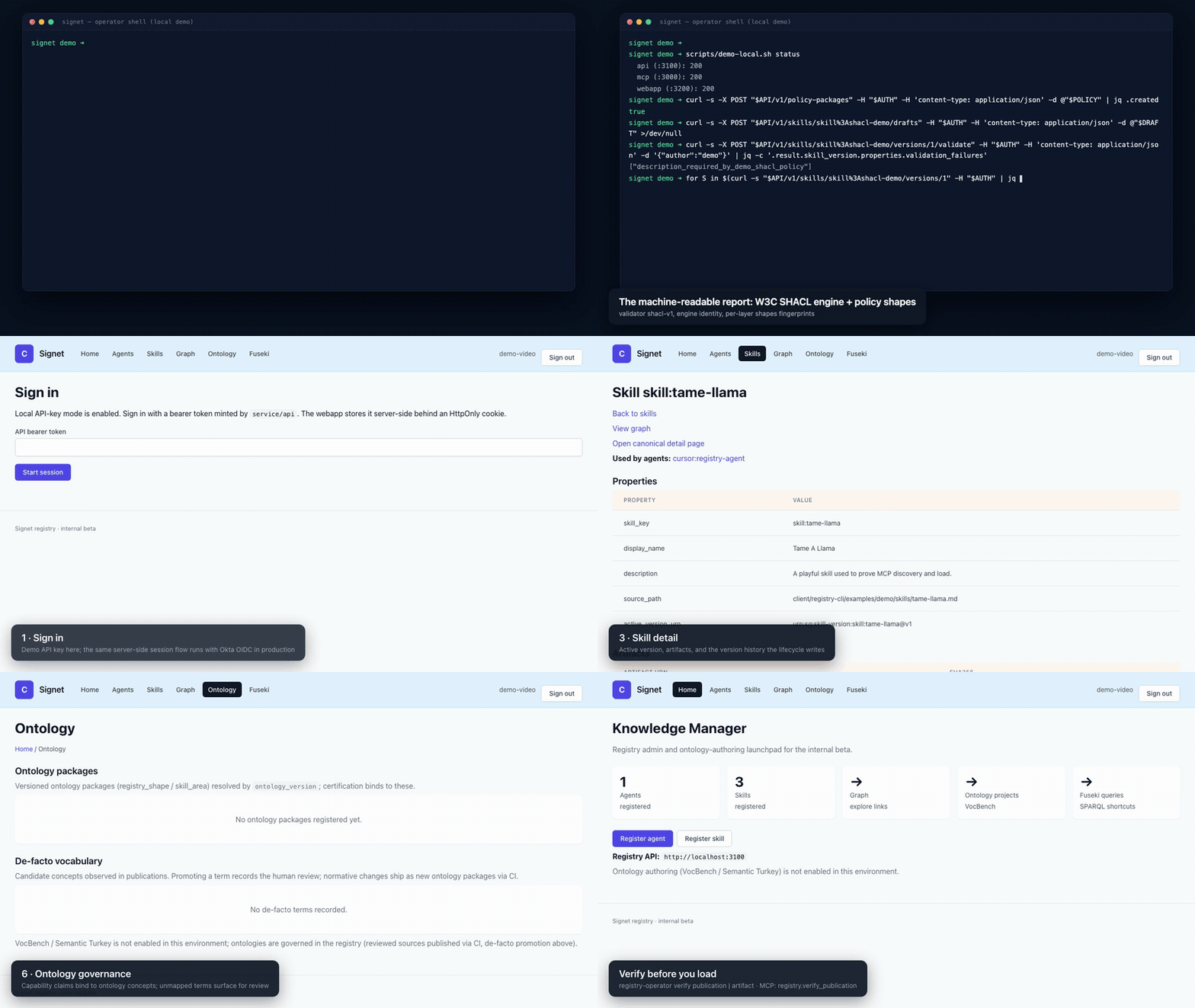
Recorded walkthrough (65s, click for full quality): the operator shell runsscripts/demo-local.sh status, registers an authored W3C SHACL Turtle
policy, shows a draft rejected with the policy's message, prints the
machine-readable report (validator: shacl-v1 + engine + policy shapes),
and registry-operator verify publication returns verdict: verified —
followed by the web console, graph explorer, and OpenAPI docs.
Full video: docs/demo/signet-demo.mp4
(source script: service/webapp/knowledge-manager/scripts/demo-video.ts).
Then verify:
curl -s http://localhost:3000/healthz
curl -s http://localhost:3100/healthz
curl -s http://localhost:3200/healthz
Expected:
service/mcponhttp://localhost:3000service/apionhttp://localhost:3100service/webapp/knowledge-manageronhttp://localhost:3200
Current local metadata defaults:
service/apiin compose defaults to the persistent localjson_filegraph state atdata/registry/graph/registry-state.json- local Fuseki-backed
sparqlremains available as the optional inspection and live-validation backend for operators
Current artifact default:
- filesystem CAS under
data/registry/objects/
Best human entrypoints
Start here:
docs/governance-model.mddocs/tessera.mdDEMO.mddocs/quick-value-roadmap.mddocs/blessed-demo-path.mddocs/fuseki-query-pack.mddocs/graph-ui-plan.md
Human Proof Runs
The current team-facing proof story has four lanes:
- inspect the committed real sample shape
- seed that sample through the real operator path and print reports
- run happy-path and unhappy-path verification tests
1. Inspect the committed real sample
Run from:
cd signet/client/registry-cli
Print the committed transparency sample without requiring the stack or an API token:
npm run dev -- seed transparency-sample --spec examples/transparency/sample-graph.spec.json --dry-run
This uses the checked-in sample under:
client/registry-cli/examples/transparency/sample-graph.spec.json
2. Seed the real sample and print reports
Create a write API key first if you do not already have one:
cd signet/service/api
npm run create-api-key -- --owner-label "Teammate Sample Run"
Then seed the committed sample through the real operator path:
cd signet/client/registry-cli
npm run dev -- seed transparency-sample --api-token "<api-token>" --spec examples/transparency/sample-graph.spec.json
That prints:
- the seeded sample metadata
- the transparency log payload
- the verification payload
- the timeline payload
For a smaller human-facing report instead of the full JSON payloads:
cd signet/client/registry-cli
npm run dev -- seed transparency-sample --api-token "<api-token>" --spec examples/transparency/sample-graph.spec.json --human-proof-report
What the seeded real sample models:
- one transparency log
- one trusted checkpoint key
- two witnesses
- two checkpoints
- one conflicting same-size-different-root observation
- one witness-to-witness gossip event
3. Run happy-path and unhappy-path trust tests
Run these from:
cd signet/service/api
Happy path for a markdown-backed skill publication:
npx vitest run tests/unit/skill-lifecycle.test.ts -t "shows a happy-path trust story for a markdown skill publication" --reporter=verbose
This proves:
- the publication envelope still matches the signed state
- a trusted public key is resolved
- cryptographic verification passes
- the transparency proof validates against the trusted checkpoint/log model
Unhappy path showing tamper-evident failure after a signed publication changes:
npx vitest run tests/unit/skill-lifecycle.test.ts -t "shows tamper-evident failure for a signed markdown skill publication after state changes" --reporter=verbose
This proves:
- the later mutation is detected
verification_status: signature_mismatchtransparency_verification_status: mismatch- signer, key, log, and proof context remain visible for human inspection
4. Run realistic sample-graph integration proofs
Persistent local proof over real HTTP with the json_file backend:
npx vitest run tests/e2e/transparency-blackbox.test.ts --reporter=verbose
Live Fuseki/SPARQL proof:
ENABLE_LIVE_SPARQL_E2E=1 \
REGISTRY_SPARQL_QUERY_URL=http://127.0.0.1:3030/registry/sparql \
REGISTRY_SPARQL_UPDATE_URL=http://127.0.0.1:3030/registry/update \
REGISTRY_SPARQL_USERNAME=admin \
REGISTRY_SPARQL_PASSWORD=admin \
npx vitest run tests/e2e/api-sparql-live.test.ts --reporter=verbose
What these prove today:
- the operator CLI can seed a committed real sample that teammates can inspect and replay
- the happy-path skill test shows a valid signed and transparency-verified publication
- the unhappy-path skill test shows a tamper-evident trust failure with preserved forensic context
- the e2e lanes prove the same trust story over realistic sample graphs, first with persistent local
json_file, then with live Fuseki/SPARQL
Fast demo path
If you want the current blessed demo:
cd signet/client/registry-cli
npm install
npm run dev -- bootstrap test --reset --force --up
That command seeds:
- one demo agent:
cursor:registry-agent - one MCP usage skill:
skill:registry-mcp - one fun proof skill:
skill:tame-llama
The operator CLI now also supports:
- richer multi-skill / multi-agent bootstrap packs with profiles and dependency-aware planning
- a second real-Okta bootstrap verification lane for the registry-admin surface
Fresh bootstrap path
For a fresh local registry bootstrap, the intended operator sequence is:
- start the stack with
cd signet/infra && make up - mint write credentials for
service/api - seed lifecycle-aware skills first
- seed agents that reference those skills
- verify discovery/load through
service/mcp
Important bootstrap rule:
- skills must be seeded before agents that reference them
- lifecycle-aware bootstrap should use the skill lifecycle endpoints, not only
POST /v1/skills - the future home for this workflow is
client/registry-cli
High-level architecture (intended)
- Domains: registry entities and relationships (graph-first metadata model).
- Connect:
- MCP adapter(s) for agent harnesses (Cursor, Claude Code, etc.)
- API surfaces for programmatic interaction (canonical contracts)
- Human interfaces:
- Web UI for browsing/operating the registry
- current thin launchpad under
service/webapp/knowledge-manager
- Data/Storage:
- Graph database for registry metadata and relationships (planned / evolving)
- Content-addressable artifact store for agent/skill source files (planned / evolving)
- Processes:
- Validation/certification and other operational processes (planned / evolving)
Agent Data Access Gateway (this repo area)
Under service/mcp/ we are building the Agent Data Access Gateway as specified in the spec pack at service/mcp/AGENTS/.
Canonical boundaries
service/registry- canonical internal registry core
service/api- canonical external management plane for humans, webapp flows, and CI/CD
service/mcp- canonical AI-facing plane
Current rule:
service/apiandservice/mcpshould consume shared registry logic directlyservice/mcpshould not callservice/apiover HTTP inside the same service- Jena/Fuseki stays behind adapters, not as the public contract
Key invariants:
- MCP stays thin: it is an adapter only.
- Canonical Tool API is the source of truth.
- Read-only + auditability are hard release gates.
Current implementation status (incremental):
service/mcp/: PHASE 0–9 implemented and green (Tool API + MCP + auth + audit + safety + mock-first connectors + Stage 2 seams).service/api/: bootstrap skeleton plus first versionedagentsandskillsmetadata API slices implemented and green, including artifact attachment semantics, skill linkage, and idempotent create behavior.service/api/: lifecycle-oriented management plane for skills and agents with full parity (draft/validate/publish/promote/deprecate/certify/revoke/archive/active-version resolution).service/api/: the certification state machine now coversdraft/validated/rejected/published/certified/deprecated/revoked/archivedwith deterministic draft rejection, supersession guards, and policy/ontology-bound certification.service/api/: policy packages are first-class versioned artifacts (POST /v1/policy-packages) in legacy JSON and authored W3C SHACL Turtle formats; draft validation executes W3C SHACL Core for the built-in graph shape and policy shapes, stores machine-readable violation reports in the CAS, and links them viasg:validatedBy.service/api/: dual ontology packages (registry_shape/skill_area) are versioned artifacts (POST /v1/ontology-packages); draft validation checkscapability_claimsbind to known skill-area concepts, rejects disjoint combinations, records de facto candidates, and binds certification to registered ontology packages.service/api/: advisory LLM validation runs as a fourth, always-non-blocking layer with scorecard evidence artifacts; human review records decisions asreview_evidenceartifacts with policy-driven gating and a pending-review queue.service/api/: semantic compiler ingestion (POST /v1/compile/skill) normalizes markdown and tool manifests into typed proposals, with a de facto vocabulary store and human-reviewed promotion.service/registryandservice/apinow expose the first time-aware object slice (commits, refs, tags, workspaces, manifests, retention roots, GC jobs) with a first public draft-workspace operation and a durable, non-destructive GC job execution seam.service/api/now defaults to a persistent local graph adapter for metadata writes in local development.service/api/also exposes an optional SPARQL-backed graph seam, with the default testsuite now including a black-box e2e API test.- local Fuseki/Jena is now available in compose, and the env-gated live SPARQL API e2e path has been validated successfully.
service/api/write routes now require auth and persist audit/auth state in SQLite.service/mcp/now includes a repeatable registry bootstrap CLI that can seed the configured persistent graph backend plus CAS for beta environments.service/webapp/knowledge-manager/now goes beyond browsing and exposes first registry-admin read/write flows overservice/api(agent registration, skill registration, and skill draft creation).service/registryandservice/apinow expose a real transparency/governance trust layer with trusted public keys, transparency logs, transparency witnesses, checkpoint history, consistency proofs, witness attestations, observations, disagreement evidence, gossip events, timeline inspection, signed-note compatibility, richer note parsing, temporal witness forensics, and stronger provenance on observations and gossip.service/registrynow emits canonical governance events for every lifecycle operation into an internal append-only Merkle log, with inclusion-proof generation and verifier replay over/v1/governance-log*.service/registrynow projects publication graphs to canonical RDF (RDFC-1.0) with semantic digests, and verifies dual (operational/semantic) detached signatures.service/registrynow tracks PROV-O provenance for all lifecycle operations, with traversal and audit-replay endpoints and the read-onlyregistry.get_provenanceMCP tool.service/apinow serves a generated OpenAPI 3.1 spec atGET /v1/openapi.jsonand a Swagger UI atGET /v1/docs, derived from the route contracts via@hono/zod-openapi.client/registry-sdknow provides a typed, read-first client SDK (@signet-registry/sdk) generated from the OpenAPI spec, with a CI publish workflow onregistry-sdk-v*tags.service/mcpnow exposes aregistry.searchdiscovery tool so a fresh agent can self-orient by searching skills and agents, plus a read-onlyregistry.verify_publicationtool that returns envelope digest, signature, and transparency verdicts for a version.service/mcpnow includes an opt-in cognitive layer that estimates tool-result token cost and summarizes payloads that exceed a configured LLM context budget, with ephemeral summary caching.- the repo now includes Terraform for a locked-down shared S3 bucket seam, Aurora/Secrets Manager wiring for the Tessera AWS backend state, and optional
tessera-sidecar/tessera-runtimecompanions for future transparency-backend experiments. - publish/certify flows can now stage real publication/governance append intents through the sidecar and preserve the returned S3 references in the trust model when the sidecar is configured.
- Note: external warehouse connections and Okta validation may run in MOCK mode in early phases to stay unblocked (documented in
service/mcp/README.md).
Agent integration surfaces
Signet is designed to be available to every agent workflow. The current surfaces:
- OpenAPI 3.1 spec + Swagger UI —
GET /v1/openapi.jsonandGET /v1/docsonservice/api. Seedocs/api-reference.md. - Typed read-first SDK —
@signet-registry/sdkunderclient/registry-sdk, generated from the spec. Seeclient/registry-sdk/README.md. - MCP gateway —
service/mcpexposes read-onlyregistry.*tools (includingregistry.search,registry.verify_publication, andregistry.get_attestations) over Streamable HTTP at/mcp. Seedocs/mcp-onboarding.mdfor per-harness config (Claude Code, Cursor, opencode, generic MCP clients). - Cognitive layer — opt-in token-context estimation + summarization in
service/mcp(seeservice/mcp/README.md). - Operator CLI —
@signet-registry/operatorunderclient/registry-cli, packaged for CLI-first agents (seeclient/registry-cli/README.md). - Onboarding skill — a distributable
signet-registryskill teaching the discover → inspect → load → trust → use flow (seeskills/and.cursor/skills/signet-registry/).
Infrastructure
- System-level infra (compose, shared networking, shared volumes, env wiring):
infra/ - Per-service infra:
service/mcp/infra/service/api/infra/service/registry/infra/service/webapp/knowledge-manager/infra/
- Local operator entrypoint:
cd infra && make up(uses base + override compose files)
Production deployment (two-repo rule)
- This repo ships release-tagged artifacts only: immutable, digest-pinned images
and the Helm chart (charts/signet), published to GHCR
(ghcr.io/<owner>/signet/…) by.github/workflows/release.yamlwith the
workflow'sGITHUB_TOKEN— no cloud account or static credentials. - The environment repo that owns Terraform state applies the pinned
chart via thesignet-eksmodule. - Reusable Terraform modules live under
infra/terraform/modules/(needed only
for the AWS/EKS deployment path — the release pipeline itself is provider-free):signet-registry— immutable ECR repos + GitHub OIDC publish role (optional ECR mirror)signet-data— KMS, Secrets Manager, S3 artifacts, RDS Postgres, ElastiCache Redis, IRSAsignet-eks— version-pinned Helm release wrapper
- Deploy runbook:
docs/runbooks/deploy.md; secrets:charts/signet/SECRETS.md.
Human docs
- local operator guide:
docs/local-development.md - adopting the deployed registry:
docs/adoption.md - deploy runbook:
docs/runbooks/deploy.md - demo data reseed:
docs/runbooks/demo-reseed.md - off-platform migration/cutover:
docs/runbooks/migration-cutover.md - service boundaries:
docs/service-map.md - registry domain/storage model:
docs/registry-model.md - API reference:
docs/api-reference.md - MCP onboarding:
docs/mcp-onboarding.md - beta-v1 readiness and scope:
docs/beta-v1-readiness.md - docs index:
docs/README.md
Service entrypoints
service/mcp/README.mdservice/api/README.mdservice/registry/README.mdservice/tessera-sidecar/README.mdservice/tessera-runtime/README.mdservice/webapp/README.mdservice/webapp/knowledge-manager/README.mdclient/registry-cli/README.mdclient/registry-sdk/README.md
Registry (agents/skills) direction
We are extending the system to provide a graph-first registry of agents and skills, exposed via canonical registry.* tools and the MCP adapter.
Beta v1 recommendation
The most credible first beta should be scoped narrowly to:
- authenticated AI agents discovering agents and skills through
service/mcp - those agents loading linked artifact content from the registry
- internal operators managing registry metadata through
service/api
The broader human knowledge-manager track under service/webapp/knowledge-manager/ should be treated as a parallel product track, not as a release gate for the first internal beta unless explicitly expanded.
Current implementation note:
- the webapp now exists as a thin runnable admin surface over
service/api - the webapp now supports a minimal server-side management session and browser-driven skill lifecycle operations
- the webapp auth/session flow now aligns to the
service/apiauth direction: API-key fallback for local mode, Okta-style session acquisition forokta/dual - the webapp session store is now durable via local SQLite persistence
- real Okta-backed ontology access via the Semantic Turkey / VocBench companion remains intentionally deferred
- ontology authoring is still intentionally externalized to VocBench / Semantic Turkey rather than rebuilt inside the repo webapp
- optional local VocBench / Semantic Turkey can be enabled as a compose companion for ontology-authoring experiments
Credits
Signet is built by Derek C. and
Pablo Ferrari.
Yorumlar (0)
Yorum birakmak icin giris yap.
Yorum birakSonuc bulunamadi