ijfw
Health Pass
- License — License: MIT
- Description — Repository has a description
- Active repo — Last push 0 days ago
- Community trust — 162 GitHub stars
Code Fail
- fs module — File system access in .github/workflows/ci.yml
- rm -rf — Recursive force deletion command in .github/workflows/publish.yml
Permissions Pass
- Permissions — No dangerous permissions requested
No AI report is available for this listing yet.
One install. Shared memory, smart routing, disciplined workflow, multi-AI audits -- across every AI coding agent. No BS.
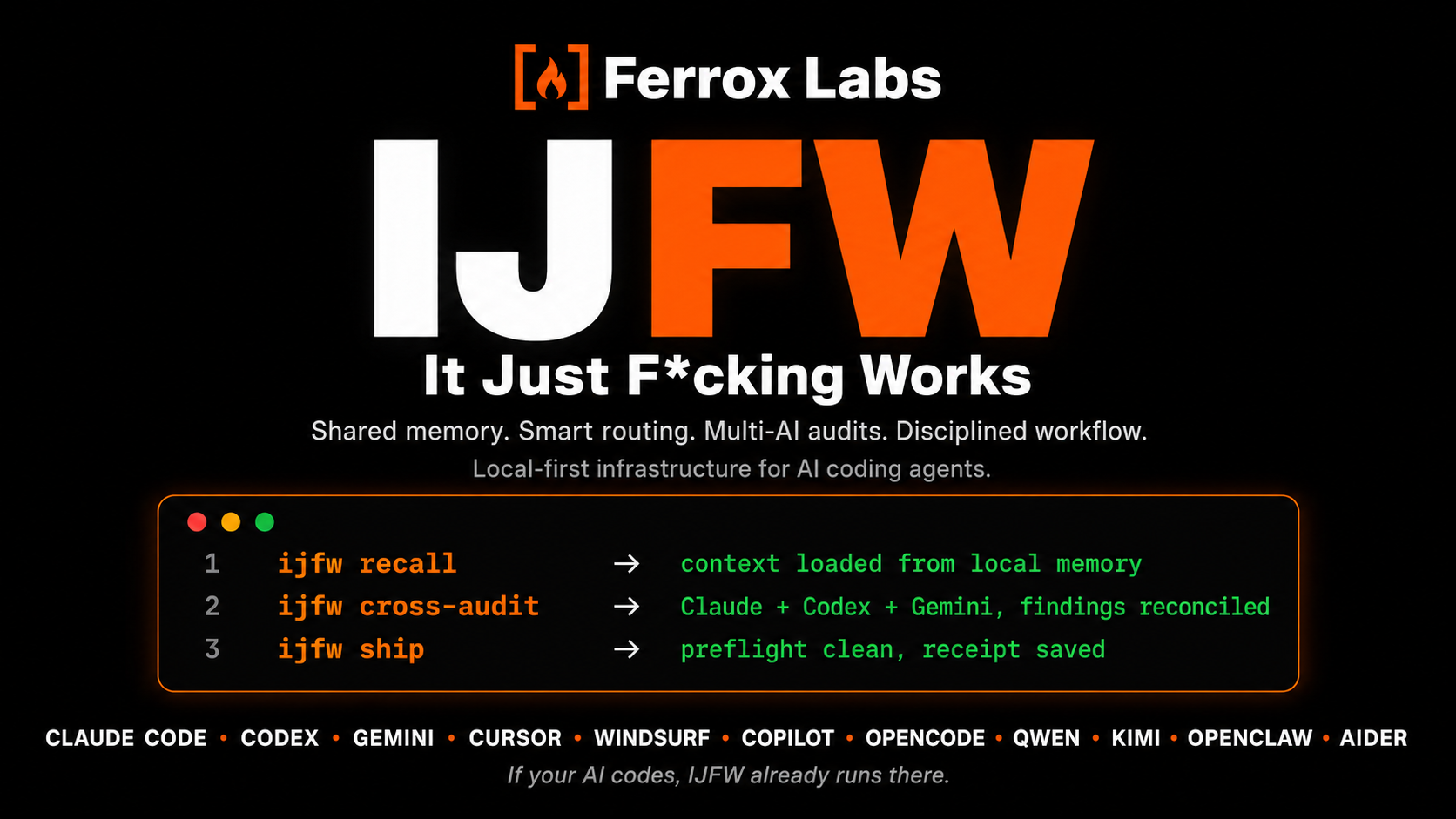


IJFW (It Just F*cking Works!)
Your AI is brilliant. It's also forgetful, undisciplined, alone, and quietly burning tokens you never needed to spend. One install fixes all four. Richest on Claude Code, connected through Codex, Gemini, Cursor, Windsurf, Copilot, Hermes, Wayland, OpenCode, Qwen Code, Kimi Code, OpenClaw, and Aider.
Thirteen AI coding agents sharing one local memory that survives every session, every project, every restart. One disciplined workflow drives anything you'd open an AI for: code, books, launches, research, businesses. From idea to ship.
An on-demand three-AI critique puts a second lineage in the room so one model's blind spot never reaches production. Tasks dispatched to the right model for the job, output rules that strip the padding, prompt-cache discipline that compounds every session. Your bill goes down while your quality goes up.
A portable design contract keeps every AI on-brand: drop a DESIGN.md in your project root, or pick from 12 curated templates (Claude Design compatible), and the same palette, typography, and component rules carry across every agent on your stack. No more "make it look nice" as a prompt. No more cross-agent drift.
Whatever AI tools you use today, whatever you switch to tomorrow, IJFW makes them work as one brain. You bring the AI accounts you already use; IJFW adds nothing to pay for, runs entirely on your machine, and keeps every byte local.
One command to install. Then your AI starts behaving like a senior partner that's already read the brief. And you start wondering how anyone still works the old way.
Install
npm install -g @ijfw/install && ijfw-install
One command. Thirteen AI coding agents configured. Nothing to log into.
Windows (PowerShell 5.1 or 7+):
iwr https://raw.githubusercontent.com/FerroxLabs/ijfw/main/installer/src/install.ps1 -OutFile install.ps1
.\install.ps1
Preflight (all platforms): Node 18 or newer, Git, and a bash shell (Git for Windows ships one). Windows users do not need WSL. If execution policy blocks the script, run PowerShell as powershell -ExecutionPolicy Bypass -File .\install.ps1.
What you see:
  +----------------------------------------+
  |                                        |
  |  IJFW  It just f*cking works.          |
  |                                        |
  +----------------------------------------+

  Installed at  ~/.ijfw

  ==> LIVE NOW (6)
      o  Claude Code
      o  Codex
      o  Gemini
      o  Windsurf
      o  Hermes
      o  Wayland

  ==> STANDING BY (2)   auto-activate on install
      o  Cursor
      o  Copilot

  ==> ONE MORE STEP   inside Claude Code
      /plugin marketplace add ~/.ijfw/claude
      /plugin install ijfw

  Full log   ~/.ijfw/install.log
Live now is the platforms on your machine, configured immediately. Standing by is every platform you do not yet have, pre-staged. Install Cursor next month and IJFW activates automatically. No rerun, no setup, no thought.
Every existing config gets a .bak.<timestamp> backup. Your existing MCP servers, model preferences, and per-project trust settings are preserved.
Full guide, one command away
Every install ships the complete guide. Open it in your terminal or your browser -- no network required, no page to bookmark, no docs site to remember.
ijfw help             # terminal, paged through less -R
ijfw help --browser   # rendered in your default browser, dark theme
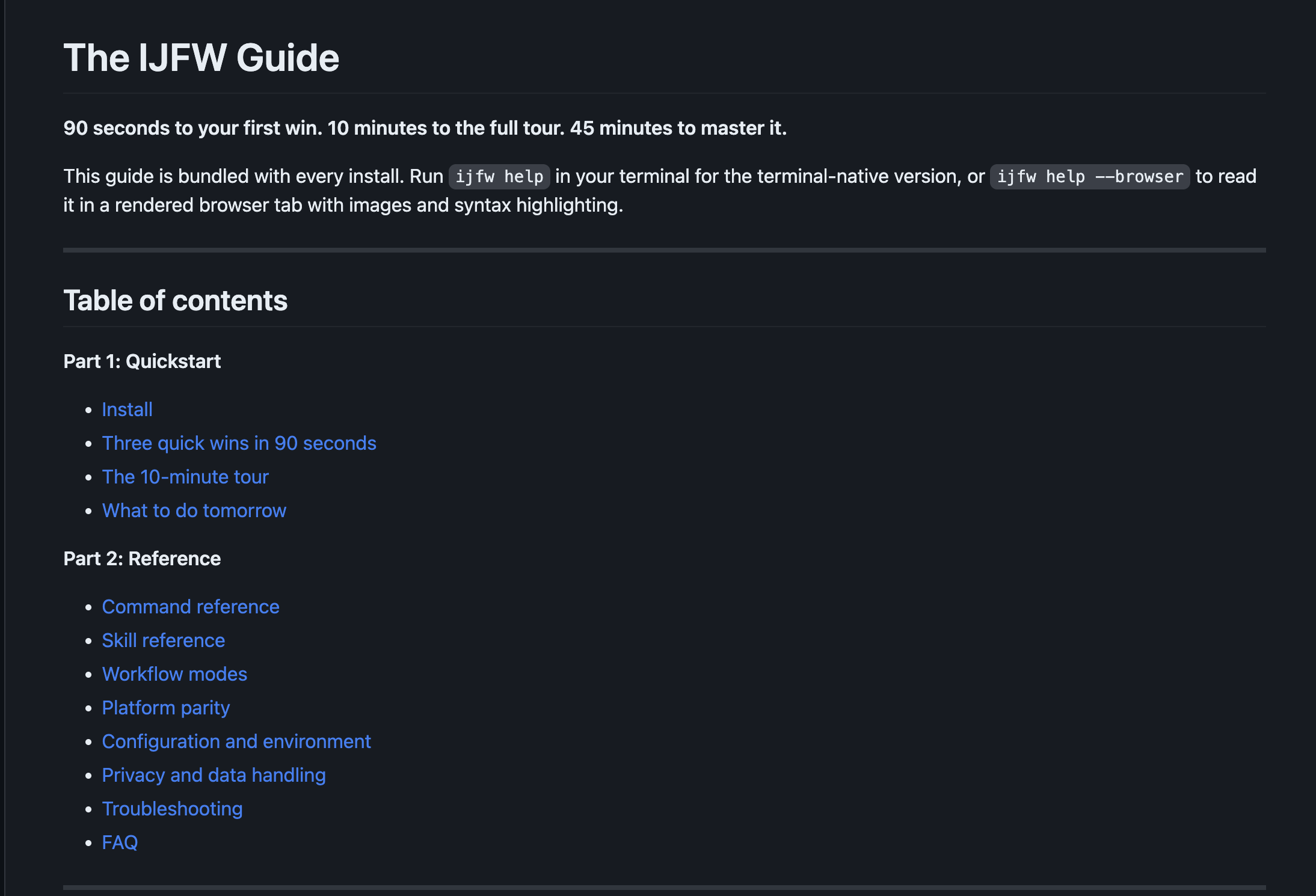
90 seconds to your first win. 10 minutes to the full tour. 45 minutes to master it.
Too lazy to type? Tell your AI to do it.
Copy this whole block, paste it into any AI coding agent you use (Claude Code, Codex, Cursor, Windsurf, Copilot), and hit enter. The agent will install IJFW, verify the MCP server is running, and prompt you to restart.
Install IJFW (It Just F*cking Works) on my machine with the one-command installer, then verify it is working.

Run this exactly:

  npm install -g @ijfw/install && ijfw-install

After it finishes, do these verifications and paste the results back to me:

  1. Run `ijfw doctor` -- expect a platform table showing which AI agents are live
  2. Run `ijfw --help` -- expect the full command list
  3. Check `~/.ijfw/claude/.mcp.json` exists and contains an absolute node path
  4. Run a quick MCP handshake test:
     echo '{"jsonrpc":"2.0","id":1,"method":"initialize","params":{"protocolVersion":"2024-11-05","capabilities":{}}}' | node ~/.ijfw/mcp-server/src/server.js | head -1
     expect a JSON response containing "result" and "ijfw-memory"

If a step does not complete, read the installer log at ~/.ijfw/install.log and tell me what it shows so we can resolve it.

When everything is green, tell me to fully exit my AI agent (not just a new tab -- full process quit) and restart it so IJFW loads on session start. Once restarted, run /mcp inside Claude Code to confirm plugin:ijfw:ijfw-memory shows as connected.
Uninstall
One command reverses the install across every configured platform. Memory is preserved by default.
ijfw uninstall        # keeps ~/.ijfw/memory/ (recoverable on reinstall)
ijfw uninstall --purge  # also removes memory (destructive)
Equivalent aliases: ijfw off (same as ijfw uninstall), or ijfw-uninstall from the @ijfw/install npm package.
What gets removed: IJFW entries from ~/.claude/settings.json (mcpServers.ijfw-memory, enabledPlugins['ijfw@ijfw'], extraKnownMarketplaces.ijfw), Codex / Gemini / Cursor / Windsurf / Copilot / Hermes / Wayland platform configs, ~/.ijfw/claude, ~/.ijfw/mcp-server, the ijfw* binaries from ~/.local/bin/, and plugin cache under ~/.claude/plugins/cache/ijfw/. Every modified file gets a .bak.<timestamp> first. Your other plugins, MCP servers, and per-project trust settings stay untouched.
Preflight
Run this before any publish or production deploy. ijfw preflight executes an 11-gate quality pipeline in under 90 seconds on a warm cache and exits 0 only when every blocking gate passes.
ijfw preflight
| # | Gate | Blocks on fail? | What it catches |
|---|---|---|---|
| 1 | shellcheck | yes | Unbound variables, POSIX violations in hook scripts |
| 2 | oxlint | yes | Unused imports, dead variables in JS/TS |
| 3 | eslint-security | advisory | Security anti-patterns (non-literal fs paths, injection sinks) |
| 4 | psscriptanalyzer | advisory on macOS | PowerShell lint (blocking in Windows CI) |
| 5 | publint | yes | package.json bin/exports integrity |
| 6 | gitleaks | yes | Plaintext secrets and credentials |
| 7 | audit-ci | yes | npm audit: high and critical vulnerabilities |
| 8 | knip | advisory | Unused exports and dead code |
| 9 | license-check | advisory | Production dep license compatibility |
| 10 | pack-smoke | yes | npm pack -> temp install -> ijfw --help exits 0 |
| 11 | upgrade-smoke | yes | Plugin key wiring after upgrade from floor version |
Each gate uses npx --yes <tool>@<pinned-version> with versions tracked in preflight-versions.json. Missing tools are reported as "skipped" with a positive install hint. Preflight is optional -- it is not on the install path -- so the three-second install promise holds.
SLO: warm cache <=90s, cold cache <=240s. Both are printed in the summary line.
PASS 8  WARN 2  SKIP 1  FAIL 0
Time: 7s  within warm-cache SLO (<=90s)

All blocking gates passed.
Dashboard
A live window into every AI session across Claude, Codex, and Gemini. Every PostToolUse event appends one JSONL line to ~/.ijfw/observations.jsonl. The dashboard reads that ledger and streams new events to the browser in real time via SSE.
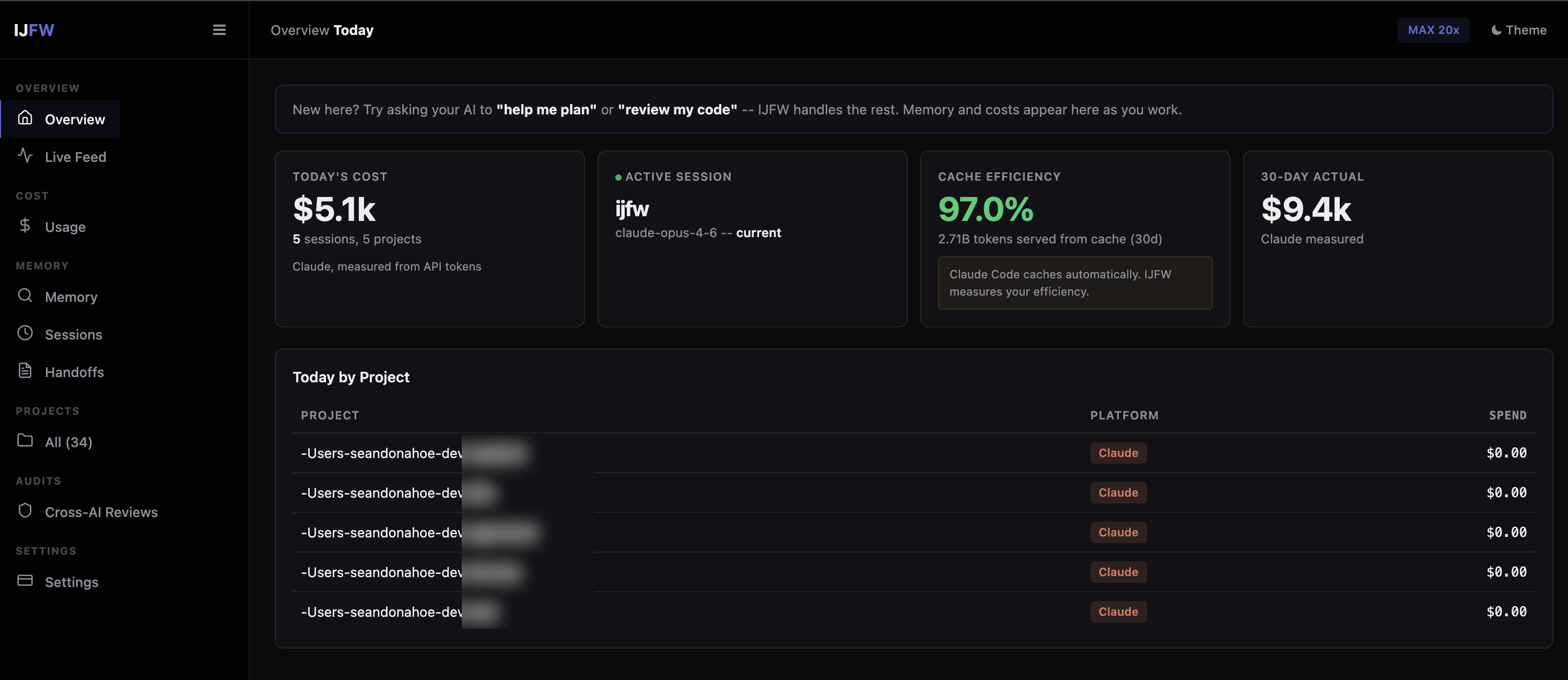
Dogfood receipt -- one machine (the author's), 30-day window: $5.1k today across 5 active sessions, 97% cache efficiency, 2.71B tokens served from cache, $9.4k actual 30-day burn. These are one user's real numbers, not an averaged benchmark. Your own mileage materialises the moment you run ijfw dashboard start against your own traffic.
Dollar-saved ledger. The dashboard's headline tile shows actual spend, estimated spend without IJFW, and savings amount + percentage computed from three levers applied to your real session data: cache hit rate vs a 25% baseline (Anthropic cache reads at ~10% of input pricing), model routing (Haiku fraction vs all-Sonnet baseline), and output discipline (30% measured midpoint of the 20-40% range). Composite capped at 5x for defensibility. Methodology toggle inline -- every number traced to its source. Your numbers, defensible math, zero marketing.
ijfw dashboard start    # bind 127.0.0.1:37891, open browser
ijfw dashboard status   # show port + observation count
ijfw dashboard stop     # graceful shutdown
The web dashboard at http://localhost:37891 is a single-file zero-dependency HTML page:
- Session timeline showing every tool call, file touched, and heuristic classification (bugfix, feature, change, discovery, decision).
- Filter bar narrows rows client-side -- no round-trips.
- Platform column color-coded: Claude (blue), Codex (purple), Gemini (green).
- Light and dark themes via
prefers-color-scheme. Reduced-motion respected. - "Load earlier" button for paginating past the default 200-row backfill.
- Port walk: if 37891 is busy, walks to 37900. Actual port written to
~/.ijfw/dashboard.port. - External requests (non-localhost) receive 403. Bound to 127.0.0.1 only.
- Zero runtime dependencies.
npm ls --production: 0 entries.
The observation ledger feeds into a session summary written at SessionEnd: files read, files edited, what was learned, what ships next.
Retention math. The ledger lives at ~/.ijfw/observations.jsonl and rotates when it hits 10 MB (observations.jsonl.<timestamp> archives). Each line is capped at 8 KB. 1.1.8 adds bounded retention: the 10 most-recent archives are kept, older archives are GC'd on the next rotation. Worst-case disk footprint is therefore ~110 MB (one live file + ten 10 MB archives). Override via IJFW_LEDGER_ARCHIVES=<N> (0 disables GC for unbounded archiving).
What makes it feel smart
Three invariants run through every surface.
On-demand skill loading. IJFW ships 20 skills (workflow, commit, handoff, review, critique, compress, team setup, debug, memory audit, cross-audit, summarize, and more). Only the core skill (under 60 lines) is always loaded. Everything else hot-loads on trigger and unloads when done. Your context window stays lean; your token bill stays low.
Natural-language invocation, context-aware. Say "cross-audit this" and IJFW picks up the file you are looking at, the diff you just staged, or the range you just referenced. Say "plan this feature" and the workflow skill opens the Quick or Deep flow with the brief already seeded from your current conversation. You describe what you want; IJFW figures out the where.
Installed-skill handoff. IJFW notices the other Claude Code skills you already have and hands off at the right moment. UX/UI skills for design phases. Frontend-design for landing pages and layouts. Feature-dev, code-review, hookify, testing plugins, domain libraries, any skill you have installed. One line, one-word yes. No registries to maintain, no configuration. The skill you already paid for gets used at the phase where it earns its keep.
Visual companion for software builds. Design happens before build, not after. For Deep-mode software projects, IJFW offers a live visual companion the moment the brief locks: Mermaid diagrams for architecture, component boundaries, data model, API surface, and security posture. If you have a dedicated design skill installed (frontend-design, UX/UI), IJFW hands the visual off to it so you get real mockups, not just shapes. Written to .ijfw/visual/, refreshed at every phase audit, and diff-reviewed at ship so the picture never rots.
The seven engines
IJFW is not one thing. It is seven connected engines under one install.
1. Token economy
Every turn runs through six compounding cost reductions. Your bill drops, your quality rises, and every lever is measurable at the end of every session.
| Lever | What it does | Where the number comes from |
|---|---|---|
| Prompt cache | 90% off cached input tokens, hit aggressively via stable rules-file + CLAUDE.md prefixes | Anthropic's posted cache-hit pricing |
| Smart routing | Haiku for reads, Sonnet for code, Opus for architecture. 5-25x cheaper per turn across the tiers | Anthropic's per-model pricing (Claude Code sub-agent tiers) |
| Output discipline | Banned openers, lead-with-answer, no monologues -- strips 20-40% of typical output | Measured per session, dashboard logs it |
| Skill hot-load | A 55-line core is always resident. 19 other skills load on trigger and unload after, instead of sitting in context all day | Architecture fact: only one always-on skill by design |
| Command sandbox | Large-output commands (builds, test suites, grep -r, log tails) route to ijfw_run, which streams to disk and returns a terse summary instead of flooding context. Git, nav, and quick ops go through Bash. 90%+ context tokens saved on large commands |
Mechanical: full output in ~/.ijfw/session-sandbox/, summary in context |
| Memory recall | ijfw_memory_prelude replaces the 10-20-tool grep cascade every session normally starts with. One MCP call, indexed answer |
Mechanical fact: one call vs N |
| Compression | /compress shrinks handoffs and memory artifacts 40-50% |
Measurable per artifact |
Each lever is logged. Every session ends with a receipt so the savings are not a claim, they are an entry:
[ijfw] This session: ~14.3k tokens saved vs baseline (~$0.087)
[ijfw] Memory: 3 decisions stored, 1 Trident run on record.
[ijfw] Next: ship the auth migration after Trident review.
Run ijfw dashboard start to see the compound -- today's burn, cache hit rate, 30-day spend by project. Your numbers, not our marketing. Every claim above is auditable against the dashboard logs.
2. Disciplined workflow
The spine that stops AI coding from falling apart mid-session. No skipped plans, no scope creep, no "I thought we agreed on X" arguments a week later. Every move visible, every gate user-signed.
IJFW ships an opinionated brainstorm, plan, execute, verify, ship spine. Two modes. Auto-picked from your prompt.
Quick mode (five moves, 3 to 5 minutes) for features, fixes, ideas. FRAME. WHY. SHAPE. STRESS. LOCK. Every move has one input slot. The AI proposes three approaches so you never face a blank page. A pre-mortem flash surfaces the risk you had not thought of. One word locks the brief.
Deep mode (six modules, 20 to 45 minutes) for new projects, major refactors, launches. FRAME. RECON. HMW. DIVERGE. CONVERGE. LOCK. Plus auto-triggered modules for external-facing briefs (mini PR / FAQ), anti-scope ("what we will not do"), and Trident cross-critique before the brief is finalized.
Every phase is conversational. One question at a time. No monologues. Every artifact is summarized in chat before it is written. Every gate is a user-facing checklist, not a silent pass. No "plan complete, 25 tasks ready to dispatch" surprises.
Parallel execution by design. Step 5 of Deep mode emits an explicit Wave Table -- every wave labeled PARALLEL or SEQUENTIAL with a one-line dependency justification. Step 6 reads the Wave Table directly for deterministic agent dispatch: parallel waves fire together, sequential waves wait for their dependency. No re-inference from prose, no ambiguity about what runs when.
3. Custom agent teams, generated on demand per project
A bench of specialists built for the project you are actually running, not a generic kit. IJFW studies what you are building, then generates the exact team that fits, the moment you need it.
The ijfw-team skill fires on the first session of a new project. It reads what you are doing, detects the domain, and generates a purpose-built bench: software gets architect, senior dev, security, qa. Fiction gets story architect, world builder, lore master. Campaign gets strategist, copywriter, brand lead. Research gets investigator, synthesist, fact-checker. Every agent is written to fit this project's stack, this project's conventions, this project's constraints. They are saved to .ijfw/agents/, swappable with one command, and dispatched automatically when a task matches their role.
Plus a permanent specialist swarm that runs alongside your team for hard problems: code-reviewer, silent-failure-hunter, pr-test-analyzer, type-design-analyzer. Dispatched in parallel during cross-audit and verify phases.
4. Connected memory
Your AI stops being amnesiac, and your memory stops being a dumping ground. What matters gets promoted. What went stale gets pruned. What contradicts itself gets reconciled. Every session makes the next one smarter.
Decisions, patterns, handoffs, and journal entries persist as plain markdown in .ijfw/memory/. Three tiers, plus a dream cycle that cleans the memory the same way a rested mind does.
| Tier | Shape | When it runs |
|---|---|---|
| Hot | Plain markdown | Always on. Instant reads. Git friendly. |
| Warm | BM25 ranked retrieval | Always on. Scales to around 10,000 entries. |
| Cold | Optional semantic vectors via @xenova/transformers |
Only if installed. Off by default. |
Ten MCP tools (cap raised 8 -> 10 in 1.1.6 to land the update-check + update-apply admin tools) talk to that memory from every MCP-integrated AI. Cross-project search lets you find a decision from a different project two months ago. The team tier (.ijfw/team/) is git-committed so your team's conventions ride along with the repo. A new hire's first session inherits all of it.
Dream reconciliation. On demand (/consolidate or "run a dream cycle"), IJFW sweeps your memory: it promotes observed patterns into the knowledge base, prunes stale entries, reconciles contradictions, and optionally lifts winners into your global memory so every future project benefits. You end up with a memory that grows sharper over time instead of heavier.
5. Multi-AI Trident
Never trust the output of one AI when you can use three to check each other's work. The Multi-AI Trident is Sean Donahoe's IJFW method for killing single-model blind spots: one OpenAI-lineage model, one Google-lineage model, and a Claude specialist swarm all reviewing the same target in parallel. Disagreement is data. Consensus is a green light. Silence is never an answer.
ijfw cross audit src/auth.js
Codex and Gemini audit your file in parallel. Findings tagged consensus (both AIs agree, high priority) or contested (they disagree, your judgment call). The Claude specialist swarm runs alongside on the same target. Receipts logged locally with cache savings, duration, and findings count.
Default Trident picks two auditors from different lineages so blind spots do not compound. The roster spans six independent training lineages -- OpenAI (Codex / Copilot), Google (Gemini), Anthropic (Claude), Alibaba (Qwen), DeepSeek (deepseek-v4-pro, 1.6T parameter frontier model), and Moonshot (Kimi) -- with an OSS path (opencode / aider) for the privacy-first crowd. Background fires by default so you keep working while the audit runs. Every commit can auto-fire Trident via the optional post-commit hook. Every run appends to .ijfw/receipts/cross-runs.jsonl with duration, tokens, and finding counts. The method travels with the memory, the receipts, and the brief, so every future decision inherits the scrutiny.
Adding your own auditor is a roughly ten-line addition to the roster. See docs/CONTRIBUTING-AUDITORS.md for the playbook -- the Qwen entry from @carrmjw (PR #11) is the canonical worked example.
What this looks like in practice. A real cross-audit run from a shipping project (Bangkok Big Bike V1):
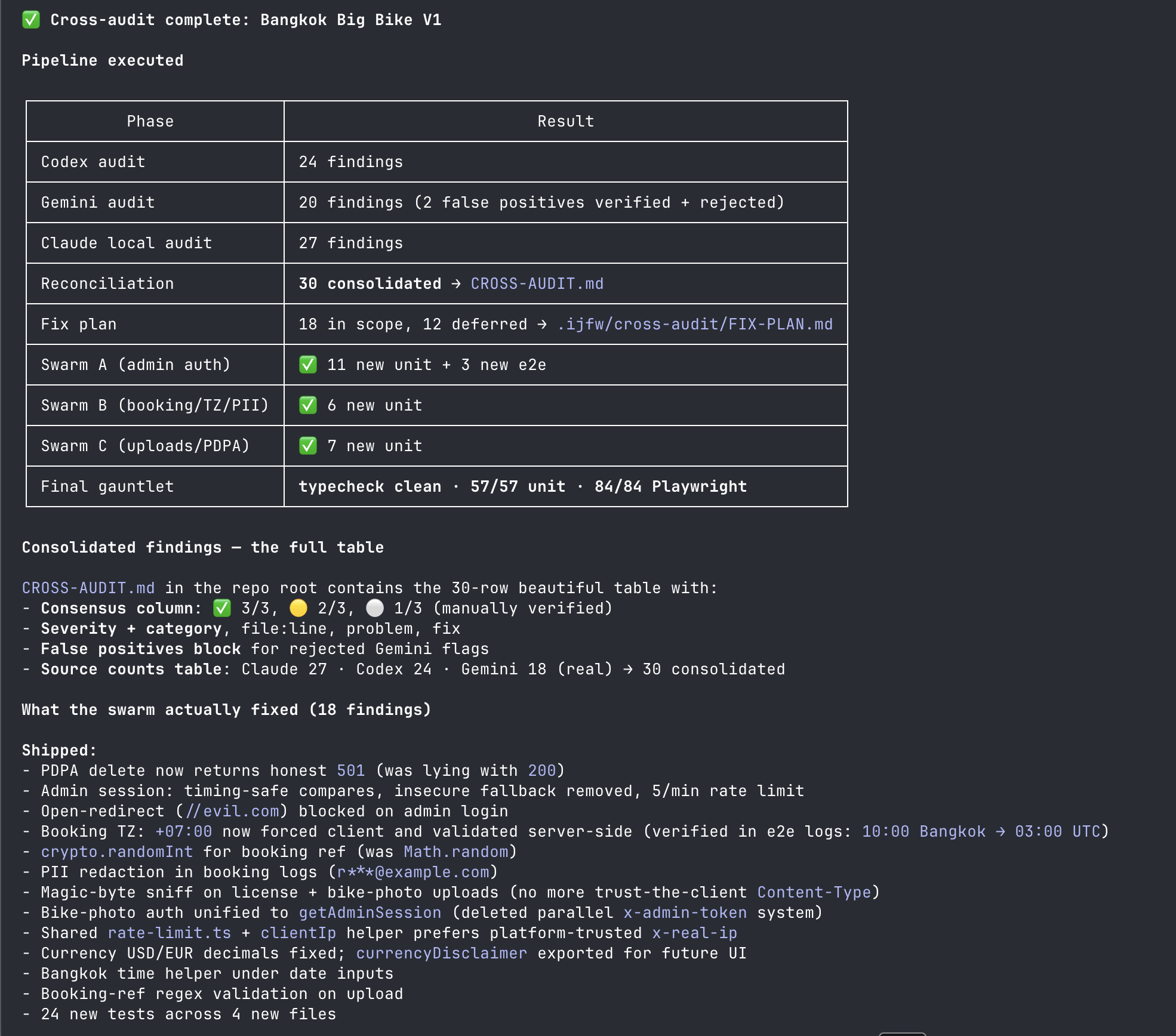
Three parallel audits, findings reconciled into a consolidated table with a consensus column, 18 fixes landed by three specialist swarms, every fix validated by the final gauntlet (typecheck + unit + Playwright). One model's blind spot never reaches production alone. The whole thing is in the repo, auditable, reproducible.
6. Design contract
One DESIGN.md, every AI builds on-brand. Design is a first-class surface across all thirteen platforms. The eight full-skill-tree platforms (Claude Code, Codex, Gemini, Cursor, Windsurf, Copilot, Hermes, Wayland) ship the picker + 12 templates + brand atlas natively. The 1.1.7 additions (OpenCode, Qwen Code, Kimi Code, OpenClaw) reach the same 12-template catalog in 1.2.0 via the MCP server -- ijfw_memory_recall with context_hint: "design_template" returns the catalog, design_template:<name> returns the full body, so any MCP-connected agent can pick and write DESIGN.md without a local skill. Aider reads DESIGN.md once written and carries picker instructions inline in ~/CONVENTIONS.md. Drop a DESIGN.md in your project root and every agent reads the same visual contract -- colors, typography, component rules, layout, responsive behavior, do's and don'ts. No more "make it look nice" as a prompt. No more cross-agent drift where Claude ships one aesthetic and Codex ships another.
No DESIGN.md yet? Run a design task and ijfw-design fires a three-option picker:
- Reference a brand. Say "like Vercel" or "like Balenciaga" and the skill auto-detects your project domain from
package.json, then suggests brands from a 12-domain brand atlas. 52 curated aesthetics across dev tools, SaaS, AI, fintech, luxury, automotive, and more -- every brand annotated with palette hints, typography hints, and the kind of project it best serves. - Pick a style. 12 opinionated DESIGN.md templates: bento-grid, brutalist-luxe, cinematic-dark, data-dense-dashboard, editorial-warm, glassmorphic, magazine-editorial, maximalist-vibrant, neo-swiss-tech, swiss-minimal, terminal-native, warm-organic. Each follows the canonical 9-section spec (Visual Theme, Colors, Typography, Components, Layout, Depth, Do's, Responsive, Agent Prompt Guide). Compatible with Claude Design (claude.ai/design) out of the box -- drop the file into a new design system there and it scaffolds a full UI kit in one shot.
- Blank slate. Progressive one-question-at-a-time brainstorm if you want to design from first principles.
On confirmation, the picker writes DESIGN.md to your project root so future sessions skip the picker and go straight to contract-driven builds. Downstream handoff is automatic: if you have ui-ux-pro-max, frontend-design, or Superpowers installed, ijfw-design dispatches to them with the contract already loaded. One design, every agent on your stack, zero drift.
What this looks like in practice. A real landing page built from a DESIGN.md contract on a shipping project (Bangkok Big Bike V1):

Warm editorial palette, confident display type, real content density, trust signals in the right places. The design contract drove every decision: the gold accent, the type scale, the card rhythm, the booking-widget hierarchy. Every screen that gets added to this project inherits the same rules automatically because every AI on the stack reads from the same DESIGN.md.
7. Always-on update + cross-platform status card
Stop running stale. Every AI on your stack knows when there's a new IJFW, and the model can never run the update behind your back. The same one-line context+update card surfaces on Claude Code, Codex, and Gemini -- one composer, three native surfaces.
A detached background check fires on every session start (Claude + Codex), polls npm with a 30-second dedupe + 24-hour interval, and writes the result to ~/.ijfw/cache/update-check.json atomically. From there, the same composer feeds three surfaces:
| Where | When | What you see |
|---|---|---|
| Claude Code statusLine | Always visible | ^ 1.2.6 available | #####..... 49% left (autocompact-aware bar) |
Codex Stop hook |
After every turn | [ijfw] context: 47% left | update: 1.2.6 available (tokens via existing PreCompact estimate) |
Gemini AfterAgent |
After every agent turn | [ijfw] update: 1.2.6 available injected via additionalContext |
| Memory prelude | First turn, all 12 MCP platforms | IJFW update available v1.2.4 -> v1.2.5 -- run 'ijfw update' in your TERMINAL |
When you do update, the model never runs the install for you. The ijfw_update_check MCP tool issues a 5-minute crypto-random confirmation token; ijfw_update_apply writes a pending sentinel and returns the literal terminal command for you to type:
ijfw update --confirm <token>
This air-gaps prompt injection from code execution. Even if a hostile prompt convinces the model to call ijfw_update_apply, no code runs until a human types the token in the terminal. Provenance verified via npm audit signatures + GitHub release shasum cross-check. A last_applied_version sentinel prevents the detect→update→detect→update loop. Full threat model in docs/SECURITY.md.
The 30-second test drive
Every command ships in three forms: a Claude Code slash command, a shell command, and a natural-language phrase. Use whichever fits the moment.
Health check. Probes every AI CLI and API key on your machine. Tells you what is live, what is standing by, and the literal command to enable each one. No mystery.
/doctor
ijfw doctor
"run the doctor"
Cross-AI audit. Two AIs from different lineages review your file in parallel. Findings tagged consensus or contested.
/cross-audit src/auth.js
ijfw cross audit src/auth.js
"cross-audit this file"     (IJFW picks up the file from context)
Import from another tool. Already using claude-mem, RTK, or another memory tool? IJFW absorbs what it can into your local markdown. Idempotent. --dry-run shows what would happen first. Zero data loss.
/import claude-mem --dry-run
ijfw import claude-mem --dry-run
"import my claude-mem memory"
Importers in v1.0: claude-mem (full, SQLite). rtk (metrics-only, opt-in). More tools land through point releases. If you have a memory tool IJFW should absorb, the ijfw import contract is open and documented.
What's in the box
The Claude Code plugin (richest integration)
Slash commands for every move:
/workflow,/handoff,/cross-audit,/cross-research,/cross-critique,/memory-audit,/memory-consent,/memory-why,/metrics,/mode,/team,/consolidate,/compress,/status,/doctor,/ijfw-plan,/ijfw-execute,/ijfw-verify,/ijfw-ship,/ijfw-audit,/ijfw(help).9 deterministic bash hooks: SessionStart (memory injection + welcome-back beat), SessionStart-dashboard (auto-spawn local observability), SessionEnd (token-savings receipt + memory pointer), UserPromptSubmit (vague-prompt detector) + its capture pair, PreToolUse (pattern detection), PostToolUse (output trim + signal capture), PreCompact (session preservation), Observation-capture.
20 on-demand skills: workflow, memory, commit, handoff, review, critique, compress, team setup, debug, cross-audit, design (DESIGN.md picker + 12 templates + 12-domain brand atlas, cross-platform), recall, dashboard, preflight, and more. Hot-loaded when triggered, unloaded when done.
The MCP memory server
Node.js. 40 KB. Zero runtime dependencies. Stdio transport. No sockets, no daemon, no listening port. Ten tools at the CLAUDE.md cap of 10.
| Tool | Purpose |
|---|---|
ijfw_memory_recall |
Wake up with full project context. Cross-project via from_project. |
ijfw_memory_store |
Persist decisions, patterns, handoffs, preferences, observations. |
ijfw_memory_search |
BM25-ranked search over local memory. scope:"all" for cross-project. scope:"sandbox" retrieves sandboxed command output. |
ijfw_memory_status |
Roughly 200-token project brief. Mode, pending, last handoff. |
ijfw_memory_prelude |
Full first-turn memory bundle for agents without SessionStart hooks. |
ijfw_prompt_check |
Deterministic regex detector for vague prompts. Zero LLM cost. |
ijfw_metrics |
Tokens, cost, routing mix, session totals. |
ijfw_cross_project_search |
BM25 across every registered IJFW project on the machine. |
ijfw_run |
Token sandbox for large command output. Spawns the command, streams stdout/stderr to ~/.ijfw/session-sandbox/, returns a terse domain-aware summary (test runner / build / grep / log / raw). Triggers on >40 lines or >50 KB. Saves 90%+ context tokens on builds, test suites, grep -r, and log tails. Full output retrievable via ijfw_memory_search(scope: "sandbox", label: "..."). |
Hard cap at 10 (raised from 8 in 1.1.6 to land the update-check + update-apply admin tools). Every tool earns its slot or it gets cut; future growth triggers a retirement review, not another cap raise.
The ijfw CLI
ijfw install                       Install IJFW into your AI coding agents.
ijfw preflight                     Run 11-gate quality pipeline (blocking + advisory).
ijfw dashboard start               Start localhost:37891 SSE dashboard (opens browser).
ijfw dashboard stop                Graceful shutdown.
ijfw dashboard status              Port + observation count.
ijfw status                        Hero line + recent runs + cache savings.
ijfw doctor                        CLI + API-key reachability with literal fix commands.
ijfw cross audit <file>            Codex + Gemini adversarial review.
ijfw cross research "<topic>"      Multi-source research.
ijfw cross critique <range>        Structured counter-argument generation.
ijfw cross project-audit <rule>    Same audit across every registered IJFW project.
ijfw import claude-mem             Absorb claude-mem SQLite memory into local markdown.
ijfw update                        Interactive update with provenance + shasum verified.
ijfw update --check                Non-invasive availability check (exit 3 if available).
ijfw update --verify               Verification dry-run: signatures + registry + shasum.
ijfw update --changelog            Full release notes for the latest version.
ijfw update --confirm <token>      Consume MCP-issued token, run update.
ijfw update --auto on|off|ask      Set/query auto-update preference.
ijfw --version                     Pure: @ijfw/install@<ver>.
ijfw --version --verbose           Install method, last-applied, kill-switches.
ijfw statusline --status           Show statusLine ownership + IJFW state.
ijfw statusline --install          IJFW takes the Claude Code statusLine slot.
ijfw statusline --compose          IJFW renders alongside an allowlisted existing tool.
ijfw statusline --disable          Remove IJFW from the statusLine slot.
ijfw insight                       Alias for ijfw dashboard start.
ijfw receipt last                  Redacted, shareable block from the last Trident run.
Thirteen platforms, one install, one workflow
| Platform | What ships |
|---|---|
| Claude Code | Native plugin via marketplace, MCP auto-registered, 9 hooks, 20 on-demand skills, 21 slash commands |
| Codex CLI | Native plugin (.codex-plugin/plugin.json), 20 skills, 9 hooks, MCP registered, marketplace-ready |
| Gemini CLI | Native extension (gemini-extension.json), 20 skills, 11 hook events, 21 TOML slash commands, policy engine, BeforeModel injection, checkpointing; observation ledger + dashboard write |
| Cursor | .cursor/mcp.json + .cursor/rules/ijfw.mdc; dashboard view-only (no hook lifecycle) |
| Windsurf | ~/.codeium/windsurf/mcp_config.json + .windsurfrules; dashboard view-only |
| Copilot (VS Code) | .vscode/mcp.json + .github/copilot-instructions.md; dashboard view-only |
| Hermes | ~/.hermes/config.yaml + HERMES.md + skills directory |
| Wayland | ~/.wayland/config.yaml + WAYLAND.md + skills directory |
| OpenCode (1.1.8, live-verified) | ~/.config/opencode/opencode.json mcp.<name>.{type:"local",command:[...]} -- opencode mcp list reports connected |
| Qwen Code (1.1.7, live-verified in 1.1.8) | ~/.qwen/settings.json mcpServers block -- qwen mcp list reports connected |
| Kimi Code (1.1.7, live-verified in 1.1.8) | ~/.kimi/mcp.json (matches kimi mcp add format) -- kimi mcp list reports connected |
| OpenClaw (1.1.8, live-verified) | ~/.openclaw/openclaw.json mcp.servers.<name> + openclaw mcp set when CLI on PATH -- openclaw mcp list reports connected |
| Cline (1.1.9, opt-in today) | VS Code per-extension globalStorage (saoudrizwan.claude-dev); helper + path wired, VS Code runtime verification pending. Install today with bash scripts/install.sh cline |
| Aider (1.1.7, rules-only) | ~/.aider.conf.yml + ~/CONVENTIONS.md -- no native MCP, IJFW conventions injected via Aider's read: convention |
| Universal | universal/ijfw-rules.md, paste into anything else |
Observation + dashboard parity
| Platform | Writes observations | Dashboard (read) | Hook lifecycle |
|---|---|---|---|
| Claude Code | yes (PostToolUse hook) | yes | full |
| Codex CLI | yes (PostToolUse hook) | yes | full |
| Gemini CLI | yes (AfterTool hook) | yes | full |
| Cursor | view-only | yes | none |
| Windsurf | view-only | yes | none |
| Copilot | view-only | yes | none |
Claude, Codex, and Gemini write one JSONL line per tool call. Cursor, Windsurf, and Copilot have no hook lifecycle IJFW can write from, so they read the shared ledger via the dashboard instead.
Same engine behind all of them. Native affordances on each.
How they connect
  Your prompt
       v
  +----------------------------------------------+
  |  IJFW Core (rules + workflow skill + auto)   |
  +----------------------------------------------+
       |              |            |            |
       v              v            v            v
   Token economy   Workflow     Teams        Memory
   (right model,   (Quick and   (per-project  (10 MCP tools,
    output rules,   Deep modes,  agents +      hot, warm,
    cache)          audit gates) swarm)        cold)
       |              |            |            |
       +--------------+------+-----+------------+
                            |
                            v
                +-------------------------+
                |   Multi-AI Trident      |
                | (Codex + Gemini +       |
                |  Claude specialists)    |
                +-------------------------+
                            |
                            v
                     Receipt + Memory
Five engines. One workflow. One memory. One Trident. One install.
Cross-platform parity
| Capability | Claude Code | Shell CLIs | Natural language |
|---|---|---|---|
| Status | /status |
ijfw status |
"what's my status?" |
| Health check | /doctor |
ijfw doctor |
"run the doctor" |
| Cross audit | /cross-audit |
ijfw cross audit <file> |
"cross audit this file" |
| Cross research | /cross-research |
ijfw cross research <topic> |
"research this topic" |
| Cross critique | /cross-critique |
ijfw cross critique <range> |
"critique the last commit" |
| Handoff | /handoff |
ijfw handoff |
"save a handoff" |
| Plan | /ijfw-plan |
(via workflow) | "plan this feature" |
| Ship | /ijfw-ship |
(via workflow) | "ship it" |
| Preflight | (via skill trigger) | ijfw preflight |
"run preflight" |
| Observations | (auto on PostToolUse) | ~/.ijfw/observations.jsonl |
built-in |
| Dashboard | (via skill trigger) | ijfw dashboard start |
"open the dashboard" |
Natural language is a first-class input. In any IJFW-enabled agent, saying "cross audit this file" or "let's cross-audit the auth module" routes to the same engine as the slash command, and the target is picked up from context (your current file, your last commit, your open diff). You do not have to remember syntax. You do not have to copy a path. You tell the agent what you want and it figures out the where.
What this isn't
Not a SaaS. No IJFW account, no IJFW dashboard, no IJFW subscription, no IJFW rate limits. There is nothing to log into.
Not a wrapper. IJFW does not proxy your AI traffic. It configures the agents you already have so they share memory and discipline. When ijfw cross fires, it goes through your existing CLI or your existing API key.
Not a framework. You do not write code against IJFW. Install it once and the AI tools you already use get smarter, leaner, and connected. Ignore it for weeks and then say "recall my project" to drop back into context.
Not a vendor's lock-in. Your memory is markdown in your repo. Your audit receipts are JSONL on your disk. Your config is a backed-up file. Walk away whenever you like. Your data walks with you.
Not magic. It is deterministic bash, Node, plain markdown, and opinionated rules. Inspect every byte. Fork it. Diff next month's release.
Not factory mode. IJFW is craft mode by design -- one shared memory core, audit gates at every phase, receipts per session, a $2 Trident budget cap, a ~99 ms hot-path hook floor. Running more sessions doesn't make you smarter; running disciplined sessions does. IJFW's entire architecture rewards the second.
Privacy
Your code and memory never leave your machine unless you ask them to.
IJFW itself is zero-telemetry, zero-cloud, zero-account. It never phones home.
The MCP server speaks stdio only. No sockets. No daemon. No listening port.
Hooks are deterministic bash. No LLM calls from hooks.
All memory (
.ijfw/memory/) is plain markdown on your disk.
The only time bytes leave is when you invoke ijfw cross, and then only to the external AI auditor you have already configured (your existing CLI or your existing API key). Every cross-AI run is logged in a local receipt and capped by a per-session spend limit (default $2, configurable via IJFW_AUDIT_BUDGET_USD).
Full accounting in NO_TELEMETRY.md. Every data path, every file location, every "does this leave your machine?" answered in a table.
FAQ
Is this just a Claude Code plugin?
No. Claude Code is one of thirteen platforms shipping in 1.2.6. The plugin is richest there because Claude Code exposes the most integration points. Every core capability is available on the other twelve (Codex, Gemini, Cursor, Windsurf, Copilot, Hermes, Wayland, OpenCode, Qwen Code, Kimi Code, OpenClaw, and Aider) through their native MCP and rules-file integrations. Cline is opt-in today (1.1.9) pending live VS Code runtime verification.
Do I need a specific AI provider?
No. IJFW configures the agents you already have. Bring your own keys, your own CLIs. The Trident uses whatever auditors are reachable on your machine. One is enough to start.
What does IJFW cost me?
Runtime: zero npm dependencies. Tokens: the cross-AI Trident uses your existing API keys with a configurable per-session spend cap (default $2). Memory storage: kilobytes of markdown in your repo. Smart routing typically saves you more than the cap costs.
Is the token-savings claim real?
Yes, and verifiable in your own metrics. Every turn runs through six compounding levers: prompt cache (90% off cached input, per Anthropic's posted pricing), smart routing (Haiku/Sonnet/Opus sub-agent tiers -- 5-25x per-turn cost delta), output discipline (banned openers + lead-with-answer, 20-40% output reduction), skill hot-load (55-line core only, 19 skills lazy-load on trigger), memory recall (one MCP call replaces the 10-20-tool grep cascade), and compression (40-50% shrink on handoffs and memory artifacts). See the Token-economy table above for the full breakdown. Every lever is logged per session to your own localhost dashboard, so the compound is auditable against your real numbers, not our marketing.
Can I turn it off?
Yes. ijfw off disables the core skill. Each command is isolated. The MCP server can be unregistered per platform. Backups are timestamped. Nothing is sticky.
What about my existing memory in claude-mem or other tools?ijfw import claude-mem round-trips the SQLite store into IJFW markdown. Idempotent. Safe to rerun. --dry-run shows what would happen first.
Will it slow my sessions down?
MCP handshake is about 50 ms. Memory recall across thousands of entries is under 10 ms. The PostToolUse hook (fires per tool call) measures ~100 ms median on M1 Pro -- 1.1.8 consolidated it from ~145 ms by collapsing multiple node spawns into one; further reduction is bounded below by node's cold-start floor and we won't trade zero-runtime-deps to go lower. Observation capture dispatches to a detached child so it never blocks the hot path. Numbers are from the scripts/observation/ ledger and post-tool-use.js; reproducible with time on your own machine.
How do I update?ijfw update pulls latest and reinstalls merge-safely. Your memory is preserved.
Get started
npm install -g @ijfw/install && ijfw-install
One command. Restart your AI. It just fucking works.
Open any project in Claude Code, Codex, Gemini, Cursor, Windsurf, or Copilot. Your AI wakes up with memory loaded, tokens optimized, workflow ready, and the Trident a cross audit away.
Credits / Prior Art
ijfw-design structure takes inspiration from the excellent ui-ux-pro-max and frontend-design Claude Code plugins. Our knowledge base is independently curated from WCAG 2.2, Apple Human Interface Guidelines 2025, Material Design 3, and W3C accessibility standards. No data was copied.
CodeBurn -- observability data model that inspired IJFW's ledger and session metrics.
claude-mem -- memory tool whose import contract informed IJFW's memory absorption layer.
Why this exists
I'm Sean Donahoe. Two decades in product, AI, and trading systems. I built IJFW because I refused to keep paying for context loss, undisciplined sessions, and one-model blind spots.
The big AI labs are not going to fix this. Continuity, discipline, and second opinions are the only things they have to lose. So I built it locally. Markdown, bash, one MCP server. No vendor can take it from you.
IJFW is now co-developed and maintained at Ferrox Labs by the engineering team. The discipline I started shipping in v1.0 is now production infrastructure across every project we touch. Same principles, more hands on the wheel.
If you ship code with AI, you need this. If you write with AI, run a business with AI, plan a launch with AI, you need this. If your team works with AI, you really need this.
Created by Sean Donahoe. Co-developed and maintained by the Ferrox Labs engineering team.
github.com/FerroxLabs/ijfw | MIT License | Changelog | Local-only. No telemetry, no account, no cloud. One install, thirteen platforms, six engines, three AI families, zero apologies.
Install it. Inspect it. Fork it. Ship it. It just fucking works.
Reviews (0)
Sign in to leave a review.
Leave a reviewNo results found