Froxel
Health Uyari
- License — License: MIT
- Description — Repository has a description
- Active repo — Last push 0 days ago
- Low visibility — Only 5 GitHub stars
Code Basarisiz
- rm -rf — Recursive force deletion command in .github/workflows/release.yml
- rm -rf — Recursive force deletion command in packaging/android/bundle.sh
- rm -rf — Recursive force deletion command in packaging/ios/bundle.sh
Permissions Gecti
- Permissions — No dangerous permissions requested
Bu listing icin henuz AI raporu yok.
Voxel editor in Rust with a GPU path tracer, glTF export with bones, Rhai scripting, and an MCP server for AI agents. Opens MagicaVoxel .vox.

Froxel
A voxel editor with a path tracer and an MCP server, written in Rust.
macOS, Windows, Linux, FreeBSD, Android, and iOS.
Download · MCP · Scripting · Bridges · Command line · Build
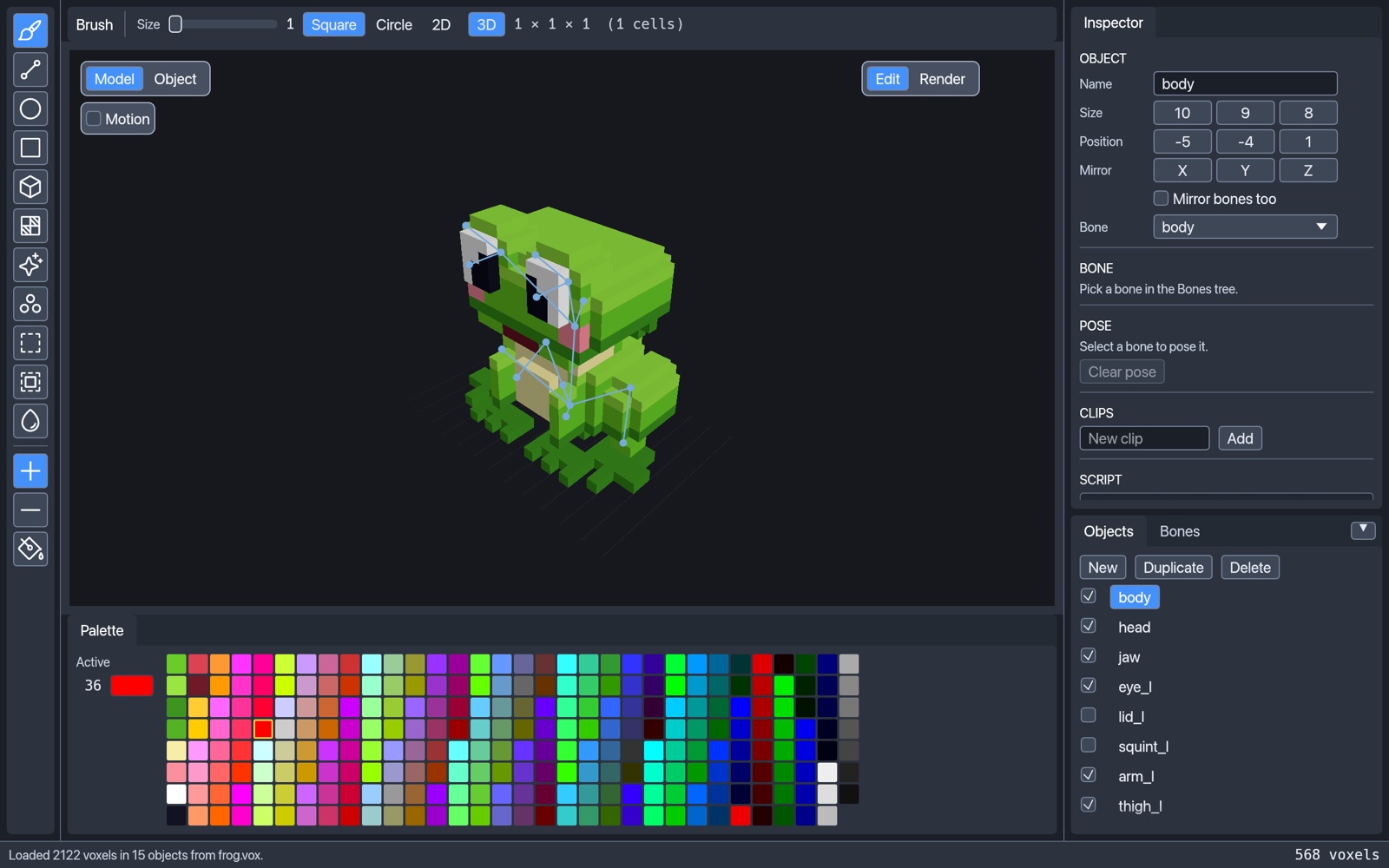
Froxel opens and saves MagicaVoxel .vox files, edits them with brushes, shapes,
and selections, path-traces them on the GPU, and exports glTF with bones and
animation clips. An AI agent can drive all of it through the built-in
Model Context Protocol server.
Features
.voxin and out. Keeps groups, layers, hidden objects, animation frames,
and materials (_diffuse,_metal,_glass,_emit). Files saved by Froxel open
in MagicaVoxel.- Editing. Brush, line, circle, square, box, face fill, generators, mutators,
marquee, box select, and flood select. Add, remove, and paint modes. Object mode
moves, rotates, mirrors, and flips whole objects. Each stroke undoes in one step. - Characters. Bones, rigid binding of objects to bones, poses, and animation
clips, saved in the.voxfile and exported to glTF. - Render mode. A path tracer with sky, sun, metal, glass, and emission. It
accumulates on the GPU through wgpu (Metal, Vulkan, DX12) and falls back to the
CPU. Denoising is built in. - glTF export.
.glbwith merged coplanar faces, no T-junctions, and a palette
texture or vertex colours. - Mesh import. A
.glb,.gltf, or.objsculpted in Blender or made by an
image-to-3D tool, voxelized solid or as a shell at a cell count or a voxel size
in metres, its texture and vertex colours quantized into the palette. - Scripts. Objects can carry a sandboxed Rhai script with
sliders for its parameters. - Bridges. Godot and Blender can drive those sliders and import the mesh
live, then bake a standalone scene. See docs/bridges.md. - Automation. An MCP server for agents and a command line for batch renders.
Install
Download the file for your system from the
latest release.
| System | File | Notes |
|---|---|---|
| macOS 11+ (Apple silicon and Intel) | froxel-<version>-macos-universal.dmg |
Signed and notarized. Drag Froxel to Applications. |
| Windows (x64, x86, ARM64) | froxel-<version>-windows-<arch>.zip |
Not signed yet (why). SmartScreen may ask once: choose More info → Run anyway. Windows 11 with Smart App Control on blocks it outright. |
| Debian, Ubuntu (x86_64, aarch64, riscv64) | froxel-<version>-linux-<arch>.deb |
sudo apt install ./froxel-*.deb adds the menu entry and icon. Needs Vulkan. |
| Other Linux | froxel-<version>-linux-<arch>.tar.gz |
Needs Vulkan and glibc 2.35 or newer (2.39 for riscv64). |
| FreeBSD (x86_64) | froxel-<version>-freebsd-x86_64.tar.gz |
|
| Android 7.0+ (arm64) | froxel-<version>-android-arm64.apk |
Open it on the phone. Android asks once to allow installs from the browser or file manager. |
| iOS 16+ simulator | froxel-<version>-ios-simulator.zip |
Unzip and drag Froxel.app onto a booted simulator. The device build goes to the App Store. |
| Godot 4.3+ plugin | froxel-<version>-godot-addon.zip |
Unzip into the project folder. See Godot and Blender. |
| Blender 4.2+ add-on | froxel-<version>-blender-addon.zip |
Preferences → Add-ons → Install from Disk. |
Every release has a SHA256SUMS.txt. How the builds are signed is in
CODE_SIGNING.md.
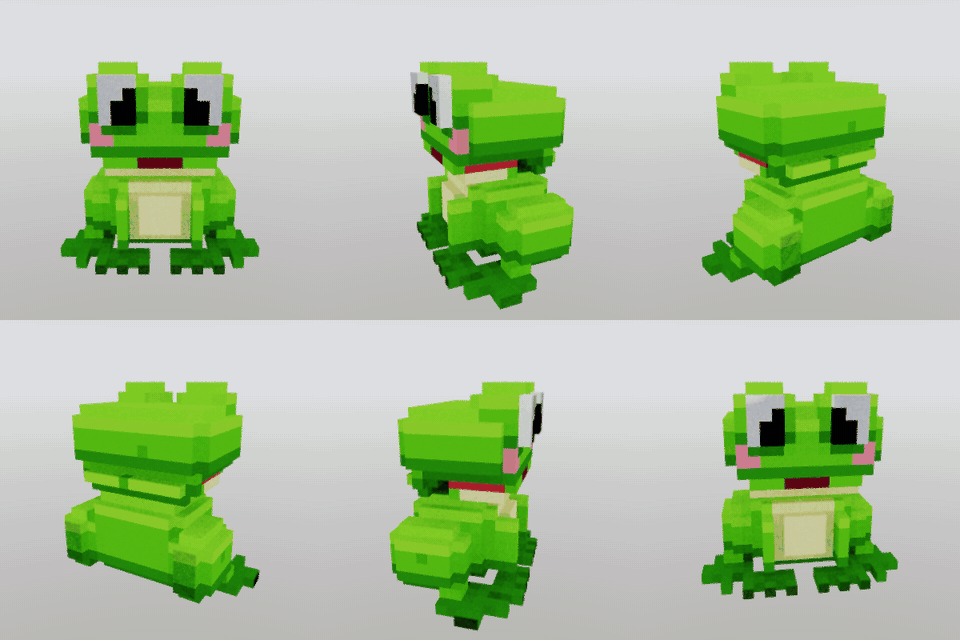
Try it on the frog, examples/frog.vox, or on the scripted
lily pad, examples/lily_pad.vox.
Phones and tablets
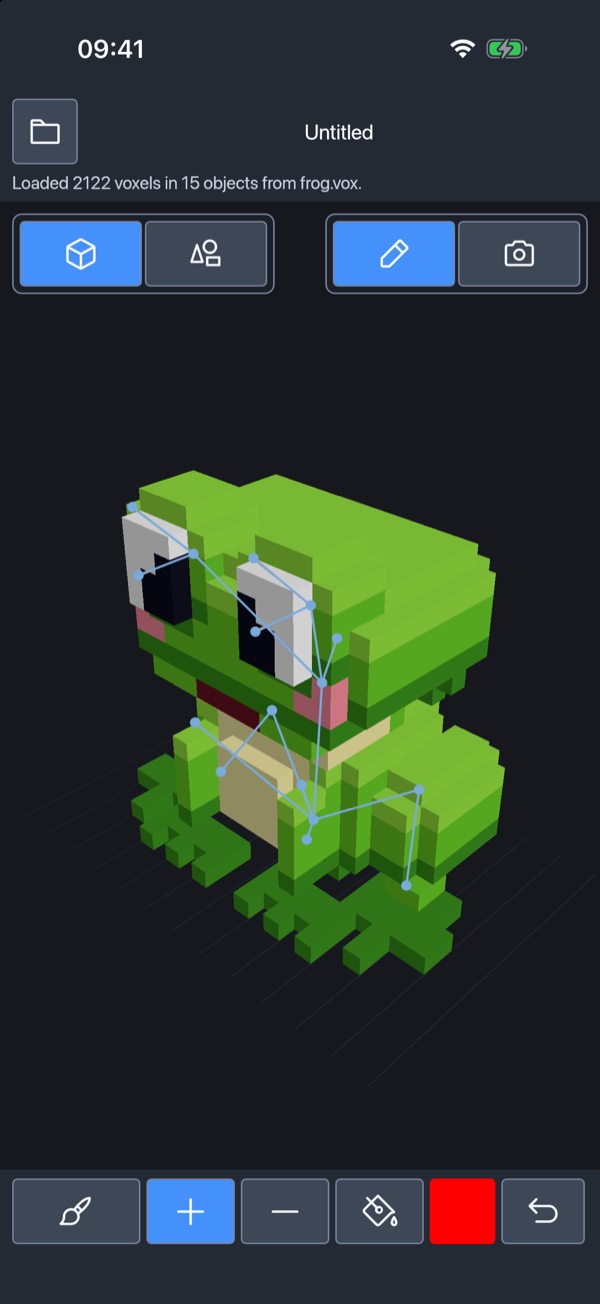
The Android and iOS builds are the same editor with a touch layout. The
viewport fills the screen. The strip at the bottom holds the tool, add, remove,
and paint, the colour, and undo. The tool settings, the palette, and the files
open as sheets above it. The bundled frog and lily pad are under the folder
button, and your own files are saved to the app's documents.
- One finger uses the active tool.
- Two fingers orbit and pinch to zoom. Three fingers pan.
- Long-press the colour, then tap a voxel, to pick its colour.
On a tablet 700 points wide or more, the desktop tools and palette sit on the
left instead of the strip.
Controls
- Right-drag orbits. Scroll zooms. Space-drag or middle-drag pans.
- Left-drag uses the active tool.
- V brush, L line, B box, F face, U mutator, M marquee.
- T add, R remove, G paint. These three apply in Model mode.
- Tab switches Model and Object mode.
- In Object mode, X / Y / Z rotates the active object. Shift flips it.
- ⌘Z / ⇧⌘Z undo and redo. ⌘C / ⌘X / ⌘V copy, cut, and paste.
- ⌘N / ⌘O / ⌘S / ⇧⌘S new, open, save, and save as.
- ⇧⌘E exports a glTF
.glbwith a palette texture and merged faces.
On Windows and Linux, use Ctrl in place of ⌘.
MCP: let an agent build models
froxel mcp is a Model Context Protocol server.
An agent can create objects, place voxels, fill boxes and ellipsoids, set the
palette, add bones and clips, run scripts, export .glb, and path-trace a PNG
to check its work. The frog in these pictures was built this way.
Add it to Claude Code. On macOS, after installing from the dmg:
claude mcp add froxel -- /Applications/Froxel.app/Contents/MacOS/froxel mcp
Or add it to any MCP client's config:
{
  "mcpServers": {
    "froxel": {
      "command": "/path/to/froxel",
      "args": ["mcp"]
    }
  }
}
Then ask for a model:
Build a 16-voxel-tall voxel frog with big eyes and pink cheeks, give it a head
and jaw bone, render it from the front, and export it tofrog.glb.
froxel mcp works headless, with no window. To watch the edits happen, and let
the agent take screenshots and click controls, connect it to an open editor:
froxel mcp --connect 127.0.0.1:7979 --launch
--launch opens the window if it is not already running. The full tool list and
the connected mode are in docs/mcp.md.
Creatures and other one-off shapes are made by hand sculpting: block out
with box and ellipsoid fills, refine single cells, render after every step,
and compare with the reference. No script is stored. See
docs/hand-sculpting.md.
skills/froxel/SKILL.md is an agent skill that
explains when and how an agent should use these tools. To install it for
Claude Code, copy the skills/froxel folder into ~/.claude/skills/.
Scripting
An object can carry a Rhai script. The editor shows a slider
for each parameter, and Regenerate rebuilds the voxels. Scripts run in a
sandbox with no file, network, or clock access, and saved files keep the voxels,
so the .vox still opens in MagicaVoxel.
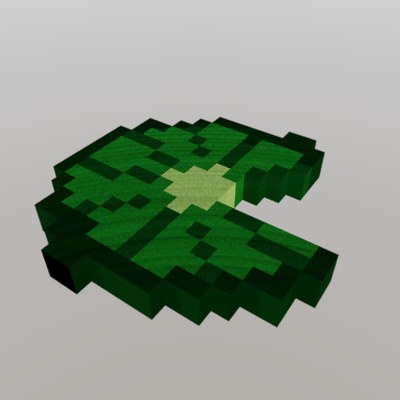
let radius = param_float("radius", 8.0, 3.0, 16.0);
let seed = param_int("seed", 1, 0, 9999);

set_slot(1, [18, 72, 28]);   // a palette colour
// …for each cell inside a wobbly disc:
set(ix, 0, iz, slot);
The whole lily pad is examples/lily_pad.rhai.
Scripts also have the hand-sculpting tools (tubes, carving, smoothing, breaks,
and debris); examples/hollow_log.rhai uses all of
them, and examples/fallen_tree.rhai shapes a
fallen tree with loft, deform, and brush. The API is in
docs/scripting.md.
Godot and Blender
froxel bridge serves a .vox on 127.0.0.1. A Godot node or the Blender
sidebar connects with the printed session file, shows a slider for each script
parameter, and imports the model as glTF, bones and clips included. Moving a
slider reruns the script. Bake writes an ordinary scene or Blender object
that no longer needs Froxel, and headless Godot can bake a list of variants in
one go. --bridge PORT serves the open editor instead, so edits in the window
show up in the next import.
froxel bridge --input examples/lily_pad.vox      # four sliders: radius, notch, direction, seed
froxel --bridge 29771 examples/lily_pad.vox
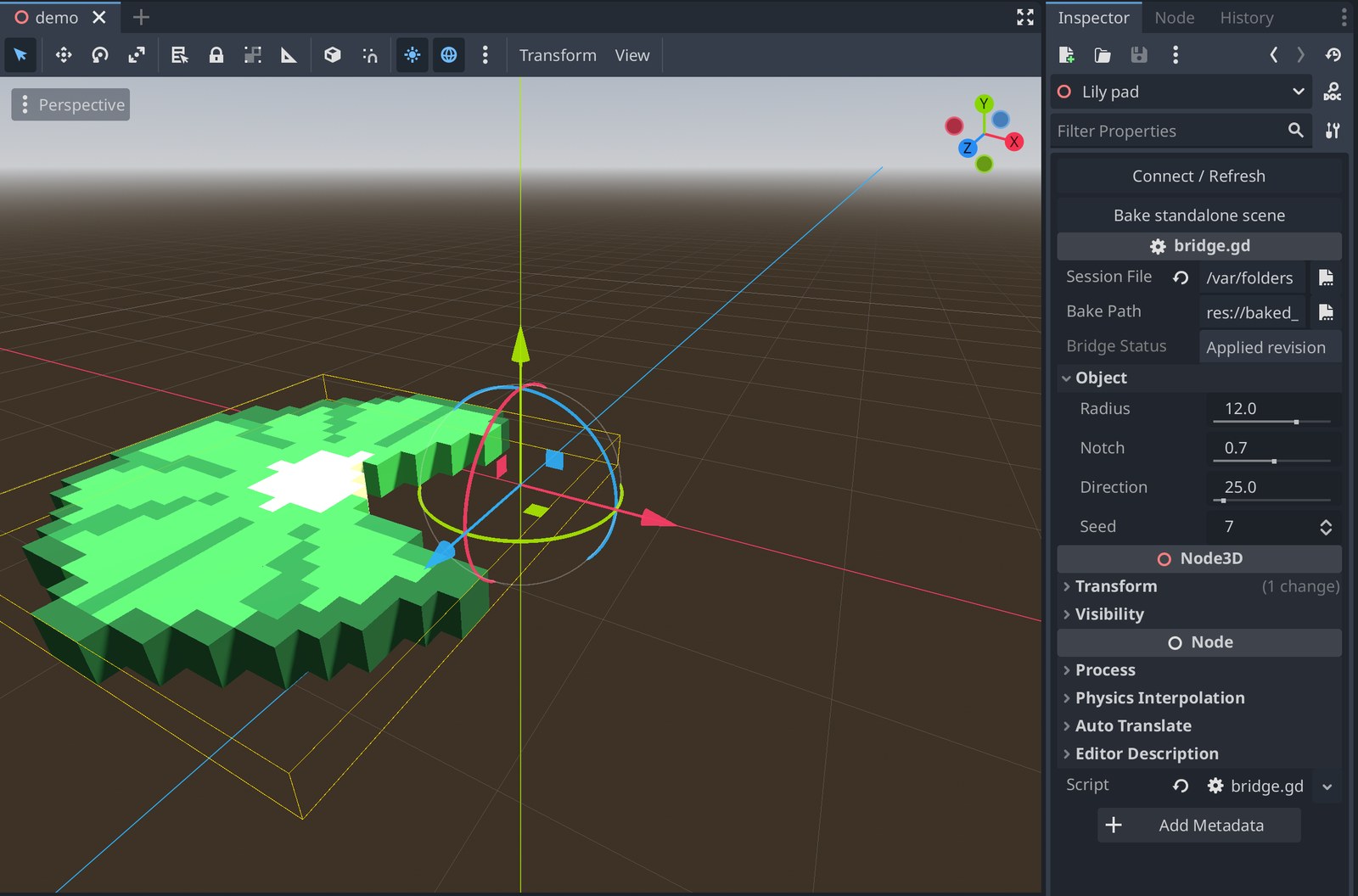
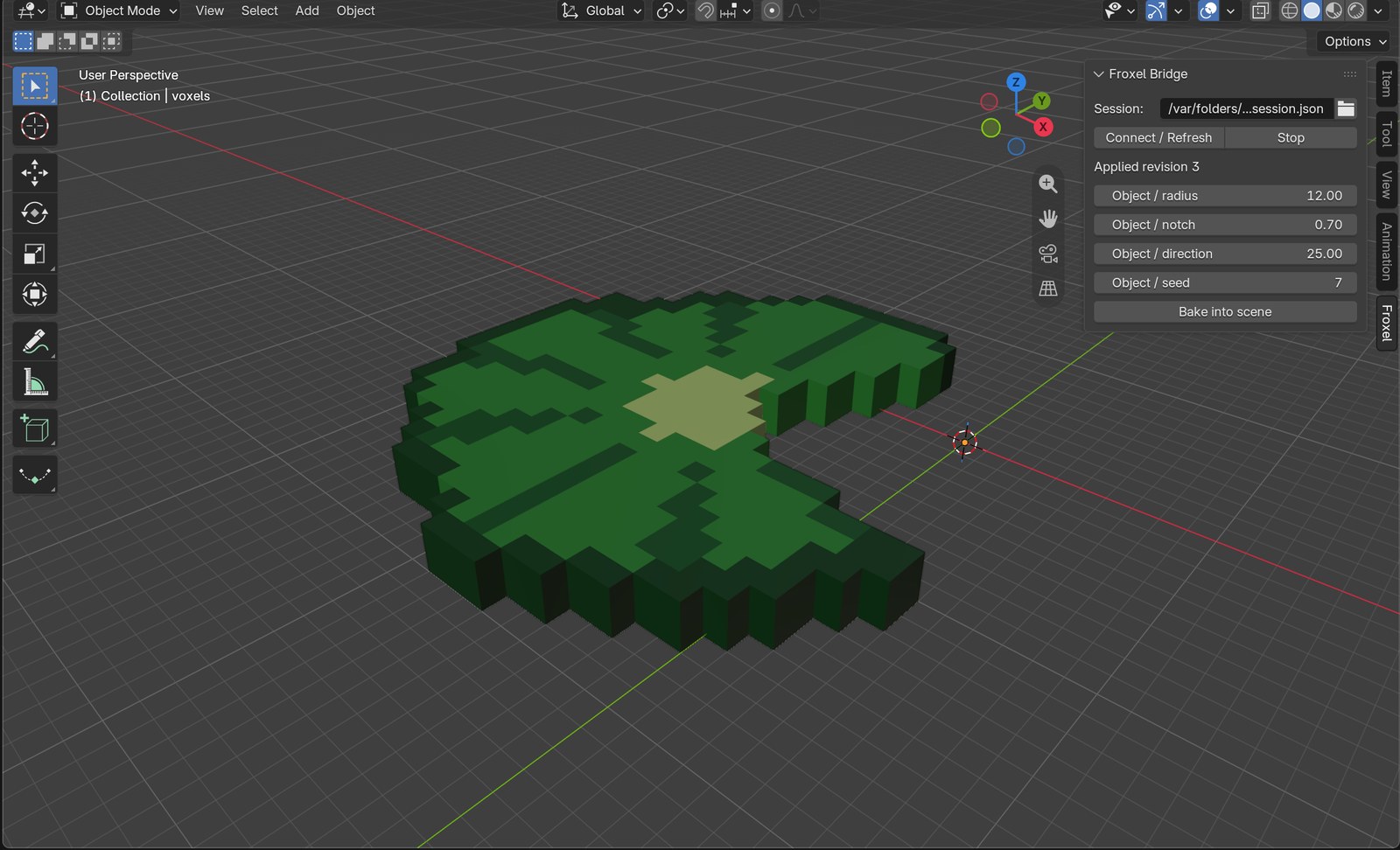
The Godot plugin is godot/addons/froxel_bridge and
the Blender add-on is blender/froxel_bridge. Both are
in every release since 0.2.0 as froxel-<version>-godot-addon.zip andfroxel-<version>-blender-addon.zip. Tested with Godot 4.5 and Blender 5.2.
Setup, the variant baker, and the protocol are in docs/bridges.md.
Command line
froxel render path-traces a .vox file to a PNG with no window. The CPU tracer is
the default, so a given seed always writes the same image. --gpu uses the wgpu
tracer.
froxel render --input examples/frog.vox --output frog.png \
  --width 1440 --height 810 --samples 256 --denoise --gpu \
  --yaw -62 --pitch 16 --distance 0.72
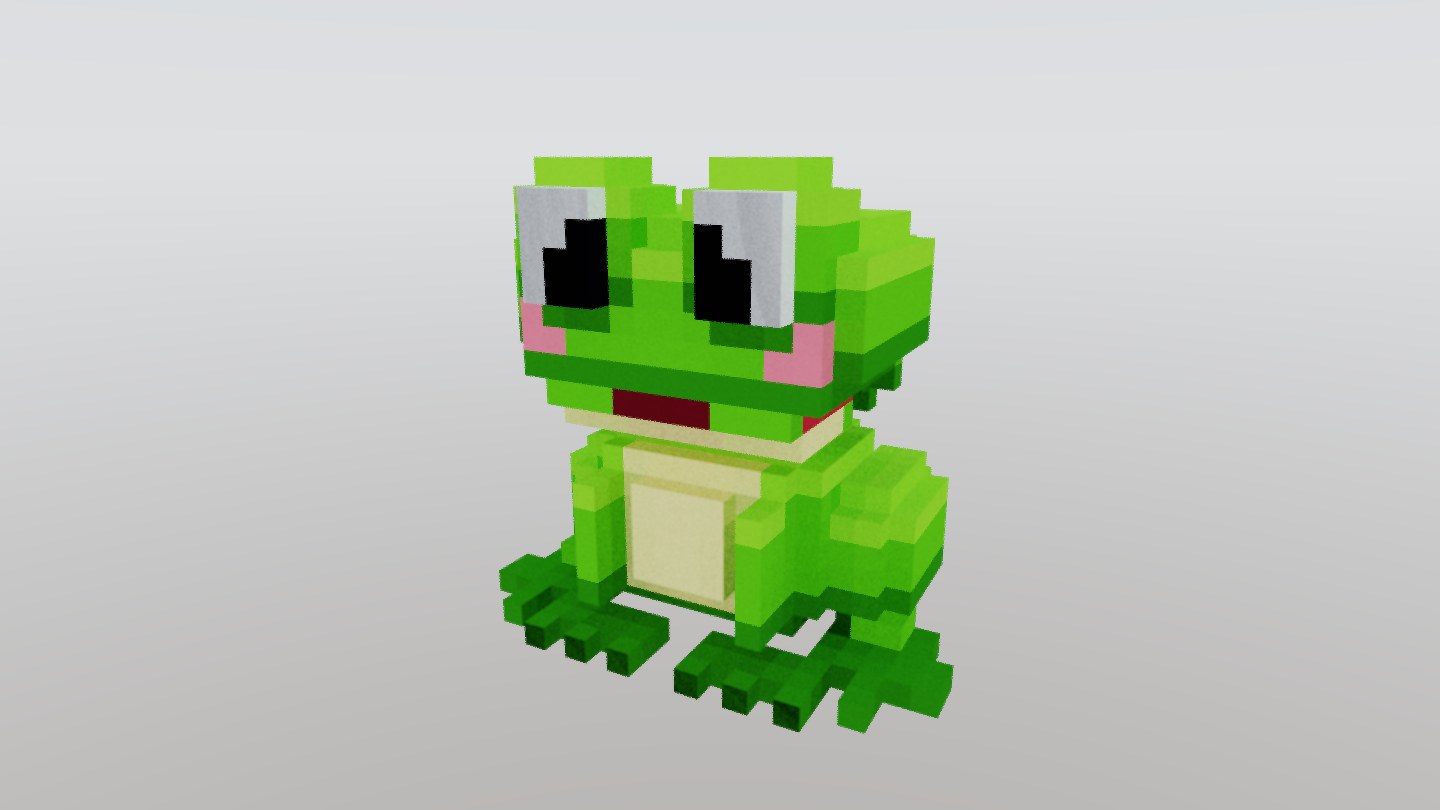
That command made this picture. --help lists every option: camera,
depth of field, sky, sun, glass mode, and albedo and normal passes. The turntable
above is 48 such renders, one every 7.5° of --yaw.
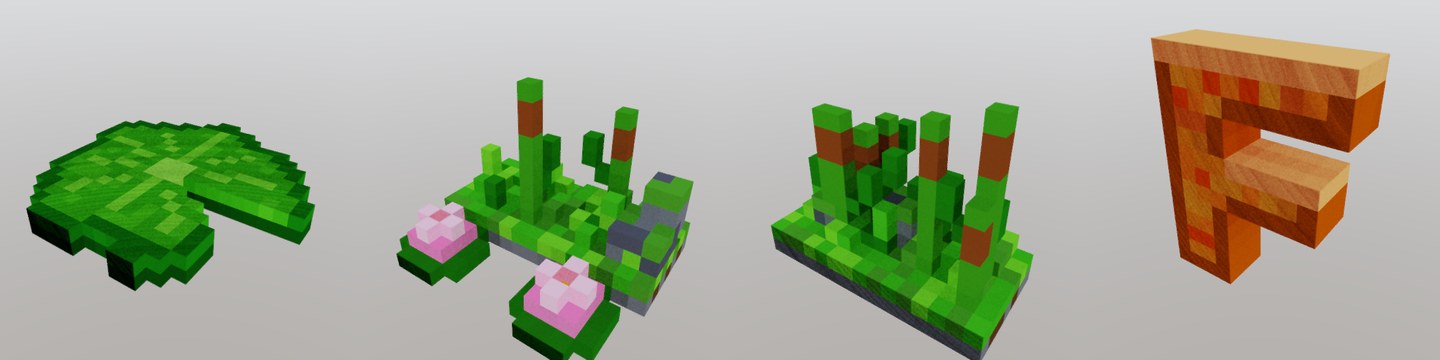
froxel preview draws the same .vox as the edit viewport lights it,
rasterised on the CPU in a fraction of a second, fitted to the model (or--object) with a margin. docs/preview.md has the
flags; MCP preview is the same image. --preset game is the gameplay
camera (orthographic, yaw −60, pitch 25), and several --input files,--variants, or a --reference concept make a labelled contact sheet.--lighting old_pond (or a preset of your own) lights it with a game's
sun, ambient, and grade instead of the viewport light. It prints two
triangle counts: the unmerged mesh it draws, and whatfroxel export writes with the export flags given (--merge,--color-atlas).
froxel preview --input model.vox --out preview.png --yaw -35 --pitch 30 --width 1600 --height 800
froxel compare --input model.vox --concept sheet.png --crop 40,60,520,300 --view front --ortho --out vs.png scores the model's silhouette against a
concept view: it prints IoU, the share of the concept missing, and the
share of the model in excess, and writes an overlay with the concept's
outline and both in colour. froxel carve --views views.json --out model.vox fills the visual hull of a turnaround sheet's front, side, and
top views. MCP compare_silhouette and carve_from_views are the same;
see docs/mcp.md.
froxel compare --input log.vox --concept log-sheet.png --crop 40,60,520,300 --view front --ortho --out log-vs-front.png
froxel export --input model.vox --output model.glb writes the glTF with
the export_mesh options as flags: --merge, --vertex-colors,--color-atlas, --export-hidden, --split-objects, and --ao STRENGTH
with --ao-radius CELLS and --ao-target vertex|texture|both for baked
ambient occlusion in COLOR_0 or the colour atlas.
froxel export --input ruins.vox --output ruins.glb --merge --ao 0.8 --ao-radius 3
froxel import --mesh tree.glb --output tree.vox --voxel-size 0.08 voxelizes
a mesh with the MCP import_mesh options as flags (--size, --scale,--z-up, --rotation, --position, --anchor, --shell, --slots,--max-new-slots, --tolerance, --input for a document to add to,--new-object) and prints the report: cells, slots, and bounds.
froxel variants --input wall.vox --variants sets.json --out variants/
bakes a scripted document once per parameter set in sets.json (a list of{"name": "low", "params": {"height": 12}}) and writes low.vox,low.glb, and a variants.json manifest of each set's parameters,
markers, and bounds; it takes the froxel export mesh flags and--no-vox. Exporting again into the same folder updates the manifest by
variant name, so a subset can be redone without dropping the others;--replace writes it fresh. MCP export_variants and the Export panel's Export
variants… do the same.
froxel voxrt --input model.vox loads a file, saves it, loads the save, and
checks that nothing changed: objects, palette, materials, scene graph, bones,
scripts, and motion. --dump prints the chunk tree instead.
Build from source
You need Rust. On Linux, the editor loads Wayland or X11 and
Vulkan at run time, so the build needs no -dev packages.
git clone https://github.com/theromis/Froxel
cd Froxel
cargo run --release -- examples/frog.vox
The binary is target/release/froxel. On macOS the File and Edit commands live on
the application menu bar. Elsewhere, or with FROXEL_NO_NATIVE_MENU set, they are
in a menu strip at the top of the window.
--features oidn links Open Image Denoise for--denoise. It needs the library on the build machine. Without it, Froxel uses
its built-in edge-aware filter.
The phone builds need the Android NDK and
cargo-apk, or Xcode on macOS:
cargo apk build --lib --features android-lib --release   # target/release/apk/froxel.apk
packaging/android/bundle.sh                               # Play bundle, froxel.aab (needs a JDK)
packaging/ios/bundle.sh                                   # simulator Froxel.app
Tests:
cargo test --bin froxel
What changed in each version is in CHANGELOG.md. Releases are built
by a GitHub workflow. See docs/releasing.md.
Thanks
Inspired by MacVoxel.
License
MIT. See LICENSE.
Yorumlar (0)
Yorum birakmak icin giris yap.
Yorum birakSonuc bulunamadi