modeldeck
Health Uyari
- License — License: NOASSERTION
- Description — Repository has a description
- Active repo — Last push 0 days ago
- Low visibility — Only 5 GitHub stars
Code Basarisiz
- process.env — Environment variable access in bin/modeldeck.mjs
- exec() — Shell command execution in dashboard/src/SessionAnatomy.jsx
Permissions Gecti
- Permissions — No dangerous permissions requested
Bu listing icin henuz AI raporu yok.
macOS menu bar app that tracks usage limits across all your Claude Code and Codex CLI accounts — live "% left" meters per rate-limit window, reset countdowns, low-capacity alerts, and one-click account switching. Local-first: no cloud, no telemetry, credentials never touched. Native SwiftUI + a localhost Node daemon.
ModelDeck
One menu bar icon that always knows how much Claude Code and Codex you have left.
A native macOS menu bar app + local daemon that tracks usage limits across
all of your Claude Code and Codex CLI accounts — live "% left" meters,
reset countdowns, and one-click account switching.
Local-first. No cloud backend. No telemetry. Your provider credentials
are never copied, stored, or transmitted by ModelDeck. The only secrets
ModelDeck creates are its own local Keychain items — the token that guards
the daemon's API and, if you use the managed proxy, a client key per
profile — and they contain nothing of yours. The only optional outbound calls of
ModelDeck's own are the daily update check (reads this repository's public
releases feed) and the update download you approve (fetches the release
asset) — update checks are off unless you enable them.





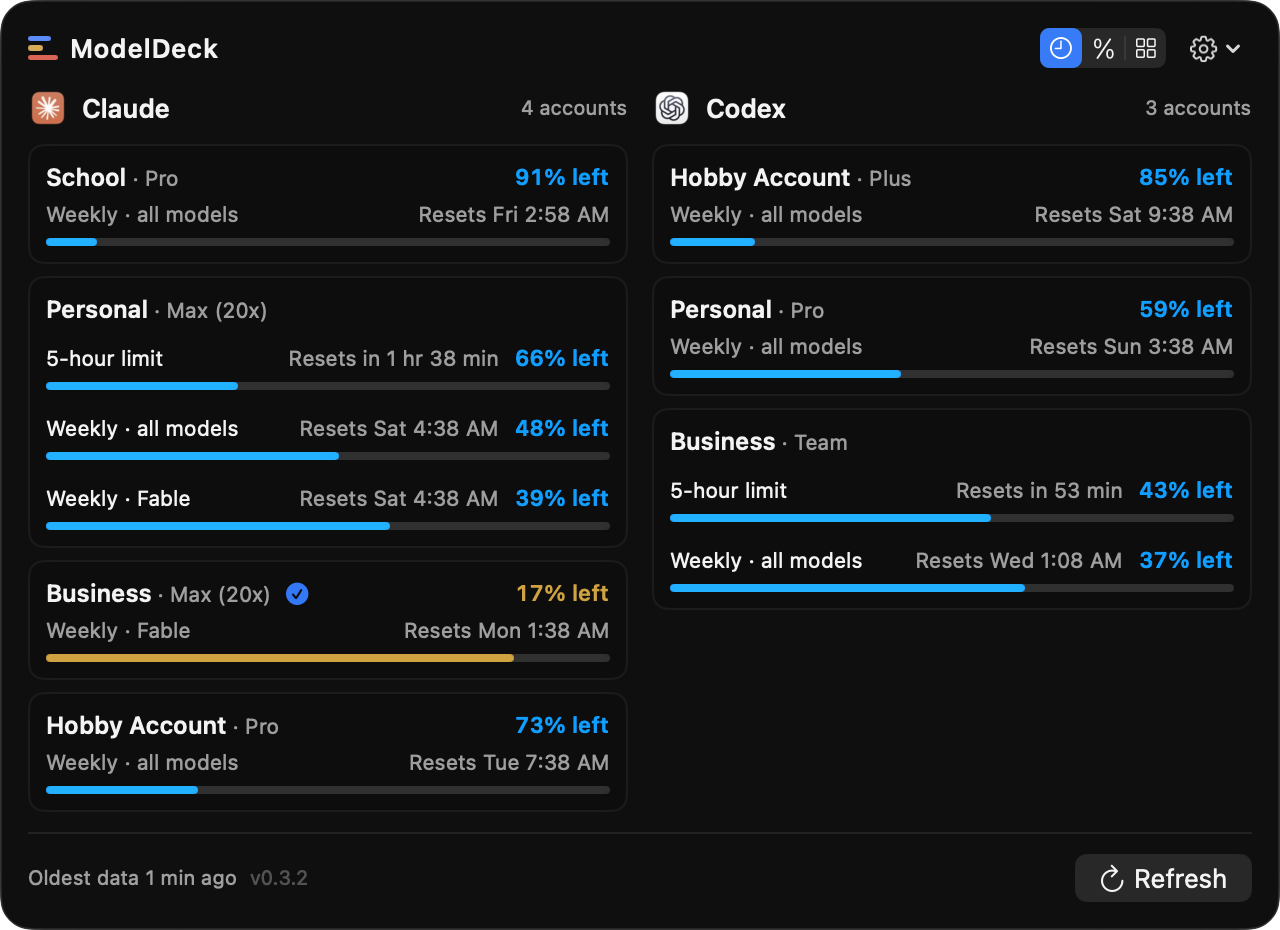
All screenshots show a demo-seeded instance with placeholder accounts.
Why
If you run AI coding agents seriously, you probably don't have one
account — you have a work Claude Max plan, a personal Pro plan, a Codex
subscription, maybe a spare for side projects. Each one has its own
5-hour session window, weekly limit, and model-scoped caps, all resetting
on different clocks.
Today the only way to know where you stand is to interrupt what you're
doing and check each account by hand — usually right after an agent run
dies mid-task because a limit you forgot about ran out.
ModelDeck puts all of it in your menu bar:
- See every limit at once. Every account, every window (5-hour session,
weekly, model-scoped like "Weekly · Fable"), as a live "% left" meter with
its next reset time. - Get warned before you hit the wall. The menu bar icon shows a gold
percentage when any account drops below your threshold, red when critical,
and a macOS notification fires exactly once at the crossing — no nagging. - Switch accounts in one click. Activate a different account for new
CLI sessions without touching anything that's already running.
Features
- Multi-account usage deck — a popover with one card per account:
worst-window headline bar, plan tier ("Max (20x)", "Pro"), and expandable
detail rows for every rate-limit window with right-aligned reset times
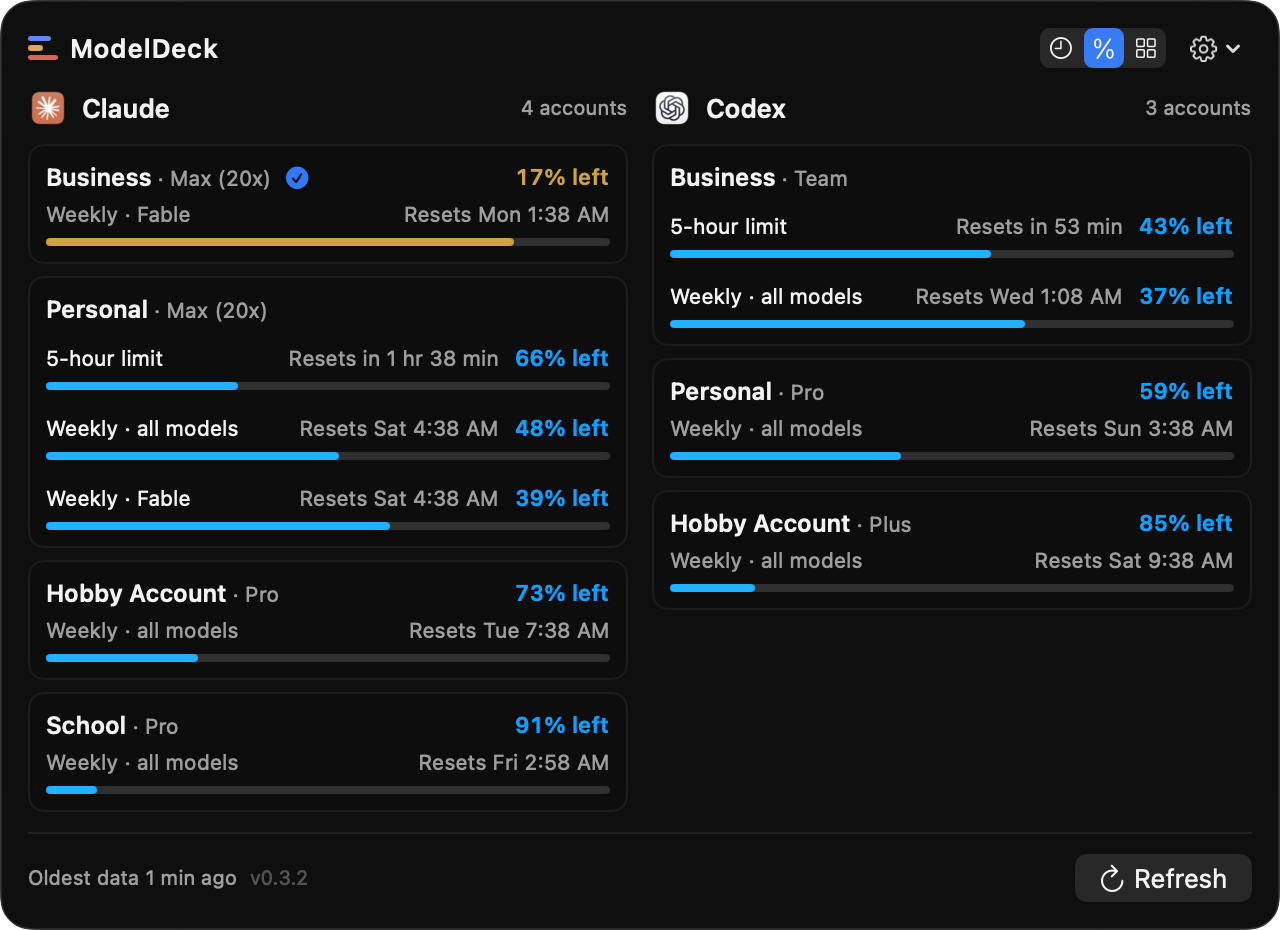
("Resets Wed 5:59 PM PDT") in your time zone. - Both providers, side by side — Claude Code and Codex CLI columns with
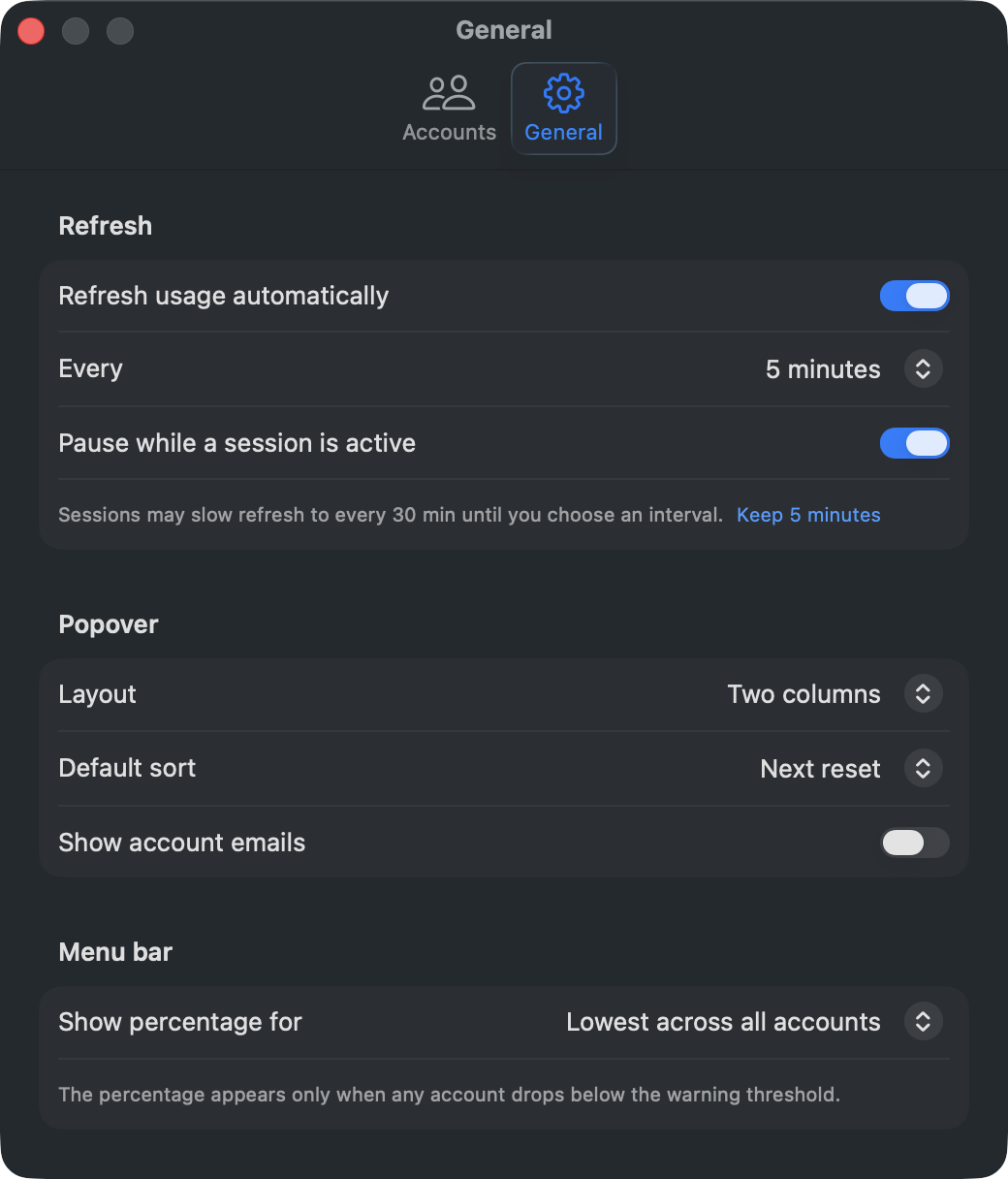
their brand marks, or a single-column layout if you prefer. Sort by next
reset, lowest remaining, or provider. - Model-scoped weekly limits — per-model caps are parsed and shown as
first-class meters, not buried in a tooltip. - Account activation with honest states — each provider has one active
account for new terminal sessions. Activation atomically swaps isolated
per-account profile homes, then verifies the result and reports it
truthfully (effective/identity-mismatch/identity-unverified)
instead of assuming success. Running sessions are never stopped, logged
out, or touched. - Duplicate-token warning — if two accounts of either provider end up
sharing the same credential (a missed/loginceremony, a copied
profile), the deck flags them with a warning marker and banner instead of
silently counting the same limit twice. - Isolated profile homes — every account lives in its own owner-only
config home (CLAUDE_CONFIG_DIR/CODEX_HOME), macOS Keychain-aware,
so identities never bleed into each other. - Transition-only notifications — a banner when an account crosses
your remaining-% threshold, silence otherwise. Thresholds configurable. - Menu bar at-a-glance state — plain glyph when healthy, gold "% left"
beside it when anything is low, red at critical, back to plain on recovery.
Or pin one account (or "the active account") from Settings or a card's
right-click menu and its percentage stays in the menu bar continuously. - Guided add-account flow — three steps: name it, sign in through the
provider's own browser login, confirm the identity ModelDeck read back.
ModelDeck never sees your password or token. - CLI health — installed vs. latest versions of Claude Code and Codex
CLI, with auth-state chips per account ("Healthy" / "Sign in again"). - Launch at login and one-click updates — start with your Mac, and
optionally check the public releases feed daily for new versions. When one
is found, Update Now downloads, verifies (EdDSA + Apple signature),
installs, and relaunches in one click; an "Install updates automatically"
toggle (on by default once checks are enabled) installs quietly on the
next relaunch instead. Turn checks off and ModelDeck never phones out.
Privacy: local-first, by design
This is the point of the tool, so it's worth being explicit:
| Cloud services | None. No backend, no sync, no accounts. |
| Telemetry | None. Nothing is phoned home, ever. |
| Provider credentials | Never copied or persisted by ModelDeck. Sign-in happens in the provider's own browser flow, and credentials stay in the provider-managed profile/Keychain; ModelDeck uses them in place, at runtime, only for usage and auth-state reads. |
| ModelDeck's own secrets | A few Keychain items of its own, all locally generated: one random token that authorizes the app to the daemon's localhost API, plus — only if you use the managed proxy — one client key per profile (service cli-proxy-api-client.<profile>) that ModelDeck mints for its own local proxy. None contain provider data. |
| Network | Daemon binds to 127.0.0.1 only. Outbound calls go solely to the providers you already use, with credentials they already hold. |
| Removal | Removing an account deletes only ModelDeck's reference — never your Keychain entries or provider auth state. |
Install
Requirements: macOS 14+ and the Claude Code and/or Codex CLIs you want
to track. (Node.js is only needed if you build from source.)
1. Download the app
Get the latest signed, notarized DMG from the
Releases page, open
it, and drag ModelDeck to Applications.
2. Launch it
The DMG is self-contained: on first launch ModelDeck asks your consent to
register its bundled background service (the local daemon that does the
actual usage reads, listening on 127.0.0.1:3867 only) and sets up its
Keychain token — one approval, no Terminal.
3. Add accounts
Open Settings → Accounts → Add Account and follow the three-step flow
for each account — e.g. "Work", "Personal", "Side Project". Each gets its
own isolated profile home and signs in through the provider's own login
flow.
Uninstall
First, what uninstalling never touches: ~/.claude, ~/.codex, and
your provider credentials. Those belong to the CLIs and their own sign-in
flows; every removal path below leaves them exactly as they are, and every
account you added keeps working from its provider's point of view.
If you installed the DMG
- Quit ModelDeck (menu bar icon → right-click → Quit ModelDeck).
- Drag ModelDeck from Applications to the Trash. The background service
and the launch-at-login entry live inside the app bundle, so removing
the app removes them too — no Terminal needed. - Optionally, delete the data ModelDeck kept (skip this if you might
reinstall — it's what makes a reinstall pick up where you left off):~/Library/Application Support/ModelDeck— settings, usage history,
and the isolated per-account profile homes ModelDeck created. Deleting
it removes those managed sign-ins; your own~/.claudeand~/.codex
are not in here. (If you run the daemon withMODELDECK_DATA_DIRorMODELDECK_DB_PATHset, delete those locations instead.)~/Library/Preferences/app.modeldeck.mac.plist,~/Library/Caches/app.modeldeck.mac, and (if you ever ran the
from-source launch agent)~/Library/LaunchAgents/ai.hermes.modeldeck.plist.
If you installed via Homebrew
brew uninstall modeldeck
removes the app and leaves your data in place for a reinstall. To delete
the data as well (same caveat about managed account profiles as above):
brew uninstall --zap modeldeck
Keychain items (both install methods)
Neither the Trash nor --zap can remove Keychain items, so two kinds may
remain — both are ModelDeck's own locally generated secrets, containing
nothing of yours. Open Keychain Access, search for modeldeck andcli-proxy-api-client, and delete what turns up; or from Terminal:
security delete-generic-password -s modeldeck -a mutation-token
The cli-proxy-api-client.* items exist only if you used the managed
proxy feature, one per profile; delete each withsecurity delete-generic-password -s "cli-proxy-api-client.<profile>" -a "".
How it works
flowchart LR
    A["Menu bar app<br/>(SwiftUI)"] <-->|"HTTP<br/>127.0.0.1:3867"| D["Local daemon<br/>(Node.js + SQLite)"]
    D --> C["Claude Code CLI<br/>per-account profile homes"]
    D --> X["Codex CLI<br/>per-account CODEX_HOME"]
- The app (
macos/ModelDeckMac/) is a SwiftPMMenuBarExtraapp — no
Xcode project, no Electron. It is a pure client of the daemon's
localhost API. - The daemon (
src/) is API-only: it binds to127.0.0.1, rejects
unexpected Host/Origin headers, and requires a per-server token plus aSameSite=Strictcookie for every mutation. State lives in an owner-only
SQLite database under~/Library/Application Support/ModelDeck/. The old
control-plane web UI is retired: the native app drives everything the
daemon does. Its one remaining page is the read-only usage dashboard at/dashboard, served on the same loopback listener behind theusageAnalyticsEnabledsetting and opened from the app. - Usage reads go through each provider's own channel: Codex via the
officialcodex app-serverstdio protocol, Claude via Anthropic's native
usage endpoint using only the credential already stored in that profile —
ModelDeck never initiates logins, never refreshes tokens, and never
persists credentials.
Development
Building from source instead of using the released DMG (requires Node.js
24+ for the daemon):
# daemon (foreground)
npm install
npm start                             # daemon on 127.0.0.1:3867

# app
cd macos/ModelDeckMac
swift run ModelDeckMac
To keep a checkout's daemon running across logins instead of the bundled
one, install it as a launch agent:
scripts/set-mutation-token.sh                # one-time Keychain token setup
scripts/install-launch-agent.sh --port 3867  # installs + starts the launchd agent
Or assemble a signed .app bundle (ad-hoc by default):
macos/ModelDeckMac/Scripts/build_app.sh
The usage dashboard (/dashboard, behind the usageAnalyticsEnabled
setting) is a React app in dashboard/, compiled to ONE self-contained HTML
file and inlined into src/dashboard-app.mjs — a committed build output the
daemon serves and the single-file binary carries. Edit dashboard/, then:
npm run dashboard:build               # regenerate src/dashboard-app.mjs
npm run dashboard:dev                 # Vite + HMR against a daemon on :3867
npm test fails if the committed artifact is older than the sources.
Tests:
npm test                              # daemon test suite
cd macos/ModelDeckMac && swift test   # app test suite
See macos/ModelDeckMac/README.md for the
app package layout, DESIGN.md for the daemon's safety
contract and architecture decisions, and docs/RELEASE.md
for how release DMGs are cut.
Roadmap
The native app is the interface for everything the daemon does; the
read-only usage dashboard at /dashboard is the one browser page.
Release history lives inCHANGELOG.md, with the app design authority indesign/mac-app-spec.md. Project news lands at
modeldeck.ai.
License
ModelDeck is source-visible and free for personal, noncommercial use under
the PolyForm Noncommercial License 1.0.0: read the code, build
it, run it on your own machine, and share it noncommercially. Commercial
rights are reserved by the author — if you want to use ModelDeck
commercially, open an issue and ask.
Contributing
Issues and pull requests are welcome — contributions are accepted under the
same license as the project. Bug reports with the daemon's/api/health output and your macOS + CLI versions are especially useful.
Please don't include real account identities or usage data in issues —
placeholder labels are fine.
Yorumlar (0)
Yorum birakmak icin giris yap.
Yorum birakSonuc bulunamadi