dsh-researcher
Health Warn
- License — License: MIT
- Description — Repository has a description
- Active repo — Last push 0 days ago
- Low visibility — Only 5 GitHub stars
Code Fail
- process.env — Environment variable access in bin/feedback.js
- fs module — File system access in bin/feedback.js
- spawnSync — Synchronous process spawning in bin/install.js
- fs.rmSync — Destructive file system operation in bin/install.js
- os.homedir — User home directory access in bin/install.js
- process.env — Environment variable access in bin/install.js
- fs module — File system access in bin/install.js
- fs.rmSync — Destructive file system operation in bin/project-cognition.js
- fs module — File system access in bin/project-cognition.js
- network request — Outbound network request in evaluation/candidate_pool.json
Permissions Pass
- Permissions — No dangerous permissions requested
No AI report is available for this listing yet.
Read-only repository research, durable project memory, and evidence-gated definitions of done for AI coding agents on DeepSeek Harness.
dsh-researcher
English | 简体中文




Stop AI coding agents from forgetting project reality—or declaring DONE without evidence
dsh-researcher is an experimental governance layer for DeepSeek Harness. It separates two jobs that ordinary Plan mode tends to mix:
- Project Research reconstructs purpose, architecture, constraints, risks, and unknowns inside a guarded read-only session.
- Goal Governor freezes the target, boundaries, budget, human gates, and definition of done; the host then derives the terminal state from trusted events instead of assistant prose.
They are independent. You can trial Project Research without adopting Goal Contracts.
Honest maturity: the mechanisms, installer lifecycle, adversarial replay, and offline E1 infrastructure are tested. Live E1, net productivity gain, long-term Project Cognition value, and adapters beyond DSH are not proven.
The problem
AI coding becomes unreliable across sessions, not only within one prompt:
- A new session re-guesses why the repository exists.
- Locally plausible changes slowly cross architecture or migration boundaries.
- An agent says “done” without sufficient outcome evidence—or keeps polishing after the task is already satisfied.
- The person never froze a stopping condition, so neither side knows when to stop.
A Plan says what steps may be attempted. This project records what is believed true, what must be achieved, who may prove it, and when work must stop.
See the mechanism in 60 seconds
The public demo is offline and starts real verifier child processes. It uses a synthetic DSH-shaped event envelope, so it proves reducer behavior—not Live DSH or model productivity.
git clone https://github.com/TLNing260310/dsh-researcher.git
cd dsh-researcher
npm run demo
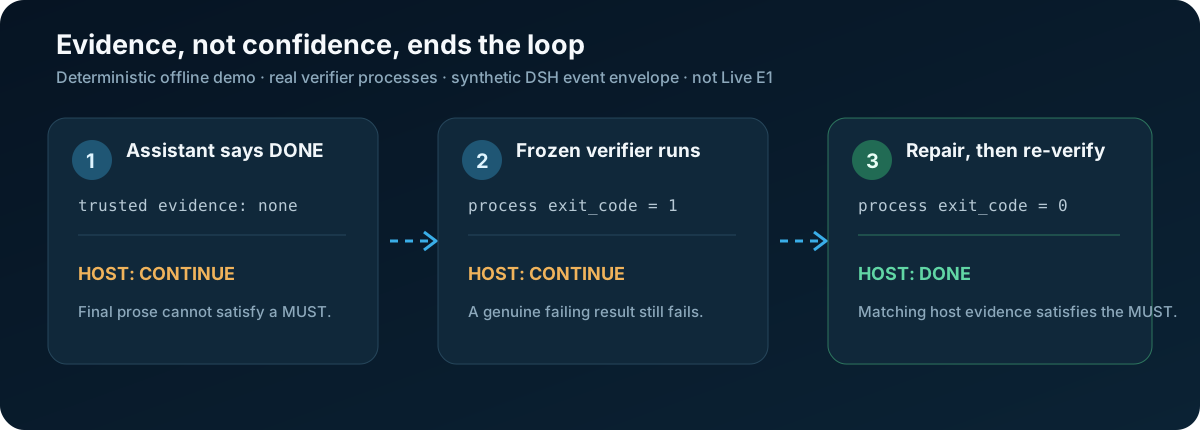
The three decisions are reproducible:
assistant says DONE, no trusted evidence  → CONTINUE
matching verifier exits 1                → CONTINUE
matching verifier exits 0 after repair   → DONE
The final assistant message is never evidence. A MUST criterion is satisfied only by a host event bound to an approved verifier's tool name, complete arguments, argument hash, and result policy.
Choose only the layer you need
| Your situation | Use | Maturity |
|---|---|---|
| Taking over an unfamiliar repository or checking architecture before a risky change | Project Research | Isolated trial; read-only runtime boundary has a real DSH Web smoke |
| Checking one project fact during coding | /researcher <question> in Governed Coding |
Isolated one-turn trial |
| Freezing acceptance criteria, budgets, human gates, and stopping states | Goal Governor | Advanced alpha; mechanisms tested, outcome gain unproven |
| A tiny bug, CRUD change, or disposable script | Ordinary Agent / Plan | This project is probably too heavy |
| Codex, Claude Code, OpenClaw, Kiro, or Zed/Zcode without DSH | Do not install yet | Portable core exists; client adapters are not delivered |
Safe trial on DeepSeek Harness
Requirements:
- DeepSeek Harness: exactly verified against
0.1.0-rc.7. - Node.js:
>=22.12.0. - Use an isolated
DSH_HOMEand a non-critical repository copy first.
This repository is GitHub-distributed only. The unscoped npm name dsh-researcher belongs to a different maintainer and repository. Do not use npm install dsh-researcher; use the pinned GitHub source or signed release assets below. main now uses the private scoped identity @tlning260310/dsh-researcher to prevent accidental publication under the wrong identity. The existing v0.8.0-alpha.8 tag predates that metadata change, but its github: source remains unambiguous and never resolves the npm registry package.
Preview every installer-owned change first:
npx -y github:TLNing260310/dsh-researcher#v0.8.0-alpha.8 --dry-run
Install only after reviewing the preview:
npx -y github:TLNing260310/dsh-researcher#v0.8.0-alpha.8
The installer refuses unknown DSH versions and existing presets by default. Backup, force-upgrade, uninstall, rollback, and SHA-256-bound release installation are documented in Safe installation and recovery.
Path A: read-only Project Research
- Start a new DSH Web session and select
Read Only. - Select
项目研究 Project Research. The preset tightens approval tonever. - Ask a bounded, evidence-oriented question:
Run research_doctor first. Review this repository without writing files.
Use path:line evidence to explain its purpose, immutable constraints,
documentation/implementation conflicts, and the next hypothesis worth testing.
Mark anything unverified as UNKNOWN.
research_doctor must be the first tool call. Research remains locked unless the Runtime Certificate is SAFE; later permission drift revokes the certificate before another model response.
Two entry points exist:
| Entry | Lifetime | Intended use |
|---|---|---|
项目研究 Project Research preset |
Persistent session; environment-level read-only, approval never, no generic shell | Full or high-risk repository research |
/researcher <question> |
One guarded read-only turn inside Governed Coding | A focused fact check during implementation |
The real smoke proves the runtime boundary, not report quality. Two local 14B probes failed to produce a publishable report; that negative evidence remains public in Project Research local-output smoke.
Path B: a review-first Goal Contract
The Quickstart generates external Cognition, Verifier Registry, Goal Contract, and REVIEW.md drafts. It does not approve a goal or promote project facts for you.
npx -y --package=github:TLNing260310/dsh-researcher#v0.8.0-alpha.8 project-cognition init .
npx -y --package=github:TLNing260310/dsh-researcher#v0.8.0-alpha.8 project-cognition quickstart --root . --out ../my-goal-review --goal-id fix-login-timeout
Review purpose, boundaries, MUST criteria, budget, and verifier definitions in the generated REVIEW.md, then follow its explicit approval commands. See the five-minute Quickstart.
What “done” means here
- Every MUST criterion needs a frozen verifier or direct human gate.
- The final attempt re-proves every MUST; it cannot inherit an old attempt's success.
- An already-passing baseline returns
ALREADY_SATISFIEDwithout a performative code change. - Attempt, time, token, or no-progress budgets end in
STOPPED. - Contract, cognition, permission, or verifier drift ends in
NEEDS_HUMAN. - A model cannot write or replace its own terminal decision; the host recomputes it from the trusted event prefix.
Authority flow
read-only research
  → Research Session Ledger (non-authoritative)
  → draft revision
  → owner review
  → seal
  → .project-cognition/state.json (canonical truth)
  → deterministic PROJECT_COGNITION.md projection

Goal Contract + frozen verifier registry
  → host-observed calls, results, gates, usage, and repository revision
  → replay / reducer
  → CONTINUE | NEEDS_HUMAN | DONE | STOPPED
The CLI actor label is not human authentication. Repository governance must keep approval authority outside the model workflow.
Evidence ledger
| Layer | Status | What it establishes |
|---|---|---|
| Unit, replay, integration, adversarial, installer, and package tests | PASS | The published mechanisms reject the covered drift and forged-evidence paths |
project-cognition doctor . |
PASS | Current schema, hashes, projection, goals, and registry agree; it does not prove evidence freshness |
| DSH Web Project Research smoke | Runtime boundary PASS; output probes FAIL | The exact tested runtime can become SAFE and reject drift; research quality is not established |
| Goal Governor E1 infrastructure | READY; Live E1 NOT RUN | Preflight, run lock, cost admission, bundle, replay, and scorer exist |
| Outcome value and portability | NOT PROVEN | Requires Live E1, a non-inferential pilot, E2, then second-adapter conformance |
Run the public offline checks without a model or network call:
npm run check
npm run demo
npm run eval:e1:preflight
The proof order is frozen as Gate 0 → E1 → non-inferential pilot → E2 → second-adapter conformance → E3. See Validation Status and the protocol-owned Goal Governor evaluation definition.
How this differs from familiar tools
| Layer | Primary question |
|---|---|
| Plan / Tasks | What steps should we attempt next? |
| Spec | What behavior do we intend to build or change? |
| Memory | What did the agent previously learn? |
| Project Cognition | What claims about repository reality are trusted, why, and when do they become stale? |
| Goal Governor | What observable state counts as done, who may prove it, and when must work stop? |
Spec Kit, OpenSpec, Kiro, Serena, Beads, and client-native Plan/Memory may be better choices for many users. The candidate differentiation here is the combination of staleable project reality and host-owned terminal adjudication, not any individual feature. See the competitive and integration landscape.
Repository map
- Mature project introduction
- Safe installation and recovery
- Five-minute Quickstart
- Validation Status
- Architecture
- Goal Governor guide
- Project Cognition governance
- Case library and admission standard
- E1 harness
Feedback
You do not need a polished report. The most useful signals are whether the demo ran, where installation stopped, whether the workflow prevented a wrong completion, and whether it added only overhead.
- Submit a 10-minute trial report
- Share a full real-world run
- Open a reproducible bug
- Report security issues privately under SECURITY.md.
Current release: v0.8.0-alpha.8. The alpha line is intentionally frozen until a meaningful evidence or onboarding milestone; documentation changes on main are not a new product claim.
Reviews (0)
Sign in to leave a review.
Leave a reviewNo results found