verbatim-citation-gate
Health Warn
- License — License: MIT
- Description — Repository has a description
- Active repo — Last push 0 days ago
- Low visibility — Only 5 GitHub stars
Code Warn
- network request — Outbound network request in bench/build_corpus.py
Permissions Pass
- Permissions — No dangerous permissions requested
No AI report is available for this listing yet.
Catch fabricated RAG citations before they reach the user: a zero-token verbatim gate + a burden-of-proof judge, framework-agnostic.
verbatim-citation-gate


Catch fabricated RAG citations before they reach the user. A two-stage, framework-agnostic auditor for quote-style citations.
The deterministic half is src/verbatim_citation_gate/gate.py: zero dependencies, zero tokens.
The model half is src/verbatim_citation_gate/judge.py, and plugs into whatever LLM your pipeline already speaks.
Quickstart — 30 seconds, no API key
pip install "git+https://github.com/tonydzi/verbatim-citation-gate"
from verbatim_citation_gate import quote_gate

docs = {"veltranib-rct": "... Body weight was unchanged in both arms."}

quote_gate("Body weight was unchanged in both arms.", "veltranib-rct", docs)  # 'found'
quote_gate("Veltranib produced dramatic weight loss.", "veltranib-rct", docs)  # 'not_found'
That is stage 1, and it is the whole offline half: no key, no network, no tokens.
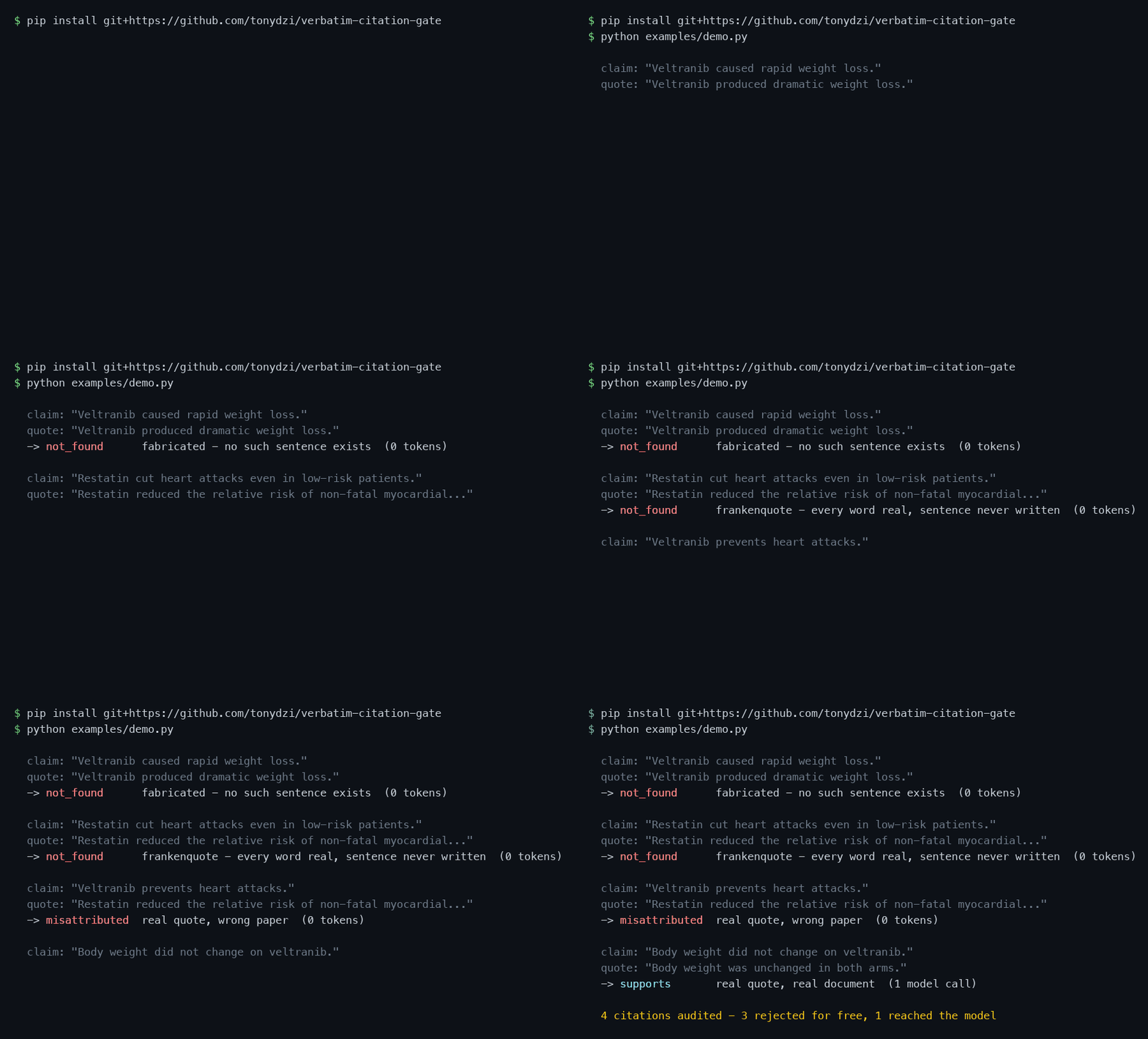
The run in the animation above is examples/demo.py — python examples/demo.py
reproduces it, model calls counted by the demo itself.
Stage 2 (the judge) needs a model and is one argument away — see Use below.
📖 Docs: https://tonydzi.github.io/verbatim-citation-gate/ — the two stages, the API, the verdicts, and every known limit with its issue.
RAG systems love to cite. The problem is how they fail — a quote that reads as authoritative and word-for-word can still be one of three things, each with its own case in tests/test_gate.py:
- fabricated — a plausible sentence that appears in no source (
test_fabrication_is_not_found), - a frankenquote — every word is real, but the sentence was stitched together and never actually written (
test_frankenquote_is_not_found), or - misattributed — a real quote lifted from a different document (
test_misattributed_real_quote_from_wrong_doc).
A judge model, asked "does this quote support this claim?", waves all three through: they read as fluent and supportive.
The fix is to ask the cheaper, prior question first, deterministically — that is src/verbatim_citation_gate/gate.py.
The two stages
                 ┌─────────────────────────┐
 claim + quote → │ 1. verbatim gate (free)  │ → not_found / misattributed   (rejected, 0 tokens)
   + doc id      └─────────────┬───────────┘
                               │ found
                               ▼
                 ┌─────────────────────────┐
                 │ 2. skeptical judge (LLM) │ → supports / partial / unrelated / contradicts
                 └─────────────────────────┘
Stage 1 — the verbatim gate, all of it in src/verbatim_citation_gate/gate.py.
Pure re + substring matching over a normalized form: case, smart quotes, dashes and whitespace folded, numbers and % preserved (test_normalize_preserves_numbers_and_percent in tests/test_gate.py).
It cannot be sweet-talked, and every fabrication it rejects costs zero model calls — proven by test_audit_fabrication_never_calls_judge in tests/test_gate.py.
Frankenquotes fail because the match is contiguous, not bag-of-words, and a real quote from the wrong document is surfaced as misattributed rather than collapsed into not_found — the two need different fixes upstream (src/verbatim_citation_gate/gate.py).
Stage 2 — the skeptical judge, all of it in src/verbatim_citation_gate/judge.py.
For quotes that do exist, a burden-of-proof prompt decides whether the passage actually establishes the claim. All three rules below live in that file's prompt:
- Default-refute (
judge.py) — the verdict starts at unsupported; the quote must
earnsupports, and ties break against the claim. - Outside knowledge is inadmissible (
judge.py) — a claim can be true in the world
and still unsupported by this source. - Full-strength support (
judge.py) — same population, direction, magnitude and
certainty, or the verdict caps atpartial
(subgroup→everyone, correlation→causation, "may"→"does").
If the judge's output does not parse it fails closed (src/verbatim_citation_gate/judge.py):
an unverifiable citation never counts as support.
Install
Not on PyPI yet — install from the repository:
pip install "git+https://github.com/tonydzi/verbatim-citation-gate"

# from a clone, with the test extra:
pip install -e ".[test]" && pytest -q
Pure stdlib: the gate pulls in nothing, and the judge takes whatever llm_call
you already have.
Use
from verbatim_citation_gate import audit_citation

docs = {"veltranib-rct": "... Body weight was unchanged in both arms."}

# Stage 1 only — no model, no key, fully offline:
audit_citation("Body weight did not change.", "veltranib-rct",
               "Body weight was unchanged in both arms.", docs)   # -> "found"

# Both stages — supply any model as llm_call(system, user) -> str:
def llm_call(system, user):
    return client.messages.create(              # Anthropic shown; any vendor works
        model="claude-haiku-4-5", system=system, max_tokens=1024,
        messages=[{"role": "user", "content": user}],
    ).content[0].text

audit_citation("Body weight did not change.", "veltranib-rct",
               "Body weight was unchanged in both arms.", docs, llm_call=llm_call)
# -> "supports" | "partial" | "unrelated" | "contradicts" | "not_found" | "misattributed"
llm_call is deliberately the smallest possible contract — (system, user) → text
— so the judge wires to Claude, GPT, Gemini, Mistral, Cohere, or a local Qwen
without adapters. OpenAI, Cohere, and other one-liners are inexamples/quickstart.py.
Why the gate goes first
The number you page on for a citation auditor is recall of unfaithful
citations — the fraction of bad citations you actually catch. The gate lifts
that recall for free on the three failure modes a judge is worst at
(fabricated, franken, misattributed), because those are exactly the ones that
look supportive. What reaches the model is only the genuinely ambiguous case:
a real quote whose sufficiency is a judgment call.
Scope
For citations expressed as character offsets, use the same fail-closed gate viaspan_gate(doc_id, start, end, docs). Offsets are Python string indices and use
the half-open interval [start, end). Pass chunk=(chunk_start, chunk_end) when
the retriever returned one chunk; spans outside it are rejected rather than
silently clipped. An optional quote= must match inside the resolved span:
from verbatim_citation_gate import span_gate

span_gate("report", 10, 42, docs, quote="the cited text", chunk=(0, 100))
Contributions wiring the gates into specific frameworks (Haystack, LlamaIndex,
LangChain, Cohere, Qwen-Agent, …) are welcome.
Roadmap
Now — v0.1.0.
The deterministic gate (gate.py) and the burden-of-proof judge (judge.py), 24 tests green,
install from git. Known limits are open issues, not footnotes — read them before you rely on it,
especially #1.
Next, in the order we would take them:
| What | Why it matters | Issue |
|---|---|---|
| Minimum-evidence rule | a one-word quote currently returns found |
#4 |
| Citations by doc id / offset | the gate presumes quote-style citations | #9 |
| PyPI package | so pip install verbatim-citation-gate is real |
#8 |
Shipped from this table — all three fixed by outside contributor Guan Tong,
who claimed them off the issue list and had the first PR open within the hour: Unicode-aware normalization
(#1 — before it, the gate's
core promise was silently off in every non-Latin script), corpus normalization cached
(#2), and the py.typed marker
(#3).
Every noticeable change ships as a new release, so the
release feed
is the honest record of how far along this is — not the commit graph.
What "working" means here — the metrics we actually track
Stars are free and prove nothing. From 2026-08 this project is measured on three
numbers, reviewed monthly, target horizon 4–8 months:
- Weekly unique clones — people pulling the code, not applauding it.
- Independent consumers — repos or teams that would have to replace this
gate if it disappeared. This is the only number that really matters. - Repeat outside contributors — engineers who came back a second time.
First one already exists; that fact is why this repo became the lab's flagship.
AI contributors
This project is built by a human + AI team, and the git log says so: Claude
writes most of the code, Codex and Grok review it, Gemini feeds the research.
Each is credited on a commit only if its output changed that commit's
content — no decorative credits. Lab-wide policy, one source for every repo:
AI-CONTRIBUTORS.md.
License
MIT © Palo Alto AI Research Lab
About & contact
Built and battle-tested at Palo Alto AI Research Lab — a fleet of Claude Code machines
running 24/7 as a second brain and synthetic cofounder. This gate was extracted after it
survived production, not written as a demo.
Questions, war stories, or you want to run this on your own fleet:
- 👤 Author: Anton Dziatkovskii — Telegram @tonydzi · WhatsApp +1 341 222 9178 · X @Tony_Stef_
- 📣 Channels: @ClawRus (RU) · @ClawEng (EN)
- 🌐 palo-alto.ai · Palo Alto AI Research Lab
- 🧪 Engineers: want to test-drive this setup? Message me — I hand out free starter seeds to engineers who test and report back.
Contributors welcome — and there is a queue
The queue is visible: verbatim-citation-gate — roadmap — Now (an open PR exists), Next (scoped, free to take), Later (deferred, with the reason on the card), Shipped — and Shipped now starts with v0.1.0.
Issues labelled accepted
are scoped, free to take, and nobody is on them. Comment "claiming this" — no permission needed —
and it is yours for 7 days. New here? Start withgood first issue.
You keep the copyright to your code. No CLA, no assignment, ever — your contribution goes in
under this repo's existing license, the same terms as ours. We answer every issue and PR within
48 hours, including "no, and here is why"; our silence is our bug, so ping the thread.
Full deal: CONTRIBUTING.md
🧩 One piece of a working system
This repository is one piece lifted out of a live operation: one engineer running a fleet of
machines, built with Claude as implementation collaborator; the machines reach consensus with
each other and wake the human only for money or the irreversible. It was extracted after it
survived production, not written as a demo — and it runs on its own: nothing here phones home
to the rest.
See how the whole thing fits together → SYSTEM.md
Its closest neighbours in the gates layer: verdict-contract · claim-check · verified-ops-starter
READ THIS WITH AI
One click and an agent reads the repo, pulls out the patterns and helps you apply them to your own work.



Read this repo: https://github.com/tonydzi/verbatim-citation-gate (“verbatim-citation-gate” - Catch fabricated RAG citations before they reach the user: a zero-token verbatim gate + a burden-of-proof judge, framework-agnostic). Work out what problem it actually solves, pull out the reusable patterns and help me apply them to my own setup. Start by asking what I am working on.
— TonyDzi, Palo Alto AI Research Lab · second brain, agent coordination, persistent memory: github.com/tonydzi
Reviews (0)
Sign in to leave a review.
Leave a reviewNo results found