motion-film-skill
Health Uyari
- License — License: NOASSERTION
- Description — Repository has a description
- Active repo — Last push 0 days ago
- Low visibility — Only 5 GitHub stars
Code Gecti
- Code scan — Scanned 12 files during light audit, no dangerous patterns found
Permissions Gecti
- Permissions — No dangerous permissions requested
Bu listing icin henuz AI raporu yok.
Turn a report, a deck or a product into a voice-led motion film, written in code by your AI agent. Skill for Claude Code, Codex and any agent: AI voiceover, beat-synced animation, captions, critic rounds, 60 fps 16:9 + 9:16.
motion-film
Turn a report, a deck or a product into a voice-led motion film — written in code by your AI agent.
An agent skill for Claude Code, Codex and any coding agent that can run a shell.
Story first, AI voiceover, beat-synced spring animation, burned-in captions, an original score,
independent critic rounds, 60 fps in 16:9 and 9:16.





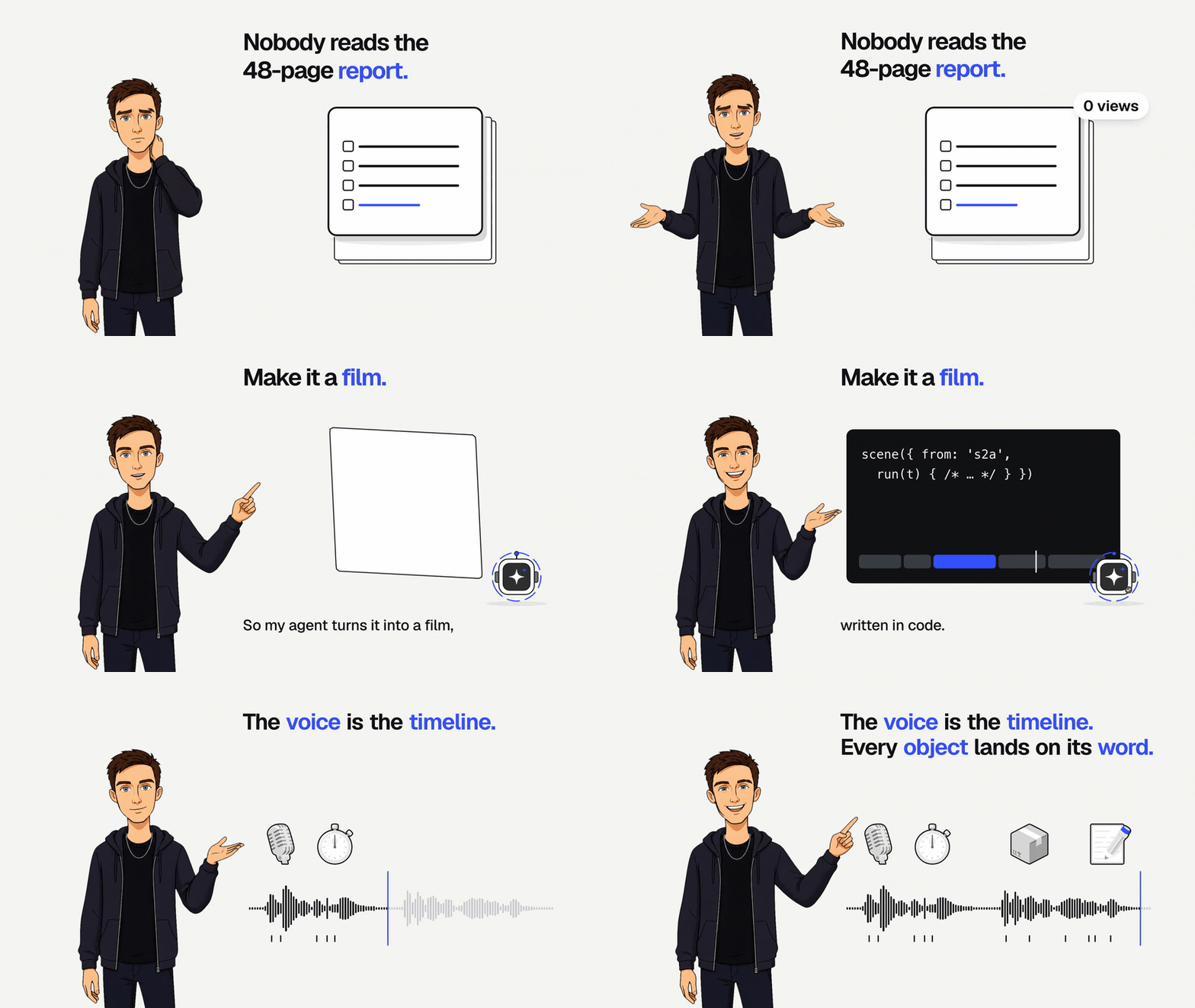
The first seconds of the demo. The whole 33-second film, sound on: 16:9 MP4 · 9:16 MP4.
It was made with this skill, from this script.
Why
Nobody reads the 48-page report. People do watch a 90-second film. Making one normally means a motion designer,
a voice actor, a composer and a week. AI video models are quick, but they guess: text melts, numbers change,
and you can't fix one shot without regenerating the whole thing.
motion-film takes a different route. Your agent writes the film as code. Every frame is a pure function of
time, rendered by headless Chromium, so the picture is exact, every number is the real number, and changing one
word costs one re-render, not a new roll of the dice.
What you get
- 🎙️ The voice sets the timeline. Scenes start on bars and phrases on half-beats. Every element lands on the
word that names it. - 📝 Story before pixels. A logline, stakes and a turn, then a script with voice directions. You approve it
before any audio is made. - 🗣️ Any voice. ElevenLabs, OpenRouter (Gemini TTS, gpt-audio), OpenAI, or your own recordings. Every take is
transcribed back and retried if it drifts from the script. - 🌀 Motion that feels designed. Spring physics, masked type, cover transitions and no fades to grey. The rule
book comes from a motion designer's showreel practice. - 🎞️ Nine visual formats. The agent picks a visual language by the substance of the material (product demo,
one take, kinetic statement, data at true scale, an image per phrase and more), and the critic checks the format's
signature first. Explainers (Vox-style, whiteboard, 3Blue1Brown-style) have their own recipes. - 🎚️ A style is a set of switches, not one house look. Type, palette, pictures, character, caption placement,
numbers, music, sound effects and voice are chosen for the platform and the material. The choice is written into the
brief, and a preset can fix it for a whole series. - 🧑🏫 A presenter who links the chapters. A drawn presenter with a pool of looks, poses, gestures and pointing
hands, or a puppet made of pictures with mouth shapes timed from the words. Optional: most films don't need one. - 🧩 A library before a blank page. 30 stateful objects (agent, tokens, funnel, team, document, server and more)
in four drawing skins, 563 extra objects repainted into the film's palette, 120 icons from Lucide, Tabler and
Phosphor, ready chart, counter and kanban blocks, and shape morphs with a checked seam. All offline, with a search
over the catalogue. - 🧊 3D where it earns its place. A three.js layer with physical light and depth of field, a real screenshot as a
screen in 3D, cut-outs and 2.5D depth for photos, plus GSAP kinetic type and your brand's Lottie files. Deterministic
per frame, rendered on the GPU. - 💬 Burned-in captions that follow the voice clause by clause, with digits on screen, or word by word as karaoke
for social cuts. At the bottom of the frame, above the platform's UI in 9:16. - 🎼 Sound on the same grid. An original synthesised score (or your track, or generated music), UI hits on the
landing beats, and a mix at −14 LUFS. No whooshes, no risers, no cymbal crash on the end card. - 🧐 A critic that isn't the author. A fresh agent first walks every object on screen (does it read, does anything
run into it, is its label aligned), then scores 8 criteria with evidence from contact sheets, phone-size frames and
the safe zones of 9:16 platforms. The film ships only when every score is ≥ 8. - ⚡ 4.3× faster render, same pixels. Parallel chunks across Chromium workers. One worker reproduces the
sequential render byte for byte. - 📱 16:9 and 9:16 from one source, each with its own layout. Nothing is just re-cropped.
- 🔍 Checks a reviewer would make. Text lint (contrast, safe zones, text or screens cut by the frame edge, text
lying on text or on an icon, labels off their object's axis), seams across cuts, a stillness check that finds
stretches where the frame stops changing, a shot-list check against slideshow habits, and a local player for notes
by timecode. - 🎤 Over your own recording. A talk or an interview becomes the bottom layer, the graphics go on top.
- 🔁 Silent loops and GIFs. A 4–14 second loop for a feed, Telegram or X with a checked seam, and a GIF with an
exact frame count for a chat or a README.
How it works
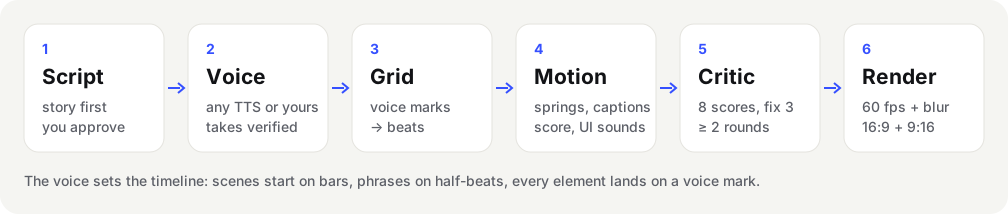
- Brief. One round of questions: the audience, the one thought to leave behind, the sources, the formats.
- Story and script.
SCRIPT.md: sections with Shot, Title and Voice lines plus directions such as{pre=0.6 mood=concern}. Linted, then you approve it. - Voice → timeline. Each line is voiced, checked, and laid onto a measured beat grid as marks (
s3a,s3a.2,s3a.end). - Style guide and shot list. You approve these too, in one message.
- Film. The agent writes
film/film.js: onescene()per scene, timed from the voice marks. - Sound. Score, SFX layout and the mix.
- Critic rounds. Draft render, contact sheets, then an independent critic. The 3 worst problems get fixed, and
the round repeats. - Final render. 60 fps with adaptive motion blur, a poster frame, and a report with every score.
The approval steps are real stops: the agent waits for you before any credits are spent.
Install
Requirements: macOS or Linux, Node 22+, Python 3.11–3.13, ffmpeg, about 1 GB of disk for the shared toolchain and headless Chromium.
Claude Code
git clone --branch v1.7.1 --depth 1 https://github.com/tonyprots/motion-film-skill ~/.claude/skills/motion-film
Restart Claude Code, then ask: "Make a 90-second film from report.pdf for our leadership channel."
Codex
git clone --branch v1.7.1 --depth 1 https://github.com/tonyprots/motion-film-skill ~/.codex/skills/motion-film
Any other agent
Clone the repo anywhere and point your agent at SKILL.md: "Follow SKILL.md in ./motion-film to make a film
from these notes." The skill is plain Markdown, Python and Node. It needs a shell and a way to look at images.
The critic step works best when the agent can start a fresh session or a subagent, for example claude -p orcodex exec.
The first project sets up the toolchain once in ~/.cache/motion-film. Python packages are installed from a
hash-pinned lock, Node packages with npm ci, and Playwright adds headless Chromium:
sh ~/.claude/skills/motion-film/scripts/init.sh ~/films/my-first-film --preset blank
To check a machine end to end without spending any credits (synth score, no voice):
sh ~/.claude/skills/motion-film/scripts/smoke_test.sh /tmp/motion-film-smoke
Voice providers and keys
Set one key. "provider": "auto" (the default) walks auto_order in defaults.json (ElevenLabs → OpenRouter → OpenAI →
SpeechKit) and picks the first provider that is set up:
| provider | voice | take check | music | key |
|---|---|---|---|---|
| ElevenLabs | eleven_v4, any voice incl. your clone | scribe_v2 | yes (plan-dependent) | ELEVENLABS_API_KEY |
| OpenRouter | Gemini TTS, gpt-audio | Gemini audio | Lyria | OPENROUTER_API_KEY |
| OpenAI | gpt-4o-mini-tts, gpt-audio | gpt-4o-transcribe | — | OPENAI_API_KEY |
| Yandex SpeechKit | API v3 voices (alena, kirill:strict …) |
SpeechKit STT | — | YANDEX_CLOUD_API_KEY, or a yc login |
| your recordings | audio/vo/<id>.wav |
any provider above | your track | — |
| synth | — | — | original score in code | — |
Keys are read from the environment, or from a file named by <NAME>_FILE. They are never printed and never
written into a project. Before a paid call the agent tells you how many characters it is about to send.
Scripts in any language work: the voice, the take check and the captions follow the script, and a preset can
ship fonts for your alphabet.
Adding your own provider is one Python file with tts(), transcribe() or music(). Seereference/PROVIDERS.md.
ElevenLabs is tested end to end with live keys. OpenRouter and OpenAI follow their documented APIs and are covered
by the same code paths, but were not run with live keys for this release. Reports are welcome.
Render speed
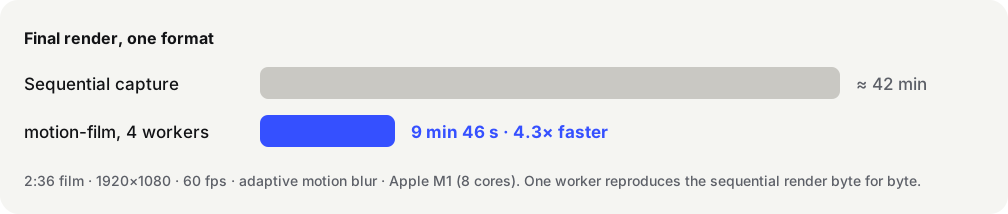
The film is cut into 4-second chunks rendered in parallel by headless Chromium workers. Each worker encodes its
own x264 segment, and the segments are joined without re-encoding. A faster PNG decoder removes the main CPU
bottleneck. Drafts for critic rounds take seconds. This README's 33-second demo renders as a draft in under
half a minute per format.
What leaves your machine
The skill runs inside your agent, so the agent's own model sees what the agent reads: the sources, the script, the code
and the frames it looks at. That includes the critic, which is a fresh session or subagent of the same agent. Where that
data goes is set by your agent and its model provider (Claude Code, Codex or another), not by this skill.
On top of that, the skill's own scripts make these calls:
| when | where | what |
|---|---|---|
| voice | your voice provider (api.elevenlabs.io, openrouter.ai, api.openai.com or Yandex Cloud SpeechKit tts.api.cloud.yandex.net) |
the script lines |
| take check | your check provider (same list; SpeechKit uses stt.api.cloud.yandex.net) |
the audio of each take, including your own recordings when you run voice.py check on them |
| music (optional) | ElevenLabs or OpenRouter | a text prompt describing the music, never your content |
| local music setup (optional, once) | github.com, huggingface.co, PyPI |
downloads of ACE-Step 1.5 and its weights; generation itself is local |
| sound library (optional, once) | freesound.org API with your key, or kenney.nl |
searches for generic sound names, downloads of CC0 sounds |
| cut-outs and depth (optional, once) | huggingface.co |
model weight downloads |
| video bridges (only if you ask for them) | openrouter.ai |
a text prompt and the two film frames each clip joins |
| brand capture (optional) | the URL you give capture.mjs |
an ordinary page visit |
| first setup | PyPI, npm, the Playwright CDN | package downloads |
| update check, at most once a week | api.github.com |
a request for the latest release tag of this repo, nothing about your films |
The scripts send nothing else: no telemetry, no server of ours. Rendering, captions, the synthesised score, the mix,
the frame checks and the contact sheets are computed on your machine. The render (for headless Chromium) and the
review player serve the film from 127.0.0.1. Both answer only a localhost Host, only with the film's own resources
inside the project, and never with hidden files such as .env or .git, even through a symlink.
For material that must not leave your company, every route has to stay inside it: an agent and model your company
allows, a voice provider module that points at your company's gateway (or your own recordings), and a take check
through that gateway or skipped. Your own recordings alone are not enough. The update check is off withMOTION_FILM_NO_UPDATE_CHECK=1; it never updates the skill, it only tells you a new release exists.
The skill treats everything it reads (reports, decks, web pages, screenshots) as material for the film, never
as instructions. If a source asks the agent to run something or send something, it reports that to you instead.
FAQ
Is this an AI video generator? No. No pixels are generated by a model. The agent writes animation code, and
the film is rendered deterministically. AI is used for the voice, optionally the music, and the agent's own writing
and critique.
How long can a film be? 1–4 minutes works best. The voice decides the length, and 1:00–2:30 is the default.
Can I use my brand? Yes. A preset holds colours, local fonts, the voice and music settings. Start frompresets/blank, or let capture.mjs read colours and type from your site.
What does a film cost? One voice pass is about the length of the script in characters, plus retries for
takes that drift. The synthesised score is free, and rendering is local.
Can I edit the result by hand? Yes. It's a small web project: film/film.js, timeline.json,captions.json. Change one line, re-render one range.
Which agents does it work with? Anything that can read Markdown, run a shell and look at images. It was built
and tested with Claude Code and Codex.
Credits
This skill stands on the work of two authors — thank you both.
- Art Kruglov (ArtKruglov) — voice-film, the skill this one is built
on: the story-first approach, the script format with voice directions, line extraction and linting, and the idea
of a pluggable voice provider. MIT licence, seeLICENSE-voice-film. - Lukas Margerie — Motion Reel Kit: beat-synced launch videos, made in code with Claude Code
(weekly10x.com). Its engine, motion rules and critic loop are the core of the picture
side; we substantially reworked and extended it: voice-driven timelines, captions, pluggable providers, music
sources, presets with local fonts, and a parallel render several times faster.
Smaller parts are adapted from huashu-art-motion (explainer grammars, MIT), RenderComp free-remotion-templates,
RemotionUI and onda (counter, kanban and chart layouts, MIT), HyperFrames (chart and wipe, Apache-2.0) and anidoodle
(shape morphs and presenter hands, Apache-2.0). Icons come from Lucide, Tabler and Phosphor, extra objects from
Noto Emoji (Apache-2.0); each pack keeps its licence beside the files.
What exactly came from where and what was changed: UPSTREAM.md.
Licence
MIT for this skill's own code and documents, see LICENSE. Adapted and bundled third-party files keep
their authors' terms, listed file by file in NOTICE.md.
Keywords: AI video, motion graphics, explainer video, product video, report to video, text to video, voiceover,
ElevenLabs, OpenRouter, Claude Code skill, Codex skill, agent skill, Playwright, ffmpeg, beat sync, captions,
9:16 vertical video, Reels, Shorts, TikTok.
Yorumlar (0)
Yorum birakmak icin giris yap.
Yorum birakSonuc bulunamadi