Cobsidian
Health Uyari
- License — License: MIT
- Description — Repository has a description
- Active repo — Last push 0 days ago
- Low visibility — Only 5 GitHub stars
Code Gecti
- Code scan — Scanned 12 files during light audit, no dangerous patterns found
Permissions Gecti
- Permissions — No dangerous permissions requested
Bu listing icin henuz AI raporu yok.
Agent-agnostic workflow skill for maintaining Obsidian knowledge bases
Cobsidian
English | 简体中文


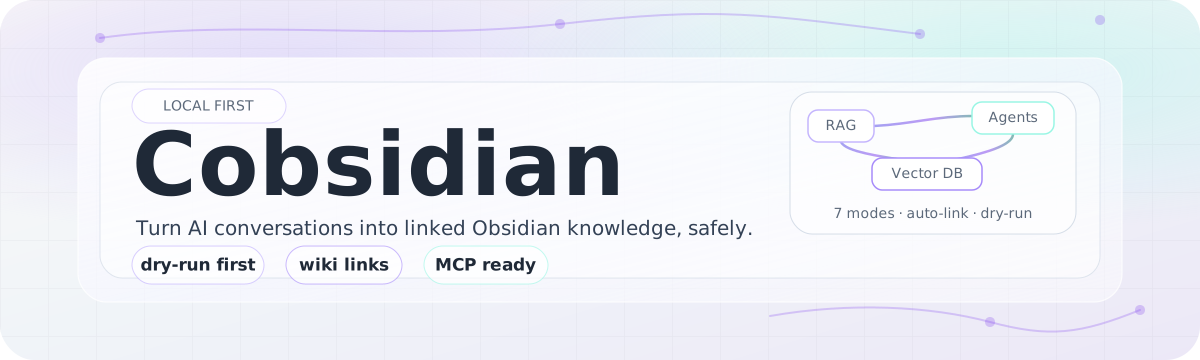
Turn AI conversations into linked Obsidian knowledge, safely.
Cobsidian is an agent-agnostic workflow skill for maintaining Obsidian or Markdown knowledge bases. It helps AI agents turn conversations, study material, logs, documents, and project analysis into durable notes with duplicate checks, wiki links, backlink suggestions, and basic vault validation.
Quick Start · MCP Server · Prompt Examples · Agent Compatibility

What Cobsidian Does
- Turns useful AI conversations into reusable Markdown notes.
- Searches existing notes before writing so agents append or merge instead of creating duplicates.
- Keeps writes reviewable with dry-run planning, backlink suggestions, and validation output.
Quick Start
git clone https://github.com/Totoro-qaq/Cobsidian.git
cd Cobsidian
python skills/cobsidian/scripts/dry_run.py examples/demo-vault --topic "AI Conversations" --text "agent workflow notes" --json
Then point your agent at skills/cobsidian/SKILL.md and give it your vault path or cobsidian.config.yml.
Use Cobsidian to organize this material into my Obsidian vault.
Vault: /absolute/path/to/obsidian-vault
Run a dry run first, check duplicates, suggest backlinks, and wait for confirmation before writing.
Before / After
flowchart LR
    A["AI chat, logs, project notes"] --> B["Cobsidian dry run"]
    B --> C["Search existing vault notes"]
    C --> D{"Create, append, or split?"}
    D --> E["Clean Markdown note"]
    E --> F["Wiki links and related notes"]
    F --> G["Validated Obsidian vault"]
| Before | After |
|---|---|
| Useful answers trapped in chat history | Durable notes in your vault |
| Isolated Markdown files | Linked notes with [[wiki links]] |
| Duplicate notes from repeated prompts | Create/append decisions based on existing notes |
| Agent writes that are hard to review | Dry-run plan before write actions |
Dry-run Preview
Dry run is the default safe path: it plans the change, reports duplicate risks and backlinks, and keeps writes empty.
{
  "dry_run": true,
  "mode": "learning",
  "decision": {
    "action": "append",
    "target_note": "AI Conversations.md"
  },
  "suggested_backlinks": [
    {
      "title": "Agent Workflows",
      "path": "Agent Workflows.md"
    }
  ],
  "writes": []
}
Not Just Markdown Generation
| Ordinary Markdown generation | Cobsidian |
|---|---|
| Produces a standalone file | Maintains a linked knowledge system |
| Ignores existing notes | Scans the vault before writing |
| Often duplicates topics | Prefers append, merge, or split decisions |
| Adds links opportunistically | Suggests links from actual vault notes |
| Writes immediately | Supports dry-run review before edits |
Obsidian Vault Workflow
flowchart TD
    U["User material"] --> R["Resolve vault path or config"]
    R --> S["Scan notes, titles, tags, wiki links"]
    S --> P["Plan: create, append, split, or ask"]
    P --> L["Suggest backlinks"]
    L --> V["Validate note hygiene"]
    V --> O["Report files, decision, links, validation"]
Features
- Create learning notes, project notes, comparison notes, and index notes.
- Check existing notes before writing to reduce duplicates.
- Suggest
[[wiki links]]and related-note sections. - Validate missing wiki-link targets.
- Detect exact and similar note titles.
- Keep note structure concise and reusable.
- Avoid writing private paths, secrets, or raw chat transcripts by default.
- Expose local MCP tools for read-only vault inspection and dry-run planning.
Install
See INSTALL.md for full setup, update, and uninstall instructions.
See Integrations for Codex, Obsidian vault, MCP host, and other-agent setup notes.
Codex Skill
mkdir -p ~/.agents/skills
cp -r skills/cobsidian ~/.agents/skills/cobsidian
On Windows PowerShell:
New-Item -ItemType Directory -Force "$env:USERPROFILE\.agents\skills" | Out-Null
Copy-Item -Recurse -Force .\skills\cobsidian "$env:USERPROFILE\.agents\skills\cobsidian"
Codex currently documents $HOME/.agents/skills for user skills. Some local or older Codex builds may scan $HOME/.codex/skills; use the skills directory shown by your Codex surface.
Other Agents
For Hermes, Claude Code, Cursor, and other agents, use the same core workflow:
- Point the agent to
skills/cobsidian/SKILL.md. - Allow it to call the helper scripts in
skills/cobsidian/scripts/. - Ask it to report create/append decisions, duplicate checks, backlink changes, and validation results.
See Agent Compatibility and Integrations.
MCP Server
Cobsidian also ships a local MCP server for hosts that support the Model Context Protocol.
python -m pip install -r requirements-mcp.txt
python skills/cobsidian/mcp_server.py
Use it as a local stdio server and configure COBSIDIAN_CONFIG or COBSIDIAN_VAULT.
See MCP Server.
Agent Usage
See Prompt Examples for copy-ready prompts.
Ask your agent to use Cobsidian when you want to write into an Obsidian vault:
Use Cobsidian to turn this conversation into an Obsidian learning note.
Check whether it should create a new note or append to an existing one.
Add useful wiki links and report possible duplicates.
More examples:
Use Cobsidian to summarize these logs into my Obsidian vault.
Preserve only reusable lessons, check for existing related notes, and add backlinks.
Use Cobsidian to compare these two project attempts and write a comparison note.
If a related note already exists, append instead of creating a duplicate.
Modes
Cobsidian supports modes so users can tell the agent what kind of note they want.
| Mode | Use when | Example prompt |
|---|---|---|
| Learning | You are studying a concept, course, paper, video, or technical topic. | Use Cobsidian in learning mode to organize this explanation. |
| Project | You are documenting a project, repository, architecture, implementation, or operation. | Use Cobsidian in project mode to summarize this repo analysis. |
| Review | You are reviewing an incident, failed experiment, decision, or result. | Use Cobsidian in review mode to write a failure review. |
| Comparison | You are comparing tools, architectures, models, libraries, databases, or approaches. | Use Cobsidian in comparison mode to compare these options. |
| Index | You need a topic map, learning path, hub note, or navigation page. | Use Cobsidian in index mode to build a knowledge map. |
| Daily Capture | You want to save rough material quickly before deep organization. | Use Cobsidian in daily capture mode to save this for later. |
| Dissection | You are breaking down a tool, framework, repo, skill, prompt system, or source code. | Use Cobsidian in dissection mode to analyze this agent framework. |
If you do not choose a mode, the agent should infer one and report the choice.
When the request is unclear, the agent should introduce the mode choices in the conversation instead of expecting users to read this README first.
See Modes for details.
CLI Utilities
Run helper scripts when you need deterministic vault checks:
python skills/cobsidian/scripts/scan_vault.py /path/to/vault --json
python skills/cobsidian/scripts/find_duplicates.py /path/to/vault
python skills/cobsidian/scripts/suggest_backlinks.py /path/to/vault --file draft.md
python skills/cobsidian/scripts/validate_notes.py /path/to/vault
python skills/cobsidian/scripts/dry_run.py /path/to/vault --topic "RAG" --text "draft text" --json
Each script also accepts --config cobsidian.config.yml when the config contains vault.path.
Optional Config
cobsidian.config.example.yml documents optional vault, naming, safety, linking, and validation conventions for agents or adapters. Copy it to cobsidian.config.yml if you want a reusable local convention.
The helper scripts read it with --config.
Roadmap
- Better duplicate detection with configurable thresholds.
- Frontmatter support for vaults that use YAML metadata.
- Optional note templates.
- Configurable naming rules.
- Safer dry-run mode for proposed edits.
- Thin adapters for Hermes, Claude Code, and Cursor.
- Optional Obsidian plugin integration after the workflow stabilizes.
Contributing
Contributions are welcome. See CONTRIBUTING.md.
Do not include private vault content, personal paths, API keys, unpublished notes, or screenshots from a private knowledge base.
Trademark And Affiliation Notice
Cobsidian is an independent open-source project. OpenAI, Codex, Obsidian, Claude, Cursor, Hermes, and other names are trademarks of their respective owners. This project is not affiliated with, endorsed by, or sponsored by those owners.
License
MIT. See LICENSE.
Yorumlar (0)
Yorum birakmak icin giris yap.
Yorum birakSonuc bulunamadi