Gadfly
Health Gecti
- License — License: MIT
- Description — Repository has a description
- Active repo — Last push 0 days ago
- Community trust — 24 GitHub stars
Code Gecti
- Code scan — Scanned 12 files during light audit, no dangerous patterns found
Permissions Gecti
- Permissions — No dangerous permissions requested
Bu listing icin henuz AI raporu yok.
A Socratic supervision layer for AI coding agents.
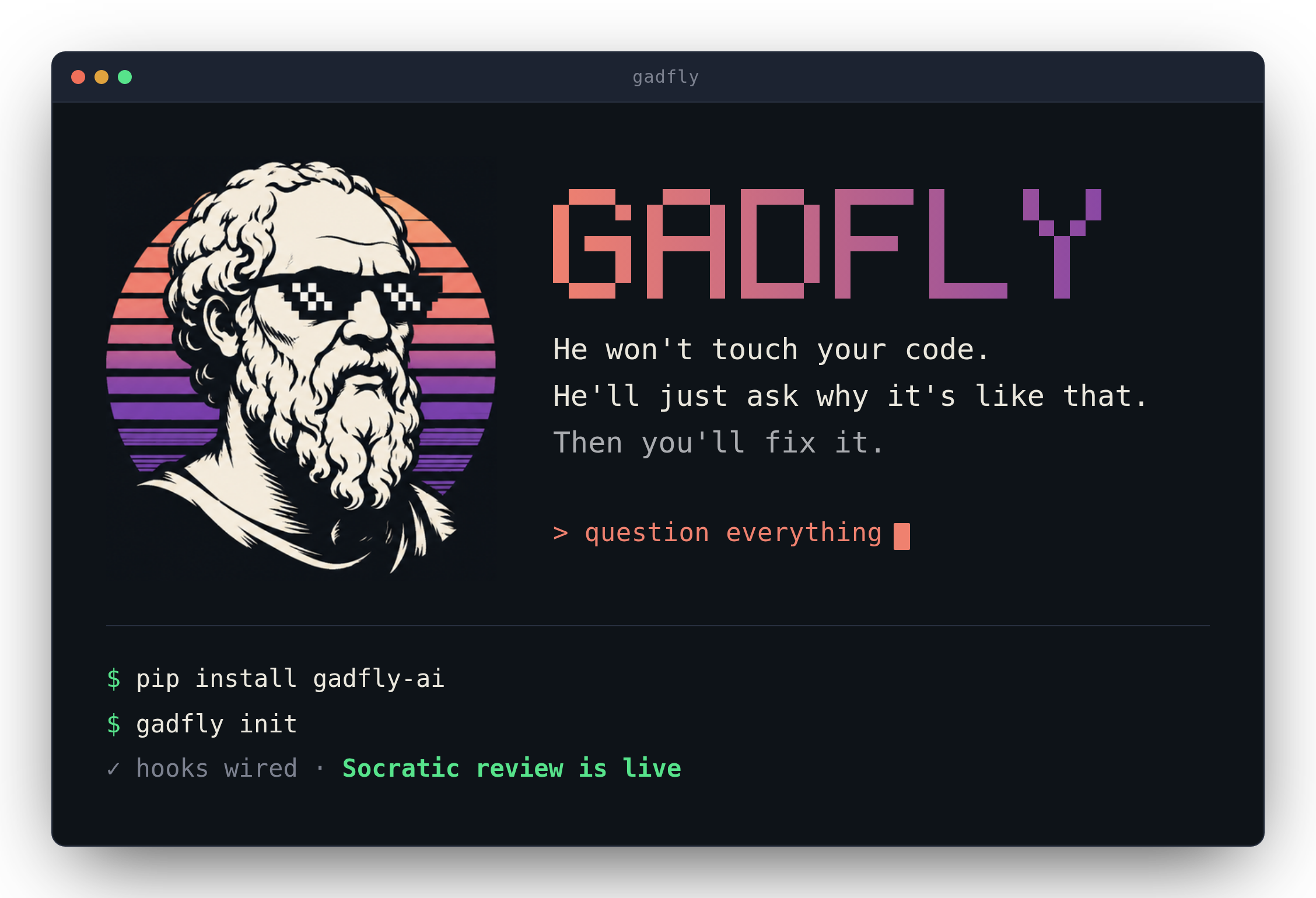
A Socratic supervision layer for AI coding agents.
“I am that gadfly which the god has given the state and all day long and in all places
am always fastening upon you, arousing and persuading and reproaching you.”
— Socrates, in Plato's Apology




Gadfly sits inside your coding agent's live tool-call loop and does what Socrates did to
Athens: it questions every consequential move before it happens. It grounds the work in
your vision, catches drift and real bugs pre-execution, surfaces the decisions that actually
matter, and learns your preferences as it goes, so you can stay at altitude instead of
babysitting a diff.
Gadfly in action
| When your agent… | Gadfly… |
|---|---|
| makes a safe, routine change | ✅ allows it, silently |
| drifts from what you asked | 💬 questions it, mid-flight |
| writes a real bug | ⛔ blocks it before it runs |
| makes a big call your spec never settled | ✋ surfaces it to you |
Four verdicts, checked on every tool call, all before anything executes. Gadfly stays quiet
when the work is on track, and speaks only when it matters.
The problem
An AI coding agent makes dozens of consequential decisions in a single session: a data
model, an auth strategy, a dependency, an edge case, a quiet deviation from what you asked
for. Almost none of them surface to you. You're left with two bad options:
- Micromanage every step, which defeats the entire point of an agent, or
- Trust blindly, and let drift, silent design choices, and latent bugs pile up.
Reviewing the code afterward doesn't close the gap. By the time a diff lands, an irreversible
command has already run, an early wrong turn already has later code stacked on top of it, and
the agent's consequential decisions are already baked into the project, most of them the kind a
diff never flags as a decision at all. The time to catch these is
while they're being made.
Gadfly is the third option: it sits in the loop and takes the review seat for you, so the agent
stays honest without you reading every line.
How it works
At every tool call, before it executes (PreToolUse), Gadfly reviews the action with
two independent, read-only supervisors. A deterministic first pass auto-allows reads and safe
commands for free, so the LLMs only wake for things that matter.
Each review lands on one of the four verdicts above. An allow is silent and stays out of
your way, the common case. A question sends a pointed note back to the agent that makes it
reconsider mid-flight. A surface pauses the build and asks you, for a genuinely
consequential call your spec never settled. A block stops an action that violates your spec
or carries a real bug.
Why you'll want it
- Fewer keystrokes, higher altitude. Gadfly replaces the human-in-the-loop role as
much as you want: supervising, gating, and deciding on your behalf. You engage through
surfaced questions, not constant approvals. - Nothing consequential slips by silently. Every consequential decision the agent would
otherwise make quietly is caught the moment it's made, then grounded in your spec, surfaced
to you, or at minimum logged. Nothing unjustified goes unlogged. - Bugs caught before they run. A skeptical code reviewer flags real logic errors,
edge cases, broken contracts, and hallucinated APIs at the gate, not in a post-hoc review
after they've already landed. - Stays true to your vision. An architectural supervisor, loyal to your spec, catches
drift and quiet betrayals of intent, like the agent satisfying the letter while missing the point. - It learns you. Correct the agent's code and Gadfly notices: an idle-time loop distills
your out-of-band edits into durable rules, so the same correction never has to happen
twice. It calibrates to your style and gets sharper the more you use it. - Socratic, not bureaucratic. Its first move is a question that leads the agent to spot the
problem itself. It blocks only when it has to.
The two supervisors
Two separate, isolated reviews, never merged, so one can't bias the other. Both run by default:
- 🏛️ The Architect (default: Opus). A Socratic visionary loyal to your vision.
Reads code as a language, to grasp what's being built and why. Catches drift from the
spec, inconsistency with the realized structure, and undiscussed decisions with lasting
consequences. Questions first; asserts only when a question won't do. - 🔬 The Code Reviewer (default: Sonnet). A logic skeptic, real defects only: wrong
conditions, unhandled edges, races, leaks, broken invariants, misused or invented APIs.
It stays silent on correct code.
Prefer to run lean? A cover-for-other mode lets the architect act as sole supervisor,
covering both lanes through a purpose-written prompt variant.
It improves itself
Gadfly keeps a private, append-only edit-ledger of every change the agent makes. When
you edit that code out of band (the classic “no, do it this way”), Gadfly diffs your
version against the agent's and hands it to a separate, idle-time extractor that decides
whether the correction generalizes. Worthy patterns become durable memory:
- project-specific rules land in the supervised project's
claude.md, - cross-project style preferences land in your global memory.
All of it off the hot path, conservative by design (usually it saves nothing), and never
blocking the build.
Grounded in your intent
Gadfly reasons from a small, layered memory of the supervised project rather than guessing:
| File | Owner | Role |
|---|---|---|
spec.md |
You (required) | The vision the architect enforces against, every gate |
claude.md |
You (optional) | Project rules, enforced when present |
codemap.md |
Builder | A live map of the current structure |
decisions.md |
Gadfly | A ledger of the decisions that shape the project, and why they were made |
memory.md |
Gadfly | Your cross-project style and calibration |
Gadfly enforces that split: the agent can read all of these files but never writes to spec.md,claude.md, or decisions.md directly. Those changes go through you or through Gadfly, never the
agent itself.
A light pre-build midwife pass reads your spec.md on the first prompt and asks the sharp
questions it leaves unanswered, so you sharpen a real spec before building instead of a vague one.
Spec-driven development that actually holds
Most "spec-driven" workflows write a spec, then drift from it the moment coding starts, and it
becomes a stale doc nobody enforces. Gadfly makes the spec binding:
gadfly initrequires aspec.md. Without one there's nothing to enforce.- The architect measures every edit against it, in letter and spirit, and catches
drift the moment it starts, not in review three hours later. - Consequential calls your spec never covered get surfaced to you, and once you accept one it's
promoted back into the spec, so the spec stays current instead of going stale.
You set the altitude
An autonomy dial controls how often Gadfly involves you:
- autonomous: decides and logs almost everything; surfaces only the critical or irreversible
- balanced: surfaces the consequential, spec-silent, high-level calls; decides the rest
- collaborative: surfaces most consequential or conceptual decisions
Irreversible operations always ask, regardless of the dial.
Quickstart
In v1, Gadfly supervises only Claude Code, so you'll need it installed first. Then:
pip install gadfly-ai   # zero dependencies
cd your-project

# 1. Write a spec.md. It's required; the architect enforces against it. Sketch the project
#    with your AI assistant and save it as spec.md. (Optionally add a claude.md of rules.)

# 2. Wire Gadfly in. Conflict-safe, and leaves any hooks you already have.
gadfly init
gadfly status        # confirm it's live
Then use Claude Code as usual. Gadfly runs on your existing Claude Code subscription, so no API
key is needed. You can also point any supervisor at the Anthropic API instead, with the key read
from an environment variable, or mix the two: for example, the architect on the API and the code
reviewer on your subscription. Set this per role in gadfly.toml.
Commands
| Command | |
|---|---|
gadfly init |
Wire hooks into this folder (a spec.md is required); init global targets ~/.claude |
gadfly status |
Check the install is live (it actually runs a hook end to end) |
gadfly config |
Show, get, or set config in gadfly.toml (models, autonomy dial, review scope) |
gadfly disable / enable |
Pause / resume without touching your settings |
gadfly uninstall |
Remove Gadfly's hooks (leaves any of your own) |
Configuration
gadfly init scaffolds a gadfly.toml in your project. Every key is optional and the defaults
are sensible, so you set only what you want to change. Read or change it with gadfly config, or
edit the file directly.
provider = "claude_cli"        # your Claude Code subscription (no key), or "anthropic_api"
autonomy = "balanced"          # autonomous | balanced | collaborative

[models]
architect = "claude-opus-4-8"  # the architect: drift, design, vision
code = "claude-sonnet-5"       # the code reviewer: bugs, edges, bad APIs
triage = "claude-haiku-4-5"    # fast command-safety triage

# Optional: run one supervisor on a different backend than the global provider.
# [providers]
# architect = "anthropic_api"
# [anthropic_api]
# api_key_env = "ANTHROPIC_API_KEY"   # the env var holding the key, never the key itself
A few more knobs, all optional:
disable_code_reviewerruns the architect alone, covering both lanes (the cover-for-other mode):
it holds on to Gadfly's Socratic voice and still catches real code bugs in solo mode.disable_architectruns the code reviewer alone, but it reviews code correctness only — design
and drift go unwatched. For a single supervisor, keep the architect. You can't disable both.test_reviewsets how edits to test files are reviewed:bothsupervisors,codeonly (the
default), oroff.auto_allow_docsistrueby default, which skips review of prose docs (.md,.rst,.txt).
Set it tofalseto have the architect review those too.[memory]sets a character budget per memory file (spec,claude,codemap,memory). When
a file grows past its budget Gadfly compacts it. For the files you own it never rewrites silently;
it proposes a shorter version and asks first. Set a budget to0to turn compaction off.
Timing and retry knobs (llm_timeout, llm_retries, poll_timeout) exist as well, but rarely
need changing.
Architecture
A small, pure core wrapped by two adapter boundaries: one speaks the host agent's
native format, the other speaks to an LLM provider. Both are swappable; the core is
agent-agnostic, LLM-agnostic, and owns its own normalized state.
flowchart TB
agent["🧑💻 Your coding agent<br/>Claude Code"]
adapter["🔌 Agent Adapter"]
core["⚙️ Pure Core<br/>Architect + Code supervisors · memory"]
llm["🧠 LLM Provider<br/>Claude (subscription or API)"]
agent -->|"every tool call"| adapter
adapter -->|"review → verdict"| core
core --> llm
style agent fill:#161b26,stroke:#4a5568,color:#f0eae6
style adapter fill:#1a2230,stroke:#3a5a7a,color:#f0eae6
style core fill:#241a33,stroke:#8A48A4,color:#f0eae6
style llm fill:#2a1e26,stroke:#EF816F,color:#f0eae6
See spec.md for the full design.
Roadmap
- More host agents. Adapters, and a proxy layer for agents without hooks, to support other
coding agents such as Codex, Gemini CLI, and Cursor. - More backends. Local models, more API models, and more providers through the existing
provider-neutral client. - A fuller pre-build pass (optional). Today the midwife only finds gaps in your spec. The
next step is a real back-and-forth that produces a detailed spec and a project plan before any
code is written. - Learning bootstrap (optional). Point Gadfly at your past sessions so it starts with your
patterns already extracted, instead of from an empty memory.
License
MIT. © 2026 Touchpoint Labs.
Yorumlar (0)
Yorum birakmak icin giris yap.
Yorum birakSonuc bulunamadi