trip2g
Health Uyari
- License — License: MIT
- Description — Repository has a description
- Active repo — Last push 0 days ago
- Low visibility — Only 9 GitHub stars
Code Uyari
- network request — Outbound network request in assets/main.ts
Permissions Gecti
- Permissions — No dangerous permissions requested
Bu listing icin henuz AI raporu yok.
Turn your Obsidian knowledge base into a monetizable website or docs
trip2g


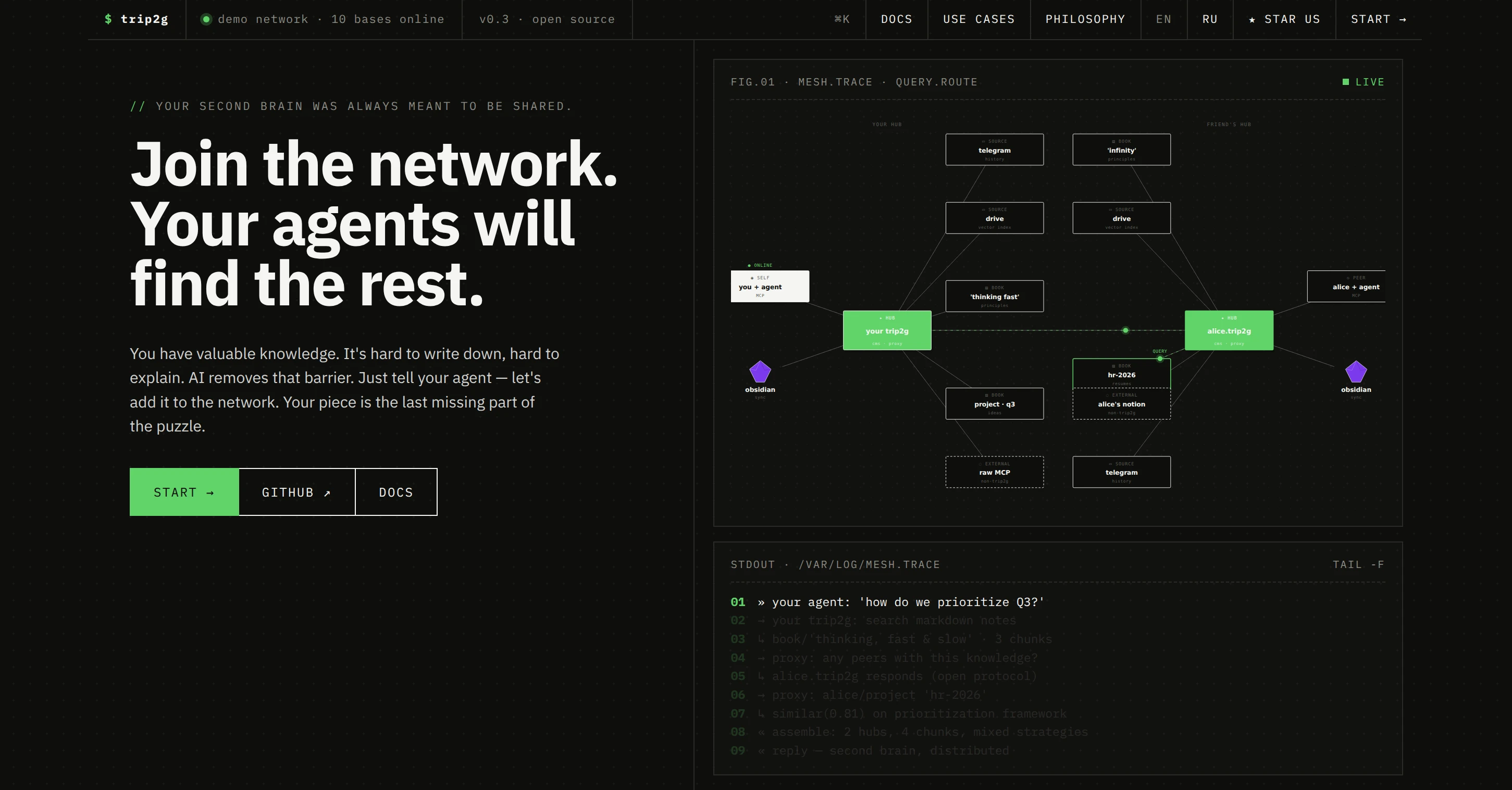
Open-source MCP knowledge mesh. Self-host your knowledge bases, expose them via MCP, and federate with peers — no SaaS in the middle.
Unlike Obsidian Publish or Quartz, trip2g is a live server: subscriptions, webhook agents, federation between hubs, and an MCP endpoint out of the box.
Try the public hub → · Self-host · Docs
Try it now
Add the public knowledge hub to your MCP client:
{
  "mcpServers": {
    "trip2g": {
      "url": "https://trip2g.com/_system/mcp"
    }
  }
}
Ask your agent anything. It searches all connected bases and returns answers with sources.
Want your own? Free cloud instance — no terminal needed.
Core capabilities
Markdown → website
- Wikilinks (
[[note]]), backlinks, outlinks — global resolution, just like Obsidian - Composable page layouts via frontmatter: sidebars, magazine grid, TOC, custom note embeds
- Full-text search (bleve) + semantic search (pluggable embeddings)
- Custom domains, multi-language with
hreflang, RSS feeds, sitemap
MCP server — built into every hub:
search_notes   full-text + semantic search
get_note       retrieve by id or slug
list_notes     list notes accessible to the caller
Access is scoped to the caller's subscription level.
Webhook agents
- Change webhooks — POST to an external agent on note create/update/remove. Agent writes notes back via API. Glob filtering, HMAC auth, depth tracking prevents recursion.
- Cron webhooks — run an agent on a schedule (
0 9 * * *). Sync or async. Optional instruction context.
Monetization
- Subgraph paywalls — group notes into paid products, free notes stay public
- Crypto payments (NowPayments), Patreon and Boosty integration
Obsidian plugin — one-click sync, hash-based diff, only changed files are uploaded
Federation
graph LR
    O[Obsidian vault] --> H[your hub]
    T[Telegram]       --> H
    H <-->|MCP federation| H2[peer hub]
    H2 --> B[their bases]
    H -->|/_system/mcp| A[agent]
    H2 -->|/_system/mcp| A
Peer hubs with trusted people or orgs. Each hub controls access per base. One agent question reaches the union of all connected knowledge.
| Topology | Setup | Result |
|---|---|---|
| Solo | One hub, many bases | All your notes, books, courses — one query |
| Friends | Each person runs a hub, hubs peer | Union of everyone's knowledge |
| Company | Central hub + per-employee hubs | Tribal knowledge and docs — queryable |
| B2B | Two star topologies, one bridge | Shared knowledge without merging systems |
Sources
| Source | Status |
|---|---|
| Obsidian | ready — vault stays local, two-way sync |
| Telegram | ready — channel publish + history mirror |
| Notion | in progress |
| Google Drive | in progress |
| Linear, Slack archive, RSS | planned |
Template system
Every page is a Jet template. Configure layout per-note via frontmatter — no code changes:
---
header: "[[Navigation]]"
left_sidebar:
  - TOC
  - inlinks
content:
  - magazine
  - selfcontent
magazine_include_files: "blog/**/*.md"
magazine_sort_property: published_date
footer: "[[Footer]]"
---
Notes can render as any content type — HTML, JSON, RSS — via content_type frontmatter.
Self-host
docker compose up
Full guide → · MIT · SQLite, no external dependencies required.
Tech stack
| Backend | Go, FastHTTP, gqlgen (GraphQL) |
| Database | SQLite (+ Litestream, optional) |
| Search | bleve (full-text) + pluggable embeddings (semantic) |
| Markdown | Goldmark — wikilinks, frontmatter |
| Templates | Jet template engine |
| Frontend | $mol, TypeScript, Tiptap |
| Assets | S3-compatible (MinIO for dev) |
License
MIT
Yorumlar (0)
Yorum birakmak icin giris yap.
Yorum birakSonuc bulunamadi