xihu-sword-ctf-agent
Health Warn
- License — License: MIT
- Description — Repository has a description
- Active repo — Last push 0 days ago
- Low visibility — Only 5 GitHub stars
Code Pass
- Code scan — Scanned 12 files during light audit, no dangerous patterns found
Permissions Pass
- Permissions — No dangerous permissions requested
No AI report is available for this listing yet.
AI agent for solving CTF challenges: automated reconnaissance, exploitation planning and flag capture.
xihu-sword-ctf-agent
🔒 FROZEN / 已冻结(2026-10-23):本仓库已被 SecAutoMind(
E:\Program\SecAutoMind)全量吞并,
现为只读知识库(攻击链、writeup、验证脚本、基准数据仍可参考复用)。不再作为参赛主体或维护对象,
不再提交新功能。后续能力发展一律在 SecAutoMind 进行;迁移路线图见E:\Program\SecAutoMind\docs\merge_xhlj_roadmap_20261023.md。Bug 级修复仅以支撑赛事复盘为限。
🔧 确定性优先的 CTF 智能体框架 — 先用 72 个可复现确定性技能横向爆破常见题型,LLM 仅在静态分析 miss 时才作为最后手段介入,且受白名单 / token 预算 / 墙钟止损三重约束。结果可复现、可调试、且对自己能做什么诚实。
🌏 中文文档 / Chinese documentation: README.zh.md
⚠️ Honesty disclaimer (read first): This project's real-world competition result on the live platform was 0 accepted flags. All "solved / pass-rate" figures in this repo refer to offline deterministic analysis of historical CTF problems (the
data/questions_real/corpus), not any live contest score. We do not claim LLM autonomous reasoning capability — the real capability here is a deterministic static analyzer (presolve) covering common CTF categories. See Honest KPI below.
🔴 口径更正 / Figure correction (2026-10-01): the "LLM autonomous reasoning 1 / 2" figure quoted in this README (from the 2026-09-22 clean-2 report) is superseded and must not be cited as current truth. The single problem behind that "1" —
real_crypto_dnui_keyboard— was judgedsolved_by=presolve(78 ms, ≈0 tokens) in two independent runs: the 2026-09-29 full 17-problem pool, and the 2026-10-01 NYU stratified 5-problem trial (cold blackboard, E3 ON, deepseek). The current verified count of LLM autonomous solves is 0. Per project policy the original wording below is retained verbatim as a historical record of what was true at the time; this notice is what overrides it. Reminder:2is the capability denominator; the runnable pool (41 problems after the 2026-10-03 Google-CTF expansion) is a separate, harder set — never divide one by the other.
An open-source AI agent framework for CTF (Capture The Flag) competitions. The agent polls a DASCTF-style platform, triages challenges, runs deterministic solvers first, and only escalates to an LLM when static analysis misses. Built and battle-tested against the West Lake Sword Tournament (西湖论剑) AI CTF track.
ℹ️ Path convention: Throughout this README, paths inside code spans are relative to
ctf_agent/; markdown links are relative to this file.
Why this exists
Most "CTF agents" are just an LLM with a shell. This one is the opposite: deterministic-first. A pre-solve layer (core/presolve.py) fans out dozens of ready-to-run skills (RSA attacks, stego extractors, source-code auditors, base64 multilayer decoders, …) in parallel. The LLM is a last-resort escalator, behind a whitelist, a token budget, and a wall-clock stop-loss. The result is a system that is reproducible, debuggable, and honest about what it can and cannot do.
Architecture
ctf_agent/
├── core/          main loop, presolve static analyzer, supervisor agent, wall-clock stop-loss
├── agents/        per-category solvers (crypto_toolkit / misc / web / reverse / pwn …)
├── skills/        78 deterministic skills (run(params) -> dict interface; machine count = `scripts/_kpi_canonical.py`)
├── llm/           LLM client (provider whitelist, fail-closed circuit breaking)
├── ctfplatform/   contest-platform client (DASCTF-style), retry / fail-open submit path
├── sandbox/       code-execution sandbox (subprocess isolation)
├── eval/          historical-problem benchmark (honest KPI measurement)
├── data/questions_real/   historical problem corpus (most flags SHA-256; a few long-public events e.g. Anxun Cup 2020 retain plaintext; 2026 contest excluded)
├── config.py      config (defaults + environment-variable fallback)
├── run.py         entry point (--mode cli/web/mock)
└── setup.sh       environment bootstrap
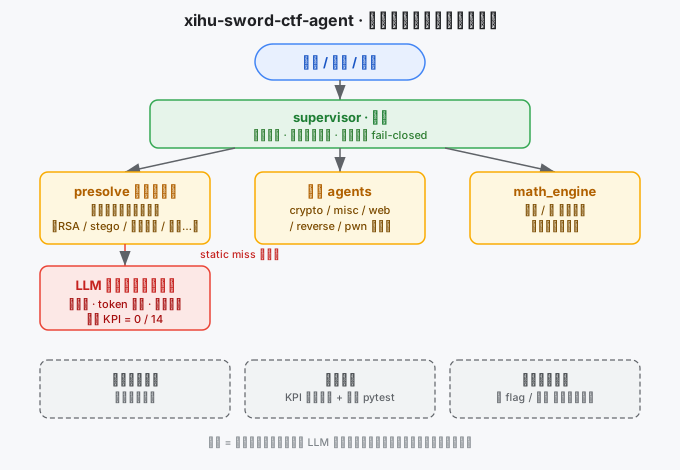
Solve pipeline
platform poll → triage/classify → attachment download + target probe
             → deterministic skills (78) ⇄ LLM reasoning (whitelisted providers)
             → flag validation → platform submit (fail-closed on request errors)
- Supervisor architecture:
core/main_agent.pyplans per challenge,core/supervisor_agent.pyenforces step budgets, tool-first discipline, and the request-failure-vs-wrong-flag separation (the post-incident fix for a submit-circuit-breaker bug). - Deterministic-first:
skills/holds 78 runnable skills (scripts/_kpi_canonical.pymachine count).core/presolve.pyruns them before any LLM token is spent. - Whitelisted LLM only (contest rule §3); multi-source fallback with 401/402 circuit breaking, per-question token budgets, heavy-model upgrade policy.
- Race harness:
scripts/_race_start.py --compete= first-blood scan → stable polling → final report, with a mandatory e2e data-link preflight (fail-closed).
Hard gates (lessons, codified)
| Gate | What | Enforced by |
|---|---|---|
| Test gate | real pytest run, no per-file fake loops |
setup.sh (exit 1 on failure) |
| E2E gate | platform actually serves challenge data | scripts/_e2e_verify.py, wired into --compete |
| Network gate | proxy alive / LLM endpoints reachable | scripts/_net_check.py (trust_env=False) |
| Secret gate | no plaintext keys in staged files | pre-commit hook (scripts/_scan_secrets.py) |
| Write-lease gate | one writer per scope; out-of-scope commits rejected | scripts/_lease.py + pre-commit |
Quick start
cd ctf_agent
bash setup.sh                      # venv + deps + whitelist + net check + test gate
export CTF_AGENT_LLM_PROVIDER=deepseek
export CTF_AGENT_LIGHT_MODEL=deepseek-chat
export DEEPSEEK_API_KEY=sk-xxx     # your key — never commit it
.venv/Scripts/python.exe run.py --mode mock --category crypto   # offline smoke test
.venv/Scripts/python.exe run.py --mode cli                      # local practice
Configuration is environment-variable driven (see config.py): DASCTF_TOKEN, DASCTF_BASE_URL, provider API keys. Never commit keys — the hook refuses.
Honest KPI
The single machine-enforced KPI is offline_verified — the number of historical real problems for which a complete, reproducible attack chain produced a flag matching the problem's ground-truth flag_sha256 (see REAL_SOLVES_LEDGER.md, guarded by the merge-gate ratchet in scripts/_merge_gate.py so it can only go up, never down).
| Metric | Result |
|---|---|
| offline_verified (strict real-problem KPI) | 14 |
| Deterministic pipeline coverage (presolve direct-solve) | 14 / 93 full-corpus (15.1%) (presolve direct-solve coverage — NOT a "solved" claim; full 93-problem corpus coverage tracked in REAL_SOLVES_LEDGER.md; real_misc_vnctf_flag 2026-09-03 governance fix —题面 flag_pattern 修订 + vision LLM 兜底链路修复后正式入 presolve) |
| LLM autonomous-reasoning contribution | 0 / 14 (all 14 verified solves are deterministic presolve/tooling; zero LLM reasoning) |
| Regression-set reproducible count | 16 / 16 (13 题严格 KPI 集 + 10732/10735 治理修复:scripts/verify_10732.py + verify_10735.py + verify_specialcurve2.py 可机器复现攻击链;REGRESSION_CHECKS 16 道全过;10732/10735 不进 PROMOTION_EVIDENCE 因题面无官方 sha256 真值闭环;specialcurve2 有题面官方 flag_sha256 闭环,经 PROMOTION_EVIDENCE 带证据晋级 12→13,详见台账题块 1/2 + scripts/_antifraud.py) |
| held-out reasoning pool (unseen, non-trivial) | 2 problems — disjoint from the 14 KPI solves (post-cleanup: 7 WRITEUP-reconstructed + 1 source-leaked web challenge excluded; the prior "10" mixed those in) |
| LLM reasoning on the held-out pool (measured 2026-09-22, clean 2-problem pool) | pool 2 / 2 solved — LLM autonomous reasoning 1 / 2 (real_crypto_dnui_keyboard, sha256-verified) and deterministic presolve 1 / 2 (real_reverse_js); both disjoint from the 14 KPI solves |
Why we never divide 14 by 2. The 14 KPI solves and the 2 held-out problems are disjoint sets.
14 / 2 = 700%would be a deceptive ratio, so our tooling hard-codescoverage_of_heldout=Noneinstead of emitting a number. The held-out yardstick measures a separate thing — genuine autonomous LLM reasoning on unseen problems — not a fraction of the 14. Under the clean held-out yardstick (measured 2026-09-22, deepseek + E3 evidence injection; raw report archived inctf_agent/heldout_evidence/benchmark_report_clean2_20260922_deepseek.json), LLM autonomous reasoning = 1 / 2 (real_crypto_dnui_keyboard; the other,real_reverse_js, is solved by the deterministic pre-solve layer). The earlier "LLM 0 / 10" figure was an artifact of two bugs now fixed: (1)bug2— the verifier checked correct flags against a retired mixed-set answer table and rejected them as hallucinations (so genuine LLM solves scored as failures); (2) the held-out denominator was contaminated by 7 WRITEUP-reconstructed questions (flags verbatim in attachments) plus 1 source-leaked web challenge (real_web_gongye_web2, flag in its providedindex.php). After excluding all contamination, the honest LLM autonomous-reasoning rate on the genuinely-unseen pool is 1 / 2 — a small sample (pool expansion is the open task).
⚠️ What
offline_verified=14does and does NOT mean. It is the count of real past-CTF problems (provenance=real_past_ctf, sha256-verified, machine-counted byscripts/_merge_gate.py count_offline_verified) solved by a reproducible deterministic pipeline — a real engineering milestone, but NOT a capability measurement. These problems' writeups are public and almost certainly in LLM pre-training corpora (contamination risk — seedata/results/CTF-Agent深度评审报告_20260828.mdG1). LLM autonomous-reasoning contribution is 0/14. Treat 14 as "template coverage of memorizable public problems," never as "reasoning ability." (Note: on 2026-08-28 the KPI was honestly cut back from a nominal 12 to 9 because three solves —real_crypto_ezrsa,real_crypto_simplelegendre,real_crypto_exciting_inverse— were not reproducible by the deterministic pipeline. All three were promoted back into the strict KPI on 2026-09-03 with evidence, each via a deterministic solver wired into presolve and returningREGRESS_PASSwith sha256 matching ground truth:real_crypto_ezrsa— Håstad broadcast solverskills/crypto_hastad_broadcast.py(_try_hastad_broadcast, e=17, CRT+iroot);real_crypto_simplelegendre— Legendre-symbol solverskills/crypto_legendre_phi.py(_try_legendre_phi, phi-leak factorization + per-bit(c|p)=(-1)^bi);real_crypto_exciting_inverse— phi+dual-modular-inverse solverskills/crypto_modinv_factor.py(_try_modinv_factor, CRT⟹A·p+B·q=N+1⟹quadratic-root factorization). This count is therefore fully evidence-backed, unlike the pre-rollback nominal 12 — and unlike the 2026-08-28 nominal 12 that the rollback exposed as unverified. SeePROMOTION_EVIDENCEinscripts/_antifraud.pyand blocks 7/8/11 ofREAL_SOLVES_LEDGER.md.) 2026-09-03 governance fix (no KPI change):real_misc_vnctf_flagwas historically ledgered as A-class ✅ but the problem JSON hadflag_patternwritten asflag\{[^}]+\}while the true flag isvnctf\{...\}— presolve's secondary regex check misclassified the skill's sha256-verified output as "bait" and dropped it. Fixed the pattern, repaired the venv's brokencertifi(force-reinstalledcertifi==2026.7.22because RECORD file was missing, blockinghttpxfrom finding the CA bundle), and confirmedscripts/_regress_one.py real_misc_vnctf_flag→REGRESS_PASS (5159ms)via the existingskills/misc_grid_resample.py(grid-resample deterministic algorithm + baiduernie-4.5-turbo-vlvision-LLM OCR fallback, sha256-gated return). The solve was already counted in the 9-baselineBASE_AUTHORIZED_KPI_SOLVES; this fix moves it from "fake-reproducible-but-counted" to "genuinely-reproducible-and-counted", closes theKNOWN_GAPentry, and grows the machine-rerun regression set from 11 → 12.
LLM reasoning break-ice experiment (not counted in KPI, read the caveat): With
scripts/_llm_breaking_ice.py --no-internal-presolve(presolve shortcuts disabled, LLM forced to reason),11/15historical problems were solved bymain_agent_llmautonomous reasoning on baidu Qianfan ERNIE (crypto×7 / reverse×3 / web×1; all 11 havesha256_ok=trueandvalidated=trueagainst the problem ground truth — disk truthdeliverables/benchmark_runs/llm_breaking_ice_20260901-050201.json). Earlier runs:8/15(2026-08-28,llm_breaking_ice_20260828-022534.json) is superseded by the 2026-09-01 run; an even earlier10/15count included two reverse solves whose sha256 did not match and was corrected.Denominator caveat (do not conflate): the
15in11/15and8/15is this experiment's own problem set — it is unrelated to the deprecated presolve-coverage "15-problem subset" caliber (15/15/ 86.7%) mentioned above, even though both happen to show the number 15. This experiment is not counted in the KPI;11/15is traceable todeliverables/benchmark_runs/llm_breaking_ice_20260901-050201.jsonand8/15tollm_breaking_ice_20260828-022534.json(superseded by the 2026-09-01 run).⚠️ Honesty caveat on the 4 unsolved (updated 2026-09-13): the original report labeled them "3×TIMEOUT + 1×wrong_direction." This conflates infrastructure failure with reasoning failure and is itself a metric-integrity bug — the benchmark never serialized reasoning
steps, so a TIMEOUT at exactly 240 s with 0 steps most likely means the first LLM call never returned (no credential / API hang / network death), not "the model can't reason." Per the user's strict-honesty requirement,scripts/_llm_breaking_ice.pynow (a) pre-checks credentials and labels runs with no key asINFRA_NO_CREDENTIAL— never counted as reasoning failure; (b) persistssteps; (c) tags TIMEOUT withtimeout_cause="api_hang_or_no_first_response_suspected". Therefore the 11/15 figure must NOT be cited as "LLM can solve 11/15" — it is "11 solved in one run where credentials were present; 4 inconclusive (timeout cause unverified)." The only strictly-honest LLM-reasoning statement remains: LLM autonomous-reasoning contribution to the KPI is 0/14 (no LLM-only solve is in the strict sha256-verified KPI set). Details inMEMORY.md.
Interpretation: capability = static-analyzer coverage, not LLM reasoning. To solve more problem types, write more deterministic skills. We say this plainly because over-claiming is the easiest way to embarrass an open-source security tool.
Known limitations
We publish these because they are structural, not because they are modest.
This measures static-analysis coverage, not reasoning. Every solve in the strict KPI (
offline_verified) comes from the deterministic pre-solve layer. The KPI contains no web solve and no pwn solve — those categories usually require live target interaction or dynamic debugging, which an offline deterministic analyzer does not do. That is a design boundary, not a backlog item.The corpus and the capability point in different directions.
miscis the single largest category in the corpus, but verified deterministic coverage concentrates incryptoandreverse. We do not write one solver per problem, so this gap cannot be closed by tuning — it closes only by adding deterministic skills.The held-out measurement is real, but far too small to extrapolate. The held-out ability denominator is currently 2 problems. In that run the pool scored 2/2 — one solve from the deterministic pre-solve layer and one from LLM autonomous reasoning. We report the LLM number because it is what happened, and we refuse to inflate it: 1 of 2 is not a capability claim. Our own sample ladder requires 8 → 12 → 20 → 30 → 60 before a result may be extrapolated; at 2 samples this is a data point, not a conclusion. It is also a single run that we have not repeated — an earlier run of the same problem did not solve it — so we do not claim it reproduces.
Two held-out numbers exist; do not divide one by the other.
2is the ability denominator.41is the runnable pool (wider sourcing, harder problems) and is a candidate pool for expansion, not a denominator. Our tooling emitscoverage_of_heldout = Nonerather than produce a ratio between two non-comparable sets.Everything here is offline. All "solved" figures describe offline deterministic analysis of historical problems, never a live-contest score — our real contest result was 0 accepted flags.
Sources (reproduce yourself):
python scripts/_kpi_canonical.py(offline_verified / real_corpus / heldout_candidates / heldout_runnable_pool);scripts/_antifraud.py(BASE_AUTHORIZED_KPI_SOLVES∪PROMOTION_EVIDENCE= the strict-KPI whitelist);ctf_agent/heldout_evidence/benchmark_report_clean2_20260922_deepseek.json(mode=real_main_agent).
Full post-mortem (Chinese, unabridged): the 14 original retrospective documents — root-cause timeline, fix evidence, and the failures we have not fixed — are published in this repo as-is.
Security & compliance
This repo publishes the engineering skeleton and methodology only. Red lines:
- Flags are handled per-event, honestly. The large majority of historical-contest flags are stored as SHA-256. A small number of entries from long-public events (e.g. Anxun Cup 2020, whose write-ups are already public) retain plaintext flags. Flags and attachments for the 2026 West Lake Sword contest itself are NOT included in this repo (excluded via
.gitignore). The strict-KPI ground truth (flag_sha256) is not hidden: it ships inside the tracked problem JSONs underdata/questions_real/**(un-ignored via!data/questions_real/**inctf_agent/.gitignore); only the raw plaintextflag.txt/flag.png/*_attachments/are gitignored. - No secrets in the repo. LLM keys and platform tokens are injected via env vars / registry only.
- Internal contest resources are excluded (
data/race_details/, attachments, signatures) via.gitignore. - Honest water-level. We do not exaggerate capability. See above.
Project status
We publish this repository while stating its numbers plainly, including the ones that are unflattering. The strict KPI is 14 solved with full evidence out of 93 collected real problems (≈15.1%), where "solved" means a deterministic, re-runnable solver produces the flag and it matches the problem statement's SHA-256 — the LLM contributes 0 of 14. On the clean held-out pool (2 unseen, non-trivial problems after excluding 7 WRITEUP-reconstructed + 1 source-leaked web challenge, disjoint from the 14), the LLM solved 1 of 2 by autonomous reasoning (real_crypto_dnui_keyboard, sha256-verified) in a real run (deepseek, ~7k tokens); the other (real_reverse_js) was solved by the deterministic pre-solve layer. The prior "0 of 10" was an artifact of a verifier bug (bug2, which rejected correct flags as hallucinations) and a contaminated denominator, now corrected. 14/2 is never computed.
⚠️ Two different held-out scopes — do not conflate them. Besides the 2-problem capability denominator above, the repository also contains a 41-problem runnable pool (2 in-house + 39 sourced from Google CTF 2021–2025). It is a candidate for pool expansion, not a capability denominator. That pool is substantially harder (measured per-problem token cost is roughly ~50× the clean pool); the problems sampled from it under a 100K-tokens-per-problem cap were all unsolved, and their reports are machine-flagged
integrity.interpretable=false— i.e. they must not be quoted as a capability rate. Presenting0/17or1/17as a capability figure would mean describing "the problems are harder" as "the model is weaker": a deceptive ratio.scripts/_kpi_canonical.pyemits the two scopes separately asheldout_candidates(=2, capability denominator) andheldout_runnable_pool(=41, runnable pool).
All of the above rests on artifacts in this repository; you can re-run them yourself.
License
MIT — open for learning and research. Respect each CTF's rules and platform terms.
Reviews (0)
Sign in to leave a review.
Leave a reviewNo results found