pallium
Health Warn
- License — License: MIT
- Description — Repository has a description
- Active repo — Last push 0 days ago
- Low visibility — Only 5 GitHub stars
Code Pass
- Code scan — Scanned 12 files during light audit, no dangerous patterns found
Permissions Pass
- Permissions — No dangerous permissions requested
No AI report is available for this listing yet.
Local-first control plane for AI coding agents: repo memory, verification, sessions, and dynamic workflows.
Pallium



A local-first control plane for coding agents.
Most people should not need to become expert agent managers to get expert-level
work from capable agents. Pallium translates a user's intent into the right
context, memory, execution shape, and verification while keeping authority with
the user. Durable orchestration and state live outside the context window, so
the work can survive a crash, restart, or end of chat.
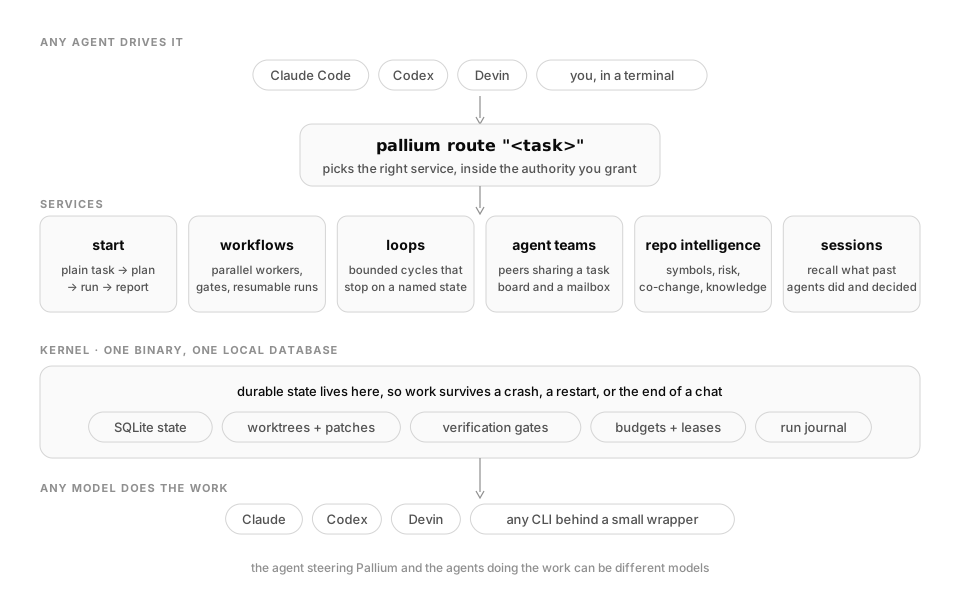
One kernel, seven services. Any model powers the work. Any agent drives it.
npm i -g pallium
pallium route "review my workflow changes and fix what's broken" --authority edit --execute --json
Update to the latest release any time with pallium update.
Route a task, then check a file before editing it:

The problem it solves
A coding agent in a chat session is powerful but underused and fragile. Users
must often know which tools to name, how to structure the work, and when to
verify it. The agent forgets prior sessions, cannot safely run ten workers in
parallel against one repo, and loses unfinished work when the session dies.
Pallium moves the durable parts out of the model:
- State lives in SQLite, not the context window, so a task survives the
session that started it. - Edits happen in isolated worktrees with delayed, reviewable patch
application, so parallel workers never corrupt each other. - Verification is first-class. Objective checks, fix-until-green loops, and
gates that must pass before work is accepted. - Providers are pluggable. Claude, Codex, or any CLI behind a small wrapper.
The agent steering Pallium and the agents doing the work can be different
models.
The seven services
Pallium is one binary and one local database. The services share that kernel and
compose through public interfaces.
pallium route "<task>", agent-driven service choice
Give Pallium the task and the authority ceiling the user or environment already
granted. It inspects repository state, selects a named capability, explains why
it fits better than alternatives, and returns structured command arguments.--execute runs that recommendation without a shell and returns its result. It
never widens authority or runs a blocked recommendation.
pallium route "find all running agent sessions" --authority observe --execute --json
pallium route "fix the checkout race and verify it" --authority edit --execute --json
pallium route capabilities --json
pallium start "<task>", the workflow golden path
Describe a task in plain language. Pallium scopes the repo, picks or generates a
plan, runs it, and reports back. Use it directly when you already know a
repo-scoped workflow is the right service, or follow a route that selects it.
Workflows: deterministic multi-agent orchestration
Author a plan as async JavaScript: fan out parallel workers, pipeline stages,
force objective checks, gate on verification. Runs persist with stable IDs, full
history, and resumable state.
pallium workflow preflight "audit the auth module" --scope internal/auth --json
pallium workflow run "audit the auth module"
pallium workflow report <run-id> --json
Loops: bounded recurring cycles
A loop runs one observe, act, verify, record cycle per tick and stops on a named
terminal state (success, no_op, blocked, stagnated, exhausted). It
detects when it stops making progress instead of spinning forever. No daemon; an
external scheduler or agent drives the ticks.
pallium loop start review-until-clean --script review.loop.js "<task>"
pallium loop tick review-until-clean
pallium loop status review-until-clean --json
Agent teams: persistent collaborating peers (experimental)
A lead plus independent teammates that share a task board and a mailbox and
coordinate on their own. Teammates persist across many turns by resuming their
native provider sessions, so a team survives the process that started it. This
service is early and evolving.
pallium team start "find the root cause of the checkout hang"
pallium team spawn <team-id> reviewer --role "trace the failure"
pallium team run <team-id>
pallium team status <team-id>
Repo intelligence: context before an edit
Fast, scriptable answers about a codebase: what a file declares, what usually
changes with it, what is risky to touch, what changed in the working tree, and
how to hand work off.
pallium index builds two halves. The git half is churn, co-change and
decision notes. The content half is symbols with kinds, signatures and doc
comments, resolved import edges, and the identifiers each file references. Go
parses through go/parser; other languages use line-anchored scanners, because
Pallium ships as a single cgo-free binary. The content half is keyed by content
hash, so reindexing only reparses files that changed.
pallium index   # per repo; incremental after the first run
pallium explain cmd/workflow.go --json
pallium symbols internal/workflow/runtime.go --json
pallium callers ResolveProvider --json
pallium search "verification plan" --json
pallium risk internal/workflow/runtime.go --json
pallium neighbors cmd/app.go --json
pallium changed-now --json
pallium handoff origin/main --json
Knowledge base: what each part of the repo is for
pallium knowledge map                # modules and dependencies, no model
pallium knowledge build --no-model   # the whole base, no model calls
pallium knowledge build              # adds prose with checked citations
pallium knowledge audit             # skeptic re-checks claims against source
pallium knowledge search "sessions"
pallium knowledge get internal%2Fworkflow
Modules are clustered from the content index. Their file lists, symbol surfaces
ranked by how many files reference each name, dependency edges in both
directions, external packages and recent history are derived from parsers. Go uses
an AST; other code languages use labeled heuristics, with incomplete syntax reported.
An incidents doc lists unconfirmed candidates mined from commit subjects that
announce a revert, rollback, hotfix or outage, which means every entry is a
real SHA with a real file list.
A model is used for one thing: the prose explaining why a module exists. It
never writes markdown. It fills a fixed JSON schema of cited claims, and every
citation is checked against the symbol index before storage. A claim citing a
file or symbol that does not exist is deleted, listed in the doc's dropped
claims, and the doc is marked unverified.
That check proves a citation resolves, not that the claim is true: "Open
deletes the database", citing a real Open, would pass. knowledge audit
assesses that gap; it does not prove truth. It hands a skeptic each stored claim together with the actual
source of every symbol it cites and asks it to refute; unclear is a
first-class verdict, because forcing a binary answer on insufficient evidence
either deletes good knowledge or keeps bad knowledge. Refuted claims are
removed from the doc, from the markdown, and recorded with the reason.
Docs live in SQLite with BM25 search and materialize to.pallium/knowledge/*.md so they can be read in an editor or committed and
reviewed.
Freshness, agent context and automatic upkeep
knowledge search "question" returns at most five compact results within 8 KB.knowledge context "task" (also pallium_knowledge_context over MCP) adds source
paths, related tests and suggested checks within 12 KB. knowledge get <slug> --section Surface drills into a section. --full on search/get/map retains the
full response for older integrations. Compact responses have version: 2.
Every read reports freshness separately from evidence: source map, citations
checked, audit supported/uncertain, or removed claims. Legacy documents require
rebuilding. The compatibility verified field only means a current,
audit-supported document; it is not a guarantee of truth. Changes during
model work reject the candidate. Linked worktrees have separate index identities.
Tracked Markdown, SQL, configuration and shell sources are included. Generated
outputs, vendored sources and lockfiles are excluded. Optional.pallium/modules.json accepts boundaries (directory paths), exclude
(directory/file paths) and include_untracked (explicit file paths). No general
session-history import or untracked-directory sweep occurs.
pallium knowledge decisions link --title "Why SQLite" --file decision.md --source "ADR-12"
pallium knowledge maintain enable       # explicitly registers this workspace
pallium knowledge maintain install      # macOS launch agent, persists after editor exit
pallium knowledge maintain status --json
pallium knowledge maintain pause        # resume / retry / disable also available
pallium knowledge serve                # loopback browser at http://127.0.0.1:8766
Decisions express authored intent. Same-title conflicting decisions remain visible;--supersedes <decision-slug> explicitly retires older intent. They survive indexing.
Background maintenance refreshes local structure after 10 seconds of quiet and
queues generation/audits after 60 seconds. A durable global ledger limits all real
knowledge model attempts to 40 per rolling 24 hours, with at most two active calls
and a three-minute timeout. Failed attempts count. Unknown cost stays unknown.
Authentication/quota failures pause the affected repository; transient failures get
one retry. Other platforms can supervise knowledge maintain run directly.
The first migration backs up an existing knowledge database topallium.sqlite.pre-knowledge-v2. Replaced documents remain inknowledge_revisions. Generated Markdown is atomically replaced per file; authored
Markdown is preserved and a name collision fails visibly. See the release notes for
rollback and migration details.
Session awareness and decisions
Recall where prior Codex and Claude work stopped, what was completed, what is
still open, and the evidence behind the answer. Session memory stays local in
SQLite. Search results are compact and cite the source session and transcript
line instead of returning entire conversations.
pallium sessions sync
pallium sessions embedding status
pallium sessions embedding configure --provider openai --model text-embedding-3-small --credential-store keychain
pallium sessions embedding check
pallium sessions recall "where did the checkout migration stop?" --repo .
pallium sessions search "production smoke test" --hybrid --source codex
pallium sessions show <session-id>
pallium sessions read <session-id> --from-line 120 --limit 50
pallium sessions live --running-only --details
pallium sessions find "Which sessions finished a few minutes ago?" --details
pallium sessions find "Which sessions were updated most recently?" --limit 10
pallium decisions "why did we choose worktrees" --json
sessions sync indexes changed transcripts, creates bounded continuity
capsules, and catches up embeddings when a provider is configured. It
automatically performs a full upgrade pass when it detects legacy noisy titles,
metadata-only large sessions, or missing capsules. Raw provider events are not
stored unless --raw-events is explicitly supplied.
sessions embedding configure saves the provider, OpenAI-compatible base URL,
model, and optional credential-store selection in ~/.pallium/embedding.json
with mode 0600. On macOS, --credential-store keychain reads the provider key
from the login Keychain service app.pallium.embedding; the secret never enters
Pallium's JSON configuration, database, logs, or command line.PALLIUM_EMBED_API_KEY remains an explicit per-process override. Use sessions embedding check to verify the active vector space before a large embed.
sessions recall uses BM25 plus current embeddings when available. If semantic
retrieval is unavailable or times out, it returns lexical evidence and says so.
Filter recall and search with --repo, --cwd, --source, --file, --since,
or --before.
Semantic retrieval stores one bounded continuity vector per session, built from
the capsule, repository metadata, touched files, commands, and first/last
conversation evidence. Exact search still covers the full indexed transcript.
sessions live discovers local Codex CLI/Desktop and Claude Code sessions. JSON
output includes its best-effort coverage and explicit exclusions, so callers do
not mistake it for a generic inventory of shells, SSH/tmux, browsers, or unknown
agent providers. Transcript lifecycle and pending calls distinguish active,waiting, blocked, finished, and idle. stuck requires both prolonged
silence and stopped or uninterruptible process evidence; silence alone is idle.
sessions find reasons over session metadata instead of transcript keywords.
It understands completion, unfinished work, last-activity age, and recency
phrases, then returns the exact interpretation and filters it applied. Use
explicit flags such as --completion not_finished, --inactive-for 3h,--finished-within 10m, and --sort updated when deterministic automation is
more important than natural phrasing. Unknown completion evidence remains
unknown; Pallium does not silently treat it as unfinished.
Maintenance is explicit and safe by default:
pallium sessions doctor
pallium sessions doctor --repair --prune-raw-events --vacuum
pallium sessions forget <session-id>          # preview
pallium sessions forget <session-id> --confirm
pallium sessions prune --older-than 180d      # preview
pallium sessions prune --older-than 180d --confirm
A worked example
A review workflow that fans out across dimensions, then verifies each finding
before trusting it. You author the plan as a script and run it:
pallium workflow generate "review the changed files for correctness and \
  security bugs, then verify each finding adversarially" \
  --style review --output review.workflow.js
pallium workflow validate review.workflow.js
pallium workflow run --script review.workflow.js "review the diff" --json
The script runs a reviewer per dimension in parallel, spawns a skeptic to try to
refute each finding, keeps the ones that survive, and returns a ranked list. The
run is saved: inspect it, resume it, or read its report later.
(A bare pallium workflow run "<task>" with no script uses a built-in
plan-and-verify default. Supply a script, or pallium start, when you want a
specific shape like the review above.)
Mental model
Think operating system, not script runner. The kernel (SQLite store,
provider dispatch, worktrees, budgets, leases) is shared and never bypassed. The
services (workflows, loops, teams, repo intelligence, sessions, adoption) are
separate products on top that compose only through each other's front doors. A
loop can run a workflow; a workflow can convene a team. None of them reach into
another's internals.
Most commands accept --json for agent parsing. Runs, loops, and teams are all
resumable and inspectable.
For agents
Pallium is built to be driven by an agent, not only a human. Point your agent at
the guide:
pallium agents guide      # the full agent-facing manual
pallium agents install    # add a short adoption block to AGENTS.md / CLAUDE.md
Deep reference for authoring workflows lives inPALLIUM_WORKFLOW.md; the agent guide isPALLIUM.md.
Install and build from source
npm i -g pallium # released binary via the npm wrapper
git clone https://github.com/tszaks/pallium.git
cd pallium
go test ./...
go run . --help
Data locations
- Repo-local index and verification data:
.pallium/ - Materialized knowledge base:
.pallium/knowledge/*.md - Session memory database:
~/.pallium/codex-sessions.sqlite - Workflow run artifacts:
~/.pallium/workflow-runs/ - User workflow library:
~/.pallium/workflows/
Status
Pallium is young and moving fast. Workflows, loops, and the repo-intelligence and
session services are stable in daily use. Agent teams are experimental and change
release to release. Expect sharp edges, file issues, and read the release notes
before upgrading.
License
MIT. See LICENSE.
Reviews (0)
Sign in to leave a review.
Leave a reviewNo results found