paperjury
Health Gecti
- License — License: MIT
- Description — Repository has a description
- Active repo — Last push 0 days ago
- Community trust — 923 GitHub stars
Code Basarisiz
- fs module — File system access in scripts/anchor-diff.js
- fs module — File system access in scripts/apply-patch.js
- child_process — Shell command execution capability in scripts/check-update.js
- exec() — Shell command execution in scripts/check-update.js
- spawnSync — Synchronous process spawning in scripts/check-update.js
- process.env — Environment variable access in scripts/check-update.js
- fs module — File system access in scripts/check-update.js
- child_process — Shell command execution capability in scripts/compile-guard.js
- exec() — Shell command execution in scripts/compile-guard.js
- spawnSync — Synchronous process spawning in scripts/compile-guard.js
- fs module — File system access in scripts/compile-guard.js
Permissions Gecti
- Permissions — No dangerous permissions requested
Bu listing icin henuz AI raporu yok.
Pre-submission AI review stress-test for research papers. A Claude Code skill: review, verdict, revise, verify.

PaperJury
真正投稿前,先让 AI reviewer 把该挑的坑挑出来。
直接对 Claude Code 说:「审稿,重点看实验和 claim 是否站得住。」
📄 论文已上 arXiv,欢迎阅读和引用。 PaperJury: Due-Process Review for Bounded LaTeX Revision






中文 · English
🧭 交互式总览 · 🏆 Dogfood showcase · 🧑✈️ Agent Guide · 📌 BibTeX · 💻 Codex 版
|
|
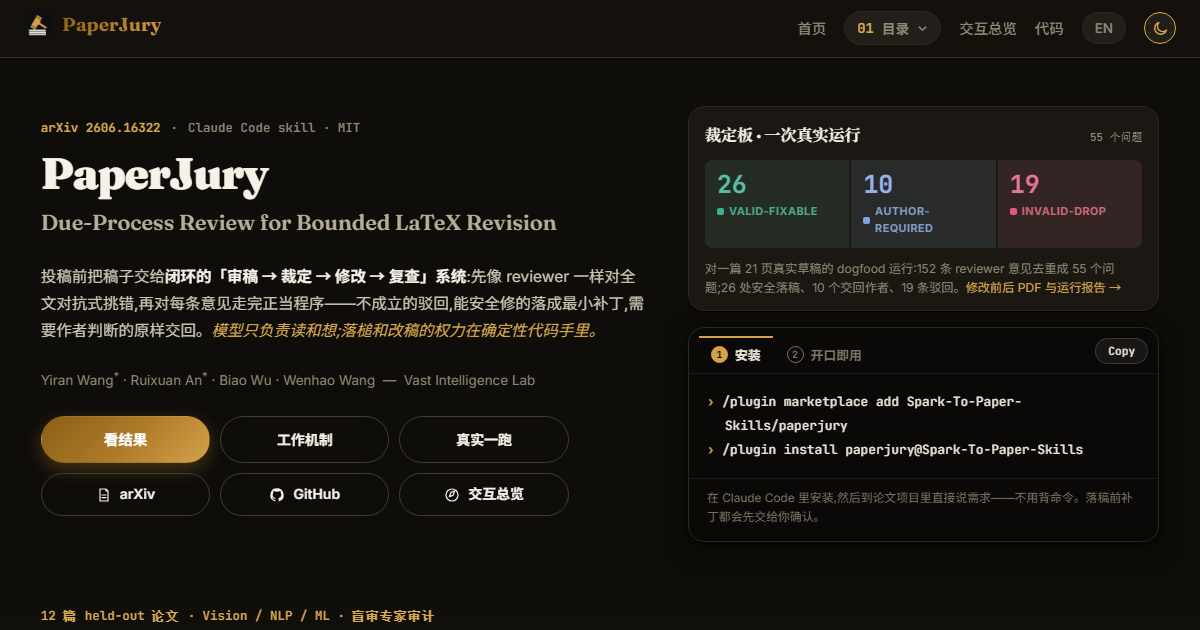
🏆 真实 Dogfood 样例 一篇真实草稿的完整多轮评审:仓库里放了修改前后 PDF,以及人工核对过的运行报告。先看样例,再决定要不要把自己的论文交给它挑刺。 
|
[!IMPORTANT]
PaperJury 是投稿前的自查工具,不能替代作者的科学判断,也不能替代 peer review。它不能用来编造实验、伪造结果、添加没有证据支撑的 claim,或掩盖论文局限。遇到需要新实验、缺证据、需要作者私有知识或研究判断的问题,它都会交回作者处理。
🔥 News
- 🎉 RedNote(小红书)里程碑: 相关分享已经达到 3 万浏览、1.8k 收藏。感谢大家转发和收藏,也感谢大家把 PaperJury 推荐给更多正在赶论文、改论文的朋友。
- 📄 2026-06-15:PaperJury 论文已上 arXiv。 arXiv 页面:PaperJury: Due-Process Review for Bounded LaTeX Revision(arXiv:2606.16322)。论文系统介绍了「审稿 → 裁定 → 修改 → 复查」这套引擎:哪些事交给确定性脚本,哪些判断交给语义 agent;有争议的问题如何进入审议;不同风险的编辑该上什么护栏。
- 🔔 2026-06-10:v1.0.0 发布。 这是第一个稳定版,和 Codex 版 v1.0 对齐。新增软更新提醒:发现新的稳定 tag 时只提示,不打断当前工作。
- 🚀 2026-06-05:PaperJury 的 Codex 版已经推送。 入口在这里:paperjury-codex。
- 🧪 Dogfood sample 已加入。 仓库里放了一个紧凑的 dogfood sample:修改前后 PDF,以及人工核对过的运行报告。
📌 引用论文
如果 PaperJury 对你的研究或写作流程有帮助,可以引用这篇 arXiv 论文:
@misc{wang2026paperjurydueprocessreviewbounded,
  title={PaperJury: Due-Process Review for Bounded LaTeX Revision},
  author={Yiran Wang and Ruixuan An and Biao Wu and Wenhao Wang},
  year={2026},
  eprint={2606.16322},
  archivePrefix={arXiv},
  primaryClass={cs.CL},
  url={https://arxiv.org/abs/2606.16322},
}
同一条目也放在 CITATION.bib。
⚡ 快速上手
在 Claude Code 里安装:
/plugin marketplace add Spark-To-Paper-Skills/paperjury
/plugin install paperjury@Spark-To-Paper-Skills
然后在你的论文项目里直接说需求:
审稿,重点看实验和 claim 是否站得住。
也可以更日常一点:
把 introduction 这段改紧一些,但不要改变 claim。
不需要背命令。PaperJury 会根据你的描述选择 direct-edit、review 或 auto 模式;真正落稿前,会先把补丁交给你确认。
🤔 这是什么?
PaperJury 以 Claude Code skill 的形式提供,把投稿前自查组织成一套闭环:审稿 → 裁定 → 修改 → 复查。它不会照单全收 AI 反馈,而是先把每条意见分成三类:
| 结果 | 含义 |
|---|---|
| ✅ 安全修复 | 表达不清、claim 过强、结构不顺这类文本问题;不需要补实验,也不会把原意改偏。 |
| 🧑💻 作者处理 | 缺实验、缺 ablation、缺数据或证据,必须由作者自己判断。 |
| 🛑 不成立 | AI reviewer 误读了论文,或者提了不该改的问题。 |
🎯 适合谁
| 你现在的情况 | 可以直接这样用 |
|---|---|
| 📝 刚写完初稿 | 让它像 reviewer 一样通读全文,先找最可能影响投稿的问题。 |
| 🔍 投稿前最后自查 | 让它检查 claim 是否说过头、实验是否撑得住,以及有没有明显格式风险。 |
| ✍️ 只想改一段话 | 直接说「把这段改紧一点,但不要改变 claim」,它会先起草补丁,等你确认后再改。 |
| 🔁 想多轮打磨但不想一直盯着 | 明确授权 auto 模式;安全修改可以落稿,高风险问题仍会交回作者决定。 |
📦 你会得到什么
| 输出 | 内容 |
|---|---|
| 📋 问题清单 | 每条 reviewer-style 问题都会带证据、位置、判断结果和当前状态;不会把一堆意见直接倒进正文。 |
| 🧩 可审阅补丁 | 只有安全修复会进入最小补丁;高风险改动会先放着,等作者决定。 |
| 🛠️ 复查报告 | 有 LaTeX 工具链就真实编译;没有就明说哪些检查做不了,不会假装验证过。 |
| 🧪 真实样例 | samples/dogfood/ 里有修改前后 PDF 和人工核对过的运行报告。 |
🧠 能帮你做什么
| 场景 | PaperJury 会怎么做 |
|---|---|
| 🔎 投稿前挑问题 | 模拟几位不同方向的 reviewer 通读全文,找出真正可能被抓住的弱点,并把致命问题和小修小补分开。 |
| ✍️ 安全改 LaTeX / Markdown | 只针对你指定的位置起草补丁,自检后再交给你确认;不会把一处小改扩成整篇重写。 |
| 🛡️ 复查格式风险 | 本机有 LaTeX 工具链时会真实编译,检查报错、未定义引用、overfull box、页数和常见 desk-reject 风险;没有工具链时会明说。 |
| 🔁 多轮打磨 | 在你明确授权的 auto 模式下,多轮跑完「评审-修订-复查」;安全修改可以自动应用,高风险问题会留给作者处理。 |
PaperJury 的重点不是“让 AI 多写一点”,而是让 AI 先像 reviewer 一样认真挑错,再用确定性脚本守住能验证的边界。
🧭 三种模式
| 模式 | 什么时候用 | 行为 | 人工确认 |
|---|---|---|---|
| ✍️ direct-edit(常用) | 只想改一处文字、caption、LaTeX 表达或段落结构。 | 不开评审面板,直接用写作工具包起草补丁。 | 作者确认后再应用。 |
| 🔎 review(偶尔) | 想让它审稿、挑问题、mock-review,或只审某一节 / 某条 claim。 | 启动对抗式评审引擎,先判断问题是否成立,再决定要不要修改。 | 每处改动逐一确认。 |
| 🔁 auto(无人值守) | 已经明确给出 /goal 或配置 mode: auto,希望它多轮跑到一个可验证目标。 |
先确认 spine 和评审分配,再按 bounded-aggressive + edit-safety 策略迭代。 |
先给整体授权;高风险项仍交回作者。 |
简单说:改一处 → 直接说;想被挑刺 → 说「审稿」;想无人值守 → 用 /goal。
[!WARNING]
auto 必须明确开启。 只打开工具权限再发普通 prompt,只会跑一轮就停,不会进入多轮循环。原因见docs/AGENT-GUIDE.md§3。
🧪 真实跑一遍
想看它真实产出,仓库里有一个 dogfood sample:在一篇真实草稿上跑完整多轮评审,附修改前后 PDF 和一份人工核对过的运行报告。
samples/dogfood/(original_draft.pdf · revised_draft.pdf · 运行报告)
如果只想确认稿件不会先被格式问题挡住,可以说:
跑一下 submission-readiness / 合规检查。
它会做确定性格式筛查,再配合编译驱动的版面检查。
🚀 安装
Claude Code plugin
推荐用 marketplace 路线:
/plugin marketplace add Spark-To-Paper-Skills/paperjury
/plugin install paperjury@Spark-To-Paper-Skills
Clone 成 skill
也可以把仓库 clone 到 Claude Code 读取 skill 的目录:
# macOS / Linux
git clone https://github.com/Spark-To-Paper-Skills/paperjury ~/.claude/skills/paperjury
# Windows (PowerShell)
git clone https://github.com/Spark-To-Paper-Skills/paperjury "$env:USERPROFILE\.claude\skills\paperjury"
也可以放在 <项目>/.claude/skills/ 下,只对单个项目生效。
安装后建议检查:
- Claude Code 会通过
SKILL.md自动发现它,skill 名称是paperjury。 - 需要
node,因为确定性检查跑在 Node 上。 - LaTeX 工具链可选;真实编译和版面检查会用到,没有时会明说哪些检查做不了。
- 在 skill 目录里运行
npm run doctor,可以检查仓库完整性、所需工具和论文文件识别。 - 启动时会对 GitHub 稳定版 release tag 做一次软更新检查;发现新版只提示,不阻塞当前工作。设置
PAPERJURY_DISABLE_UPDATE_CHECK=1可以关闭提醒。更新后请开新会话。
Claude Code 版和 Codex 版怎么选
| 版本 | 入口 | 适合 |
|---|---|---|
| Claude Code 版 | 本仓库;Claude Code plugin 或 .claude/skills/ |
你主要在 Claude Code 里写论文、改 LaTeX、跑 workflow。 |
| Codex 版 | paperjury-codex | 你主要在 Codex / Codex plugin 环境里跑同一套评审和修订流程。 |
给 Claude / 编码 agent: 更深入的驱动说明见 docs/AGENT-GUIDE.md。里面写了安装、三种模式及触发方式、引擎管线、auto 与 /goal 的区别,以及并行评审如何启动。
常见问题
PaperJury 能审 Word(.docx)文件吗?
能。PaperJury 会把 .docx 一次性转成 Markdown,并明确告诉你转换保留了什么、哪些内容带不过来,比如复杂表格和公式。随后它在这份 Markdown 工作副本上跑完整多轮评审。原始 Word 文件不会被改动。结束后你拿回的是改好的 Markdown 和逐条修改清单;要不要合并回 Word,由你自己决定。你也可以先把论文导出成 .md 或 .tex,再直接交给它。
它会不会擅自改我的论文?
不会。direct-edit 和 review 模式下,补丁需要你确认后才会应用。auto 模式也必须显式开启,并且会先拿到对核心方向、修订范围和策略的整体授权。
深入了解
新用户可以先跳过这一节。想看机制、源码结构或 agent 驱动方式,可以从这里开始:
| 你想了解 | 入口 |
|---|---|
| 真实运行效果 | samples/dogfood/RUN_REPORT.zh-CN.md |
| 怎么驱动 Claude / 编码 agent | docs/AGENT-GUIDE.md |
| 引擎设计细节 | docs/REVIEW_ENGINE_V3_DESIGN.md |
| 完整协议和状态机 | references/review-engine-v3.md · references/ledger-schema.md |
| 在线可视化说明 | 交互式总览 |
引擎原理
PaperJury 把审稿拆成一套有边界的“庭审”流程:先由有限数量的 reviewer 找问题,再把有争议的意见拿出来审议;编辑阶段按风险加护栏,多轮结束时由确定性脚本判断是否收敛。
assign-reviewers → reading-check → coverage-auditor → merge
  → { trial ‖ polish } → recall-audit → drafter
  → { edit-audit | meaning-audit } → clerk
能用脚本检查的部分都放在 scripts/ 里,由 orchestrator 在各个 workflow 之间调用;需要判断语义的问题,则交给相互隔离的 model agents。
- 读稿分解:把手稿(LaTeX 或 Markdown)切成阅读单元、规范段落列表和稳定段落编号,防止问题锚点漂移。
- Word 提取:把 .docx 一次性转成 Markdown 工作副本,并说明哪些内容保住了、哪些内容可能带不过来;原始 Word 文件不改动。
- 核心声明(仅 auto 模式):提取核心 claim,交给作者确认后冻结为配置。
- Ledger:用机器可读的记录保存活跃问题,跨轮次、跨会话都能接上。只要没有仍然阻塞的 major 问题,就视为工具侧完成;author-required 会进入人工待办,不算工具侧未完成。
- 日志:编辑历史只追加记录,方便回滚。
- 补丁应用:原子性应用编辑,记录日志,必要时可以恢复。
- 锚点追踪:定位已冻结的核心 claim;上下文变化时,标出需要重新审计的部分。
- 交叉引用检查:编辑前先查改动关键词是否还出现在其他位置;如果出现,就标记为需要语义审计。
- 段落重新对齐:每轮结束后,重新对齐被编辑挪动的段落编号,避免问题失去锚点。
- 编译检查:尝试真实 LaTeX 编译;无法编译时退到结构检查,并明确说明哪些结果不可验证。
- 提交合规检查:用脚本先筛一遍常见提交格式风险。
- 装机自检:
npm run doctor,检查仓库完整性、所需工具和手稿识别。
- 评审员分配:根据论文研究方向,分配 N 位领域 reviewer。
- 完整阅读检查:每位 holistic reviewer 通读全文一遍,列出弱点、原文引文、总体置信度和按节覆盖情况;引不出原文,就视为没有真读。
- 覆盖审计:检查哪些 reviewer / section 组合可能被略读。
- 去重:合并重复评论,并整理重要性、问题类型和交叉确认情况。
- 审议(trial):对有争议的问题开庭。先由 5 人审议,必要时升到 12 人;法官把成立的问题判定为
valid-fixable或author-required。 - 润色:快速路径处理机械性问题和轻微问题;如果判断不稳,就升级回审议。
- 召回审计(recall):找回误判丢掉的问题,并在落稿前抽查强共识 major,防止集体误判。
- 编辑起草:对确认可修的问题起草最小改动。
- 编辑审计 / 含义审计:检查高风险改动、跨节一致性、冻结锚点和论证链条。
- 书记官:汇总本轮结果,合并重复项,整理残留问题,并用确定性规则判断是否收敛。
也支持简化的 3 人评审小组,作为快速路径。
三个核心组成:Skill + Workflow + Memory- Skill(入口 + 方法论):定义协议、reviewer 分配、共识检查、写作工具包和人工确认规则。详见
references/review-engine-v3.md、references/reviewer-personas.md、references/writing-toolkit.md。 - Workflow(并行评审引擎):语义步骤以 Workflow 运行,并行生成结果,再做 schema 校验。Workflow sandbox 不能直接访问文件系统,所以确定性检查由 orchestrator 在各个 workflow 之间调用。
- Memory(持久状态 + 项目约定):
LEDGER.json是机器可读的主记录,LEDGER.md是给人看的版本;Claude memory 存放下次会话需要沿用的稳定约定,比如 house style、venue 和 reviewer persona 调校。
Reviewer panel 由 N 位领域 reviewer 组成(默认 3 位,范围 2-4 位),运行时按论文 subfield 分配。所有 reviewer 共享同一个资深 reviewer 的底层要求:严苛、精确、建设性;能区分致命缺陷和可修补的小问题,也能跨 section 推理。某个 reviewer 无法确认时,就退回通用 reviewer;单个失败不会拖垮整个 panel。
六条硬规则- 未经作者显式确认,绝不改手稿。
- 评审者 / 陪审员相互隔离。
- 每条可修复问题都有明确修复标准。
- 不把内部记录写进被审文本。 评审日志、修订记录和内部检查结论都是作者侧辅助,绝不进入论文或冻结快照。
- 分歧先讨论;谈不拢时由人覆盖,并记录原因。
- 所有路径和文件配置都在运行时解析,不硬编码。
架构与隐私
- Workflow sandbox 没有文件系统,也不能启动子进程;所以所有确定性检查都由 orchestrator 在 workflow 之间调用。
compile-guard.js不会假装验证过:无法真正编译时,就退到结构 lint,并报告compiled:null。- 提交就绪检查分两部分:A =
compliance-check.js+ 一个语义 agent;B = 复用compile-guard.js的编译检查,再让模型读取 PDF 做版面复查。
[!NOTE]
你的项目文件、ledger、journal 和 patch 都留在本地论文项目里。PaperJury 自己没有后端或服务器,也就不会把文件上传到 PaperJury 服务器。审稿走的是你自己的 Claude Code session;模型本身仍可能跑在云端,内容如何被处理取决于这套 Claude Code 环境的条款和设置,PaperJury 不会再额外加一层。
项目结构
| 路径 | 作用 |
|---|---|
.claude-plugin/ |
Claude Code marketplace 打包配置。 |
workflows/ |
语义阶段:评审分配、覆盖检查、合并、庭审、召回审计、起草和收敛。 |
scripts/ |
确定性检查脚本:ledger、journal、apply-patch、anchor-diff、cross-ref、compile-guard、doctor 等。 |
references/ |
引擎协议、ledger schema、评审者人格、写作工具和方法论。 |
docs/ |
设计说明、交互式总览、arXiv 论文 PDF 和 agent 驱动指南。 |
samples/dogfood/ |
真实草稿的 before/after PDF 和人工核对过的运行报告。 |
tests/ |
确定性脚本和核心状态机测试。 |
Roadmap
- 软更新提醒。 启动时检查有没有更新的稳定版 tag,有就给一条非阻塞提示。
- 快速版本 / quick mode。 更快、更省 token 的检查路径;不追求完整庭审深度,先给一轮可用的快速 triage。
- 按不同会议的审稿口味调整 reviewer persona。 CVPR、ACL、NeurIPS 的 reviewer 关注点并不一样;目标是让评审更贴近各自社区的预期。
- 基于视觉的版面校验。 编译、渲染、再检查版面,不只看编译日志。
- 从
.cls/ 模板自动识别 venue。 - 用更多真实论文做规模化验证。
- 引擎协议:
references/review-engine-v3.md - 自动模式:
references/auto-mode.md - 评审者角色、编辑工具、方法论:
references/reviewer-personas.md、references/writing-toolkit.md、references/methodology.md - 账本结构和状态:
references/ledger-schema.md - 提交合规:
references/submission-compliance.md - 设计说明:
docs/REVIEW_ENGINE_V3_DESIGN.md - 脚本:
scripts/(decompose、extract-docx、ledger、journal、apply-patch、anchor-diff、cross-ref、spine、rekey、compile-guard、compliance-check、doctor) - 步骤:
workflows/(assign-reviewers、reading-check、coverage-auditor、merge、trial、polish、recall-audit、drafter、edit-audit、meaning-audit、clerk、review-panel)
了解更多: docs/AGENT-GUIDE.md(驱动指南)· docs/REVIEW_ENGINE_V3_DESIGN.md(设计说明)· 在线交互式总览
致谢
PaperJury 的 spine 和防漂移设计受 PaperSpine 启发,尤其是 anchor logic-transfer audit、claim register、minimal-edit 且保义的改写策略。PaperSpine 更偏 motivation-driven 的论文起草和改写;PaperJury 借用了其中的 anchoring 思路,以及“可检查步骤交给确定性脚本、判断交给 model agent”的分工,再在此基础上加入对抗式 review 和庭审式裁定流程。
Star History

星标曲线暂停:GitHub 限制了第三方获取 stargazer 数据;仓库装上 star-history GitHub App 后自动恢复。
Yorumlar (0)
Yorum birakmak icin giris yap.
Yorum birakSonuc bulunamadi