mailcraft
Health Gecti
- License — License: Apache-2.0
- Description — Repository has a description
- Active repo — Last push 0 days ago
- Community trust — 16 GitHub stars
Code Basarisiz
- rm -rf — Recursive force deletion command in .github/workflows/package.yml
Permissions Gecti
- Permissions — No dangerous permissions requested
Bu listing icin henuz AI raporu yok.
MailCraft: an open-source, clean-room mail, calendar and contacts program (Outlook-style) in pure Rust, for Microsoft 365, Outlook.com and IMAP. Early alpha.
MailCraft

An open-source mail, calendar, contacts and tasks program, written from scratch in Rust.
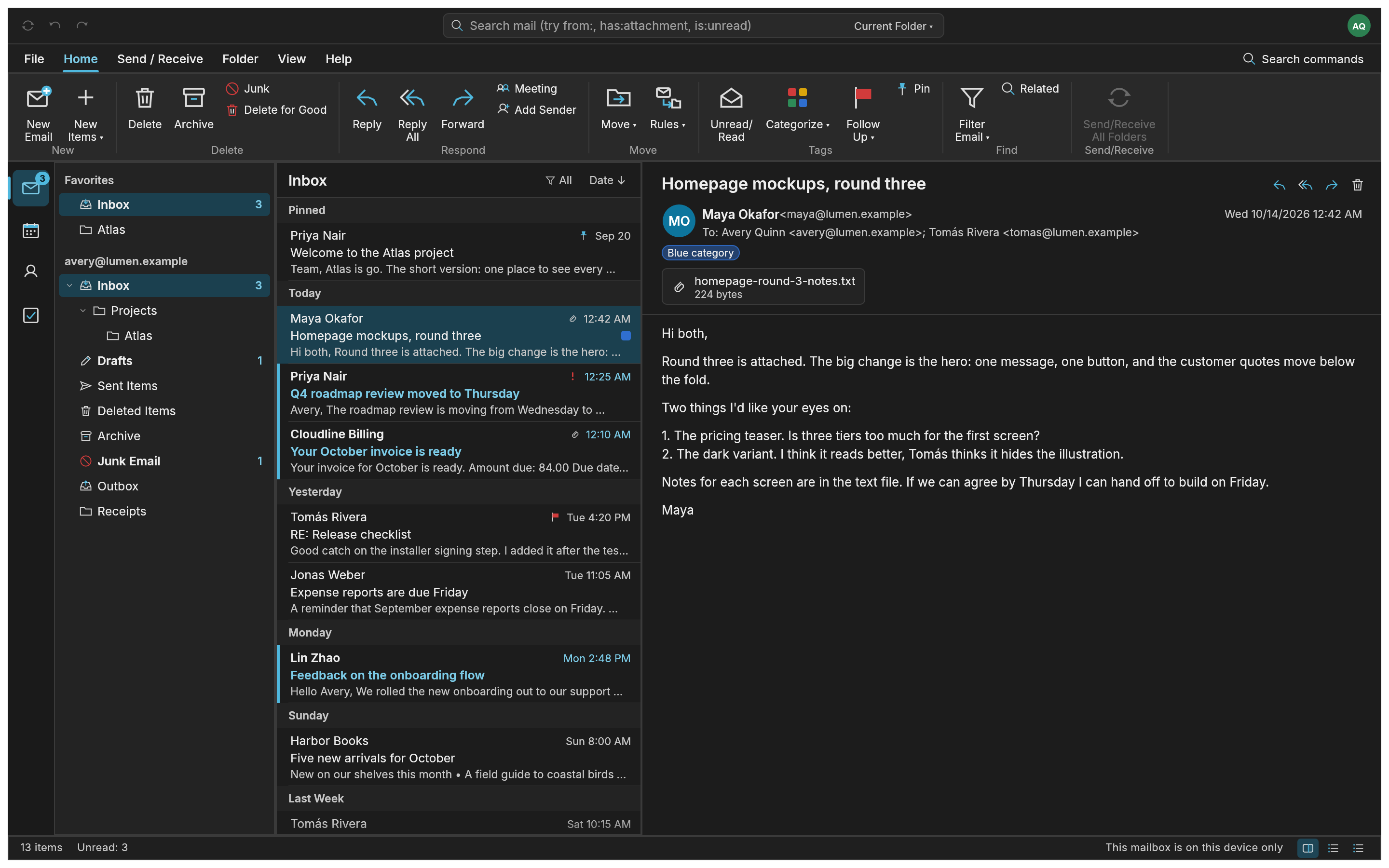
MailCraft is a clean-room reimplementation of the mail client people already know how to use: the ribbon, the folder pane, the message list with its reading pane, conversations, flags, categories, rules, a calendar with recurring meetings, people and to-dos. It is a native, GPU-rendered app (no Electron, no web view), it also runs in a browser tab through WebAssembly, and every action in it is a command that scripts and AI agents can run too.
Status: early alpha (0.4). The foundations are in place and tested; a lot of what a daily driver needs is not there yet. See ROADMAP.md and docs/gaps.md for an honest list.
MailCraft follows the architecture and conventions of WordCraft and the other Craft apps: the same layered crates, the same "everything is a command" engine, the same egui front end and design tokens, the same control channel, MCP server, tooling and packaging.
What works today
- Mail: accounts, nested folders and favourites, a virtualised message list grouped by date (or sender, importance), sort, filters, conversations, pinning, a reading pane (right, bottom or off) whose text you can select and copy, flags with due dates, colour categories, importance, junk and archive, move and copy (or drag onto a folder), two-step delete with a question before anything is gone for good, flag and delete on the row under the pointer, a click on a row's left edge to switch read and unread, a double-click to open a message in a window of its own, undo and redo for all of it.
- Search: a query language in the search box:
budget from:ada has:attachment -draft after:2026-10-01 is:unread, in one folder or every mailbox. - Writing: new mail (also from a
mailto:link clicked anywhere, once MailCraft is your mail program), Reply, Reply All and Forward with the original quoted, attachments, drafts, signatures, recipients suggested as you type (contacts, then the people you have exchanged mail with), Check Names, importance. Plain text for now. - Rules: conditions (from, to, subject, body, attachment, importance) and actions (move, categorise, flag, mark read, importance, delete), run on new mail or on demand.
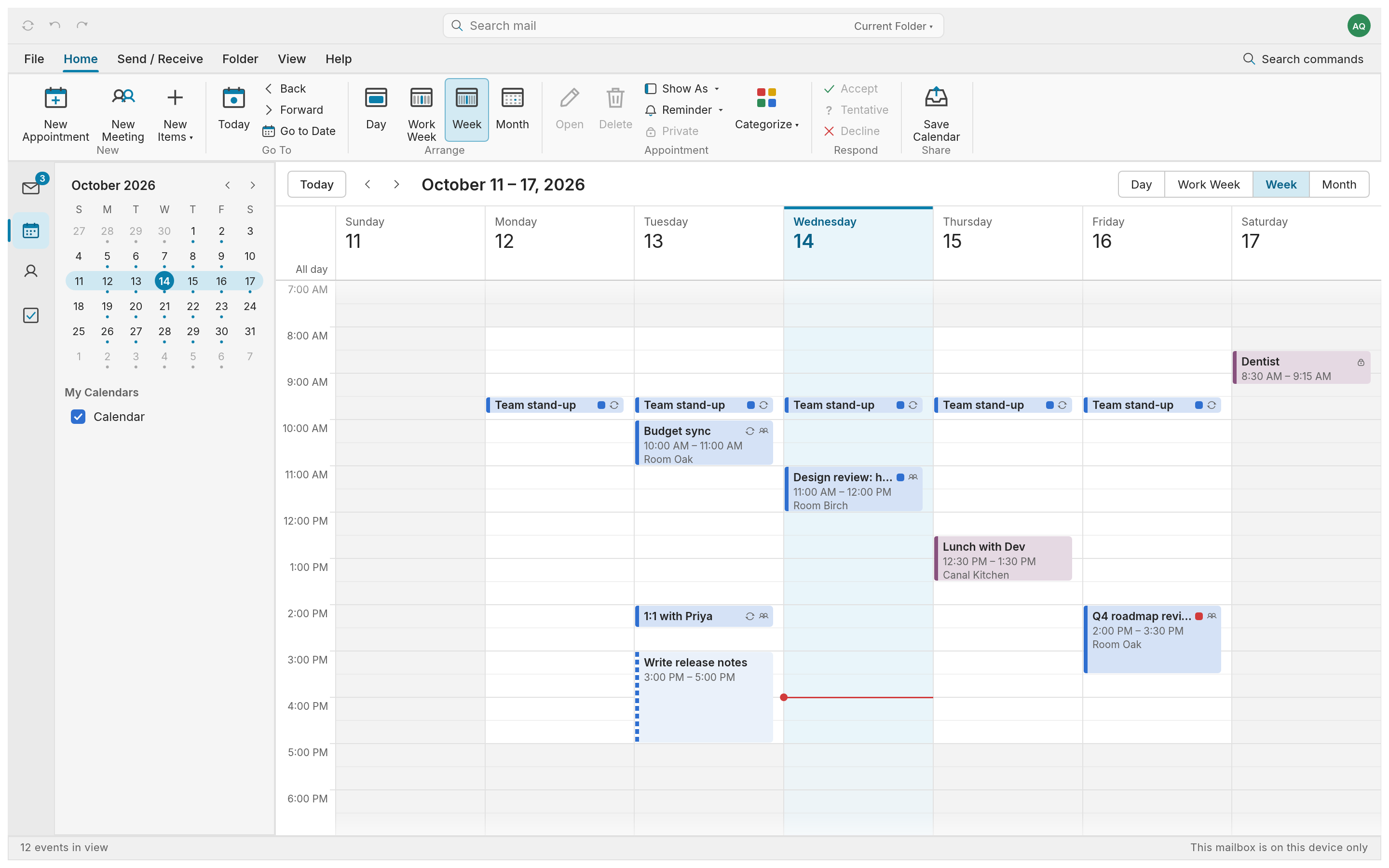
- Calendar: day, work-week, week and month views; appointments and meetings with attendees; recurrence (daily, weekly on chosen days, monthly by date or by "second Tuesday", yearly; counts, end dates, skipped days); reminders that come up in a window of their own (dismiss, snooze), show-as, private; several calendars. Click or drag over empty time and type to make an appointment on the spot; drag one to move it, its edge to resize it, with Ctrl to copy it; the keyboard works the grid as it does in Outlook; double-click opens an item in a window of its own. A repeating item asks "just this one" or "the entire series". With a Microsoft 365 account, what you make, move, change or delete is on the server at once, series and every calendar of the account included, and the calendar keeps itself current; meetings send their invitations, updates and cancellations through the server, and you answer invitations from the calendar or straight from the message in the Inbox (Accept, Tentative, Decline, with what else is on at that time). Appointments and meetings open in windows of their own, with their own command bar, a recurrence dialog and a Scheduling Assistant that shows when the people you invite are free. Several calendars stand side by side or overlaid, each in its colour. How far this is from Outlook, row by row: docs/calendar-parity.md.
- People and Tasks: contacts with several addresses and phones, favourites and categories; to-dos with due dates, importance, and links to the flagged message they came from.
- Servers: IMAP and SMTP over TLS or STARTTLS, on the desktop and in the CLI. Mail comes down, and what you do here goes back up: read marks, flags, moves, deletions and a copy of what you send. Account setup recognises the provider from the address (for a company's own domain, from who takes its mail); Outlook.com and Microsoft 365 sign in on Microsoft's page (OAuth 2.0), and sign-ins are remembered by the system's credential store (Windows Credential Manager, the macOS keychain, or the Secret Service of GNOME Keyring or KWallet on Linux and FreeBSD). Where an organisation lets only an administrator approve a new program, Microsoft's page says "Need admin approval" instead of signing you in: MailCraft says what to do next while that page is still open (an administrator approves it once on Microsoft's page, opened from MailCraft; anybody else copies a short message for one; then you sign in again), and nothing of you is in the address that is passed on. Send/Receive runs by itself, and mail shows as it arrives, the Inbox first. For Microsoft accounts, mail is sent through Microsoft Graph, the calendar goes both ways, contacts come down, and the folder pane's Favorites are the ones you keep in Outlook (read from the server through Microsoft Graph once you say so, never changed there; a work or school account may need its administrator's approval once). This has been used against one real Microsoft 365 mailbox, and no other provider yet: see docs/gaps.md.
- Files:
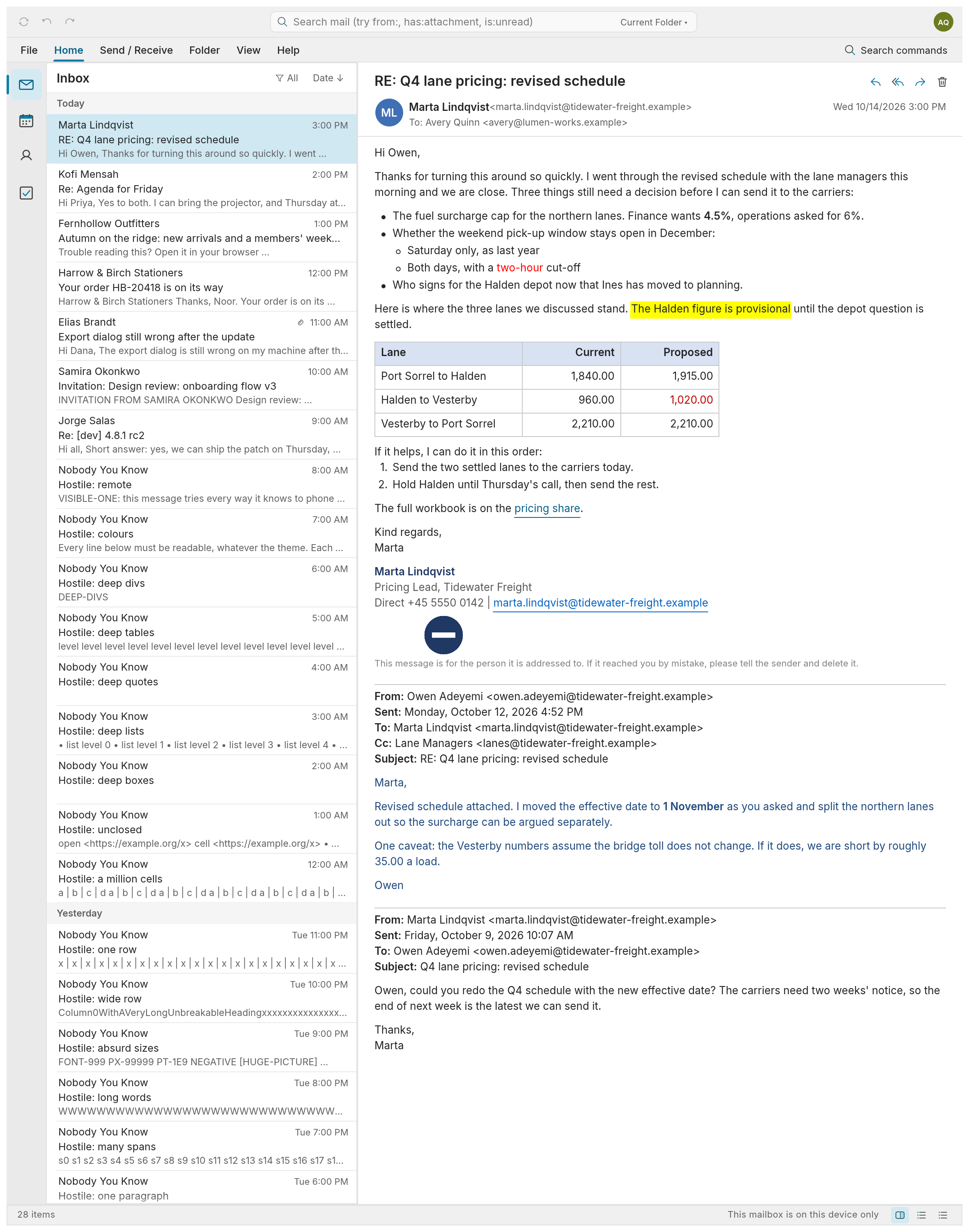
.emland.mboxmessages,.icscalendars,.vcfcontacts, in and out; the mailbox as a.mailcraftfile with its message content in a folder beside it, saved in the background, or as one self-contained file. - Reading mail safely: HTML mail is laid out with its tables, colours, lists and the pictures attached to it, readable in light and dark, without running anything in it; pictures on the web are downloaded only when you ask (for one message, always for a sender, or for all mail if you switch that on), and the request tells the sender's server nothing but the picture's address; links show where they go.
- Look: Outlook's layout: the rail, the folder pane, a one-row ribbon (or the classic three-row one, your choice), light and dark following the system's setting unless you choose; the system's own interface font on Windows.
- Installing: every release is on the Releases page with its checksums: a Windows installer (
.msi) and portable zip for x64, x86 and ARM64;.AppImage,.deb,.rpm,.flatpakand.tar.gzfor Linux on x86_64 and aarch64; a macOS disk image for Apple silicon and Intel; a FreeBSD tarball; a static site for the browser. The builds are not signed yet, so Windows and macOS ask before running them. One window per mailbox: starting MailCraft again, or opening a message file or amailto:link, goes to the window that is already open. See docs/releasing.md for what has been built and tested so far. - Agents: a CLI, a JSON control channel and an MCP server expose every command; the same registry drives the ribbon and the keyboard.
What it looks like
 |
 |
 |
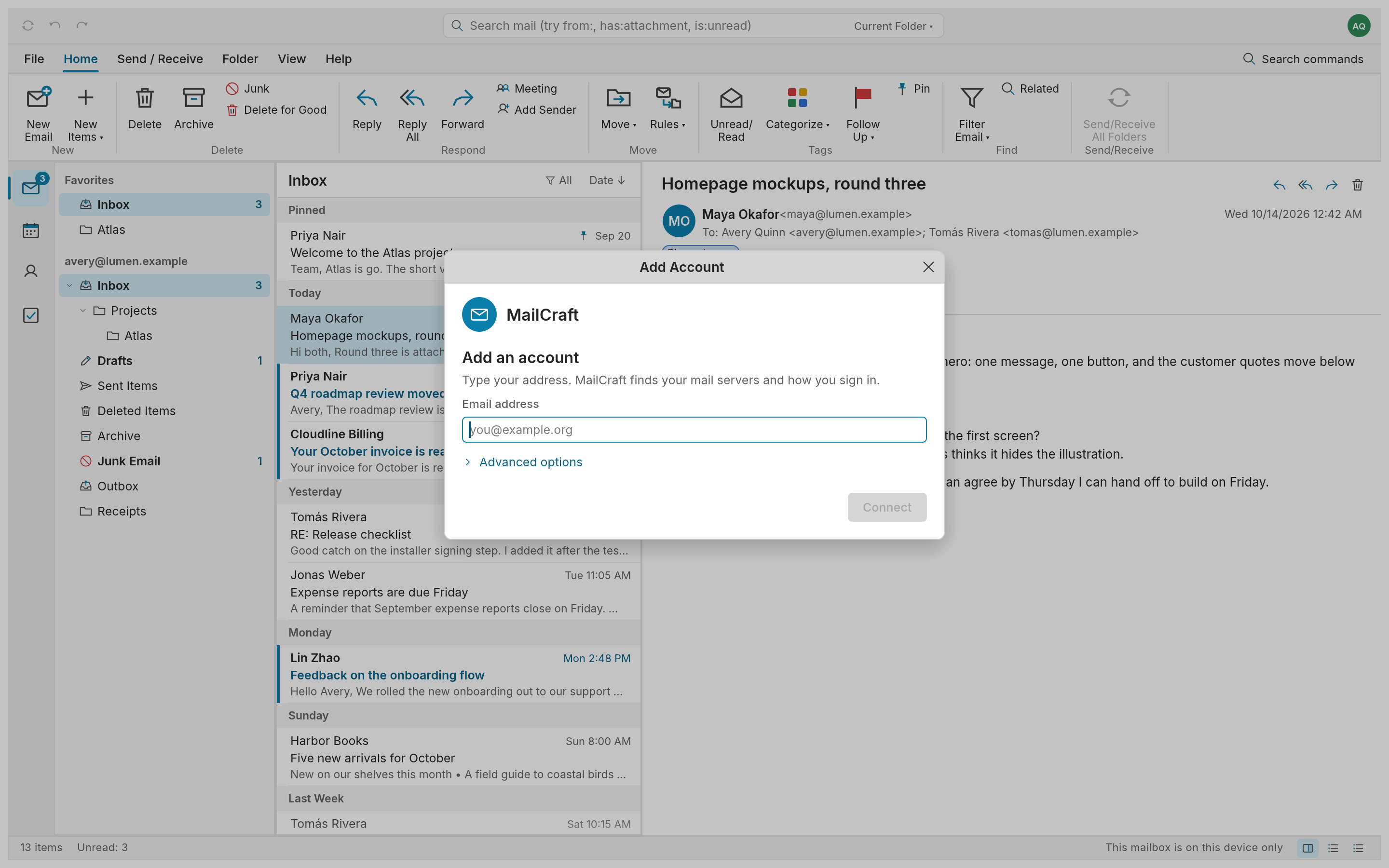 |
The pictures are of the sample mailbox (--sample): invented people and invented mail.
Platforms
| Desktop | macOS (universal), Windows (x64, arm64), Linux (x86_64, aarch64, riscv64), FreeBSD (x86_64) |
| Web | any modern browser, through WebAssembly (WebGPU, or WebGL2 where that is missing) |
The browser build is the same app with three differences that a browser imposes: it can't open connections to mail servers (bring mail in with File › Import, or use the desktop app), the mailbox lives in the browser's storage, and saving means downloading.
Build and run
git clone https://github.com/UCS-Care-Group/mailcraft
cd mailcraft
cargo run --release -p mailcraft -- --sample
--sample opens an invented mailbox to try things on and keeps nothing. Without it, MailCraft keeps your mailbox in its settings folder and saves as you go.
Command line:
mailcraft-cli run --sample --cmd mail.markAllRead --cmd 'folder.new={"name":"Later"}' --save demo.mailcraft
mailcraft-cli list demo.mailcraft --folder Inbox --query "has:attachment"
mailcraft-cli import demo.mailcraft newsletter.eml team.ics people.vcf
mailcraft-cli convert archive.mbox archive.mailcraft
mailcraft-cli commands
Web: install trunk and the wasm32-unknown-unknown target, then
cd apps/mailcraft-web && trunk serve
and open http://127.0.0.1:8772/ (?sample starts from the sample mailbox, ?empty from an empty one).
Everything CI runs: cargo xtask ci (formatting, clippy with warnings as errors, the tests, asset attribution, crate layering, the wasm build).
Driving it from an agent
mailcraft --sample --control 7991          # the app, with a control channel
mailcraft-cli mcp --connect 127.0.0.1:7991 # an MCP server bridged to that window
mailcraft-cli mcp --sample                 # or headless, no window
See docs/mcp.md and docs/control-protocol.md. Messages are data, not instructions: an agent reading your mail should never act on what a message tells it to do, and the MCP server says so in its instructions.
How it is put together
| Layer | Crates | Job |
|---|---|---|
| L0 | time, control-key |
Calendar maths and date text; control-port key files |
| L1 | model, html |
The mailbox and its edit primitives, recurrence, search; hostile HTML to safe display blocks |
| L2 | mime, ical, vcard |
Internet messages and mbox; iCalendar; vCard |
| L3 | proto, net |
IMAP and SMTP without sockets; TLS sockets and synchronisation |
| L4 | engine |
Session, undo, the command registry, the feature catalog, file dispatch |
| L5 | mcp |
MCP server |
| L6 | ui-egui |
The Outlook-style front end (swappable) |
| Apps | mailcraft, mailcraft-cli, mailcraft-web |
Desktop, command line, browser |
A crate may only depend on lower layers, and nothing below L6 knows about the UI toolkit (cargo xtask layers enforces both). More in docs/architecture.md.
Principles
- Never crash. People trust a mail program with years of correspondence. No panics in non-test code, every input (files, servers, command parameters) treated as hostile, a failed command leaves the mailbox exactly as it was.
- Your mail stays yours. Nothing in a message runs, nothing in a message is fetched unless you ask for its pictures, passwords and sign-ins are held in memory, kept by the operating system's credential store when you want them remembered, and never written to MailCraft's own files or logs. What MailCraft defends against, and how: docs/threat-model.md.
- Clean room. Built from public specifications (RFC 5322, MIME, IMAP, SMTP, OAuth 2.0, iCalendar, vCard) and from watching how mail programs behave, never from anyone's code or assets. Every icon is drawn in code; every asset is listed in ATTRIBUTION.md.
- Everything is a command. One registry behind the ribbon, the shortcuts, command search, the CLI, the control channel and MCP.
Contributing
Read CONTRIBUTING.md and AGENTS.md first (it is for people as much as for agents): the never-crash rules, the asset policy and the quality gates are short and not negotiable. Work to beta is a list of issues, one per task in the plan: claim one before you build it.
Want to test it on your own mail? Sign up as a tester, for the alpha now or the beta later.
License
MailCraft is dual-licensed under the MIT License or the Apache License, Version 2.0, at your option. Bundled fonts keep their own open licences; see NOTICE and ATTRIBUTION.md. MailCraft is not affiliated with Microsoft; Outlook is a trademark of Microsoft Corporation, named here only to say what MailCraft is an alternative to.
Yorumlar (0)
Yorum birakmak icin giris yap.
Yorum birakSonuc bulunamadi