declick
Health Warn
- License — License: NOASSERTION
- Description — Repository has a description
- Active repo — Last push 0 days ago
- Low visibility — Only 5 GitHub stars
Code Fail
- exec() — Shell command execution in bin/declick.mjs
- spawnSync — Synchronous process spawning in bin/declick.mjs
- process.env — Environment variable access in bin/declick.mjs
- network request — Outbound network request in bin/declick.mjs
- process.env — Environment variable access in bin/run.mjs
- process.env — Environment variable access in fixtures/fake-tool.mjs
Permissions Pass
- Permissions — No dangerous permissions requested
No AI report is available for this listing yet.
Compile an API, an MCP server, a database or a web page into a CLI your agent can run. Ten engines, one output contract, 4.1x less context than raw MCP.
declick
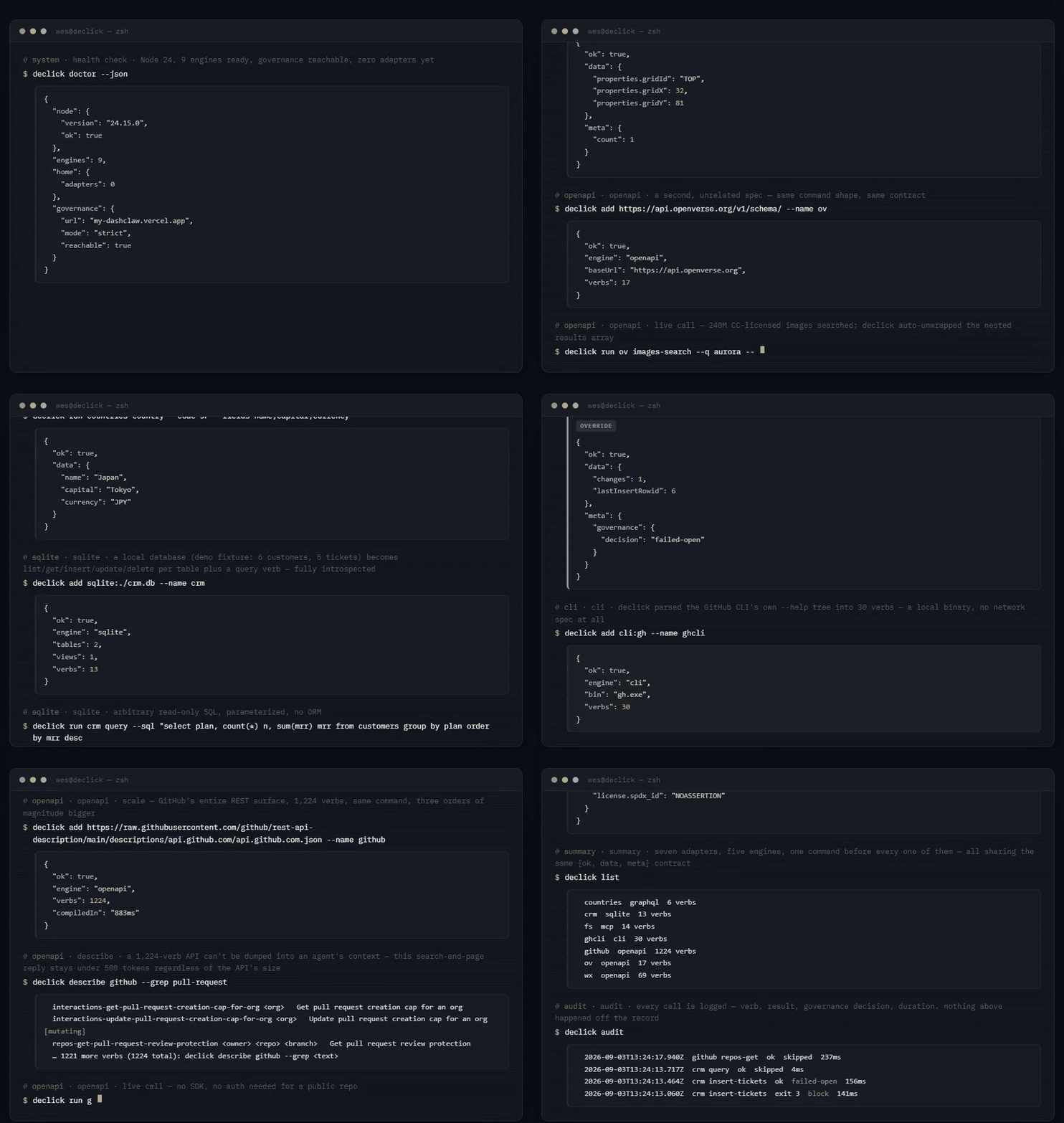
Stop writing a parser for every tool your agent calls. declick reads a source once and writes named verbs that return one envelope with five exit codes. Ten engines, zero runtime dependencies, Node 24.
The saving is measured, not claimed: against nine real MCP servers (258 tools), the raw tool listing an MCP client puts in context is 236,818 bytes and declick describe is 58,309, a 4.1x reduction. node scripts/bench-tokens.mjs reproduces it on your own adapters; the method and the caveats are in docs/bench.md.



Quickstart
Requires Node 24 or newer. An older Node exits 1 with one line naming the version it found, from either entry point, instead of a stack trace.
npm i -g declick
declick setup
declick add https://petstore3.swagger.io/api/v3/openapi.json --name petstore
declick run petstore describe
declick run petstore get-user-by-name user1 --fields username,email
declick run petstore get-pet-by-id 7 --dry-run
declick setup puts ~/.declick/bin on PATH, adopts your agent's existing MCP servers as adapters, adds a rules block to its instruction file, and (Claude Code only) installs a hook that nudges the model toward the adapter; declick setup --revert puts everything back byte for byte.
The fifth line is a real call: petstore's user endpoints declare no auth, so the envelope comes back with the row. get-pet-by-id declares an API key in the spec, so without PETSTORE_API_KEY set it exits 4 and names the key; --dry-run shows the request it would send instead.
declick add writes three things: ~/.declick/petstore/manifest.json (the compiled surface), ~/.declick/bin/petstore (a two line launcher, with a petstore.cmd twin on Windows), and a petstore/SKILL.md in each agent skills directory it knows about, so agents discover it without being told. It also writes declick's own skill next to it, so an agent that finds one adapter knows how to build the next.
declick run <name> <verb> works everywhere with no setup. Once ~/.declick/bin is on PATH (declick path --install does it for new shells, declick doctor tells you whether it is), the short form petstore get-pet-by-id 7 works too. Both forms have identical output and exit codes.
Set up your agent, and undo it
Integrating declick into an agent by hand means four things. declick setup does all four in one call, and declick setup --dry-run shows the plan first:
- PATH. The same thing
path --installdoes: puts~/.declick/binon PATH for new shells. - Adopt the agent's MCP servers. Reads
.claude.json,.mcp.json, installed Claude Code plugins, and Codex'sconfig.toml, and builds an adapter for each server it finds, so they get describe,--fields,--limitand the rest of the contract for free. A server that needs a bearer token it does not have is skipped and named, not silently dropped. - A rules block. Adds a fenced block between
<!-- declick:start -->and<!-- declick:end -->markers toCLAUDE.mdorAGENTS.md, telling the agent to reach for a declick adapter before an MCP call, WebFetch, a browser read or raw curl. Running setup again replaces the block in place instead of duplicating it. - The Claude Code hook. Registers a PreToolUse hook that nudges the model, once per adapter per session, when it calls an MCP tool or WebFetch that has a declick adapter.
Before any of that writes anything, setup takes a byte-exact snapshot of every file it is about to touch under ~/.declick/setup/<timestamp>/. declick setup --revert reads the latest snapshot and undoes exactly what setup did:
- A file setup touched that you have not edited since is restored byte for byte (or deleted, if setup created it).
- A file you edited since setup ran keeps your edits; revert removes only the rules block or the hook entry it added, nothing else.
- A file setup created is deleted.
The snapshot is also standalone: node ~/.declick/setup/<timestamp>/revert.mjs restores files with no dependency on the declick package, so it still works after npm rm -g declick. declick uninstall --yes runs a revert, if one is available, then deletes ~/.declick entirely and prints the npm rm -g declick line.
Why
Every time an agent reads a screenshot or a DOM to find a button, it pays in tokens and latency, and it pays again in the next session because nothing was learned. declick compiles the surface once and replays it deterministically: a spec, an app window, or a server becomes a set of named verbs with stable output. The point is not the conversion. It is that every generated CLI honors the same output contract no matter which engine produced it, and that declick itself honors it too, so an agent never has to leave the shell.
Engines
Every engine is built in, with zero runtime dependencies. declick engines lists them and declick engines --source <x> says which one a source would land on before anything is written.
| Engine | Source |
|---|---|
| openapi | spec.json, spec.yaml, https://.../openapi.json (openapi 3 and swagger 2, json or yaml, through a built-in YAML parser) |
| postman | collection.json (postman v2.1), insomnia.json (v4 export) |
| har | capture.har from a browser network capture; --host api.example.com picks the API host |
| graphql | graphql:https://.../graphql, schema.json, schema.graphql; --url gives a schema file its endpoint |
| mcp | mcp:<command args> for stdio servers, mcp:https://host/mcp for streamable http |
| sqlite | sqlite:<path> or data.db: tables and views become list/get/insert/update/delete plus a parameterized query |
| cli | cli:<binary> [fixed args], compiled from the tool's own --help |
| web | web:https://<site> --recipes <dir>: a real browser over CDP, and a miss returns the elements that are there instead of a screenshot |
| desktop | app:<window title> on Windows through deskclaw UI Automation. declick engines reports it as not ready, Windows only, on any other platform |
| compose | compose:<chain.json>: a chain of verbs from adapters you already built becomes one verb with one envelope (see "Compose verbs") |
A spec-shaped URL (.json, .yaml, openapi, swagger, api-docs in the path) routes to the openapi engine even when the openapi key is not in the first 64 KB, which is the case for large specs that list components first. A spec URL that answers 404 fails naming the status (GET <url> -> 404), and a plain page URL is told it is not a spec rather than compiled as one.
Compose verbs
An agent that needs the owner behind a pet id runs two commands and remembers the join between them. Next session it works the join out again. A chain writes the join down once:
{
  "compose": true,
  "verbs": [
    {
      "name": "pet-owner",
      "description": "the owner record behind a pet id",
      "args": [{ "name": "id", "description": "pet id" }],
      "steps": [
        { "run": "petstore get-pet-by-id {id}", "as": "pet" },
        { "run": "crm find-customer --name {pet.owner.name}", "as": "owner" }
      ],
      "returns": "owner"
    }
  ]
}
declick add compose:./chain.json --name ops     # or: declick compose ops --steps ./chain.json
ops pet-owner 7
declick compose ops                              # print the chain, step by step
ops pet-owner 7 answers with one envelope, one exit code and one audit line, like any other verb; --json, --fields, --limit and --dry-run all work on the composite, and meta carries steps and ms. {id} reads the composite's own arguments and flags, {pet.owner.name} reads an earlier step's data through its as; an object or array is JSON-stringified into the argument, and a template naming nothing is refused when the chain is compiled, not when an agent first runs it. returns is a step's as, a template like {owner.email}, or, left out, the last step's data.
A step that exits non-zero stops the chain and the composite keeps that step's exit code, with an error naming it (step 1 (petstore get-pet-by-id): GET /pet/999 -> 404) and data.steps carrying every step that already ran. A step marked "optional": true records its error and lets the chain continue. --dry-run passes --dry-run to every step, so nothing is sent; a template that reads an earlier step stays literal in the preview.
Every step runs as its own declick command in a child process, so it is guarded, credentialed, defaulted and audited by its own adapter. A composite is mutating when any step's target verb is, resolved from the target manifests at compile time, so a mutating chain is put to DashClaw twice: once for the composite and once per mutating step. The audit log gets one line per step plus one for the composite. declick add refuses a chain naming an adapter or verb that is not there, and a chain that calls itself stops at eight levels deep.
The output contract
Every generated adapter, and every declick command, follows this:
| Guarantee | Detail |
|---|---|
<name> describe |
Whole surface in under 2000 characters, about 500 tokens. Verbs, one line purpose, required args, base URL or window. A surface over the 2000 char ceiling pages itself: the page ends with a footer naming how many verbs are left, the total, and the flags that reach them (--grep text, --offset N, --limit N, --verb v). --full adds flag detail plus a -> line showing each verb's compiled returns (shape and field names, or the --rows path), --json gives the same as data (verbs[].returns is always present there, null when the spec has no response schema). |
--json |
Default when stdout is not a TTY. Success: {ok:true, data, meta:{count, truncated}}. Failure: {ok:false, error, exit} plus data when the engine has a payload (an API error body, a desktop tree diff). --json false forces text. |
--fields a,b |
Project only named fields, dotted paths allowed (--fields error.code,items.0.name), resolved per row. Applies to top-level arrays and objects. A field list that matches nothing anywhere is exit 1 naming the available keys; a partial miss shows up in meta.unknownFields. |
--limit N |
Cap list output. Default 50. Must be a positive integer; anything else, including 0, is exit 1. |
--rows path |
Unwrap a dotted array field inside a response object instead of projecting the object itself. meta.rows names the path, meta.extra carries the sibling fields (cursor, total, etc). Without --rows, a verb whose compiled returns.rowsPath names one is auto-unwrapped only when --fields or --limit is passed, so an unfiltered call returns the resource as the API sent it; rowsPath is compiled only for a list-shaped property, and describe/manifest/management output is never auto-unwrapped. |
--where k=v |
Filter a list before --fields and --limit. Repeatable and comma-separable, dotted paths allowed, every condition has to hold. Operators: k=v, k!=v, k~re (case-insensitive regex), k>n, k>=n, k<n, k<=n, k=* (present and not null). meta.where is {matched, of} and meta.count is what matched. A condition on a verb that answers with one object is exit 1. See "Filter a list before it reaches the model". |
--dry-run |
Every mutating verb accepts it, prints what it would do, and sets meta.dryRun: true. Management commands that write (add, build, accept, import, skill, remove, path --install, desk arm|disarm) accept it too; author, repair and ui have no preview and refuse it. |
--each file |
Run the verb once per item in a file of inputs (- for stdin), in order, and get one envelope back: data is one entry per item, meta carries count, failed and each: true. Exit 0 when every item is ok, otherwise the exit of the first that was not. Each item is guarded and shaped on its own; --dry-run previews every item and an item can never cancel it. A failing item does not stop the rest; a blocked one does. See "Run a verb over a list". |
--no-defaults |
Ignore ~/.declick/<name>/defaults.json for this call. DECLICK_DEFAULTS=off does the same for every call. See "Flag defaults per adapter". |
--max-bytes N |
Ceiling on the bytes data may carry, default 8192, 0 off, DECLICK_MAX_BYTES moves the default. Applied after --where, --rows, --fields and --limit; never to --dry-run, --help or describe. Over the cap: meta.truncated: true, meta.capped: {bytes, max, hint}, exit still 0. See "A ceiling on one answer". |
--cache <s> |
Answer a read-only verb from the response the wire already gave, when one is younger than <s> seconds. meta.cache is {hit, age} or {hit: false, stored}. Exit 1 on a mutating verb; --dry-run, --cache 0 and DECLICK_CACHE=off bypass it. See "Cache a read". |
| Streams | A text/event-stream response is read as it arrives instead of buffered whole: data is an array of parsed events, and when the timeout budget runs out mid-stream you get every event that already came in, meta.stream.truncatedByTimeout: true, meta.truncated: true and exit 0, not an error. |
| Flags | --flag value and --flag=value both work. Boolean flags (--json, --dry-run, --full, --help) never consume the next argument, so order does not matter. Unknown flags are exit 1, never ignored. -- ends flags. |
| Request flags | Verbs on the engines that speak HTTP (openapi, postman, har) also take --header 'K: V' (repeatable), --base-url <url> or --server <index|description> (or DECLICK_<NAME>_BASE_URL), --content-type <type> to pick among the declared body types, --body @file / --body-file <path> / --body - for stdin, --output <path> for a binary response, --retry N and --timeout <ms>, --verbose (meta.request, meta.response, meta.status) and --curl (a runnable line with every secret masked as its env name). describe --full lists them. Each takes a value, so a bare --retry is exit 1, not a silent default. |
| Exit codes | 0 ok, 1 error, 2 not found (adapter, verb, window or element), 3 blocked (governance, deskclaw unarmed or STOP), 4 auth needed. |
| Mutating flag | The manifest marks each verb mutating: true/false. The runtime and the authoring replay route mutating verbs through the DashClaw guard when DASHCLAW_API_KEY is set (see Governance). With no key set they run normally, nothing is written to stderr, and the envelope records governance: {enabled: false, decision: "skipped", reason: "no guard configured"}. |
| Auth | The manifest names required env keys only. At runtime declick reads process.env first, then ~/.creds/vault.env (CREDS_VAULT overrides), for just those names. declick auth <name> reports which keys are present and from where. Secrets never land in a manifest. |
| SKILL.md | Generated from the manifest: when to use, the describe output, three runnable examples, the declick run fallback, the exit codes that apply to that engine. Never overwrites a skill declick did not write. |
| Lint | declick lint <name> fails the build on: describe over 2000 chars, duplicate or reserved verb names (describe), flags or args that collide with the contract flags, descriptions over 80 chars or spanning lines, a relative or templated base URL, a path parameter with no arg, an invalid desktop recipe, or a value that looks like a secret. A failed build prints the first eight errors and a count of the rest. |
Run a verb over a list
--each <file> runs one verb once per input and answers with a single envelope. The file is NDJSON, one JSON object per line; a file that starts with [ is a JSON array of the same objects, and --each - reads from stdin. An item is either {"args": [...], "flags": {...}} or a flat object whose keys are the verb's argument and flag names. Whatever you type on the command line is the default for every item, and each item overrides it key by key.
$ cat pets.ndjson
{"petId": 7}
{"petId": 8}
{"args": ["9"], "flags": {"fields": "name"}}

$ declick run petstore get-pet-by-id --each pets.ndjson --dry-run
{"ok":true,"data":[
  {"input":{"petId":7},"ok":true,"exit":0,"data":{"method":"GET","url":"https://petstore3.swagger.io/api/v3/pet/7","headers":{"accept":"application/json","api_key":"<PETSTORE_API_KEY>"}}},
  {"input":{"petId":8},"ok":true,"exit":0,"data":{"method":"GET","url":"https://petstore3.swagger.io/api/v3/pet/8","headers":{"accept":"application/json","api_key":"<PETSTORE_API_KEY>"}}},
  {"input":{"args":["9"],"flags":{"fields":"name"}},"ok":true,"exit":0,"data":{"method":"GET","url":"https://petstore3.swagger.io/api/v3/pet/9","headers":{"accept":"application/json","api_key":"<PETSTORE_API_KEY>"}}}],
 "meta":{"count":3,"truncated":false,"failed":0,"each":true,"governance":{"enabled":false,"decision":"skipped","reason":"read-only verb"}}}
Every entry carries the item it came from, so a result is never separated from its input. A failing item is {"input":..., "ok":false, "exit":N, "error":"..."} and the batch keeps going; the process exits with the first failing item's code and meta.failed says how many there were. Governance is the one thing that stops a batch: after an item is blocked, the rest are reported as not run: item N was blocked rather than sent to the guard one by one. A file that cannot be read at all (a missing path, a line that is not JSON, an item that is neither shape) is exit 1 naming the line number, and nothing runs. The run log gets one line for the batch.
Filter a list before it reaches the model
--where k=v narrows a list on the machine that has it. It runs before --fields and --limit, so a page of two hundred rows becomes the four that matter without any of the other one hundred and ninety six passing through the context.
$ declick run shop list-pets --where status=sold --where price>20 --fields id,name
{"ok":true,"data":[{"id":4,"name":"Cleo"}],
 "meta":{"count":1,"truncated":false,"where":{"matched":1,"of":200}, ...}}
| Operator | Means |
|---|---|
k=v |
equal. A number compares as a number (id=7), a bool as a bool (done=true), everything else as an exact string |
k!=v |
not equal, which includes a row with no value at that path |
k~re |
case-insensitive regex (name~^a, url~github) |
k>n k>=n k<n k<=n |
numeric comparison; a value that is not a number fails the condition |
k=* |
present and not null |
The flag repeats and splits on commas (--where status=sold,price>20), every condition has to hold, and a dotted path resolves per row (--where owner.city=Oslo). A regex cannot contain a comma, the same limit --fields has. meta.where is {matched, of} and meta.count is what matched, so a filtered call still says how big the page was. A condition alone unwraps a response object's rows the way --fields does. A condition on a verb that answers with one object is exit 1: where applies to lists; get-pet returns an object.
A ceiling on one answer
A verb that returns 50 KB of JSON costs about 15,000 tokens of the agent's context, every time it is called, whether or not the agent needed more than two fields. So data has a ceiling: 8192 bytes by default, DECLICK_MAX_BYTES moves it, --max-bytes N moves it for one call, and 0 turns it off. Nothing fails; the answer arrives smaller and says so.
$ declick run shop list-big
{"ok":true,"data":[{"id":1,...},{"id":2,...}, ...30 of 200 rows],
 "meta":{"count":200,"truncated":true,
         "capped":{"bytes":52310,"max":8192,"hint":"add --fields or --limit; declick describe <name> --verb <verb> shows the shape"}}}
The cap is the last thing to touch the payload, after --where, --rows, --fields and --limit, so a call that already asked for two fields is rarely near it. A list drops rows from the tail and keeps at least one. A string is sliced. An object keeps every key and replaces its biggest values, biggest first, with <40002 bytes; add --fields or --limit>, so the shape an agent needs in order to write the right --fields is still readable at any cap. --dry-run, --help and describe are never capped. A --each batch is capped per item and never as a whole, because every entry is the record of a run that happened; a capped item carries its own capped.
Cache a read
--cache <seconds> answers a read-only verb from the response the wire already gave, if one is younger than that.
declick run shop list-pets --cache 300 --fields id,name     # miss: goes to the API, stores the raw response
declick run shop list-pets --cache 300 --fields id,status   # hit: same entry, different shaping, no request
The key is the adapter, the verb, its positional args and its own flags. The contract flags are deliberately not in it, so --fields, --limit, --where and --json all read one stored response instead of storing four. Entries are files under ~/.declick/<name>/cache/, holding the raw engine result under {at, verb, args, flags, result}; declick build clears them, because a rebuild recompiles the verbs they belong to, and declick remove takes them with the adapter.
meta.cache is {hit: true, age: 42} or {hit: false, stored: true}, and the audit line records cache: hit or cache: miss. Only a result that worked is stored, so a 500 is not pinned for the TTL. The local policy is still consulted on a hit, so a rule that blocks a verb blocks it whether or not an answer is on disk; the DashClaw guard is not, because only read-only verbs get this far. --cache on a mutating verb is exit 1 naming the verb, --dry-run neither reads nor writes an entry, and --cache 0 or DECLICK_CACHE=off goes to the wire and stores nothing. A defaults file can set it per verb:
declick defaults shop --verb list-pets --set cache=300
Flag defaults per adapter
~/.declick/<name>/defaults.json holds flags you would otherwise retype on every call. It sits beside manifest.json, so declick build never touches it.
declick defaults petstore --set limit=20 --set fields=id,name
declick defaults petstore --verb find-pets-by-status --set status=sold
declick defaults petstore              # print the file
declick defaults petstore --unset fields
declick defaults petstore --clear      # drop the file
{
  "*": { "limit": 20, "fields": "id,name" },
  "find-pets-by-status": { "status": "sold" }
}
The * scope applies to every verb, a verb scope wins over *, and a flag typed on the command line wins over both. meta.defaults lists the keys a run took from the file, declick describe <name> prints them on a defaults: line, and --no-defaults or DECLICK_DEFAULTS=off ignores the file. A key the verb does not accept is exit 1 naming the file and the key, so a stale default is loud rather than silent.
Warm MCP servers
A stdio MCP server is spawned per call, and the spawn is most of what the call costs: a real filesystem server measured 4.8 seconds, almost none of it the tool. declick daemon start keeps those servers alive between runs.
declick daemon start     # a detached local process, one per user
declick daemon status    # {running, pid, started, servers:[{adapter, pid, calls, idleMs}]}
declick daemon stop
Once it is up, every declick run <mcp adapter> <verb> connects to it first and reuses the running server instead of spawning one; the envelope says meta.daemon: true when it did. Nothing else changes: the verbs, the flags, the output contract, the local policy, the governance guard and the audit line are all still on the client side of the socket, so the daemon is a cache and never a way around them. declick compose runs its steps as ordinary declick run child processes, so a chain of MCP steps gets the warm servers with no extra work.
Servers are pooled per adapter and per what the adapter was spawned from, so rebuilding one with a different command gets a fresh server. A server nobody has called for DECLICK_DAEMON_IDLE_MS (default 600000) is dropped, and a daemon with no servers for the same window exits, so an idle machine ends up with no declick processes on it.
If the daemon is not running, or was killed, declick run spawns its own server exactly as before and says nothing: a 300 ms connect attempt is the whole cost of asking. HTTP MCP adapters never touch it, having no process to keep warm.
The endpoint is per user and ~/.declick/daemon.json holds {pid, endpoint, token, started}. Every message carries that token and a wrong one is refused, which is what keeps the endpoint yours on Windows, where the pipe name is per user but a file mode means nothing; on macOS and Linux the socket and the file are both chmod 0600 as well. A daemon.json whose pid is gone is treated as no daemon at all.
Works with any agent
declick is a command line tool, so the integration is the shell. declick add writes the adapter's SKILL.md into every agent skills directory that exists on the machine. ~/.claude/skills (Claude Code) is always written; ~/.codex/skills (Codex), ~/.hermes/skills (Hermes), ~/.openclaw/skills (OpenClaw) and ~/.agents/skills are written when the directory is already there. It never creates a directory for an agent you do not have, and DECLICK_SKILLS names any other list, comma separated. An agent without a skills directory reads declick describe <name>, or you paste declick skill <name> --print into its AGENTS.md or system prompt. declick setup writes more, and only to the clients it finds: Claude Code gets the rules block and the PreToolUse hook, Codex and ~/.agents get the rules block only, and every other agent gets adapters and skills the way add always wrote them.
A custom agent on the Anthropic SDK, the OpenAI SDK, or Anthropic Managed Agents needs one tool: run declick run <adapter> <verb> [args] --json and hand back stdout. The envelope is the tool result, the exit code is the status, and describe --json is the source for the tool's input schema. Nothing in that loop is specific to a model or a vendor. Governance is optional in the same way: with no DashClaw key set, mutating verbs run and nothing blocks.
import { execFile } from 'node:child_process';
import { fileURLToPath } from 'node:url';
import { promisify } from 'node:util';
const bin = fileURLToPath(import.meta.resolve('declick/bin/declick.mjs'));

// The one tool an SDK agent needs. The envelope is the result, on success and on failure.
export async function declick(adapter, verb, args = []) {
  const r = await promisify(execFile)(process.execPath, [bin, 'run', adapter, verb, ...args, '--json']).catch(e => e);
  return JSON.parse(r.stdout);
}
That is source, not captured output: npm i declick in the agent's project, then this function. Run on Node 24 against the published package, it returned the rows for list-notes on an mcp adapter and the exit 2 envelope for an unknown verb, with no shell involved.
Compared with
- Runtime REST clients such as restish are built for a person at a keyboard: shorthand syntax, colored output, one API configured at a time. declick is built for a program: one envelope, five exit codes, a
describean agent can afford to read, and the same shape for a database or a window as for an API. - SDK generators such as openapi-generator and Speakeasy produce a typed client library per language. The CLI on top, the output shaping and the exit codes are still yours to write. declick skips the library and writes the CLI.
- MCP gives an agent tools over a protocol, which needs an MCP client in the loop. The mcp engine compiles a server into shell verbs, so an agent with only a shell uses it, and
--fieldsand--limitcut the result before it reaches the context window. - Screenshot and DOM agents find the button again every session and pay tokens each time. The web and desktop engines record the path once and replay it, and a miss returns the elements that are there, not a screenshot.
The part none of those share is that all ten engines, and declick itself, honor the same contract, so an agent learns the output shape once.
Governance
The guard is DashClaw, the approval and policy layer for unattended agents from the same author: it intercepts a risky action before it runs and blocks it, or asks a person to approve it from anywhere, with one click. declick talks to it over one HTTP call per mutating verb. Nothing below is required. With no key set, a mutating verb runs, nothing is written to stderr, and the envelope records governance.enabled false with the reason no guard configured. Site: dashclaw.io.
Set DASHCLAW_API_KEY and DASHCLAW_URL (no default endpoint; DASHCLAW_URL must be set alongside the key, https unless the host is loopback) and every real mutating call (runtime and authoring replay) posts {action_type, agent_id, agent_name, declared_goal, risk_score, target, systems_touched, tool: {name, engine, method, args}} to <DASHCLAW_URL>/api/guard?record=true (the key in x-api-key) with a 3 second timeout (DASHCLAW_TIMEOUT_MS). args is redacted first: anything secret-shaped becomes <redacted>, everything else is truncated at 64 chars. Risk scores: DELETE 70, PUT and PATCH 55, POST 45, desktop 60.
Once DASHCLAW_API_KEY is set, strict is the default: a guard that is unreachable, times out, blocks, or answers anything but a decision is exit 3. Set DECLICK_GUARD=open to fall back to warn-and-proceed on a guard failure instead (a block or require_approval decision the guard actually returns is still refused either way). require_approval exits 3 and carries data.approvalId. Every envelope, ok or not, carries meta.governance: {enabled, decision, reason} (decision is one of allow, warn, block, require_approval, skipped (no key set), dry-run, or failed-open).
Every invocation through bin/run.mjs appends one line to ~/.declick/audit.jsonl (newest-last on disk, declick audit reads it newest-first): adapter, verb, mutating, dryRun, the governance decision, exit code, the bytes the envelope wrote to stdout and the duration. DECLICK_AUDIT=off turns this off.
declick audit --sum adds those lines up instead of listing them, per adapter and in total, sorted by bytes read, so the question "what did the adapters actually cost this week" is one command. --adapter, --since and --failed narrow the sum the way they narrow the lines.
$ declick audit --sum --since 24h --json false
github    88 calls   201.4 KB   14210ms   1 failed
petstore  102 calls  118.9 KB   7734ms    2 failed
calc      22 calls   19.9 KB    5102ms    0 failed
212 calls, 340.2 KB read through adapters, 3 failed
Credentials are scoped to the origin the adapter was built from: a request that goes to a different host than the one stored at build time (via --base-url/--server or an env override) does not get that adapter's keys unless the target name is listed in DECLICK_ENV_ALLOW (comma-separated) or the origin change was explicit on the command line, and either way meta.credentials[] records {name, from, scopedTo, sentTo} so the cross-origin release is visible in the envelope, not just a warning on stderr.
declick ui mints a random per-start token (X-Declick-Token) and every mutating POST from the page must echo it back (401 otherwise); repair and add --goal are refused with 403 unless the server was started with --allow-authoring. Mutating UI routes go through the same guard as the CLI.
A local policy, with no service
DashClaw is the guard. ~/.declick/policy.json is the floor under it: three decisions, one file, first match wins, no key, no endpoint, no network. It is checked on every run, read or write, before the request is built.
{ "rules": [
  { "adapter": "petstore", "verb": "delete-*", "decision": "block", "reason": "no deletes from agents" },
  { "adapter": "*", "mutating": true, "decision": "warn", "reason": "writes are logged" },
  { "adapter": "crm", "decision": "allow" }
] }
A rule matches on adapter and verb (each a glob: *, a name, or a prefix like delete-*; both default to *) and, when it names mutating, only on verbs whose effective mutating flag equals it. block is exit 3 before anything is sent (blocked by policy: <reason>); warn is one stderr line and the verb runs, with DashClaw still getting the final say when a key is set; allow runs it and stops looking. No file, or no matching rule, means allow. --dry-run sends nothing, so it never asks the policy, exactly as it never asks the guard. The file fails closed: unreadable JSON, a bad decision or an unknown field makes every run exit 1 naming the file, so a policy nobody can read never reads as no policy.
declick policy                                  # the path, whether it exists, one line per rule
declick policy --check petstore delete-pet      # which rule wins for this verb, and why
declick policy --example                        # a file worth copying
DECLICK_POLICY moves the file. Every envelope a policy decided carries meta.governance.source: "policy", and so does the audit line, so declick audit says which governor said no.
Windows apps
deskclaw is a PowerShell layer over .NET UI Automation that can snapshot a window into a tree of @eN element refs and act on them. declick 0.3 needs deskclaw 0.3.0 or newer (desk --version) for the attributed snapshot lines (value=, toggle=, selected=, expanded=, offscreen=) that the richer recipe steps read. Acting is gated: declick desk arm 15 opens a window of a few minutes, an unarmed acting call and a STOP file both surface as declick exit 3, and declick desk status shows both switches. declick does not modify deskclaw. It shells out to it.
A recipe is a list of deterministic steps with no model in the loop at replay time. Elements are located by a path of ControlType:Name segments matched against a fresh snapshot with backtracking, never by screen coordinates. Hand-written recipes work (declick add app:Notepad --recipes fixtures/notepad; a single .json file or - for stdin with --verb also work, and every recipe is validated before it is stored). The normal path is to let Claude write one:
declick desk arm 15
declick add app:Calculator --name calculator --goal "multiply two numbers and return the display" --verb multiply
declick run calculator multiply Three Four
declick add --goal runs one bounded Claude Code session (sonnet) that may only read the window tree through deskclaw. It proposes a recipe with an example and an expect regex. declick dry-runs the recipe to prove every element path resolves, routes the live replay through the governance guard when the recipe is mutating, replays it once for real, and saves it only when the returned value matches expect. A rejected proposal is kept at ~/.declick/<name>/proposals/<verb>.json; declick proposals <name> lists them and declick accept <name> <verb> promotes one after you fix it. Nothing else changes.
declick author <name> --goal "..." adds a verb to an existing adapter. declick repair <name> <verb> runs the same loop seeded with the recipe and the tree diff from the last exit 2, which the runtime writes to ~/.declick/<name>/last-error.json and declick status <name> shows. Requires the Claude Code CLI on PATH (DECLICK_CLAUDE overrides; DECLICK_AUTHOR_TIMEOUT_MS bounds the session, default 300000). The authoring session receives an allowlisted environment, never ANTHROPIC_API_KEY or your other keys.
When the app changes, replay does not guess. The missing path exits 2 and the envelope carries a diff of the recorded tree against the live one, so the failure is legible instead of a silent misclick. A window that is not open is reported as exactly that, with no repair suggested. A recipe placeholder that is not a declared arg is exit 1 before anything is clicked.
The full recipe step vocabulary, a worked recipe, the tree-diff envelope, the manifest field reference and every environment variable are in docs/REFERENCE.md.
declick ui
declick ui --open
One local page at http://127.0.0.1:4870 (127.0.0.1 only): every adapter, its engine and verb count, the last run and result, an add form, and build, repair, remove buttons per row. Repair is enabled when the runtime has recorded an element miss for that adapter. Buttons run the same declick commands you would type. The server refuses requests whose Host or Origin is not its own, so a web page you happen to have open cannot drive it. It prints {url, port, token, allowAuthoring} on stdout.
Everything is a command
An agent with only a shell can do all of this. Every command takes --json and returns the envelope above.
| Command | What it gives you |
|---|---|
declick doctor |
node version, home, whether ~/.declick/bin is on PATH (with the fix), skill dirs, vault, deskclaw presence and arm state, claude on PATH, governance config, engine readiness, and integration state (has setup run, which clients have the rules block and hook, how many MCP servers are adapted). blocking and warnings are separate lists and healthy is true only when blocking is empty, so a fresh home with nothing on PATH is healthy with one warning. Exit 1 only when node is too old. |
declick daemon [start|stop|status] |
the warm MCP server pool. start launches a detached per-user daemon, status is {running, pid, started, servers:[{adapter, pid, calls, idleMs}]} and exit 2 when nothing is running, stop shuts it down and waits for it to go. With no action it reports status. |
declick setup [--dry-run] [--no-adopt] [--no-rules] [--no-hook] [--no-path] [--revert] [--keep-adapters] |
wire declick into the agents on this machine: PATH, adapters for their MCP servers, a rules block, the Claude Code hook; --revert undoes it byte for byte; --dry-run previews with no writes |
declick uninstall [--yes] [--keep-adapters] |
revert setup if it ran, then delete ~/.declick entirely and print the npm rm -g declick line; refuses without --yes; --dry-run lists what would go |
declick list |
every adapter: engine, source, verb names, auth keys, last run, last error. A corrupt manifest is one broken row, not a crash. |
declick describe <n> [--full] [--verb v] [--grep text] [--offset N] [--limit N] |
the surface as text or data, paged instead of printed whole when it is large |
declick manifest <n> [--verb v] |
the compiled contract: http method, path, query, body props, or recipe steps |
declick run <n> <verb> [args] [--flags] |
invoke a verb without touching PATH |
declick status [<n>] |
last run, last error with the tree diff, pending proposals, stored recipes |
declick auth <n> |
which env keys are missing and where present ones came from; exit 4 when any is missing |
declick add <source> --name n [--verbs a,b | --tag t] [--engine e] [--host h] [--url u] [--force] [--dry-run] |
build from any source in the engine table above; --verbs or --tag subsets a large spec, --engine overrides detection, --host picks the API host in a HAR capture, --url gives a GraphQL schema file its endpoint, --force overwrites a launcher or skill name collision (a name that already resolves on PATH, such as calc on Windows, is refused without it), --dry-run compiles and lints without writing (refused for --goal authoring, which has no preview) |
declick build <n> [--dry-run] / declick lint <n> / declick skill [<n>] [--print] [--force] [--dry-run] |
recompile from the stored source, check the contract, regenerate SKILL.md without refetching; --print writes one adapter's SKILL.md text to stdout instead of disk, --dry-run lists the paths it would write |
declick remove <n> [<verb>] [--force] [--dry-run] |
delete the manifest, the launcher and the skill, or just one verb. Removing a verb exits 2 if it does not exist, exit 1 if the adapter is not desktop-engine (its verbs come from the spec, not per-verb files) or if it is the last recipe without --force; deleting the last verb removes the whole adapter (adapterRemoved: true). --dry-run previews what would be deleted. |
declick export <n> / declick import [<file>|-] [--force] [--dry-run] |
a JSON bundle of manifest plus recipes that rebuilds on another machine through lint. import reads export's envelope as it comes, so declick export petstore | declick import - round-trips. It refuses to replace an adapter of the same name whose source, engine or baseUrl differs (data.diff) unless --force; the write is transactional, rolling back only what that import created on failure. --dry-run validates and previews without writing. |
declick engines [--source x] / declick version / declick path [--install] [--dry-run] |
which engines this build has and what a source would compile to, which build, where things are; --dry-run on path --install previews without touching PATH |
declick author, repair, proposals, accept [--dry-run], recipes, recipe, desk status | arm [min] | disarm [--dry-run] |
the desktop authoring loop; author and repair have no --dry-run preview |
declick commands / declick <cmd> --help |
the whole command surface as data, and one row (flags, examples, whether it previews) for one command. The shipped declick skill is rendered from the same table, so it cannot drift. |
declick audit [--adapter n] [--since 10m] [--failed] [--sum] |
one line per invocation from ~/.declick/audit.jsonl, newest first: what ran, what governance decided, redacted args, bytes and ms. --sum totals them per adapter instead |
declick desk windows | tree <window> | read <window> <path> | clipboard get|set | arm [min] | disarm |
the desktop as data: tree takes --depth N, --type Button, --grep re, --interactive; read takes --prop value|name|text|toggle|selected|enabled |
declick web tree <url> [--selector css] [--grep re] / declick web text <url> [--selector css] [--grep re] |
tree is a page as a tree of elements a recipe can click, interactive ones first, instead of a screenshot; text is the page's visible text as numbered lines. --grep filters either one (role, name and href for tree; the line for text) and exits 2 when nothing matches, so declick web text <url> --grep "privacy policy" answers "does the page say X" in one call |
declick defaults <n> [--verb v] [--set k=v] [--unset k] [--clear] [--dry-run] |
flag defaults for one adapter, printed, set, unset or cleared. --set and --unset repeat; without --verb they edit the * scope that applies to every verb. Every --set is checked against the flags that scope has, so a typo cannot be written |
declick import --example [--engine e] / declick manifest --schema |
a minimal valid bundle, and the manifest field reference as data |
declick ui [--port N] [--open] [--allow-authoring] |
the human page |
Roadmap
Not yet shipped: a macOS/Linux desktop backend (deskclaw is Windows only), and an approval wait (declick approve wait <id>) for a DashClaw require_approval decision.
Development
npm test
Zero runtime dependencies, zero dev dependencies. Tests are node --test; 503 pass on 0.4.1. The CI matrix runs npm test on Windows, Linux and macOS for every push and pull request.
npm run qa (scripts/qa-real-specs.sh, bash) is the release gate the suite cannot replace: it compiles six public specs (Stripe JSON and YAML, GitHub, Openverse, api.weather.gov, petstore3 YAML) from their live URLs, makes real keyless calls, checks the exit 4 path, path --install in a fresh login shell, the web page refusal, and the Node guard. Run it on Linux and macOS before every tag; QA_FROM_NPM=1 runs it against the published package instead of the checkout.
From a clean clone:
git clone https://github.com/ucsandman/declick && cd declick
npm test
node bin/declick.mjs add fixtures/petstore.json --name petstore
node bin/declick.mjs run petstore get-pet-by-id 7 --dry-run
The suite passes whether or not ~/.declick/bin is on PATH. A launcher declick wrote is recognized as its own, so after declick path --install the collision guard no longer reads those launchers as an existing binary of the same name.
The desktop live tests drive real windows, so they are opt in:
declick desk arm 15
DECLICK_LIVE=1 npm run test:live
declick desk disarm
Without DECLICK_LIVE=1 they report as skipped rather than passing on no work.
Releases
Bump version in package.json and add a CHANGELOG entry. The version is also embedded in skills/declick/SKILL.md (a test renders it from the command table and fails on a stale one, which is how the 0.6.1 push went red on CI) and in site/index.html and site/controls.html, so bump those in the same commit. Then git tag v0.x.y && git push --tags. The publish workflow runs the tests and publishes with provenance.
License
0.3.0 on npm is MIT. Releases after 0.3.0 are under the Elastic License 2.0: read it, run it, change it, ship it inside your own product; do not offer it to others as a managed service. Free for individuals and for companies with fewer than ten people. Companies of ten or more buy seats at $19 per developer per month or $190 per year; production support (a named contact, two business day response, a private issue tracker) is $2,000 per year per company. Both are bought with a card at https://declick.dev/#license; the license arrives by email within a minute of paying and names what it covers.
Reviews (0)
Sign in to leave a review.
Leave a reviewNo results found