ufo-core
Health Gecti
- License — License: Apache-2.0
- Description — Repository has a description
- Active repo — Last push 0 days ago
- Community trust — 21 GitHub stars
Code Basarisiz
- rm -rf — Recursive force deletion command in .github/workflows/integration.yaml
- rm -rf — Recursive force deletion command in .github/workflows/sandbox-image.yml
Permissions Gecti
- Permissions — No dangerous permissions requested
Bu listing icin henuz AI raporu yok.
Business agent operating system
▗▟█▙▖     ▗▟█▙▖         ▐██▘     ▐██▌  ▐███████▘    ▄▟██████▙▄
  █▓███     ███▓█         ▝██       ██   ▐██        ▄█▛▀     ▝▜██▄
   ▝▀█▀▘     ▝▀█▀▘          ██       ██   ▐██       ▟█▛         ▝██▌
                            ██       ██   ▐██▄▄▄▄▄  ██▘          ▐██
                            ██       ██   ▐██▀▀▀▀▀  ██▌          ▐██
        ▗▟█▙▖               ██       ██   ▐██       ▜██▖         ▟█▌
       ▓████               ▜█▙▖   ▄▟██   ▐██        ▀██▄▖     ▄██▀
     ▝▀█▀▘                ▀█████▛▀██▌  ▐██▖         ▀▜██████▛▀
Run AI agents for your team on your own infrastructure.
The same runtime powers UFO's hosted service.




Self-host · How it works · Use hosted ·
Security model · Extend it · Spec ·
Documentation · Blog
Overview
UFO is an open source runtime for AI agents. Team members give agents work in chat. Agents can read
files and run commands to complete that work.
UFO's hosted service runs this code. You can also run it yourself with your own
model keys. The ufo terminal client connects to either. This repository contains the server,
client, SDK, and extensions.
One process. ufoctl serve runs the agent loop, turn queue, sandbox, surfaces, and jobs. |
Laptop to fleet. SQLite and local files alone, or Postgres, S3, and Redis for more instances. One bundle serves both. |
| Durable turns. Each turn is a DBOS workflow that survives a crash. | Grants in chat. A member grants an account to an agent in chat. Agents never borrow the speaker's identity. |
| Workspace-scoped. Every row carries its workspace id. | Everything is an extension. Tools, connectors, subagents, surfaces, model providers, sandbox carriers. |
Quick start
To host UFO yourself, run one process on SQLite and local files, with no Docker. Install
uv, then:
make install
cp .env.template .env   # set UFO_ANTHROPIC_API_KEY and UFO_OPENAI_API_KEY
make build
make init [email protected]
make serve
make init creates the workspace with you as admin and writes a CLI token to ~/.ufoctl/token.make serve listens on http://localhost:8710. In a second terminal:
mkdir -p ~/.ufo && install -m 600 ~/.ufoctl/token ~/.ufo/credentials
echo http://localhost:8710 > ~/.ufo/workspace
./client/target/debug/ufo "what can you do?"
The agent loop and conversation run in ufoctl serve in both modes. The flag selects where the
agent reads and edits files and runs commands when you start a conversation:
ufo (default) |
ufo --remote |
|
|---|---|---|
| File reads, edits, and commands | The connected client runs them on your machine as your user. | They run in the workspace's configured sandbox. |
| Working files | Your current directory when you start ufo. |
The sandbox's /workspace, separate from your current directory. |
| Client connection | Keep ufo running until the turn ends; those steps need that connection. |
The turn can continue after ufo exits. Use --wait SECONDS to leave early and --resume ID to read the rest. |
| Execution boundary | Your machine and your user account. | The configured sandbox carrier: local on the server by default, or a carrier such as Docker or E2B. |
A resumed conversation keeps the execution location it already has. See client/README.md for
client options.
.env refuses the bare names ANTHROPIC_API_KEY and OPENAI_API_KEY, because every tool that
reads .env gets all of its values.
make db starts Postgres on 127.0.0.1:5541 (user, password, and database ufo). Beforemake init, write a ufo.toml that points at it:
make db
uv run python -c 'from ufo.cli import DEFAULT_CONFIG; print(DEFAULT_CONFIG, end="")' \
  | sed 's#sqlite+aiosqlite:///ufo.db#postgresql+asyncpg://ufo:[email protected]:5541/ufo#' > ufo.toml
ufo --remote browser tools drive Chrome's headless shell from the PATH of make serve. Put its
directory on the PATH, not a symlink to the binary:
npx playwright@$(uv run python -c 'from ufo.sdk.sandbox import PLAYWRIGHT_VERSION; print(PLAYWRIGHT_VERSION)') install chromium-headless-shell
PATH="<dir>/chrome-headless-shell-mac-arm64:$PATH" make serve
<dir> is the location Playwright reports (--dry-run prints it). Intel Macs usechrome-headless-shell-mac-x64.
| Command | What it adds |
|---|---|
uv run ufoctl ingress |
Serves agent-built sites on subdomains of http://ufo.localhost:8100. Private sites need a sign-in gateway ([serve] sign_in_path). |
make debugger, then uv run ufoctl debugger |
Opens turns, steps, transcripts, and memory in a browser. Needs pnpm; run make debugger before make serve. |
How it works
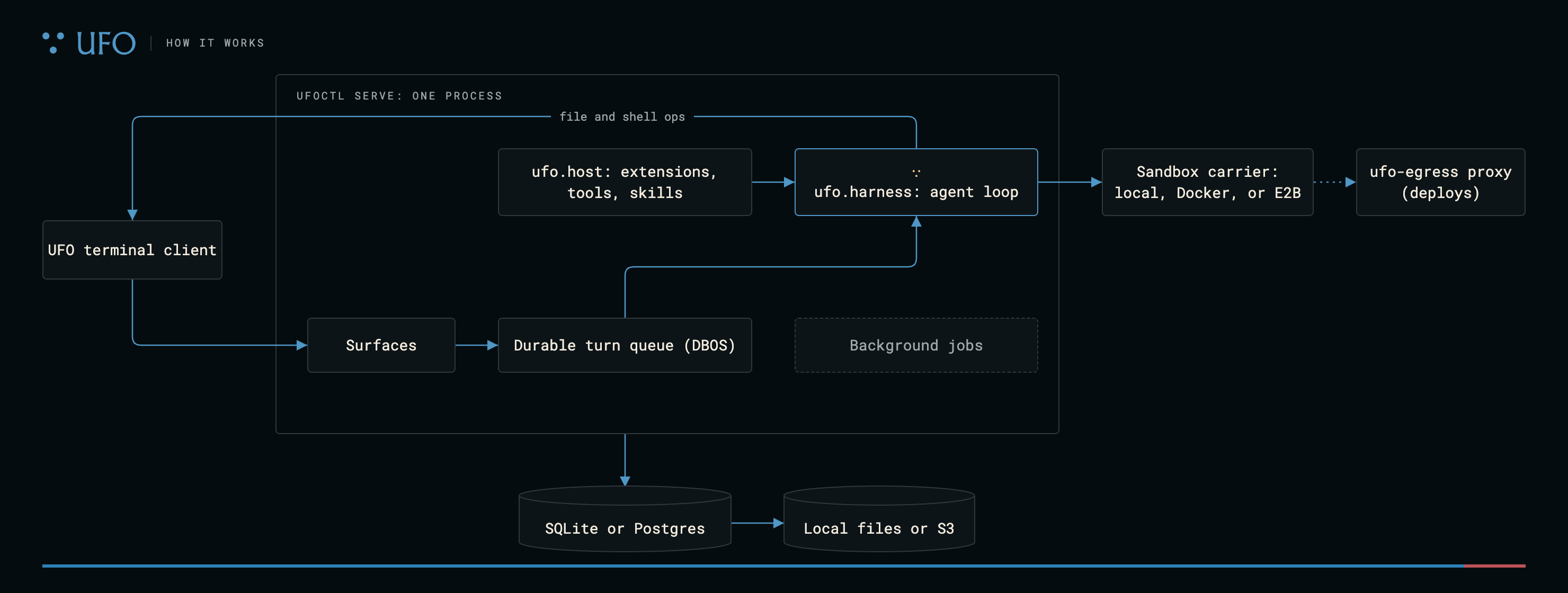
| Package | Owns |
|---|---|
ufo.harness |
Product-neutral agent execution: messages, model requests, tool calls, budgets, compaction, the sandbox protocol. |
ufo.runtime |
The durable host: identity, authorization, turns, surfaces, accounting, the extension API. |
ufo.host |
Extension discovery, built-in tools, and per-turn prompt and tool assembly. |
A pack names the extensions a deploy activates. assistant is the default.
Use hosted
Create a workspace with your work email. The hosted service runs
agents and scheduled tasks on UFO's infrastructure and provides model access. Your team can
use the web app or Slack without running ufoctl serve or setting model API
keys.
Connect Slack during workspace setup. To use the same workspace from your terminal on macOS or Linux,
install the client:
curl -fsSL https://ufo.ai/ufo | sh
Run ufo and sign in. Start it from a directory to let the agent work on its files, or runufo --remote to use the hosted sandbox. The table in Quick start compares the two
modes. See the terminal guide for more detail.
Security model
| Boundary | What holds it |
|---|---|
| Agent access | A member's account reaches an agent only through a connector grant made in chat; the granting turn is the audit record. The workspace's own keyed accounts reach only the main agent until a member grants them to another. |
| Workspace scope | Every request, turn, and job binds one workspace, and every query filters on it. |
| Keys | The Rust services under servers/ hold no customer keys; every secret stays in the runtime. |
| Sandbox | The default local carrier confines writes with Seatbelt or Landlock, but can read the whole host, and the kernel does not enforce its egress. For untrusted input or several workspaces, use docker or e2b. |
Extend it
An extension is a Python package that imports only ufo.sdk and declares one entry point:
[project.entry-points."ufo.extension"]
acme = "ufo_ext_acme.manifest:manifest"
extensions/sample exercises every manifest point. ufoctl ext search | install | remove manages
installed extensions. spec.md §Extension system lists each point's contract.
Deploy it
ufoctl bundle freezes a deploy — image recipe, client, pinned config, lockfile — into one
artifact. It serves a single node, an on-prem install, or a fleet; scale-out adds instances,
Postgres, S3, and the Redis hub.
Test it
make lists every target. make check runs the static gates, make test the parallel suite,make test-one FILE=… one file, and make test-integration the serial and Docker pass. make db
starts the Postgres and Redis they use. Browser tests need Chrome for Testing:
npx playwright@$(uv run python -c 'from ufo.sdk.sandbox import PLAYWRIGHT_VERSION; print(PLAYWRIGHT_VERSION)') install chromium chromium-headless-shell
Where to read
| Path | Contents |
|---|---|
spec.md |
The design source of truth. |
AGENTS.md |
Working rules: code style, testing, what lands together. |
core/src/ufo/ |
harness, runtime, host, onboard, and sdk. |
extensions/, packs/ |
Shipped extensions and activation bundles. |
client/ |
The ufo terminal client. |
servers/, sandbox/ |
The Rust services and the sandbox image. |
Contributing
Read spec.md before you propose a structural change, and AGENTS.md before you open a pull
request.
License
Apache-2.0. See LICENSE and NOTICE.
Yorumlar (0)
Yorum birakmak icin giris yap.
Yorum birakSonuc bulunamadi