coder_eval
Health Gecti
- License — License: Apache-2.0
- Description — Repository has a description
- Active repo — Last push 0 days ago
- Community trust — 13 GitHub stars
Code Basarisiz
- Hardcoded secret — Potential hardcoded credential in .github/workflows/claude-pr-review.yml
- Hardcoded secret — Potential hardcoded credential in .github/workflows/pr-checks.yml
Permissions Gecti
- Permissions — No dangerous permissions requested
Bu listing icin henuz AI raporu yok.
A framework for evaluating AI coding agents and their skills with sandboxing, reproducibility, and data-driven analysis.
coder_eval — evaluate & benchmark AI coding agents





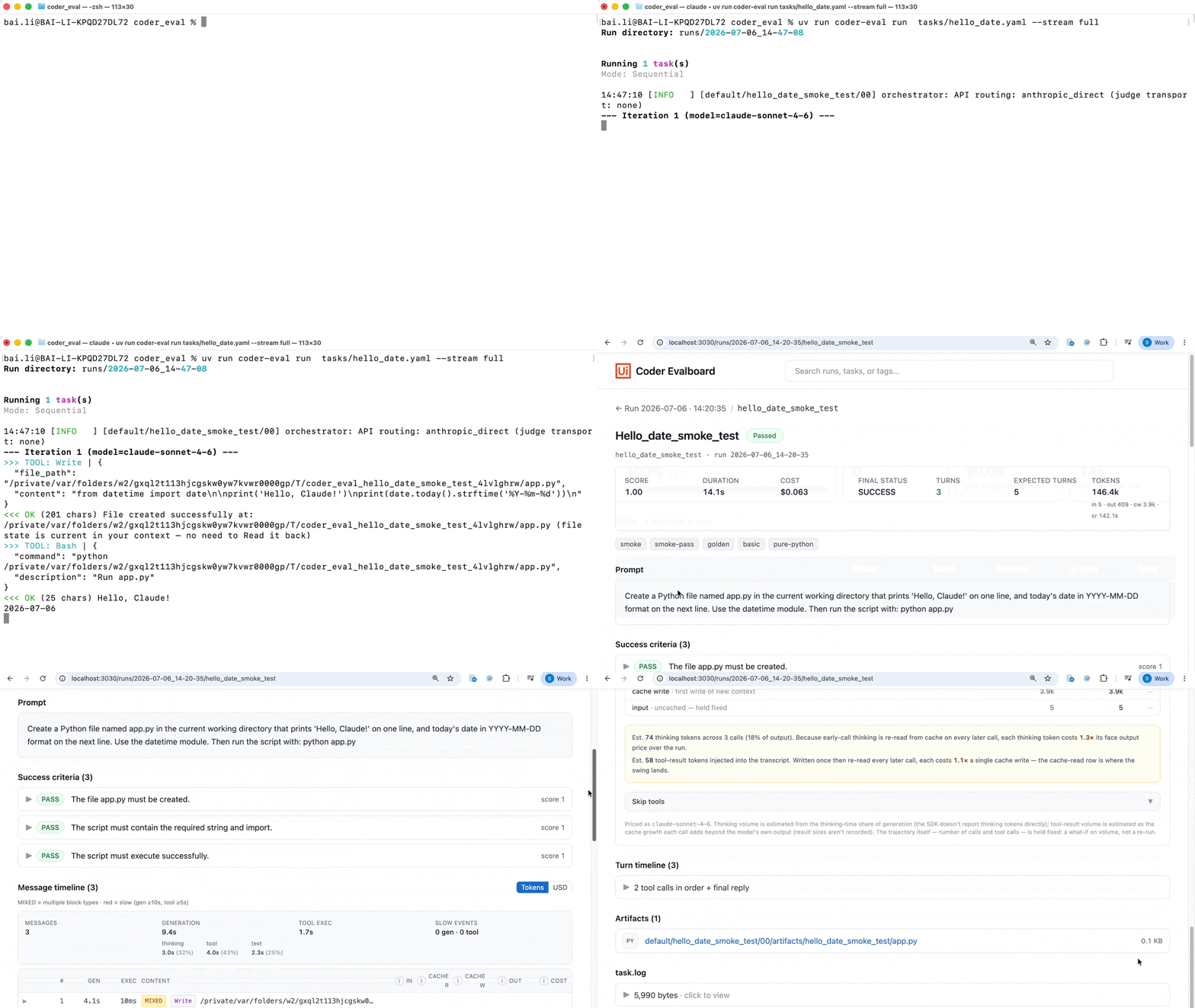
The Coding Agents Gym. A sandboxed, reproducible framework to evaluate,
benchmark, and A/B-test AI coding agents — Claude Code, Codex, and Google
Antigravity (Gemini) today, any agent via a plugin SPI — with declarative
YAML tasks and weighted scoring.
- Declarative YAML tasks with pinned dependencies and clear success criteria
- Sandboxed execution in isolated environments with resource limits
- Weighted, continuous scoring (0.0–1.0) with fractional credit and thresholds
- Many criterion types — from file checks to code similarity and LLM-graded rubrics
- Agent abstraction — Claude Code, Codex, and Antigravity (Gemini) today, extensible via a plugin SPI
- Experiment layer — A/B agent configs (models, tools, prompts) side-by-side
- Full telemetry — every tool call, token counts, and cost, with real-time streaming
What you can do with it
- Benchmark coding agents — score an agent across a suite of tasks with weighted, pass/fail thresholds
- Compare models & configs — A/B-test Claude vs. Codex vs. Gemini, model vs. model, tool-on vs. tool-off, prompt vs. prompt
- Evaluate skills — verify an agent actually engages a target skill (
skill_triggered) and score skill-driven suites (SkillsBench-style) - Keep skills up to date in CI — re-validate your skills on every change or on a schedule; catch silent regressions when models, prompts, or the skills themselves drift
- Gate CI on agent quality — run the suite in GitHub Actions and fail the build on regressions
- Bring your own dataset — fan one task out over many rows for larger benchmark suites
Keeping skills fresh? Run coder_eval as a scheduled GitHub Actions job so your
skills are continuously re-evaluated against the latest model — a skill that quietly
stops triggering surfaces as a failing criterion before your users hit it. See
Tutorial 02 — Running coder_eval in CI.
Quick Start
Prerequisites: Python 3.13+, uv 0.8+, and the
Claude CLI (brew install claude).
Developed on macOS; CI runs on Linux.
git clone https://github.com/UiPath/coder_eval.git
cd coder_eval

uv sync --extra dev          # install core + dev tools
cp .env.example .env         # then set ANTHROPIC_API_KEY

uv run coder-eval plan tasks/hello_date.yaml   # validate (no tokens spent)
uv run coder-eval run  tasks/hello_date.yaml   # run your first evaluation
uv run coder-eval report runs/latest           # view the result
New here? Follow Tutorial 01 — Your First Evaluation.
The optional [uipath] extra (uv sync --extra dev --extra uipath) adds the in-hostuipath SDK for local sandbox parity; it installs from public PyPI (no credentials
required). Without it the framework runs end-to-end; uipath-dependent features fail
at dispatch with a clear hint.
Using coder_eval in CI or another project? Install the published package:
pip install coder-eval(oruv add coder-eval; extras install the same way —pip install "coder-eval[codex,antigravity]"). In a real CI gate, pin to a
specific released version so a harness upgrade can't silently move your results.
See Tutorial 02 — Running coder_eval in CI for the full setup.
Telemetry
📊 Usage telemetry is on by default.
coder-evalsends anonymous usage
telemetry (command names, outcomes, counts, durations, an anonymous install id,
platform info) to help improve the tool. It never captures prompts, file
contents, or repo paths, and prints a one-time notice on first run. To disable
it, setTELEMETRY_ENABLED=falsein your.envor environment. See
Usage Telemetry for details and how to route
it to your own resource.
Documentation
| Guide | What's in it |
|---|---|
| Tutorials | Step-by-step walkthroughs — start here |
| User Guide | Full CLI, configuration, output, and environment-variable reference |
| Task Definition Guide | The task-file schema — all criterion types, scoring, templates |
| A/B Experiments | Compare models / tools / prompts across the same tasks |
| Bring Your Own Dataset | Fan a single task out over a dataset |
| Codex Agent Guide | Running the Codex agent |
| Docker Isolation | The container sandbox driver |
| CLAUDE.md | Architecture, key patterns, and extension points |
| CONTRIBUTING.md | Dev setup, quality bar, and how to contribute |
How it compares
- vs. SWE-bench and fixed benchmarks — SWE-bench is a fixed dataset of GitHub
issues; coder_eval is a framework for authoring your own tasks in declarative
YAML, so you evaluate the skills and workflows you care about (and can still wrap
a fixed dataset via Bring Your Own Dataset). - vs. LLM-output eval harnesses (e.g. OpenAI Evals) — those grade a model's text;
coder_eval runs a full agent in a sandbox with real tool use and multi-turn
dialog, then scores the files and commands it actually produced (continuous
0.0–1.0) — not just a judge over a string. - vs. hand-rolled scripts — reproducible sandboxes, weighted criteria,
cost/token telemetry, A/B experiments, and CI-ready pass/fail gates out of the box.
Task Definition
A task is a YAML file: a prompt, the agent config, a sandbox, and success criteria.
task_id: "hello_world"
description: "Create a Python script that prints Hello, World!"
initial_prompt: "Create hello.py that prints 'Hello, World!'"

agent:
  type: "claude-code"
  permission_mode: "acceptEdits"
  allowed_tools: ["Read", "Write", "Bash"]

sandbox:
  driver: "tempdir"
  python: {}

success_criteria:
  - type: "file_exists"
    path: "hello.py"
    description: "hello.py must be created"
  - type: "run_command"
    command: "python hello.py"
    timeout: 10
    description: "Script must execute successfully"
Tasks can omit the agent section entirely — defaults resolve from the experiment
layer (experiments/default.yaml). For the full schema and every criterion type,
see the Task Definition Guide.
Tip: In Claude Code, use
/coder-eval-task-createto scaffold a task from a
natural-language description, and/coder-eval-run-analysis runs/latestto get
improvement suggestions from a completed run.
Development
make install    # package + dev + [uipath] deps + pre-commit hooks
make verify     # format + lint + typecheck + test + coverage (CI equivalent)
Run make verify before pushing — it mirrors CI (80% coverage threshold). See
CONTRIBUTING.md for the full workflow, commit conventions, and
extension points (new criteria, new agents).
Known limits & non-goals
- Not a fixed benchmark or leaderboard — coder_eval scores your tasks and ships
example tasks, not a canonical scored dataset. - Tasks execute real code — run untrusted tasks only under the container driver
(see Docker Isolation); thetempdirdriver is not a
security boundary. - Bring your own model credentials — Anthropic, Bedrock, or Gemini keys; coder_eval
does not proxy or supply model access. - Python 3.13+ only.
Support & security
- Security vulnerabilities — report privately via SECURITY.md; never open a public issue.
- Bugs & questions — open a GitHub issue.
- Everything else — reach the maintainers privately at [email protected].
License
© 2026 UiPath. Licensed under the Apache License, Version 2.0 — see
LICENSE and NOTICE.
Acknowledgments
Built with the Claude Agent SDK,
Pydantic, Typer, and
Rich.
Yorumlar (0)
Yorum birakmak icin giris yap.
Yorum birakSonuc bulunamadi