revenueos
Health Uyari
- License — License: NOASSERTION
- Description — Repository has a description
- Active repo — Last push 0 days ago
- Low visibility — Only 5 GitHub stars
Code Gecti
- Code scan — Scanned 12 files during light audit, no dangerous patterns found
Permissions Gecti
- Permissions — No dangerous permissions requested
Bu listing icin henuz AI raporu yok.
Connect your business. RevenueOS finds opportunities, executes approved revenue work, and measures what happened. Self-hosted, MIT.
RevenueOS
Connect once. Everything runs free. Pay when you agree with the result.
Runtime proof · Architecture · Security & approval model · Integrations · Community vs Hosted · Capabilities
RevenueOS is a revenue department for one business.
- Connect once. Give it your website; it fills in the rest and labels every guess.
- Discover. It reads the site, your ads, your leads and your mailbox and turns what it finds into a short list of actions.
- Approve. Nothing changes until you approve an action.
- Execute. It deploys the site fix, pauses the wasting campaign, sends the email, books the call, raises the invoice.
- Measure. It re-checks the world and records before → after next to the action.
- Pay. Nothing is charged until it has measured a result you agreed with.
Connect once → Discover → Approve → Execute → Measure → (agree) → Pay
Try it on your site in one command
pip install revenueos
revenueos demo https://yoursite.com
No account, and nothing is kept: the demo builds a workspace in a temporary directory and
deletes it before it exits. (If a model is configured, the pages it reads are sent to that
provider; --no-llm keeps it entirely local.) It prints what is costing the site customers and
which of those fixes RevenueOS deploys itself once connected. Run on the neutral example domain, exactly as
printed:
RevenueOS demo — Example Domain (https://example.com)

  1 pages crawled · ad/analytics tags: none · booking link: no · phones: none seen

  1. MISSING DESCRIPTION — https://example.com
     Page has no meta description.
     → RevenueOS writes the fix as a deliverable you approve, then re-checks the page.
  2. THIN PAGE — https://example.com
     Only ~127 characters of body text were extracted.
     → RevenueOS writes the fix as a deliverable you approve, then re-checks the page.
  3. NO SITEMAP — https://example.com
     No sitemap.xml was discovered at the host root or under the site path.
     → RevenueOS writes the fix as a deliverable you approve, then re-checks the page.
  4. NO CANONICAL — https://example.com
     The homepage declares no canonical URL.
     → RevenueOS deploys this fix itself once the site is connected (git or WordPress), then re-checks it.

  4 finding(s). Everything above runs free, every day, once connected:
     pip install revenueos && revenueos init --from https://example.com && revenueos serve
  You pay only when you agree with a measured result.
On a real business the same command also reads the homepage for tappable phone numbers,
LocalBusiness schema, booking links and ad tags (Meta Pixel, Google Ads, GA4), and the
Watch-it-work view streams each check as it runs.
Run the demo from GitHub, no install
Add one step to any workflow and read the job summary:
- uses: unempyd/revenueos@main
  with:
    url: https://yoursite.com
Connect once
revenueos init --from https://yoursite.com   # the site fills the questionnaire; every inference is labelled
revenueos serve                              # TODAY / RESULTS / Connections / Spend on http://127.0.0.1:8791
Connections are accounts you authorise once — Stripe, Google (Search Console, GA4, Calendar, Ads),
Meta Ads, a git-hosted site, WordPress — read-only until you flip allow changes. Every change
still waits for your approval on TODAY. Details and the runtime proofs: docs/integrations.md.
Pay when you agree with the result
Everything runs free: every worker, the panel, the executors. When RevenueOS has measured a result
on an action you approved, it keeps running free for 14 more days, then continuous operation asks
for Pro ($99/month). One-shot runs and the panel never lock. There is no trial clock that starts
before you have seen a result.
What the customer sees
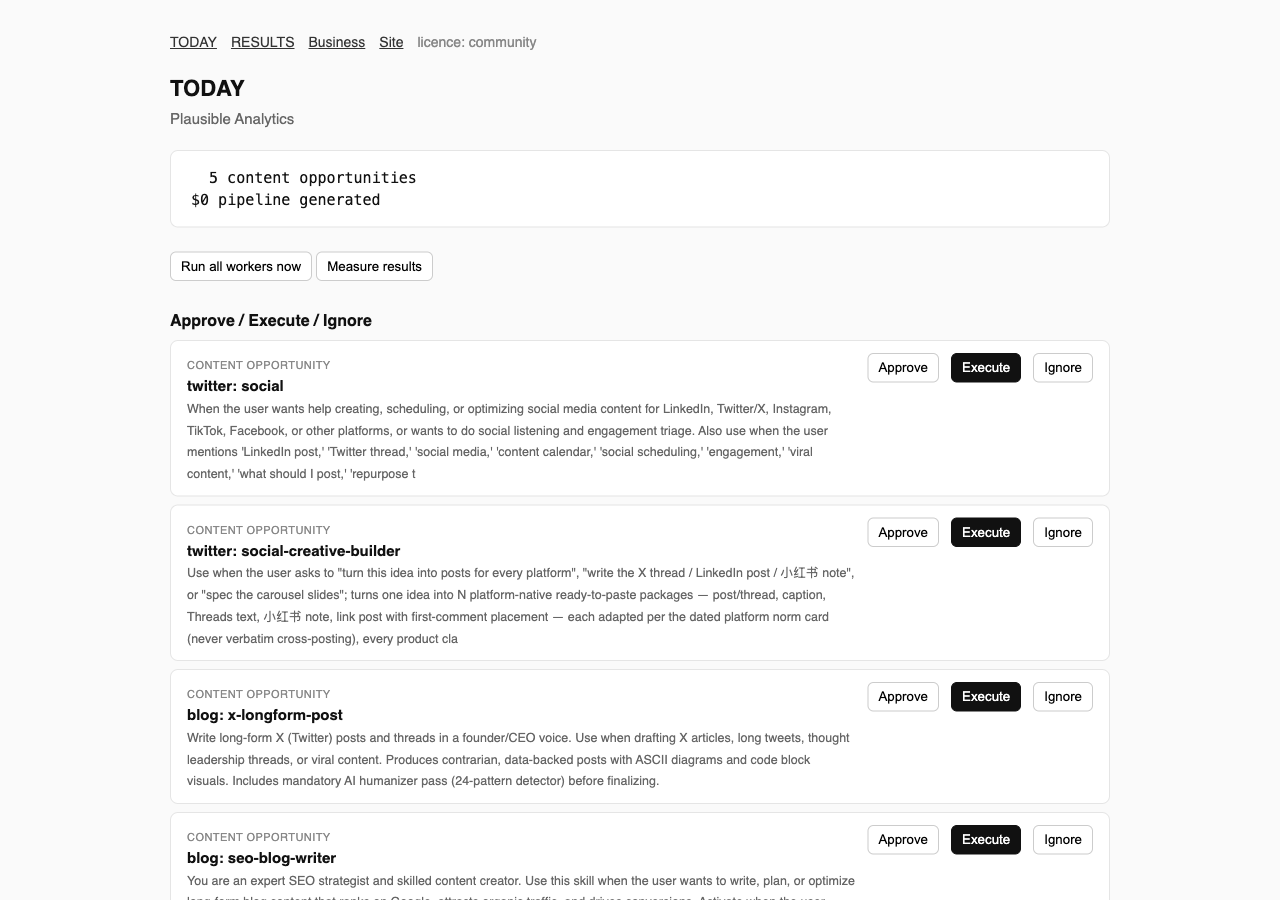
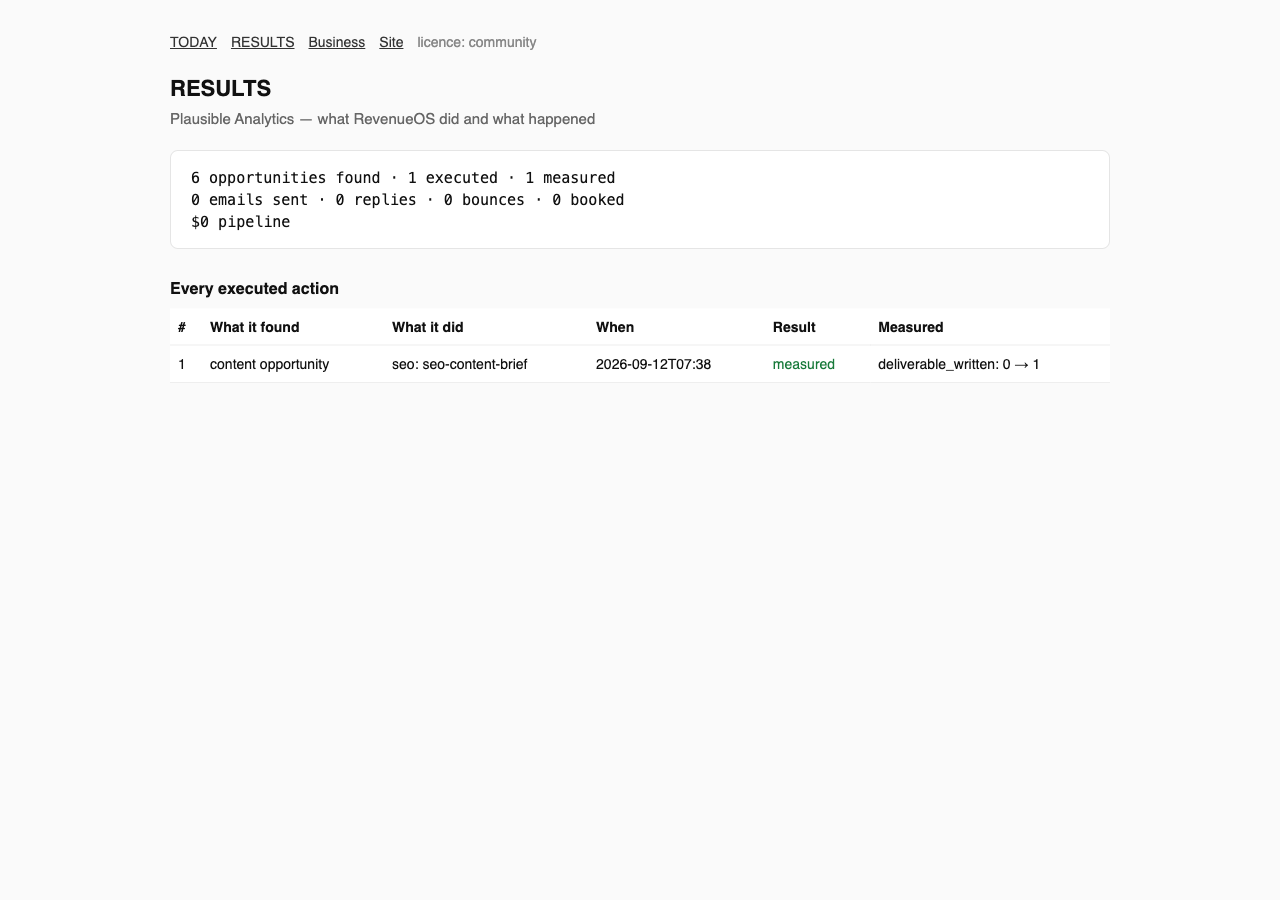
Both screens come from a real run against a real business (see below); nothing in them is mocked.
Verified runtime proof
On 2026-09-12 RevenueOS was connected to Plausible Analytics using only its public web
presence (read-only; no email sent), then run end to end:
| Stage | What happened |
|---|---|
| Discover | 12 pages crawled, competitor authority checked, Hacker News searched with a strict relevance gate, 6 content opportunities queued |
| Approve → Execute | one opportunity approved; Claude executed the RevenueOS SEO content-brief skill in 1 m 23 s and produced a 14 KB deliverable |
| Measure | the outcome deliverable_written 0 → 1 was recorded and shown in RESULTS |
The full transcript, including what it did not find and why, is in docs/proof.md.
RevenueOS reports opportunities found, actions executed, execution time and measured outcomes.
It does not claim revenue it has not measured.
Install
pip install revenueos   # or: uv tool install revenueos
revenueos init --from https://yoursite.com   # or `revenueos init` for the questionnaire
revenueos run all                    # every worker once
revenueos today                      # the brief
revenueos approve 1 && revenueos execute 1
revenueos run measure && revenueos results
revenueos serve                      # the same surface as a web panel on http://127.0.0.1:8791
From source:
git clone https://github.com/unempyd/revenueos && cd revenueos
uv sync && (cd orchestrator && npm install)
uv run revenueos init
Requirements: Python 3.12+, Node 20+ (scheduler and connector CLIs). An LLM is used if
present — ANTHROPIC_API_KEY, otherwise a signed-in Claude Code CLI. Without either, the
deterministic half of the product still runs: the site crawl and its findings, the ad-export
waste, pacing and concentration checks, search-term waste, lead qualification, inbox replies
and bounces, templated outreach drafts, content matching, and all measurement. What does need
a model, and says so rather than pretending: executing any action whose executor isrun_skill (the SEO, content and ads deliverables), the 414-control ads audit, monitor's
relevance gate, and the specialist roles. Site deploys, campaign pauses, invoices, bookings
and email sends need no model.
Workers
| Worker | Discovers | Executes (after approval) | Measures |
|---|---|---|---|
seo |
crawl defects, authority gap, indexing surface | the matching SEO skill | re-crawl: fixed or not |
ads-audit |
wasted spend, over-pacing, concentration in ad exports; search terms that spend, convert nothing and are not excluded (drop Google's keyword and search-term downloads beside the export); then the full control audit: 97 Google / 72 Meta controls (414 across 12 platforms) evaluated under the upstream runtime contract, pass/fail only with evidence | the matching ads skill | next export delta; the next search-term read; a failing control re-checked by the next audit |
ads-live |
the same on connected Google Ads / Meta accounts, with keywords, quality scores, search terms and negative-keyword lists read from Google Ads; wasting campaigns become pause / budget actions | ads_pause, ads_budget |
next spend read |
analytics |
Search Console queries losing clicks, GA4 channel results | the title/description skill | next Search Console read |
billing |
Stripe revenue, MRR, customers, open invoices | send_invoice |
Stripe paid status |
discover |
prospects from lead lists or an external prospecting service, through the qualification gate (business email + website + real company; reported as found · contactable · qualified) | — | via outreach |
outreach |
first-touch drafts from your canon | sends (daily cap, suppression list, unsubscribe footer) | replies, booked, pipeline value |
inbox |
replies, bounces and STOP requests on your mailbox | — | feeds outreach outcomes |
content |
content work matched to your channels | Claude produces the deliverable; publishes it to WordPress after a second approval | published 0 → 1 on the live URL |
monitor |
Hacker News threads that pass a strict relevance gate | — | — |
measure |
— | — | records every outcome above |
revenueos orchestrator runs the workers on a schedule (data/automations.json);revenueos serve is the control panel with password sessions, onboarding, the brief and results.
It keeps working between sessions
RevenueOS holds an objective for the business (revenueos objective add "…", the last
onboarding question, or a MANDATE.md at the workspace root that the heartbeat reads and the orchestrator reports on /health) and a heartbeat worker, scheduled every 30 minutes, that reads the
state of that objective: what is pending, what was approved and not yet run, what was measured,
what failed and why, what is blocked and what would unblock it. It writes one dated event per run,
sets the next action, and leaves a message for you only when a human is needed
(revenueos messages, or the "Inbox from RevenueOS" block on TODAY). Nothing in it sends,
publishes or spends.
Specialised roles (revenueos agent run research|marketing|sales|measurement "<task>") answer
one question each with cited evidence, may spawn sub-tasks two levels deep, and can only
propose actions, which land on TODAY like every other one. Every measured outcome becomes a
dated lesson (revenueos learn, learning-loop/LESSONS.md) that is injected into the next
prompts; role specs are refined by small evidence-backed edits with snapshots and rollback
(revenueos refine <role> …). Any of this works without a model, except the roles, which then say
so instead of answering.
Community and Hosted
RevenueOS Community (free, MIT): everything — every worker, continuous operation, the control
panel, connections and executors, the capability packs (13 packs, 790 skills, 104 agents, 64 connector
CLIs), the MCP server and the Claude Code plugin — free until RevenueOS has measured a result you
approved, then 14 more days.
RevenueOS Pro ($99/month) keeps continuous operation on after that. A signed licence key,
emailed after payment, unlocks it. That is the whole difference in the software today: the licence
check gates one thing, revenueos orchestrator running continuously. Business and Agency
($299 / $999 per month) are the arrangement under which we run and support RevenueOS for you;
the multi-brand, multi-user and fleet features named on the pricing page are not built yet
and nothing in this repository gates them. Ask before paying for those.
Details: docs/community-vs-hosted.md.
Security and approval
Workers never send, publish or spend — they only write actions. Only an approved Execute acts,
and it is bounded by a daily send cap, a suppression list, List-Unsubscribe and reply-STOP
handling. Provider keys and mailbox passwords come from the environment and are never written
to the workspace. The one exception is a connection you authorise: its tokens (a Stripe
key, Google/Meta OAuth tokens, a WordPress application password) are stored indata/connections.json at mode 600, and are encrypted at rest only when you setREVENUEOS_TOKEN_KEY — without it they are readable by anything that can read the file. The
panel refuses to bind a public address without a password. See docs/security-and-approval.md and
SECURITY.md.
Integrations
Website crawl, Hacker News, ad-platform exports (CSV), lead-list CSVs, SMTP/IMAP mailboxes,
64 connector CLIs (analytics, CRM, email, SEO, ads, enrichment) keyed by environment
variables, and an optional external prospecting service. See docs/integrations.md.
Deployment
Dockerfile, docker-compose.yml (orchestrator, panel, optional TLS proxy) and deploy/
(runbook, Fly.io, Railway, smoke test). See deploy/README.md.
Licence
RevenueOS is MIT-licensed. It includes permissively licensed open-source components, listed
with their licences in NOTICE.md and reproduced in THIRD_PARTY_LICENSES/.
Provenance of every included file is recorded in VENDOR.json.
Develop
uv sync --extra dev --extra mcp && uv run pytest -q
(cd orchestrator && npm test && npm run typecheck)
uv run ruff check src tests
See CONTRIBUTING.md.
Yorumlar (0)
Yorum birakmak icin giris yap.
Yorum birakSonuc bulunamadi