crw
Health Pass
- License — License: AGPL-3.0
- Description — Repository has a description
- Active repo — Last push 0 days ago
- Community trust — 21 GitHub stars
Code Pass
- Code scan — Scanned 12 files during light audit, no dangerous patterns found
Permissions Pass
- Permissions — No dangerous permissions requested
This tool is a lightweight web scraper and crawler written in Rust. It acts as a Firecrawl alternative and provides a built-in MCP server to easily give AI agents like Claude or Cursor web scraping capabilities.
Security Assessment
By design, this application makes extensive external network requests to scrape and crawl public web pages on the user's behalf. The automated code scan did not find any dangerous patterns, hardcoded secrets, or requests for dangerous local permissions. It is distributed as a single binary, which inherently executes with the permissions of the user running it. The primary attack surface is the standard network activity associated with a web scraper. Overall risk: Low.
Quality Assessment
The project is actively maintained, with the most recent push happening just today. It uses the AGPL-3.0 license, which is a strong copyleft license, meaning any modifications or network use must share the source code. Community trust is currently minimal but positive, sitting at 21 GitHub stars. The installation is streamlined via standard package managers like npm, pip, and Cargo.
Verdict
Safe to use, but be mindful of the AGPL-3.0 copyleft licensing requirements if integrating into a larger commercial project.
⚡Lightweight Firecrawl alternative in Rust — 91.5% coverage, 5x faster, 3MB RAM. Web scraper & crawler with MCP server for Claude, LLM extraction, JS rendering.
The web scraper built for AI agents. Single binary. Zero config.
Works with: Claude Code · Cursor · Windsurf · Cline · Copilot · Continue.dev · Codex
MCP Integration • Installation • API Reference • Cloud • JS Rendering • Configuration • Discord
English | 中文
Don't want to self-host? fastcrw.com is the managed cloud — global proxy network, auto-scaling, dashboard, and API keys. Same Firecrawl-compatible API. Get 500 free credits →
CRW is the open-source web scraper built for AI agents. Built-in MCP server (stdio + HTTP), single binary, ~6 MB idle RAM. Give Claude Code, Cursor, or any MCP client web scraping superpowers in 30 seconds. Firecrawl-compatible API — 5.5x faster, 75x less memory, 92% coverage on 1K real-world URLs.
Built-in MCP server. Single binary. No Redis. No Node.js.
# npm (zero install):
npx crw-mcp
# Python:
pip install crw
# Direct binary (no package manager):
curl -fsSL https://github.com/us/crw/releases/latest/download/crw-mcp-darwin-arm64.tar.gz | tar xz
# Replace darwin-arm64 with your platform: darwin-x64, linux-x64, linux-arm64, win32-x64, win32-arm64
# Cargo:
cargo install crw-mcp
# Docker:
docker run -i ghcr.io/us/crw crw-mcp
Listed on the MCP Registry
What's New
0.3.0 (2026-04-02)
Features
- renderer: escalate to JS renderer on HTTP 401/403 responses (88c8aa5)
Bug Fixes
- use GitHub latest release instead of pinned version for binary download (4afcb1a)
0.2.1 (2026-03-28)
Bug Fixes
- make crw-mcp npm wrapper executable (576a9eb)
- use latest tag in server.json OCI identifier (7ec3b82)
0.2.0 (2026-03-28)
Features
- add MCP Registry support for official server discovery (154b9f5)
Why CRW?
CRW gives you Firecrawl's API with a fraction of the resource usage. No runtime dependencies, no Redis, no Node.js — just a single binary you can deploy anywhere.
| Metric | CRW (self-hosted) | fastcrw.com (cloud) | Firecrawl | Crawl4AI | Spider |
|---|---|---|---|---|---|
| Coverage (1K URLs) | 92.0% | 92.0% | 77.2% | — | 99.9% |
| Avg Latency | 833ms | 833ms | 4,600ms | — | — |
| P50 Latency | 446ms | 446ms | — | — | 45ms (static) |
| Noise Rejection | 88.4% | 88.4% | noise 6.8% | noise 11.3% | noise 4.2% |
| Idle RAM | 6.6 MB | 0 (managed) | ~500 MB+ | — | cloud-only |
| Cold start | 85 ms | 0 (always-on) | 30–60 s | — | — |
| HTTP scrape | ~30 ms | ~30 ms | ~200 ms+ | ~480 ms | ~45 ms |
| Proxy network | BYO | Global (built-in) | Built-in | — | Cloud-only |
| Cost / 1K scrapes | $0 (self-hosted) | From $13/mo | $0.83–5.33 | $0 | $0.65 |
| Dependencies | single binary | None (API) | Node + Redis + PG + RabbitMQ | Python + Playwright | Rust / cloud |
| License | AGPL-3.0 | Managed | AGPL-3.0 | Apache-2.0 | MIT |
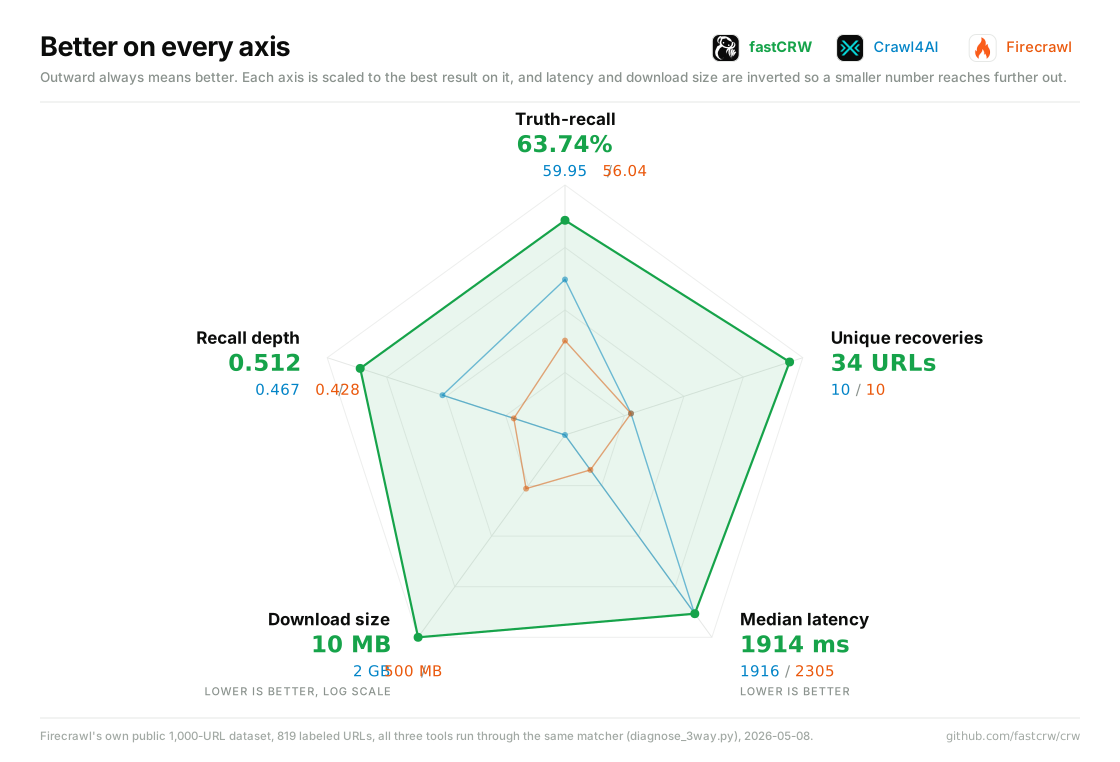
CRW vs Firecrawl — Tested on Firecrawl scrape-content-dataset-v1 (1,000 real-world URLs, JS rendering enabled):
- CRW covers 92% of URLs vs Firecrawl's 77.2% — 15 percentage points higher
- CRW is 5.5x faster on average (833ms vs 4,600ms)
- CRW uses ~75x less RAM at idle (6.6 MB vs ~500 MB+)
- Firecrawl requires 5 containers (Node.js, Redis, PostgreSQL, RabbitMQ, Playwright) — CRW is a single binary
Crawl4AI vs Firecrawl vs Spider — Independent benchmark by Spider.cloud:
| Metric | Spider | Firecrawl | Crawl4AI |
|---|---|---|---|
| Static throughput | 182 p/s | 27 p/s | 19 p/s |
| Success (static) | 100% | 99.5% | 99% |
| Success (SPA) | 100% | 96.6% | 93.7% |
| Success (anti-bot) | 99.6% | 88.4% | 72% |
| Latency (static) | 45ms | 310ms | 480ms |
| Latency (SPA) | 820ms | 1,400ms | 1,650ms |
Firecrawl independent review — Scrapeway benchmark: 64.3% success rate, $5.11/1K scrapes, 0% on LinkedIn/Twitter.
Resource comparison:
| Metric | CRW | Firecrawl |
|---|---|---|
| Min RAM | ~7 MB | 4 GB |
| Recommended RAM | ~64 MB (under load) | 8–16 GB |
| Docker images | single ~8 MB binary | ~2–3 GB total |
| Cold start | 85 ms | 30–60 seconds |
| Containers needed | 1 (+optional sidecar) | 5 |
Features
- 🔧 MCP server — built-in stdio + HTTP transport for Claude Code, Cursor, Windsurf, and any MCP client
- 🔌 Firecrawl-compatible API — same endpoint family and familiar request/response ergonomics
- 📄 6 output formats — markdown, HTML, cleaned HTML, raw HTML, plain text, links, structured JSON
- 🤖 LLM structured extraction — send a JSON schema, get validated structured data back (Anthropic tool_use + OpenAI function calling)
- 🌐 JS rendering — auto-detect SPAs with shell heuristics, render via LightPanda, Playwright, or Chrome (CDP)
- 🕷️ BFS crawler — async crawl with rate limiting, robots.txt, sitemap support, concurrent jobs
- 🔒 Security — SSRF protection (private IPs, cloud metadata, IPv6), constant-time auth, dangerous URI filtering
- 🐳 Docker ready — multi-stage build with LightPanda sidecar
- 🎯 CSS selector & XPath — extract specific DOM elements before Markdown conversion
- ✂️ Chunking & filtering — split content into topic/sentence/regex chunks; rank by BM25 or cosine similarity
- 🕵️ Stealth mode — browser-like UA rotation and header injection to reduce bot detection
- 🌐 Per-request proxy — override the global proxy per scrape request
Cloud vs Self-Hosted
| Feature | Self-hosted | Cloud (fastcrw.com) |
|---|---|---|
| Setup | cargo install crw-server |
Sign up → get API key |
| Infrastructure | You manage | Fully managed |
| Proxy | Bring your own | Global proxy network |
| Scaling | Manual | Auto-scaling |
| API | Firecrawl-compatible | Same Firecrawl-compatible API |
Both use the same Firecrawl-compatible API — your code works with either. Switch between self-hosted and cloud by changing the base URL.
Quick Start
MCP (AI agents — recommended):
claude mcp add crw -- npx crw-mcp
That's it. Claude Code now has
crw_scrape,crw_crawl,crw_maptools. For Cursor, Windsurf, Cline, and other MCP clients, see MCP Server.
CLI (no server needed):
cargo install crw-cli
crw https://example.com
Self-hosted server:
cargo install crw-server
crw-server
Enable JS rendering (optional):
crw-server setup
This downloads LightPanda and creates a config.local.toml for JS rendering. See JS Rendering for details.
Cloud (no setup):
curl -X POST https://fastcrw.com/api/v1/scrape \
-H "Authorization: Bearer YOUR_API_KEY" \
-H "Content-Type: application/json" \
-d '{"url": "https://example.com"}'
Get your API key at fastcrw.com — 500 free credits included.
Docker:
docker run -p 3000:3000 ghcr.io/us/crw:latest
Docker Compose (with JS rendering):
docker compose up
Scrape a page:
curl -X POST http://localhost:3000/v1/scrape \
-H "Content-Type: application/json" \
-d '{"url": "https://example.com"}'
{
"success": true,
"data": {
"markdown": "# Example Domain\nThis domain is for use in ...",
"metadata": {
"title": "Example Domain",
"sourceURL": "https://example.com",
"statusCode": 200,
"elapsedMs": 32
}
}
}
Use Cases
- RAG pipelines — crawl websites and extract structured data for vector databases
- AI agents — give Claude Code or Claude Desktop web scraping tools via MCP
- Content monitoring — periodic crawl with LLM extraction to track changes
- Data extraction — combine CSS selectors + LLM to extract any schema from any page
- Web archiving — full-site BFS crawl to markdown
API Endpoints
| Method | Endpoint | Description |
|---|---|---|
POST |
/v1/scrape |
Scrape a single URL, optionally with LLM extraction |
POST |
/v1/crawl |
Start async BFS crawl (returns job ID) |
GET |
/v1/crawl/:id |
Check crawl status and retrieve results |
DELETE |
/v1/crawl/:id |
Cancel a running crawl job |
POST |
/v1/map |
Discover all URLs on a site |
GET |
/health |
Health check (no auth required) |
POST |
/mcp |
Streamable HTTP MCP transport |
LLM Structured Extraction
Send a JSON schema with your scrape request and CRW returns validated structured data using LLM function calling.
curl -X POST http://localhost:3000/v1/scrape \
-H "Content-Type: application/json" \
-d '{
"url": "https://example.com/product",
"formats": ["json"],
"jsonSchema": {
"type": "object",
"properties": {
"name": { "type": "string" },
"price": { "type": "number" }
},
"required": ["name", "price"]
}
}'
- Anthropic — uses
tool_usewithinput_schemafor extraction - OpenAI — uses function calling with
parametersschema - Validation — LLM output is validated against your JSON schema before returning
Configure the LLM provider in your config:
[extraction.llm]
provider = "anthropic" # "anthropic" or "openai"
api_key = "sk-..." # or CRW_EXTRACTION__LLM__API_KEY env var
model = "claude-sonnet-4-20250514"
MCP Server
CRW works as an MCP tool server for any AI assistant that supports MCP. It provides 4 tools: crw_scrape, crw_crawl, crw_check_crawl_status, crw_map.
Also available on the MCP Registry
Install:
# npm (zero install):
npx crw-mcp
# Python:
pip install crw
# Direct binary (no package manager):
curl -fsSL https://github.com/us/crw/releases/latest/download/crw-mcp-darwin-arm64.tar.gz | tar xz
# Replace darwin-arm64 with your platform: darwin-x64, linux-x64, linux-arm64, win32-x64, win32-arm64
# Cargo:
cargo install crw-mcp
# Docker:
docker run -i ghcr.io/us/crw crw-mcp
Claude Code
claude mcp add crw -- npx crw-mcp
Claude Desktop
Edit your config file:
| OS | Path |
|---|---|
| macOS | ~/Library/Application Support/Claude/claude_desktop_config.json |
| Windows | %APPDATA%\Claude\claude_desktop_config.json |
| Linux | ~/.config/Claude/claude_desktop_config.json |
{
"mcpServers": {
"crw": {
"command": "npx",
"args": ["crw-mcp"]
}
}
}
Cursor
Edit ~/.cursor/mcp.json (global) or .cursor/mcp.json (project):
{
"mcpServers": {
"crw": {
"command": "npx",
"args": ["crw-mcp"]
}
}
}
Windsurf
Edit ~/.codeium/windsurf/mcp_config.json:
{
"mcpServers": {
"crw": {
"command": "npx",
"args": ["crw-mcp"]
}
}
}
Cline (VS Code)
{
"mcpServers": {
"crw": {
"command": "npx",
"args": ["crw-mcp"],
"alwaysAllow": ["crw_scrape", "crw_map"],
"disabled": false
}
}
}
Continue.dev (VS Code / JetBrains)
Edit ~/.continue/config.yaml:
mcpServers:
- name: crw
command: npx
args:
- crw-mcp
OpenAI Codex CLI
Edit ~/.codex/config.toml:
[mcp_servers.crw]
command = "npx"
args = ["crw-mcp"]
Other MCP Clients
Any MCP-compatible client can connect to CRW using the standard JSON format:
{
"mcpServers": {
"crw": {
"command": "npx",
"args": ["crw-mcp"]
}
}
}
Tip: The stdio binary (
crw-mcp) works with any client. For clients that support HTTP transport, usehttp://localhost:3000/mcpdirectly — no binary needed.
See the full MCP setup guide for detailed instructions, auth configuration, and platform comparison.
JS Rendering
CRW auto-detects SPAs by analyzing the initial HTML response for shell heuristics (empty body, framework markers). When a SPA is detected, it renders the page via a headless browser.
Quick setup (recommended):
crw-server setup
This automatically downloads the LightPanda binary to ~/.local/bin/ and creates a config.local.toml with the correct renderer settings. Then start LightPanda and CRW:
lightpanda serve --host 127.0.0.1 --port 9222 &
crw-server
Supported renderers:
| Renderer | Protocol | Best for |
|---|---|---|
| LightPanda | CDP over WebSocket | Low-resource environments (default) |
| Playwright | CDP over WebSocket | Full browser compatibility |
| Chrome | CDP over WebSocket | Existing Chrome infrastructure |
Renderer mode is configured via renderer.mode: auto (default), lightpanda, playwright, chrome, or none.
With Docker Compose, LightPanda runs as a sidecar — no extra setup needed:
docker compose up
Architecture
┌─────────────────────────────────────────────┐
│ crw-server │
│ Axum HTTP API + Auth + MCP │
├──────────┬──────────┬───────────────────────┤
│ crw-crawl│crw-extract│ crw-renderer │
│ BFS crawl│ HTML→MD │ HTTP + CDP(WS) │
│ robots │ LLM/JSON │ LightPanda/Chrome │
│ sitemap │ clean/read│ auto-detect SPA │
├──────────┴──────────┴───────────────────────┤
│ crw-core │
│ Types, Config, Errors │
└─────────────────────────────────────────────┘
Configuration
CRW uses layered TOML configuration with environment variable overrides:
config.default.toml— built-in defaultsconfig.local.toml— local overrides (or setCRW_CONFIG=myconfig)- Environment variables —
CRW_prefix with__separator (e.g.CRW_SERVER__PORT=8080)
[server]
host = "0.0.0.0"
port = 3000
rate_limit_rps = 10 # Max requests/second (global). 0 = unlimited.
[renderer]
mode = "auto" # auto | lightpanda | playwright | chrome | none
[crawler]
max_concurrency = 10
requests_per_second = 10.0
respect_robots_txt = true
[auth]
# api_keys = ["fc-key-1234"]
See full configuration reference for all options.
Integration Examples
Python:
import requests
response = requests.post("http://localhost:3000/v1/scrape", json={
"url": "https://example.com",
"formats": ["markdown", "links"]
})
data = response.json()["data"]
print(data["markdown"])
Node.js:
const response = await fetch("http://localhost:3000/v1/scrape", {
method: "POST",
headers: { "Content-Type": "application/json" },
body: JSON.stringify({
url: "https://example.com",
formats: ["markdown", "links"]
})
});
const { data } = await response.json();
console.log(data.markdown);
CrewAI (crewai-crw — CRW tools for CrewAI):
pip install crewai-crw
from crewai import Agent, Task, Crew
from crewai_crw import CrwScrapeWebsiteTool, CrwCrawlWebsiteTool, CrwMapWebsiteTool
scrape_tool = CrwScrapeWebsiteTool() # uses localhost:3000 by default
researcher = Agent(
role="Web Researcher",
goal="Research and summarize information from websites",
backstory="Expert at extracting key information from web pages",
tools=[scrape_tool],
)
task = Task(
description="Scrape https://example.com and summarize the content",
expected_output="A summary of the page content",
agent=researcher,
)
crew = Crew(agents=[researcher], tasks=[task])
result = crew.kickoff()
LangChain (langchain-crw — CRW document loader):
pip install langchain-crw
from langchain_crw import CrwLoader
# Self-hosted (default: localhost:3000)
loader = CrwLoader(url="https://example.com", mode="scrape")
docs = loader.load()
print(docs[0].page_content) # clean markdown
# Cloud (fastcrw.com)
loader = CrwLoader(
url="https://example.com",
api_url="https://fastcrw.com/api",
api_key="crw_live_...",
mode="crawl",
params={"max_depth": 3, "max_pages": 50},
)
docs = loader.load()
More integrations (PRs pending): Flowise · Agno · n8n · All integrations
Docker
Pre-built image from GHCR:
docker pull ghcr.io/us/crw:latest
docker run -p 3000:3000 ghcr.io/us/crw:latest
Docker Compose (with JS rendering sidecar):
docker compose up
This starts CRW on port 3000 with LightPanda as a JS rendering sidecar on port 9222. CRW auto-connects to LightPanda for SPA rendering.
Benchmark
Tested on Firecrawl's scrape-content-dataset-v1 (1,000 real-world URLs, JS rendering enabled):
| Metric | CRW | Firecrawl v2.5 | Crawl4AI | Spider |
|---|---|---|---|---|
| Coverage | 92.0% | 77.2% | — | 99.9% |
| Avg Latency | 833ms | 4,600ms | — | — |
| P50 Latency | 446ms | — | — | 45ms (static) |
| Noise Rejection | 88.4% | noise 6.8% | noise 11.3% | noise 4.2% |
| Cost / 1,000 scrapes | $0 (self-hosted) | $0.83–5.33 | $0 | $0.65 |
| Idle RAM | 6.6 MB | ~500 MB+ | — | cloud |
CRW hits a sweet spot: near-Spider speed with Firecrawl API compatibility and ~75x less RAM. Unlike Crawl4AI (Python + Playwright), CRW ships as a single Rust binary with no runtime dependencies.
Run the benchmark yourself:
uv pip install datasets aiohttp
uv run python bench/run_bench.py
Crates
| Crate | Description | |
|---|---|---|
crw-core |
Core types, config, and error handling | |
crw-renderer |
HTTP + CDP browser rendering engine | |
crw-extract |
HTML → markdown/plaintext extraction | |
crw-crawl |
Async BFS crawler with robots.txt & sitemap | |
crw-server |
Axum API server (Firecrawl-compatible) | |
crw-cli |
Standalone CLI (crw binary, no server needed) |
|
crw-mcp |
MCP stdio proxy binary |
See docs/crates.md for usage examples and cargo add instructions.
Documentation
Full documentation: docs/index.md
Security
CRW includes built-in protections against common web scraping attack vectors:
- SSRF protection — all URL inputs (REST API + MCP) are validated against private/internal networks:
- Loopback (
127.0.0.0/8,::1,localhost) - Private IPs (
10.0.0.0/8,172.16.0.0/12,192.168.0.0/16) - Link-local / cloud metadata (
169.254.0.0/16— blocks AWS/GCP metadata endpoints) - IPv6 mapped addresses (
::ffff:127.0.0.1), link-local (fe80::), ULA (fc00::/7) - Non-HTTP schemes (
file://,ftp://,gopher://,data:)
- Loopback (
- Auth — optional Bearer token with constant-time comparison (no length or key-index leakage)
- robots.txt — respects
Allow/Disallowwith wildcard patterns (*,$) and RFC 9309 specificity - Rate limiting — configurable per-second request cap with token-bucket algorithm (returns 429 with
error_code) - Resource limits — max body size (1 MB), max crawl depth (10), max pages (1000), max discovered URLs (5000)
Community
Don't be shy — join us on Discord! Ask questions, share what you're building, report bugs, or just hang out.
Contributing
Contributions are welcome! Please open an issue or submit a pull request.
- Fork the repository
- Install pre-commit hooks:
make hooks - Create your feature branch (
git checkout -b feat/my-feature) - Commit your changes (
git commit -m 'feat: add my feature') - Push to the branch (
git push origin feat/my-feature) - Open a Pull Request
The pre-commit hook runs the same checks as CI (cargo fmt, cargo clippy, cargo test). You can also run them manually with make check.
License
CRW is open-source under AGPL-3.0. For a managed version without AGPL obligations, see fastcrw.com.
Reviews (0)
Sign in to leave a review.
Leave a reviewNo results found