useagent
Health Gecti
- License — License: AGPL-3.0
- Description — Repository has a description
- Active repo — Last push 0 days ago
- Community trust — 354 GitHub stars
Code Basarisiz
- network request — Outbound network request in .github/workflows/ci.yml
- spawnSync — Synchronous process spawning in apps/desktop/build/make-icons.ts
- process.env — Environment variable access in apps/desktop/electron-builder.config.cjs
Permissions Gecti
- Permissions — No dangerous permissions requested
Bu listing icin henuz AI raporu yok.
The open-source Devin alternative. Run Claude Code, Codex or OpenCode in isolated cloud workspaces you can self-host.
 UseAgent
The open-source Devin alternative.
Run Claude Code, Codex, OpenCode or Pi in isolated cloud workspaces you can self-host.
Hand off work from Slack, the web or the API, and get pull requests and files back.





Try the hosted app · Self-host · Watch the demo · Docs · Contribute
UseAgent gives Claude Code, Codex, OpenCode and Pi a shared workspace with
repositories, a terminal, a browser and your team's tools. Ask for research, a
website, a spreadsheet or a code change from the web app, Slack or the API.
Follow the work live, step in when you need to, and keep the files it makes.
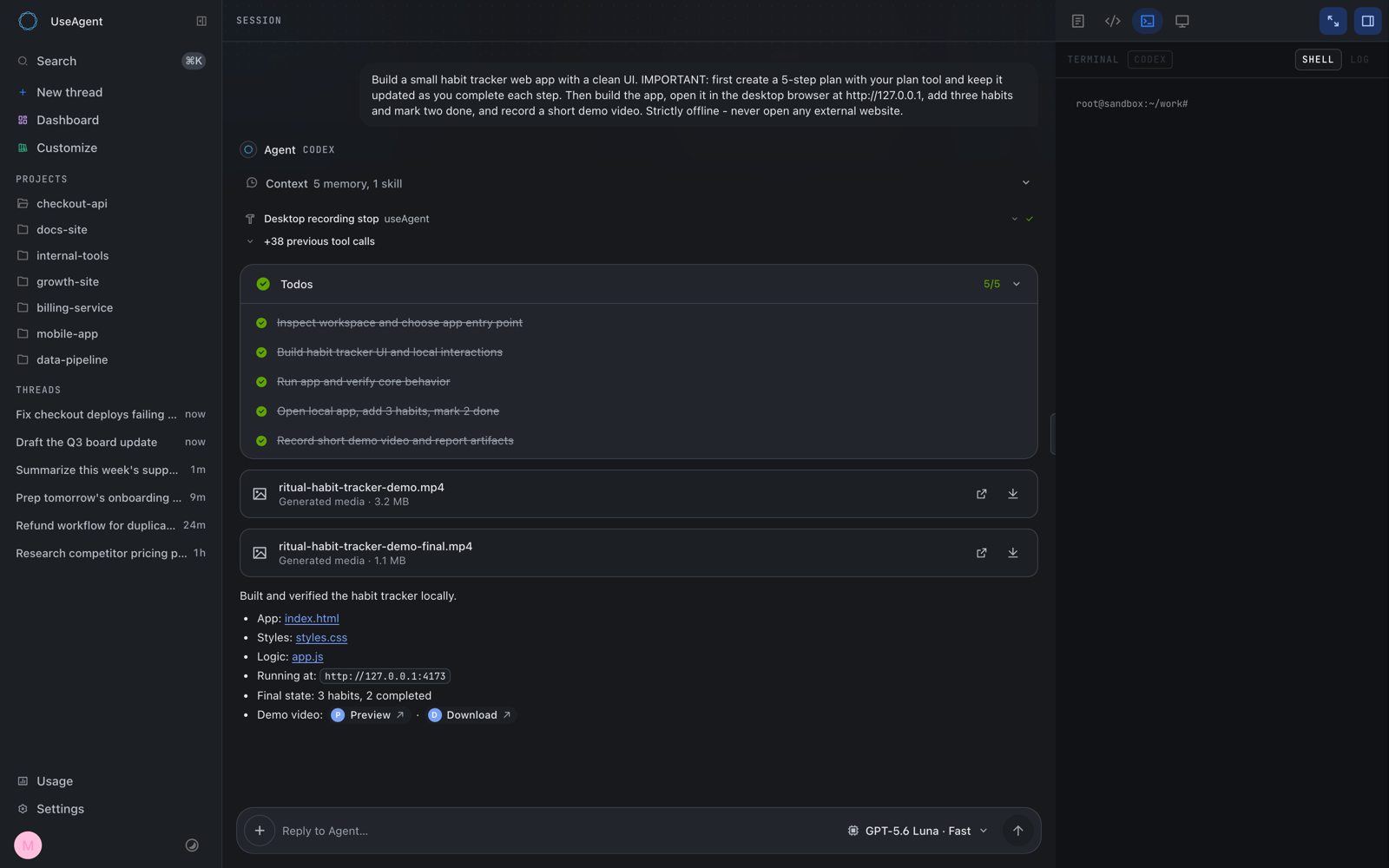
Watch the 63-second product tour →
Real product footage. No sign-in required.
Why teams pick UseAgent
|
It runs on your server. Self-host the whole thing on any Linux box. Your |
Every run is on the record. Postgres stores each step, tool call and |
|
Use the accounts you already pay for. Run Codex on your ChatGPT plan, or |
Swap the agent, keep everything else. Claude Code, Codex, OpenCode and Pi |
Alpha software. UseAgent runs real daily workloads, but APIs and schemas
can change between releases. Pin a tag if you need stability.
UseAgent and Devin
| Devin | UseAgent | |
|---|---|---|
| Source code | Closed | Open source (AGPL) |
| Where it runs | Cognition's cloud; enterprise plans can put the workspace in your VPC, the agent itself stays in Cognition's cloud | All of it on our cloud, your own servers, or your laptop |
| Which agent | Devin's own | Claude Code, Codex, OpenCode or Pi, side by side |
| Model bill | Paid through Devin | Your own keys, your ChatGPT plan for Codex, or free models |
| Record of the work | In Devin's app | Every step in your own Postgres, replayable |
UseAgent is not a new model, and not a proven replacement for every Devin workflow. It is the workspace around the agents you already use: a computer per task, your team's tools and context, and a full record of what happened.
Use the hosted app
No install, no credit card. Start here:
- Sign up at app.useagent.org with your email.
- Start a thread from the home page and say what you want done: a website,
a research report, a spreadsheet, a fix in one of your repositories. - Pick a model. Free models are always available. Choose one from the
Free list in the model menu and go. - Bring the plan you already have. Open Settings → Provider connections
and connect your ChatGPT account to run Codex on your own plan. In India, the
free ChatGPT Go plan works too. - Add more models when you want them. Paste an API key in the same place.
Keys are write-only and never enter the agent's sandbox.
Watch the agent work in its browser and terminal, answer it when it asks, and
open the files it makes.
Features
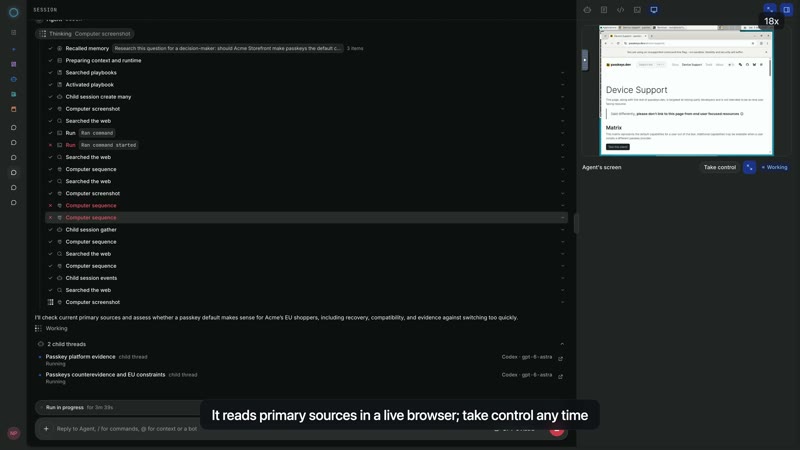
A computer for every threadWatch an agent research in a real browser, run commands, and work with your |
|
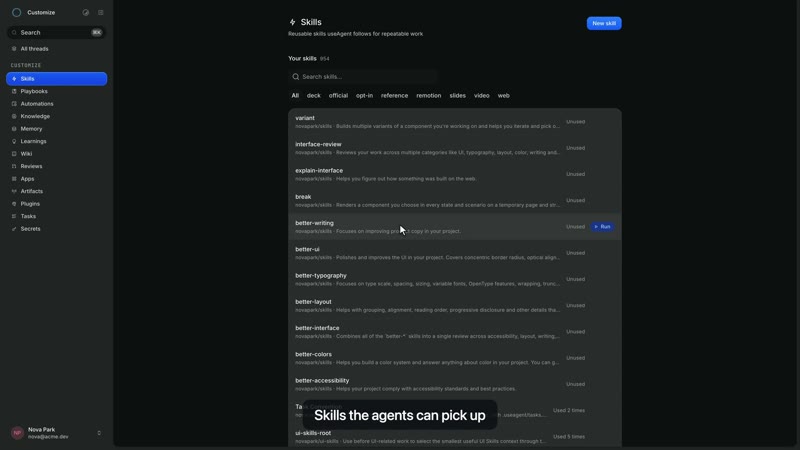
Teach it how your team worksImport skills from GitHub, pin a playbook to a task, and reuse the procedures |
|
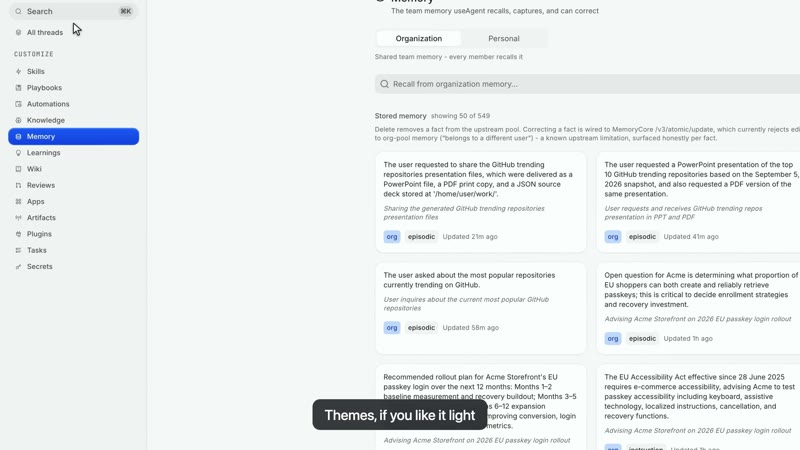
Context that carries forwardKeep knowledge, wiki pages, and optional team memory beside the work. Inspect |
|
Also in the workspace:
- Files you can use - documents,
spreadsheets, presentations, PDFs, images, and videos. Supported workpieces
have revisioned edits and native exports. - Work from Slack - mention an
agent, send attachments, and receive artifacts in the thread. - Recurring work - schedule
tasks, inspect their history, or run one immediately. - Approval controls -
gated tools pause for a decision and resume with a one-shot, argument-bound capability. - Durable sessions -
Postgres stores the event timeline; recovery re-probes live sessions after a restart.
Supported agents
Claude Code Codex OpenCode Pi
One session UI and event format across engines. Connect a provider account or
API key; the models, login methods and tools you get depend on the engine and
your configuration. See the engine guide.
Integrations
| Surface | What's connected |
|---|---|
| Where work starts | Web app, Slack, email, REST API, CLI and MCP, schedules. Every channel enters through the same run door |
| Native | Slack (mentions, threads, delivery), GitHub (App auth, clones, PRs) |
| Via connectors | Gmail, Linear, Notion, HubSpot. OAuth runs through the broker and tokens stay sealed on the server |
| Workspace | Knowledge base, team memory, skills and playbooks, scheduled automations |
| Open for contributors | Discord, Telegram, Microsoft Teams, webhooks, a GitHub Action |
Get started
Hosted. Follow Use the hosted app above.
From source. You need bun and Postgres 16+ with
pgvector. No Postgres handy? One container does it:
git clone https://github.com/useagenthq/useagent.git && cd useagent

docker run -d --name useagent-pg -p 127.0.0.1:5432:5432 \
  -e POSTGRES_HOST_AUTH_METHOD=trust pgvector/pgvector:pg16
export DATABASE_URL=postgres://postgres@localhost:5432/postgres

for workspace in \
  packages/agent-harness packages/artifact-workspace \
  packages/agent-client packages/artifact-formats packages/sandbox-contract \
  packages/conformance packages/cli \
  backend frontend; do
  (cd "$workspace" && bun install --frozen-lockfile)
done

bun run dev:backend    # API and orchestration on :3201
bun run dev:frontend   # UI on :3400 (proxies /api/* to the backend)
Running a real agent task also needs a sandbox provider key and a model key.
The setup guide walks
through both. bun run typecheck covers every package.
Self-hosting
UseAgent runs on any Linux host: AWS, Google Cloud, Azure or bare metal.infra/self-host/ has the full guide, a
one-command reference host (Terraform) and the provider-agnosticdeploy-app.sh:
SERVER_IP=<host-ip> PG_PASSWORD=... OPENROUTER_API_KEY=... \
  infra/self-host/deploy-app.sh /path/to/this/repo
Sandboxes are plugins: Daytona (managed, the easiest start),
CubeSandbox (runs on your own hardware for full data locality) or Box.
Docker Compose for a single machine is indocs/operations/compose-releases.md.
Architecture
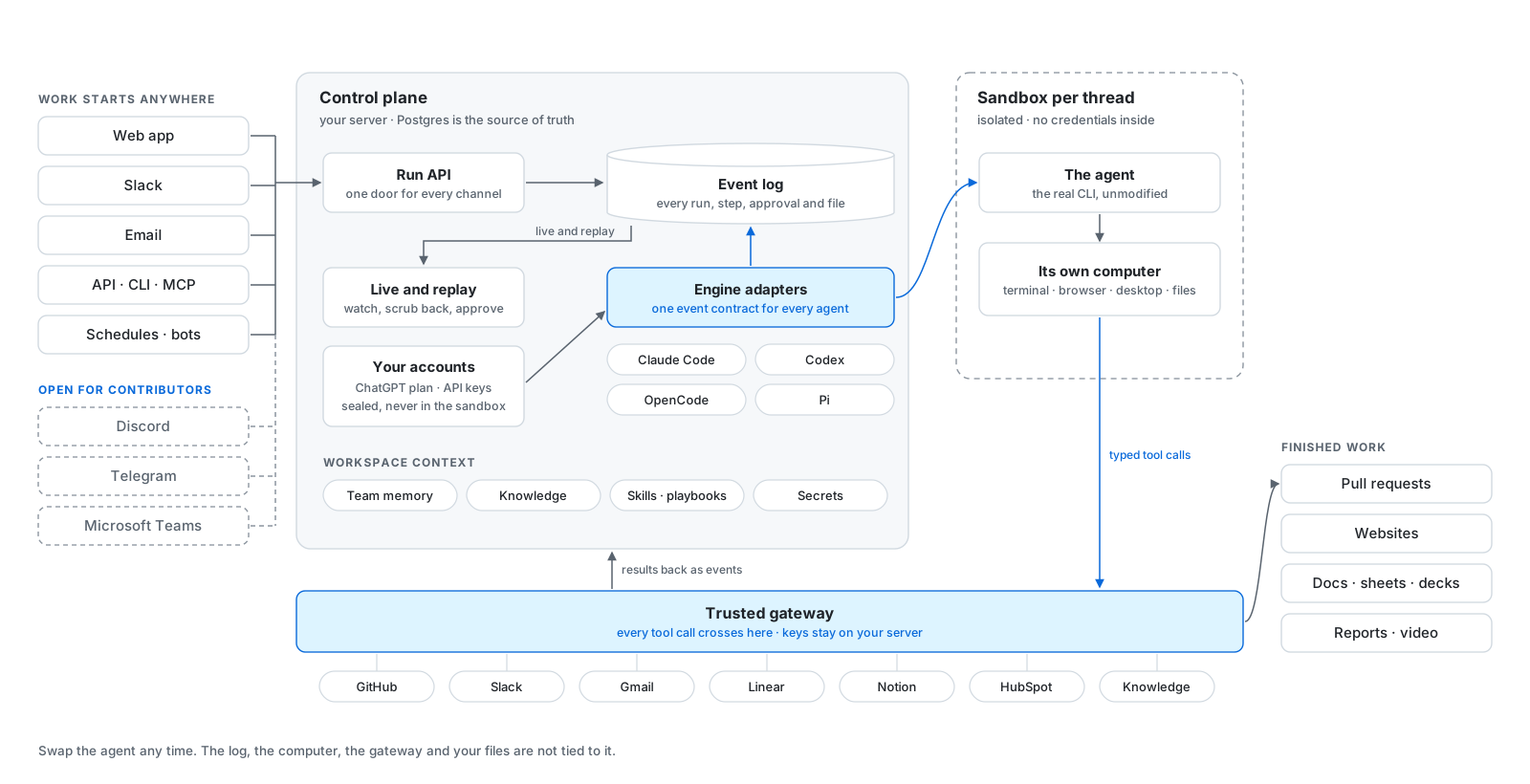
Three properties do the heavy lifting:
- The engine is a plug. Every engine speaks one event format through its
adapter, so you can swap engines and keep your threads, files and memory. - Every run is an event log. Postgres is the source of truth: runs survive
backend restarts, replay exactly and stay inspectable afterwards. - Credentials never enter the sandbox. The agent's computer is isolated.
Every integration call crosses the trusted gateway as a typed tool, and the
keys stay on your control plane.
| Path | What it owns |
|---|---|
frontend/ |
Product UI: chat, sessions, skills, playbooks, wiki, artifacts, automations, settings |
backend/ |
Control plane: auth, runs, sandboxes, engines, knowledge, memory, artifacts, connectors |
packages/ |
Shared contracts: thread events, engine events, sandbox providers, the CLI |
docs-site/ |
Documentation site: concepts, architecture, API, operations |
infra/self-host/ |
Self-hosting on any provider, with a reference Terraform host |
memory/ |
Optional team-memory service |
More in the documentation and the interactive
request-flow diagram.
Hacktoberfest 2026
UseAgent is in Hacktoberfest. Pick an issue with
the hacktoberfest
label, comment that you're taking it, and open a pull request.
- New here? Start with
good first issue. - Want something bigger? The channel issues (Discord, Telegram, Microsoft Teams)
build on the existing connector framework, with the email connector as a worked example. - How it counts: merged, approved or
hacktoberfest-acceptedpull requests count.
Low-effort pull requests are closed.
Read CONTRIBUTING.md before your first pull request.
Community
- Report a bug or request a feature
- Read the release notes
- Our sister project threads is an agent framework
for TypeScript and Python built on the same idea: every run is a log you can replay.
License
UseAgent is free and open-source software under the
GNU AGPL v3.0 (AGPL-3.0-only). You may use, modify and self-host it
under the AGPL.
To embed UseAgent in proprietary software, distribute it without AGPL
obligations, or build an OEM or white-label product, a
commercial license is available.
Contributions are accepted under the CLA. The UseAgent name and logo
are covered by the trademark policy, not the code license.
Third-party components are listed in NOTICE; vendored and ported
files carry per-file attribution headers.
Yorumlar (0)
Yorum birakmak icin giris yap.
Yorum birakSonuc bulunamadi