Lifeblood
Health Warn
- License — License: NOASSERTION
- Description — Repository has a description
- Active repo — Last push 0 days ago
- Low visibility — Only 5 GitHub stars
Code Pass
- Code scan — Scanned 12 files during light audit, no dangerous patterns found
Permissions Pass
- Permissions — No dangerous permissions requested
This tool acts as a compiler-as-a-service for AI agents. It bridges language intelligence—like type resolution, diagnostics, and reference finding—from your codebase directly to AI tools via an MCP connection.
Security Assessment
The overall risk is Medium. The static code scan of 12 files revealed no dangerous patterns, hardcoded secrets, or excessive permission requests. However, by design, the server requires deep read access to your local project files to build a semantic graph. Additionally, it features a code execution tool (`lifeblood_execute`) that can run arbitrary C# code against your project's types. While powerful, this execution capability could lead to unintended local system changes if improperly prompted by an AI agent.
Quality Assessment
The project is actively maintained, with repository activity as recent as today. The codebase is open-source and testable, but it currently suffers from extremely low community visibility, evidenced by only 5 GitHub stars. This means it has not undergone widespread peer review or battle-testing. Additionally, the repository lacks a clearly defined software license (marked as NOASSERTION), which is a significant concern for enterprise or commercial adoption due to potential intellectual property ambiguities.
Verdict
Use with caution: the codebase is actively maintained and free of obvious malware, but its low community adoption, unasserted license, and inherent ability to execute local code warrant careful isolation and strict human oversight before deploying in sensitive environments.
Compiler truth in, AI context out. Open semantic glue between language intelligence and AI tools.
Lifeblood
Compiler-as-a-service for AI agents.
Lifeblood gives AI agents direct access to what compilers know. Type resolution, call graphs, diagnostics, reference finding, code execution. All over a standard MCP connection. No IDE required. Load a project, ask the compiler, get verified answers.
Compilers already know everything about your code, just pipe that truth to AI agents instead of letting them grep and guess.
Roslyn (C#)    ──┐                              ┌──  Execute code against project types
TypeScript     ──┤  ┌────────────────────────┐  ├──  Diagnose / compile-check
JSON graph     ──┼→ │    Semantic Graph      │ →┤──  Find references / rename / format
               ──┤  │  (symbols / edges /    │  ├──  Blast radius / file impact
  community    ──┘  │   evidence / trust)    │  └──  Context packs / architecture rules
  adapters          └────────────────────────┘
Born from shipping a 400k LOC Unity project with AI assistance and realizing that AI writes code but does not verify what it wrote.
Quick Start
Install (30 seconds)
dotnet tool install --global Lifeblood
dotnet tool install --global Lifeblood.Server.Mcp
Requires .NET 8 SDK.
Connect to Claude Code, Cursor, or any MCP client
Add to your project's .mcp.json:
{
  "mcpServers": {
    "lifeblood": {
      "command": "lifeblood-mcp",
      "args": []
    }
  }
}
See MCP Setup Guide for Claude Desktop, VS Code, Cursor, and raw stdio configs.
Use
lifeblood_analyze projectPath="/path/to/your/project"   → load semantic graph
lifeblood_blast_radius symbolId="type:MyApp.AuthService" → what breaks if I change this?
lifeblood_file_impact filePath="src/AuthService.cs"      → what files are affected?
lifeblood_find_references symbolId="type:MyApp.IRepo"    → every caller, every consumer
lifeblood_search query="quantize timing to grid"         → ranked keyword + xmldoc search
lifeblood_invariant_check id="INV-CANONICAL-001"         → query architectural invariants from CLAUDE.md
lifeblood_compile_check code="var x = 1 + 1;"            → snippet compiles, auto-wraps for library modules
lifeblood_execute code="typeof(MyApp.Foo).GetMethods()"  → run C# against your types
After the first analysis, use incremental: true for fast re-analysis (seconds instead of minutes).
CLI (for CI and scripting)
lifeblood analyze --project /path/to/your/project
lifeblood analyze --project /path/to/your/project --rules hexagonal
lifeblood context --project /path/to/your/project
lifeblood export  --project /path/to/your/project > graph.json
Build from source
git clone https://github.com/user-hash/Lifeblood.git
cd Lifeblood
dotnet build
dotnet test
22 Tools
Connect an MCP client. Load a project. The AI agent gets 22 tools: 12 read, 10 write.
| Tools | |
|---|---|
| Read | Analyze, Context, Lookup, Dependencies, Dependants, Blast Radius, File Impact, Resolve Short Name, Search, Dead Code¹, Partial View, Invariant Check |
| Write | Execute, Diagnose, Compile-check, Find References, Find Definition, Find Implementations, Symbol at Position, Documentation, Rename, Format |
¹ lifeblood_dead_code ships as experimental / advisory in v0.6.3. Known false-positive classes: (1) symbols referenced only via method-group conversion (delegates, Lazy<T>, events), (2) methods with canonical-id drift in multi-module workspaces, (3) private fields read via same-class access. Every response carries a status: "experimental" marker and a warning describing the limitations. See INV-DEADCODE-001 in CLAUDE.md for the full architectural note. Root-cause investigation scheduled for v0.6.4.
Every read-side tool that takes a symbolId routes through one resolver. Exact canonical id, truncated method form, bare short name, and wrong-namespace-correct-short-name (v0.6.3, INV-RESOLVER-005) all resolve to the same answer.
New in v0.6.3:
lifeblood_invariant_check: queryCLAUDE.md's architectural invariants as structured data. Lookup by id, list all, audit for duplicates. Works on any project withINV-*markers.lifeblood_compile_checknow auto-wraps bare statement snippets (var x = 1 + 1;) so they compile inside library modules without manual class wrapping.lifeblood_searchtokenizes multi-word queries for ranked OR scoring (previously any query longer than one word collapsed to zero results).- Resolver falls back to extracted-short-name lookup when a kind-prefixed input's namespace is wrong but the short name is unique.
Architecture
Hexagonal. Pure domain core with zero dependencies. Language adapters on the left, AI connectors on the right.
LEFT SIDE                     CORE                     RIGHT SIDE
(Language Adapters)        (The Pipe)               (AI Connectors)

Roslyn (C#)       ──┐                            ┌──  MCP Server (22 tools)
TypeScript        ──┼→  Domain  →  Application  →┤──  Context Pack Generator
JSON graph        ──┘       ↑                     ├──  Instruction File Generator
                      Analysis (optional)         └──  CLI / CI
22 port interfaces, all wired (left side adapters + right side connectors + ISymbolResolver for identifier resolution + IInvariantProvider for CLAUDE.md invariant introspection). Boundaries enforced by architecture invariant tests, 60+ typed invariants in CLAUDE.md (queryable via lifeblood_invariant_check), and 11 frozen ADRs.
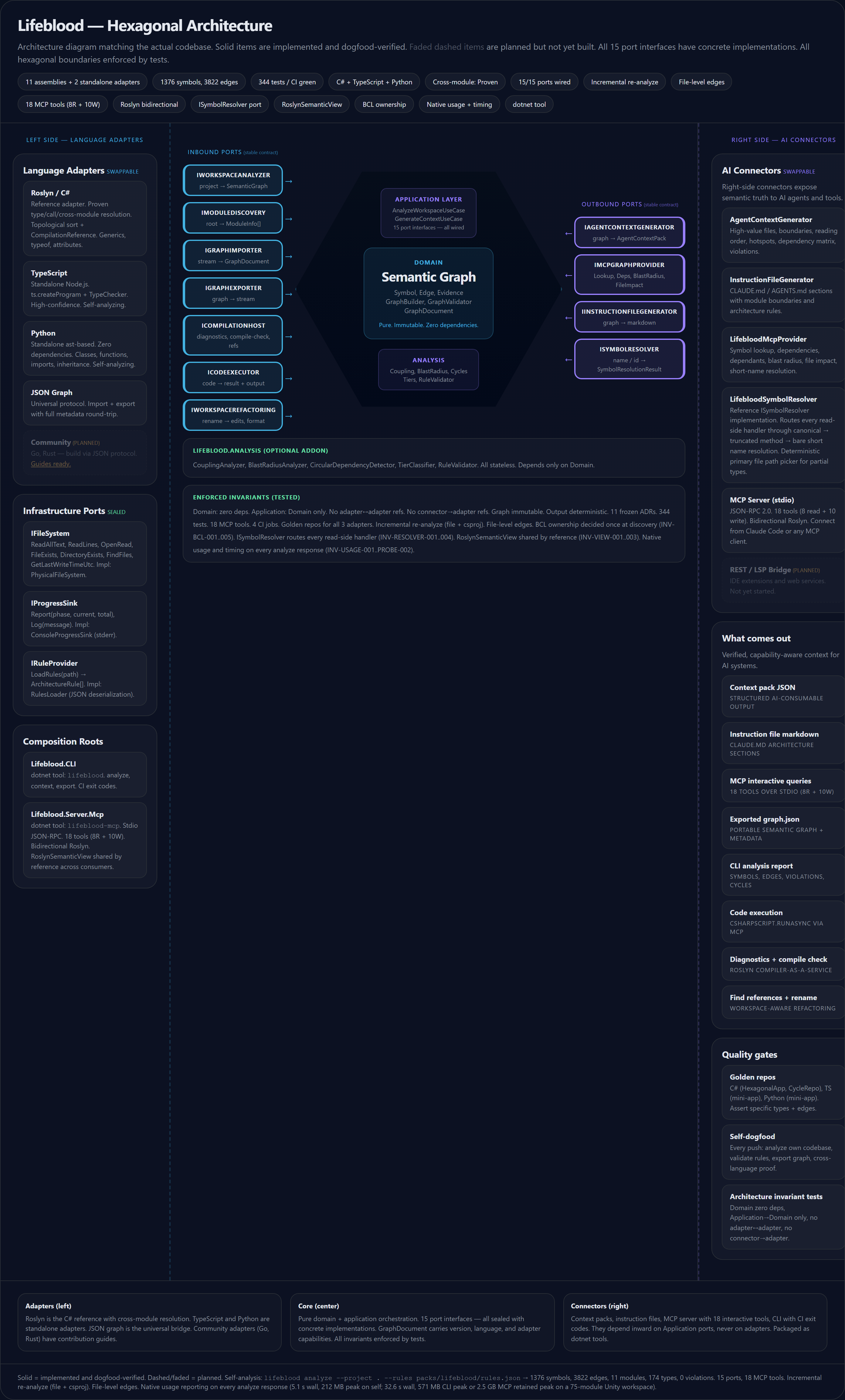
Full architecture | Interactive diagram
Three Languages, One Graph
| Adapter | How it works | Confidence |
|---|---|---|
| C# / Roslyn | Compiler-grade semantic analysis. Cross-module resolution. Bidirectional: analysis + code execution. | Proven |
| TypeScript | Standalone Node.js. ts.createProgram + TypeChecker. |
High |
| Python | Standalone ast module. Zero dependencies. |
Structural |
| Any language | Output JSON conforming to schemas/graph.schema.json. Adapter guide. |
Varies |
Unity Integration
Lifeblood runs as a sidecar alongside Unity MCP. All 22 tools available in the Unity Editor via [McpForUnityTool] discovery. Runs as a separate process, so no assembly conflicts, no domain reload interference.
Dogfooding
Self-analysis (MCP, v0.6.3): 1,863 symbols, 5,777 edges, 11 modules, 235 types, 0 violations. Lifeblood now audits its own architectural invariants via lifeblood_invariant_check against CLAUDE.md: 58 invariants across 25 categories, zero duplicate ids, zero parse warnings.
Production-verified on a 75-module 400k LOC Unity workspace. Same workspace, two different paths, two different memory profiles. Both are correct, both are by design, both come from the native usage field on every lifeblood_analyze response.
| Path | Wall | CPU total | CPU % (1 core) | Peak working set | Use when |
|---|---|---|---|---|---|
| CLI (streaming, compilations released) | ~14 s | ~23 s | ~150% | ~570 MB | One-shot analyze, rules check, graph export |
| MCP (compilations retained) | ~32 s | ~58 s | ~180% | ~2,800 MB | Interactive session with write-side tools (execute, find_references, rename, etc.) |
The MCP retained profile sits around 4x the CLI streaming profile because the write-side tools need the loaded workspace in memory to answer follow-up queries. Pass readOnly: true to lifeblood_analyze to drop MCP back to the streaming profile in exchange for no write-side tools. Both measured on AMD Ryzen 9 5950X (16 cores / 32 threads). Exact numbers are surfaced live on every lifeblood_analyze response via the usage field so they can be cited deterministically.
Seven+ dogfood sessions found 50+ real bugs invisible to unit tests, including the v0.6.3 resolver wrong-namespace fallback (INV-RESOLVER-005), the compile_check library-module auto-wrap, and the lifeblood_dead_code false-positive classes tracked under INV-DEADCODE-001.
Roadmap
- Community adapters: contribution guides for Go and Rust. Contract and checklist ready, no implementation code yet.
- REST / LSP bridge: expose the graph to IDE extensions and web services.
Documentation
| Page | Description |
|---|---|
| Tools | All 22 tools with descriptions, symbol ID format, incremental usage, dead_code caveats |
| MCP Setup | Copy-paste configs for Claude Code, Cursor, VS Code, Claude Desktop, Unity |
| Unity Integration | Sidecar architecture, setup guide, incremental, memory |
| Architecture | Hexagonal structure, dependency flow, 22 port interfaces, invariants |
| Architecture Decisions | 11 frozen ADRs |
| Invariants | 58 typed architectural invariants, queryable via lifeblood_invariant_check |
| Phase 8 Spike | Design record for lifeblood_invariant_check, rollout phases 8A-8E |
| Status | Component table, test counts, self-analysis, production stats |
| Adapters | How to build a language adapter (13-item checklist) |
| Dogfood Findings | 50+ bugs found by self-analysis and reviewer dogfood sessions |
| CHANGELOG | Every release: additions, fixes, known limitations |
Related
- LivingDocFramework: The methodology that shaped the architecture
- Roslyn: The C# compiler platform
- Case study: The 400k LOC Unity project where we proved these ideas
License
AGPL v3
Reviews (0)
Sign in to leave a review.
Leave a reviewNo results found