payo
Health Uyari
- License — License: MIT
- Description — Repository has a description
- Active repo — Last push 0 days ago
- Low visibility — Only 5 GitHub stars
Code Basarisiz
- process.env — Environment variable access in src/cli/banner.ts
- process.env — Environment variable access in src/config.ts
- spawnSync — Synchronous process spawning in src/generator/agent.ts
Permissions Gecti
- Permissions — No dangerous permissions requested
Bu listing icin henuz AI raporu yok.
Generate project-tailored AI assistant rules & skills (CLAUDE.md, .cursorrules, Copilot instructions, AGENTS.md) in under two minutes. Works with Claude, Cursor, Copilot, Codex, Windsurf, Antigravity.

Generate project-tailored AI assistant rules & skills in minutes.
Payo interviews you about your stack, then writes the guidance files your AI
coding assistant reads — so Claude, Cursor, Copilot, and friends follow your
project's conventions instead of guessing.




Contents
- What is Payo?
- Why Payo?
- Who is this for?
- Quick Start
- How to use — a walkthrough
- What gets generated
- What it asks about
- AI vs. template generation
- Bootstrap prompt
- Resume anytime
- Roadmap
- Requirements
- Run locally
- Contributing
- License
What is Payo?
AI coding assistants are only as good as the context they're given. Payo is an
interactive CLI that interviews you about your project — language, framework,
database, auth, testing, conventions — and then generates the guidance files
your assistant actually reads.
It supports Claude, Cursor, GitHub Copilot, Codex, Windsurf, and Antigravity.
Where the assistant ships a headless CLI, Payo drives that tool's own AI to
write rich, project-specific docs; where it doesn't, Payo falls back to solid
templates — so you always end up with usable output.
Why Payo?
Every AI coding session starts cold. Your assistant doesn't know you use Drizzle
over Prisma, that handlers live in src/routes, that you write Vitest specs
beside the file, or that commits follow Conventional Commits. So you re-explain
it — in chat after chat — and still get code that ignores half of it.
The fix is the guidance files each tool already reads (CLAUDE.md,.cursorrules, .github/copilot-instructions.md, AGENTS.md). But writing them
by hand is tedious, easy to get wrong, and different for every tool. Most people
never do it, or do it once and let it rot.
Payo writes them for you in minutes — tailored to your actual stack,
in each tool's native format — so your assistant follows your conventions from
the first prompt instead of guessing.
Vibe coding, without the mess
Vibe coding is fast and fun — you prompt, the AI improvises, code appears. The
problem isn't the speed, it's that the assistant has no rules to improvise
within. So it guesses: a different ORM than the rest of the repo, files
scattered wherever, its own naming, your tests and commit conventions skipped.
Fine for a throwaway demo; on a real codebase it quietly piles up inconsistency
you pay for later in reviews, bugs, and refactors — and each new chat starts the
guessing over.
Payo gives that improvisation a guardrail. It generates the guidance files your
assistant already reads, so the AI reaches for your framework, your folder
layout, your testing and git rules every time — without you stopping to explain
them. You keep vibe coding at full speed; the output just fits the project
instead of fighting it.
Who is this for?
- Devs starting a new repo who want their AI assistant productive from
commit #1, not after a dozen "actually, we do it this way" corrections. - Teams enforcing conventions who need every contributor's assistant to
follow the same folder structure, naming, testing, and git rules. - Multi-tool users who switch between Claude, Cursor, and Copilot and want
the same project guidance expressed in each tool's native format. - Anyone bootstrapping a stack they haven't wired up before — Payo encodes
sensible, framework-specific defaults and can scaffold a runnable project.
If you've ever pasted the same "here's how this project works" preamble into a
chat for the third time, Payo is for you.
Quick Start
No install required — run it in any project directory:
npx @uge/payo
# or
bunx @uge/payo
The command you run after install is still
payo. Install globally withnpm i -g @uge/payo(orbun add -g @uge/payo), then just runpayo.
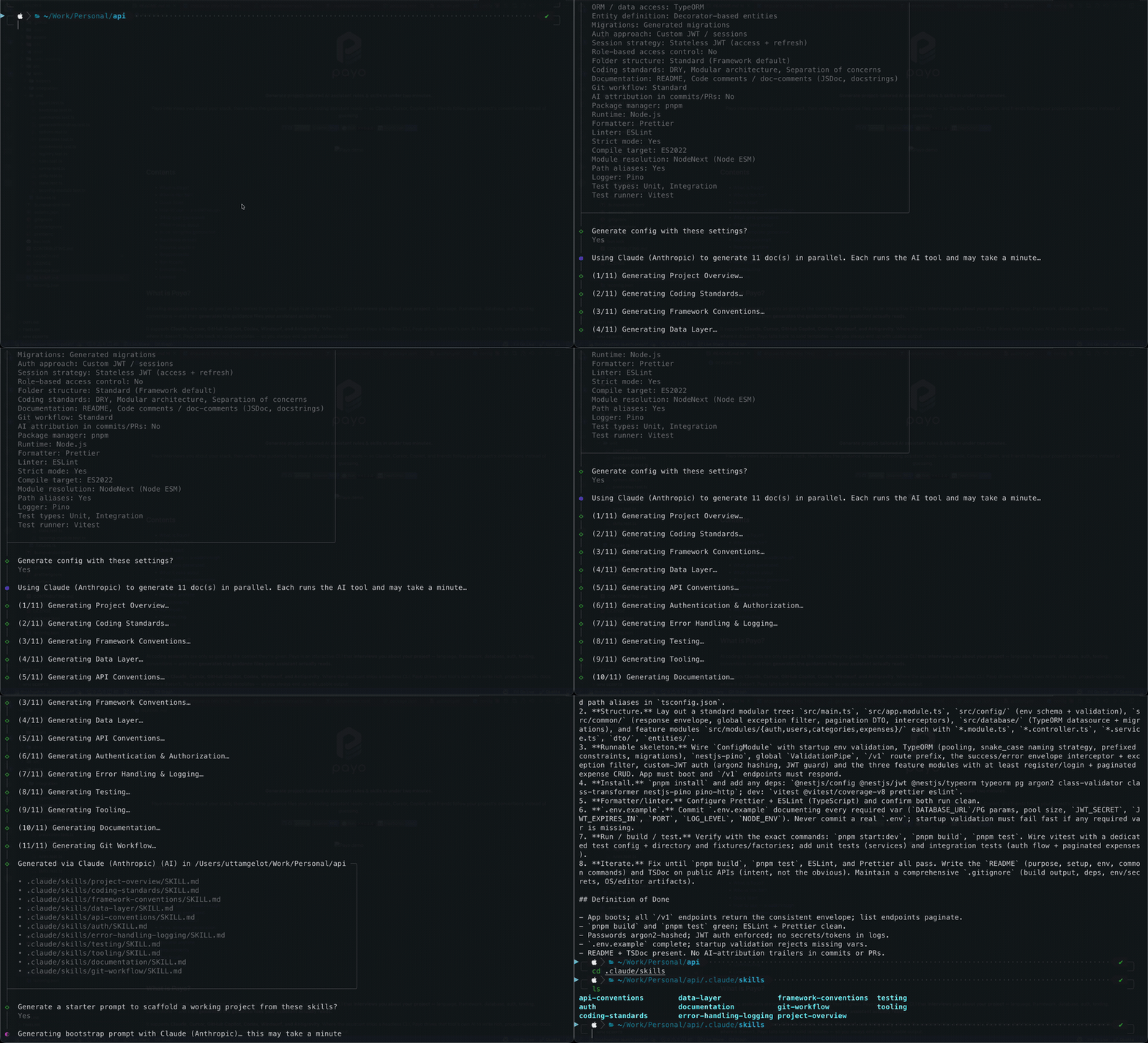
Answer a short questionnaire about your stack, and Payo drops tailored AI
guidance files straight into your repo.
How to use — a walkthrough
- Run Payo from your project root.
npx @uge/payo— it writes into the
current directory, socdinto the repo first. - Answer the questionnaire. Pick your AI tool, project type, language,
framework, and so on. Questions adapt to your answers — choose Next.js
and you get Next.js-specific follow-ups; choose Postgres and you're asked
about migrations and naming. Most prompts ship a recommended default, so
you can blast through with Enter. - Review your stack — and edit inline. Before writing anything, Payo shows a
summary of every answer. Choose Edit an answer to change any response — or
re-open a section you skipped — right from the review; dependent questions are
re-asked automatically. Pick Generate when it looks right. - Payo generates the guidance. It writes each tool's files in their native
format and location (see the table below). With the tool's CLI installed,
files are generated in parallel by the AI; otherwise solid templates are used. - (Optional) Get a bootstrap prompt. Payo offers to write a paste-ready
bootstrap-prompt.mdyou hand to any LLM to scaffold a runnable project that
honors the guidance it just generated. - Interrupted? Just rerun. Progress lives under
.payo/; Payo resumes and
only generates what's missing.
What gets generated
Each tool gets files in its own native format and location:
| Tool | Files generated |
|---|---|
| Claude (Anthropic) | CLAUDE.md · .claude/skills/** |
| Cursor | .cursorrules · .cursor/rules/** |
| GitHub Copilot | .github/copilot-instructions.md · .github/instructions/** |
| Codex CLI | AGENTS.md |
| Antigravity (Google) | AGENTS.md · .agents/skills/** |
| Windsurf | .windsurfrules |
| Other / generic | AI_RULES.md |
Rich AI generation needs the selected tool's CLI on your
PATH. Without it,
Payo writes well-structured template defaults instead.
What it asks about
Payo understands 25 frameworks, 24 ORMs, and 4 databases across
TypeScript/JavaScript, Python, Go, and Rust — and tailors its follow-up
questions to whatever you pick. Dimensions covered:
- Project — type (frontend / backend / full-stack) and a short description
- Language & framework — plus framework-specific conventions
- API — REST, GraphQL, gRPC, tRPC
- Frontend — styling and state management
- Data — database and ORM/data-layer, with naming & migration conventions
- Auth — approach, session strategy, RBAC
- Validation & logging — stack-appropriate libraries
- Testing — unit / integration / component / E2E and runners
- Tooling — package manager, runtime, formatter, linter
- TypeScript —
tsconfigstrictness, target, module resolution, path aliases - Conventions — folder structure, coding standards, docs, git workflow
AI vs. template generation
Payo always leaves you with output. When the chosen assistant's headless CLI
is installed, it generates each guidance file in parallel from your answers —
richer and more specific. When the CLI is missing, or every run fails, it falls
back to static templates.
A few environment variables tune AI generation:
| Variable | Default | Purpose |
|---|---|---|
PAYO_CONCURRENCY |
4 |
Max parallel agent subprocesses |
PAYO_RETRIES |
1 |
Extra attempts after a failed run |
PAYO_AGENT_TIMEOUT_MS |
120000 |
Wall-clock cap per file (ms) |
Your data stays yours
Payo has no backend and no telemetry. Rich generation runs entirely through the
AI CLI you already have installed (claude, cursor-agent, etc.), so your
answers go only to that tool under your own account and credentials — exactly as
if you'd prompted it yourself. Payo itself sends nothing to any server; without a
CLI present it never leaves your machine at all, falling back to local templates.
Bootstrap prompt
An empty repo with great guidance is still an empty repo. After generating, Payo
offers to write a bootstrap-prompt.md — a paste-ready prompt that tells any
LLM to scaffold a runnable project using the stack's official tooling (the
framework's own create command / CLI), honor the generated conventions, and
iterate with you until it runs.
Resume anytime
Interrupt a run and pick up where you left off. Payo saves your questionnaire
answers and generation progress under .payo/; rerun and it resumes, only
generating what's missing. Finished runs clean the directory up automatically.
Roadmap
Payo works today, but it's still early. Here's where it's headed:
- First-class existing-project support. Right now Payo shines on a fresh
repo. The next big step is making it just as good on an established codebase:
detect the stack from what's already there (manifests, lockfiles, config,
folder layout), auto-answer the questionnaire from that evidence, and let
you confirm or tweak instead of typing it all out — then the normal generation
flow continues. - Broader stack coverage. More languages, frameworks, ORMs, databases, and
AI tools, plus deeper, more opinionated defaults for the ones already
supported — so the guidance fits more of the ecosystem out of the box. - A smoother flow. Faster, clearer prompts; better defaults and grouping;
tighter summaries and confirmations; and a generation step that's quicker and
more transparent about what it's doing.
Have a stack you want supported or an idea to make the flow better?
Open an issue or see
Contributing.
Requirements
To run Payo: Node.js >= 18. That's it — npx @uge/payo
runs the published, Node-targeted binary, so you do not need Bun to use Payo.
If you prefer Bun, bunx @uge/payo works too.
To develop Payo: Bun >= 1.1.0 (the project builds, tests,
and runs from source with Bun — see Run locally).
Run locally
Hacking on Payo or running it from source:
git clone https://github.com/uttam-gelot/payo.git
cd payo
bun install        # Bun >= 1.1.0
bun run dev        # runs src/index.ts directly
Other useful scripts:
bun test           # run the test suite
bun run typecheck  # tsc --noEmit
bun run lint       # eslint
bun run build      # bundle to dist/ (Node target)
Contributing
Contributions are welcome — new frameworks, ORMs, AI tools, and fixes. See
CONTRIBUTING.md for setup, the project layout, how to add
a stack module, and the pre-PR checklist.
License
Yorumlar (0)
Yorum birakmak icin giris yap.
Yorum birakSonuc bulunamadi