foreman
Health Uyari
- License — License: MIT
- Description — Repository has a description
- Active repo — Last push 0 days ago
- Low visibility — Only 7 GitHub stars
Code Uyari
- fs module — File system access in .github/workflows/test.yml
Permissions Gecti
- Permissions — No dangerous permissions requested
Bu listing icin henuz AI raporu yok.
📋 Prompt-engineering and project-roadmap plugin that crafts professional xml prompts and picks, surveys, and tracks your next tasks.

Foreman
Every Claude Code session forgets everything when it ends. Foreman is what's waiting when the next one wakes up.
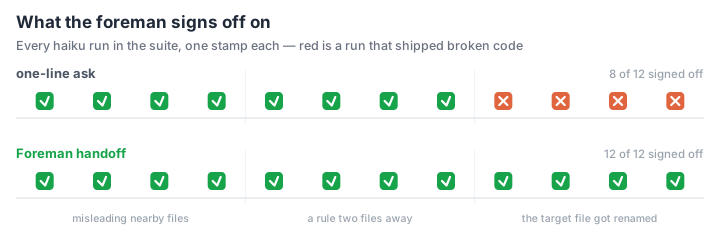
This is what passes inspection.


TL;DR — Every Claude Code session starts with amnesia. Foreman keeps the plan in your repo, committed like code: ask "what's next?" and you get the best task with a ready-to-run prompt, checked against the actual codebase — about a quarter cheaper per session than a bare one-line ask.
What is this?
Close the laptop and every plan that only lived in your head closes with it. Open Claude Code tomorrow and it starts from zero — no memory of what you were building, what you already ruled out, or that the file it's about to edit got renamed yesterday.
Foreman keeps the plan where the code lives: a plain-language roadmap, committed like any other file. Ask "what's next?" and it hands back the best task and a ready-to-run prompt, built from what's actually true about your project right now. It earns its keep on real engineering work — the kind that outlives a single chat window.
Why you'd want it
- Your plan survives you forgetting it. The roadmap lives in your repo, committed like code — the next session picks up exactly where you left off, not from a shrug.
- You don't have to be good at prompting. Every handoff prompt comes from the same template, guardrails built in — say what you want in plain language, Foreman does the rest.
- It updates itself. After each commit, Foreman checks what got finished and marks it. Opt in, and it also flags new work the commit uncovered.
- Nothing moves without you. No task gets added, changed, or checked off behind your back, and a project you haven't set up stays untouched.
How it works
| Moment | What happens |
|---|---|
| You ask "what's next?" | Foreman weighs the roadmap — dependencies, collisions, what's done — and hands back the best task with a ready-to-run prompt |
| You describe new work | It becomes a roadmap entry, once you approve it |
| You commit | Finished tasks get checked off; opt in and new work the commit uncovered gets flagged too |
| You suspect the plan has drifted | The top tasks get double-checked against the actual code, and the roadmap corrected |
And when a handoff runs as tracked tasks — here, or pasted into another session from a copied prompt with several checks — every finished task lands as a commit on a dedicated foreman/<slug> branch — done work stays done, and at the end you choose: squash, merge, PR, or keep.
Install
Inside Claude Code, run:
/plugin marketplace add V-Songbird/foundry
/plugin install foreman@foundry
Then, in each project you want a roadmap for, run /foreman:init once — it asks a few questions and builds the roadmap for you. That's the whole setup.
Running razor and hush too? Good instinct — razor keeps the code lean, hush keeps it quiet, Foreman writes the prompts.
What you can do
You talk to Foreman in plain language. Touching the roadmap file by hand defeats the point, so don't.
| You want to… | Command |
|---|---|
| Set up a roadmap for a project (one-time) | /foreman:init |
| Pick the next task, add one, or check status | /foreman:roadmap |
| Build a handoff prompt for a specific task | /foreman:craft-prompt |
| Double-check the top tasks against your actual code | /foreman:survey |
Benchmarks
We measured what a good handoff is actually worth: the same real coding jobs, run as full agent sessions, started four ways — from a bare one-line ask up to a Foreman handoff — with the real bill read straight from the API.
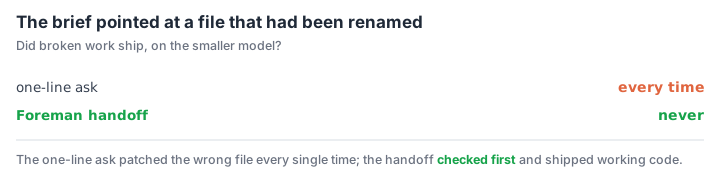
When the brief goes stale, the one-line ask ships broken work. Every living repo accumulates stale detail — a file gets renamed, a note outlives the code it described. We planted exactly that trap. On the smaller model the one-line ask patched the wrong file every single time; the Foreman handoff checks the brief against the code first, found the real file, and finished the job — every single time.
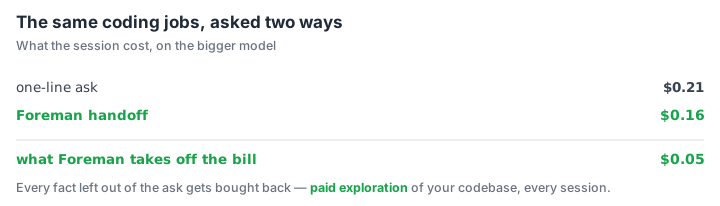
Skipping the brief doesn't skip the cost. Every fact you leave out of the ask, the session buys back by exploring your codebase at your expense. On the bigger model the one-line ask cost about a third more than the Foreman handoff for the same jobs — the shortest prompt was the most expensive session.
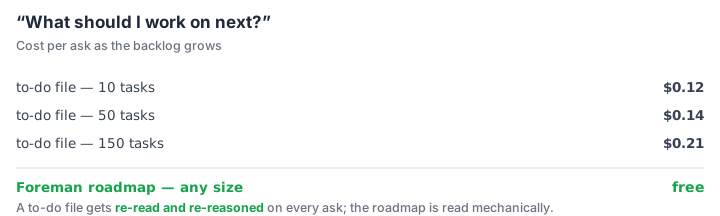
"What's next?" is free, every time you ask. Keep your backlog in a plain to-do file and Claude re-reads the whole thing on every ask — the bill grows with the list, and the pick can change with the model's mood. Foreman reads the roadmap mechanically: instant, free at any size, same answer every time.
[!NOTE]
A carefully hand-written brief performs like a Foreman handoff — the difference is you don't have to write it, and the guardrails come along for free. On a strong model with a fresh, accurate brief, the rescue above simply isn't needed: stale and thin briefs are where it pays.
How we tested: same jobs, four ways of asking, several runs each in fresh throwaway workspaces — a full multi-turn agent session every time, never a single generated reply — costs read from the API, not estimated. Numbers move a few percent between runs. Reproduce it yourself — see benchmarks/.
Under the hood
The roadmap is a plain file in your repo (field-by-field details in roadmap-schema.md), and every prompt Foreman assembles is script-checked before it ships — a malformed handoff never reaches a session. Pairs naturally with razor and hush: razor cuts the code, hush cuts the noise, Foreman writes the prompts — and measured together, the three add no overhead to each other.
Decision docs
Git remembers every diff. Nobody remembers why. Turn on decisionLog and any task that decides something writes a short ADR — one file per roadmap entry, at <dir>/<id>.md — and marks the code it governs with an anchor comment, [Foreman: 019] (or [Foreman: 019, 034] once more than one decision lands on the same spot). Come back in six months and you get the choice, the alternatives that lost, and the consequences — not a git-blame dig.
Closing a task is a forced choice, not an afterthought: every finished entry names its doc, or says "none" when nothing was worth writing down. Skip that, point it at a doc that was never written, or forget the anchor in the commit, and the completion check catches it — gate decides how loud: off stays silent, nudge (the default) reminds you, block holds the completion until the record's fixed.
The anchors keep paying off after the fact, too: read or edit any file carrying one and Foreman surfaces the doc it points to — before you violate a decision you didn't know was there, not after.
Decision docs are dated records, never rewritten backward. Change your mind later and the old doc stays as it was; the new one names it in its own supersedes frontmatter instead. The history stays honest either way.
Settings
Most people never touch these — /foreman:init asks the questions and writes .foreman/config.json for you. The knobs, if you ever want them by hand:
| Setting | What it does |
|---|---|
discoverySuggestions |
After each commit, offer new roadmap entries Claude spotted in the work. |
usePersona |
Whether handoff prompts open with a "You are a…" role sentence, or plain domain framing. |
omitSections |
Prompt sections to leave out entirely (tone, example, background, output_format). |
requireVerification |
Hold off marking a task done after a commit until you confirm it's verified. |
taskCloseGate |
When a tracked task finishes with its roadmap entry still open: off says nothing, nudge (default) reminds you to close it, block holds the completion until you do. |
decisionLog |
Per-task decision docs: {enabled, dir, gate}. enabled (default false) turns them on, dir (default docs/foreman) is where they're written, gate (default nudge) sets how a missing doc or anchor is enforced at completion — off, nudge, or block, same ladder as taskCloseGate. Environment overrides can flip it on or repoint the folder for a single run without touching the file. |
checkpoints |
How task-split runs commit their work. Four optional keys: baseBranch names the base branch (default: auto-detect), branch: false checkpoints on the current branch instead of creating a foreman/<slug> one, push: true pushes each checkpoint commit (default: keep them local), and onFinish set to squash, merge, pr, or keep performs that end-of-run action directly instead of asking (default: ask). |
targetModel |
How much detail crafted prompts spell out, scoped to the model that runs them: haiku elaborates fully, sonnet, opus, and fable skip scaffolding those models don't need, and inherit (default) keeps the standard level. At inherit, Foreman recommends a model per task at craft and dispatch time for you to confirm or override; set a concrete value to pin one for every prompt. |
fableEnabled |
Declare that your plan can run Fable 5 (Max or API). On tasks with two or more verification checks, the executing-model question then offers Fable — orchestrates workers per slice: Fable never edits files itself, it dispatches one implementer subagent per check and reviews each result before accepting it. Default false. |
Running with razor and hush? The recommended shape is:
{
  "usePersona": false,
  "omitSections": ["tone"]
}
razor already gives the session its persona and hush already owns the voice, so Foreman's prompts stay out of both lanes. Add "output_format" to the list if hush should own the reply's shape too. Prompts handed to a background agent keep Foreman's minimal default tone even when tone is omitted — output styles don't reach those sessions, so nothing else would own the voice there.
[!NOTE]
Foreman never detects which plugins you run — this file is you declaring the shape you want, and it works the same for any third-party style plugin.
License
MIT — see LICENSE.
Yorumlar (0)
Yorum birakmak icin giris yap.
Yorum birakSonuc bulunamadi