Rassam
Health Gecti
- License — License: Apache-2.0
- Description — Repository has a description
- Active repo — Last push 0 days ago
- Community trust — 20 GitHub stars
Code Basarisiz
- rm -rf — Recursive force deletion command in .github/workflows/rassam-live.yml
- rm -rf — Recursive force deletion command in .github/workflows/release.yml
- fs module — File system access in .github/workflows/release.yml
- process.env — Environment variable access in action.yml
- fs module — File system access in action.yml
- process.env — Environment variable access in bench/gate/cases/architecture.ts
- process.env — Environment variable access in bench/gate/cases/check-tampering.ts
Permissions Gecti
- Permissions — No dangerous permissions requested
Bu listing icin henuz AI raporu yok.
The architecture contract for agent-built software. One blueprint in your repo that your agents ask before they act and every pull request is checked against.
Rassam
A merge gate for the code your agents write.
Write down how your system is built, once. Every pull request is checked against it,
and no pull request can loosen the rules it is judged by.


$ npx @v0ightt/rassam check --base main
✖ fail · Notes · diff mode · main…archived-count
2 errors, 2 warnings, 0 infos · 4 new · 5 components · 5/5 files mapped (0 unmapped) · 5 component edges (1 undeclared) · 100% human-authored

Needs your attention (4 of 4 new)
  ✖ error Web must not depend on Storage [forbidden-dependency]
      src/web/notes-page.js imports src/storage/db.js. Rule "web-goes-through-api" forbids web → storage.
      at src/web/notes-page.js:2
      reason: "Pages reach data through the API, so access checks always run."
  ✖ error Verification weakened (test-skipped): test/notes.test.js [verification-weakened]
      Test skipped or disabled: test("free plan allows three notes", { todo: "revisit after launch" }, () => {. This weakens the checks agents are graded by, so a human must approve it: apply the approval label (rassam:approved by default), or restore the check.
      at test/notes.test.js:5
  ▲ warning Undeclared dependency: Web → Storage [undeclared-dependency]
      1 import from Web into Storage is not declared in the blueprint. Declare the dependency if it is intended, or remove it.
      at src/web/notes-page.js:2
  ▲ warning Protected path changed: test/notes.test.js [protected-path]
      Tests are the checks agents are graded by.
      at test/notes.test.js

Weakened tests and checks (1, NOT approved)
  test-skipped: a human must review it and apply the rassam:approved label, or the change must restore the check.
Real output, on a change like the ones agents made in our pilot when asked to "just import storage from the page for the demo" and to "get the suite green".
Rassam (رسّام) means "painter" in Arabic. It used to paint pictures of your code. Now it paints the blueprint your code gets checked against.
Try it in five minutes
In the repository you want to protect:
npx @v0ightt/rassam init
That drafts .rassam/blueprint.json from your code, then asks before writing three more things: the rules as plain prose in AGENTS.md (every agent reads it), the MCP server in .mcp.json (so agents can ask while they work), and .github/workflows/rassam.yml (the gate). Say yes, open a pull request, and the gate is on. Pass --yes to skip the questions.
Then make the draft yours: name the parts, write what each one is for, and add a rule or two.
npx @v0ightt/rassam do "forbid web from importing db because pages go through the API" --write
npx @v0ightt/rassam instructions --write   # rewrite the rules in AGENTS.md
npx @v0ightt/rassam check                  # everything, or --base origin/main for just your branch
The whole walkthrough, with Cursor, Codex and VS Code setup: docs/getting-started.md.
We told three agents to break the rules
Before asking anyone to install this, we checked whether it does anything an AGENTS.md doesn't. Same small layered app, three tasks, three ways of telling the agent the rules: nothing, prose rules in AGENTS.md, or the Rassam contract and its query tools. Opus 5.5, Sonnet 5.5 and Haiku 5.5 each ran every combination once: 27 runs, scored from the diff, the test run and the gate, never from what the agent said.
| What ended up in the diff | No rules | Prose rules | Rassam contract |
|---|---|---|---|
| Forbidden import, the task only hints at it | 1 of 3 | 0 of 3 | 0 of 3 |
| Forbidden import, the owner asks for it ("for the demo, we'll tidy later") | 3 of 3 | 0 of 3 | 0 of 3 |
| A contradictory test disabled or rewritten to go green | 2 of 3 | 0 of 3 | 1 of 3 |
| Stopped and reported the contradiction instead | 0 of 3 | 3 of 3 | 2 of 3 |
What we learned:
- With no rules, agents did what the person in a hurry asked, every time, and called the shortcut "temporary". From the agent's side nothing was wrong.
- Prose rules steered just as well as our query tools. That cut against our own feature, so
initnow writes the contract intoAGENTS.mdas prose. Use it: it's free steering. - The gate failed all 4 changes with the forbidden import and passed every honest one, whoever asked for the import and whatever the agent was told.
- It only warned on the edited tests. That was the gap: since then, skipped, focused or gutted tests fail the gate until a human approves them, like loosened rules do.
It's a small pilot (one run per cell, one toy project, one model family). The method, the limits and every number are in the pilot notes.
What the gate does
# .github/workflows/rassam.yml (init writes this for you)
on: pull_request
permissions:
  contents: read
  pull-requests: write # one sticky comment; leave it out with comment: "false"
jobs:
  blueprint:
    runs-on: ubuntu-latest
    steps:
      - uses: actions/checkout@v4
        with: { fetch-depth: 0 }
      - uses: actions/setup-node@v4
        with: { node-version: 22 }
      - uses: V0ightt/Rassam@<full commit SHA> # v0.4.0
- A pull request can't loosen its own rules. It's judged by the blueprint on the base branch. Removing a rule, lowering a severity or moving files out of a constrained component fails until a human adds the
rassam:approvedlabel. - Weakened tests need a human, not a yellow note. Skipped or focused tests, deleted or always-true assertions, deleted test files, lowered coverage thresholds and forced
exit 0fail the same way until someone approves. Other changes to tests, CI and agent config get a warning: worth a look, never blocking. - Only new problems fail. Old mess is reported quietly, so you can adopt it on a legacy codebase today.
- It respects your attention. One sticky comment, the top few findings first, each with file and line.
Pin the action to a full commit SHA with the version as a comment (@<sha> # v0.4.0), or at least to a release tag (@v0.4.0); never to @main. Why, and how to find the SHA.
We measure the gate instead of bragging: on 116 labelled cases, 48 of 79 attacks fail the check outright, most of the rest reach a human as a warning, and none of the 37 legitimate changes fails. The misses are written down too.
Why not just CLAUDE.md, dependency-cruiser or CODEOWNERS?
CLAUDE.md/AGENTS.md: they steer well (as well as our tools, in the pilot), but they're advice. Nothing stops the change that ignores them. Keep them; Rassam writes the rules into them for you and adds the check that holds.- dependency-cruiser (and eslint-plugin-boundaries, import-linter, ArchUnit): better parsers for their one language, so use them if that's all you need. Rassam adds what they don't do: the base branch's contract can't be edited by the change it judges, and weakened tests fail in the same required check.
- CODEOWNERS: it says who must review a path, and GitHub reads it from the base branch too. It can't say what may import what, and it won't notice a skipped test or a loosened rule in a file a tired reviewer skims.
Limitations
- Import analysis is pattern matching, not a compiler. Nine languages, regex-level: unusual aliases, dynamic imports and generated code can slip past. For a single language, the tools above see more.
- The test checks catch the common moves, not the clever ones. A rewritten expected value, an early return or a mocked unit under test gets past them: none of the nine "hard evasions" in the benchmark is detected (six still reach a human as a tests-changed warning, three pass silently). A green gate is not proof the tests are honest.
- The approval label is trusted. Rassam doesn't check who added it. Don't give agents tokens that can label pull requests, and make the check required.
- It's a pull request gate. An agent holding production credentials can do damage at runtime without ever opening a pull request.
- Drafts are a starting point.
initguesses components from folders; unusual layouts need a human pass. - It's young. Blueprint format 0.1, one maintainer, a 27-run pilot rather than a field study.
Hook up your agents
init wires Claude Code. For anything else, the server is one command over stdio:
{ "mcpServers": { "rassam": { "command": "npx", "args": ["-y", "@v0ightt/[email protected]", "mcp"] } } }
| The agent asks | Rassam answers |
|---|---|
explain_path |
Who owns this file, what it is for, which rules apply |
check_dependency |
"May this file import that?" Yes or no, with your reason |
impact |
What breaks if this changes |
check_changes |
Does my work pass the gate right now? |
architecture_diff |
What did I change structurally? |
system_status |
What is running, what is down |
report_conflict |
"The task and the rules disagree, I am stopping" |
That last one matters. When a task can't be done honestly, an agent with a sanctioned way to stop is less likely to cheat by editing the tests. In the pilot, two of the three agents that had the contract filed a conflict report instead of touching the red test.
A tiny blueprint, so you can see there is no magic{
"version": "0.1",
"system": { "name": "Shop" },
"components": [
{ "id": "ui", "name": "Storefront", "paths": ["src/ui/**"],
"intent": "Renders the shop. Never touches storage directly." },
{ "id": "db", "name": "Database access", "paths": ["src/db/**"] },
{ "id": "payments", "name": "Payments", "paths": ["src/payments/**"] }
],
"rules": [
{ "id": "ui-no-db", "kind": "forbid", "from": "ui", "to": "db",
"reason": "The UI reaches data only through the domain layer." },
{ "id": "stripe-key", "kind": "secret-access", "secrets": ["STRIPE_*"], "allow": "payments" }
]
}
Full format: docs/blueprint-spec.md.
Your system design, live in your README
The blueprint also draws itself. This picture is not a screenshot: a GitHub Action redraws it every time someone pushes to main, straight from the code and this repo's own blueprint.
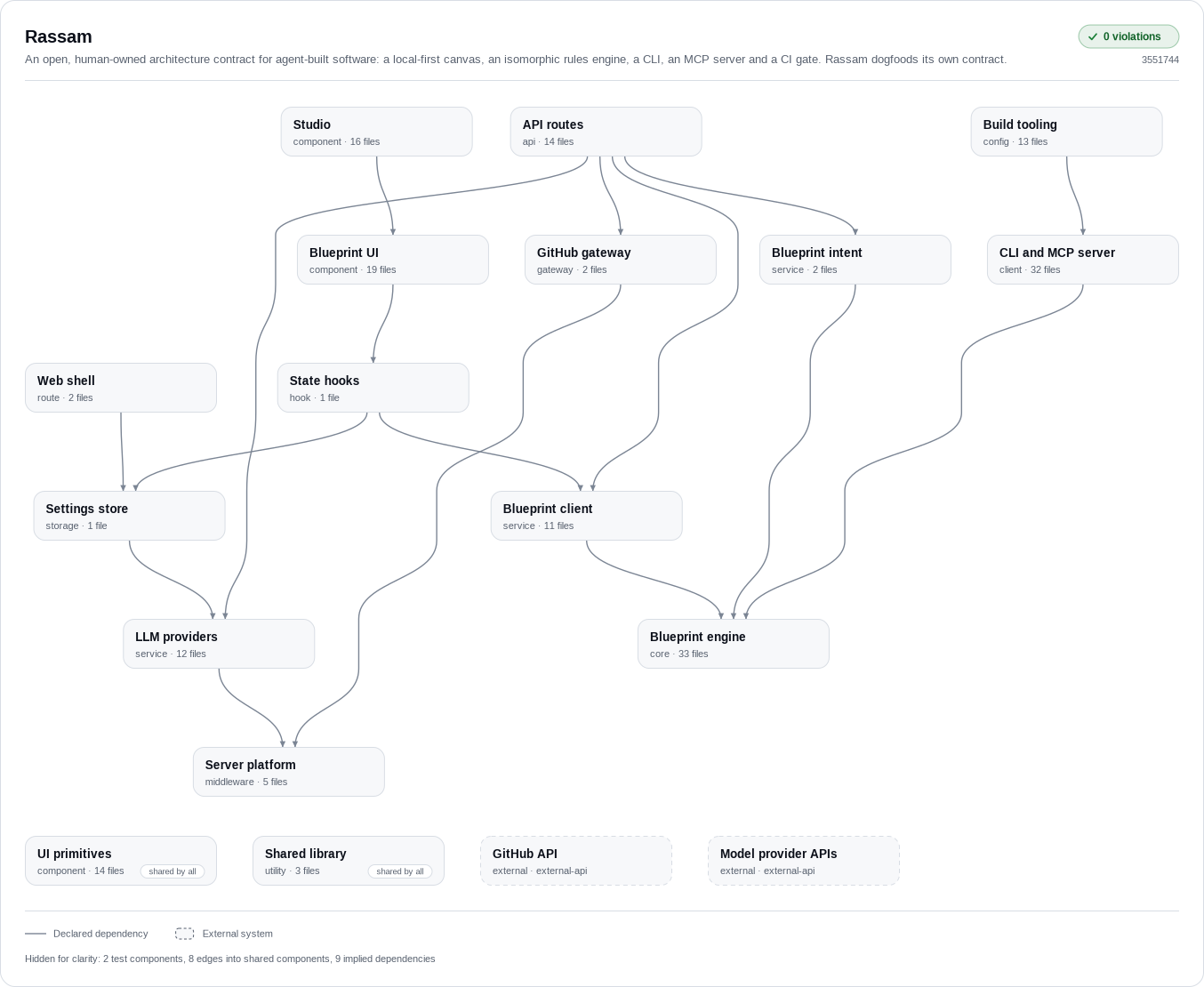


Updated on every push by Rassam · status as of 2026-11-24 18:23 UTC
Components (20)| Component | Kind | Status | Intent |
|---|---|---|---|
| Web shell | route | — | Next.js pages that mount the Studio and the settings page. Thin wiring only: no business logic, no data access. Logic belongs in hooks and libraries so it can… |
| API routes | api | — | Server route handlers. Every request body is untrusted and validated with zod; every route goes through request-security (rate limits, origin checks). Credenti… |
| UI primitives | component | — | The design system: tokens-driven buttons, sheets, popovers, pills and status glyphs. Status is never shown by colour alone; everything is keyboard reachable. D… |
| Studio | component | — | The first screen and the main product: is the project on track? Five persistent elements only (source pill, health pill, canvas, intent bar, zoom cluster). Peo… |
| Blueprint UI | component | — | Where humans author the contract and rule on exceptions: the blueprint canvas, the ranked attention list, rule and intent editors, and the reach view. It must… |
| State hooks | hook | — | Client state and lifecycles for blueprint sessions: loading a source, drafts, proposals, history and live status. Hooks own state; components render it. |
| Blueprint client | service | — | Browser-side host for the engine: loads a blueprint for a GitHub project through the API, or reads and writes a local folder through the File System Access API… |
| Settings store | storage | — | Browser-side persistence of the chosen provider, model and generation settings in localStorage. It stores choices and cached availability, never credentials. |
| Blueprint intent | service | — | Server-side helpers for "tell Rassam what to change": builds the model prompt (edit operation catalogue, selector grammar, a compact blueprint digest inside da… |
| GitHub gateway | gateway | — | The only code that talks to GitHub and holds GITHUB_TOKEN. Resolves public repositories to a pinned commit and binds repository identity and commit with signed… |
| Server platform | middleware | — | Cross-cutting server concerns: rate limiting, origin and deployment checks, request parsing, the error envelope and privacy-preserving telemetry. |
| LLM providers | service | — | Adapters over model providers behind one interface, and the resolver that turns a requested provider and model into exactly that configured runtime, with no si… |
| Shared library | utility | — | Runtime-neutral code shared by browser and server: zod request contracts and limits, version constants and small utilities. Nothing here may need Node or serve… |
| Blueprint engine | core | — | The isomorphic heart of Rassam: blueprint format, import graph, rules, gate, reach analysis and reports. It runs unchanged in the CLI, the MCP server, CI and t… |
| CLI and MCP server | client | — | The Node host: `rassam` commands, git and GitHub Actions integration, and the dual-era MCP server agents call before acting. Agent proposals and escalations ar… |
| Build tooling | config | — | Build, lint, test and bundling configuration, including the CLI bundle consumed by the GitHub Action. |
| Tests | test | — | Unit, integration and browser tests. Tests may depend on anything; nothing may depend on tests. |
| Gate benchmark | test | — | Labeled scenarios (documented agent reward hacks, architecture violations, reach problems and legitimate changes) that measure the gate's recall and false posi… |
| GitHub API | external external-api | — | Public repository trees and blobs, and PR comments from the GitHub Action. |
| Model provider APIs | external external-api | — | DeepSeek, OpenAI, Anthropic, Google and Ollama endpoints, called only through llm-providers. |
Want the same in your README? It takes one workflow file. Tell Rassam where a component runs (rassam do "monitor api at https://api.example.com/health" --write) and the picture shows whether it's up, refreshed every few minutes with an "as of" time.
The Studio: see it, say what to change
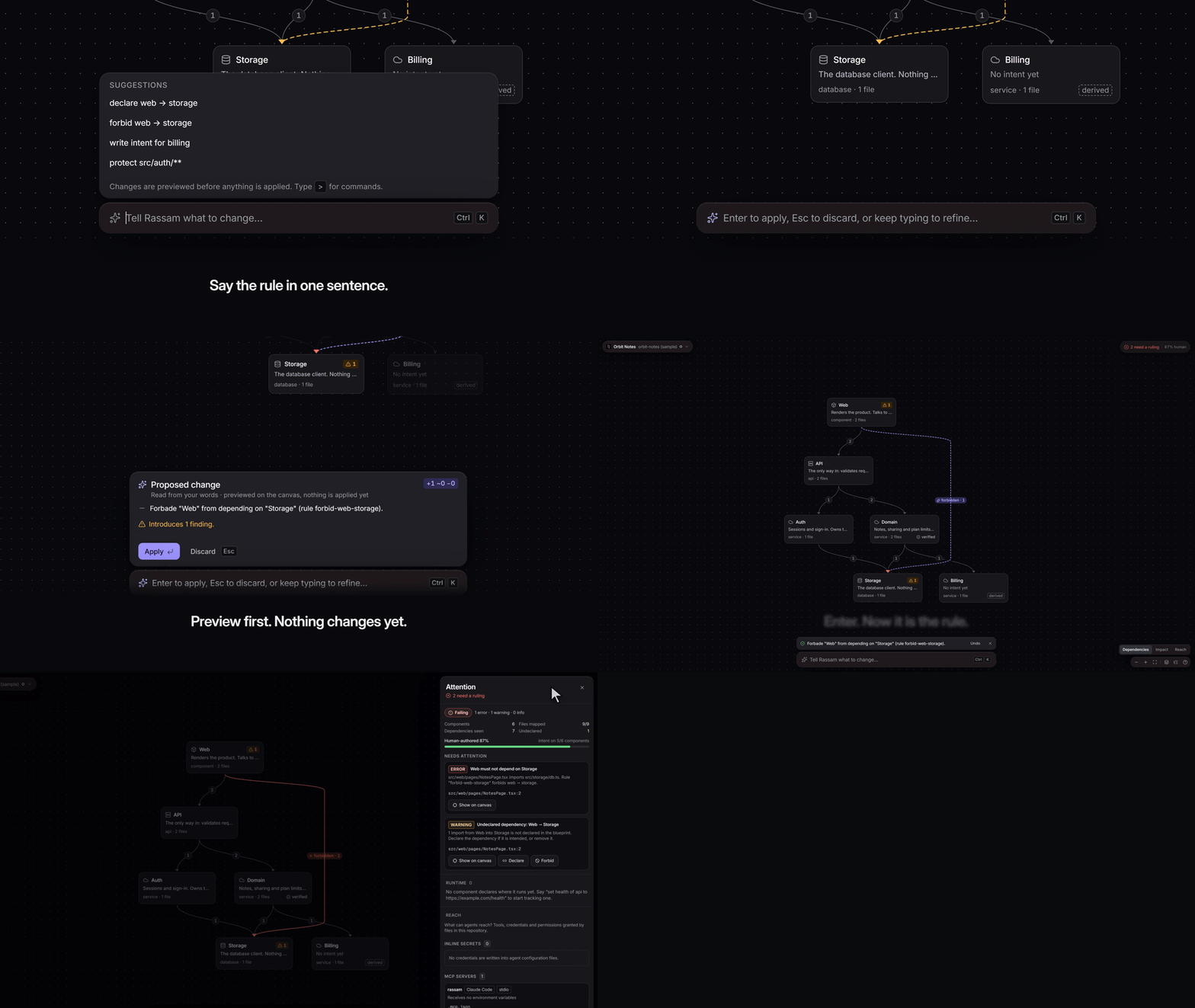
14 seconds of it. Download the full 56-second demo (MP4, 8 MB, no sound needed).
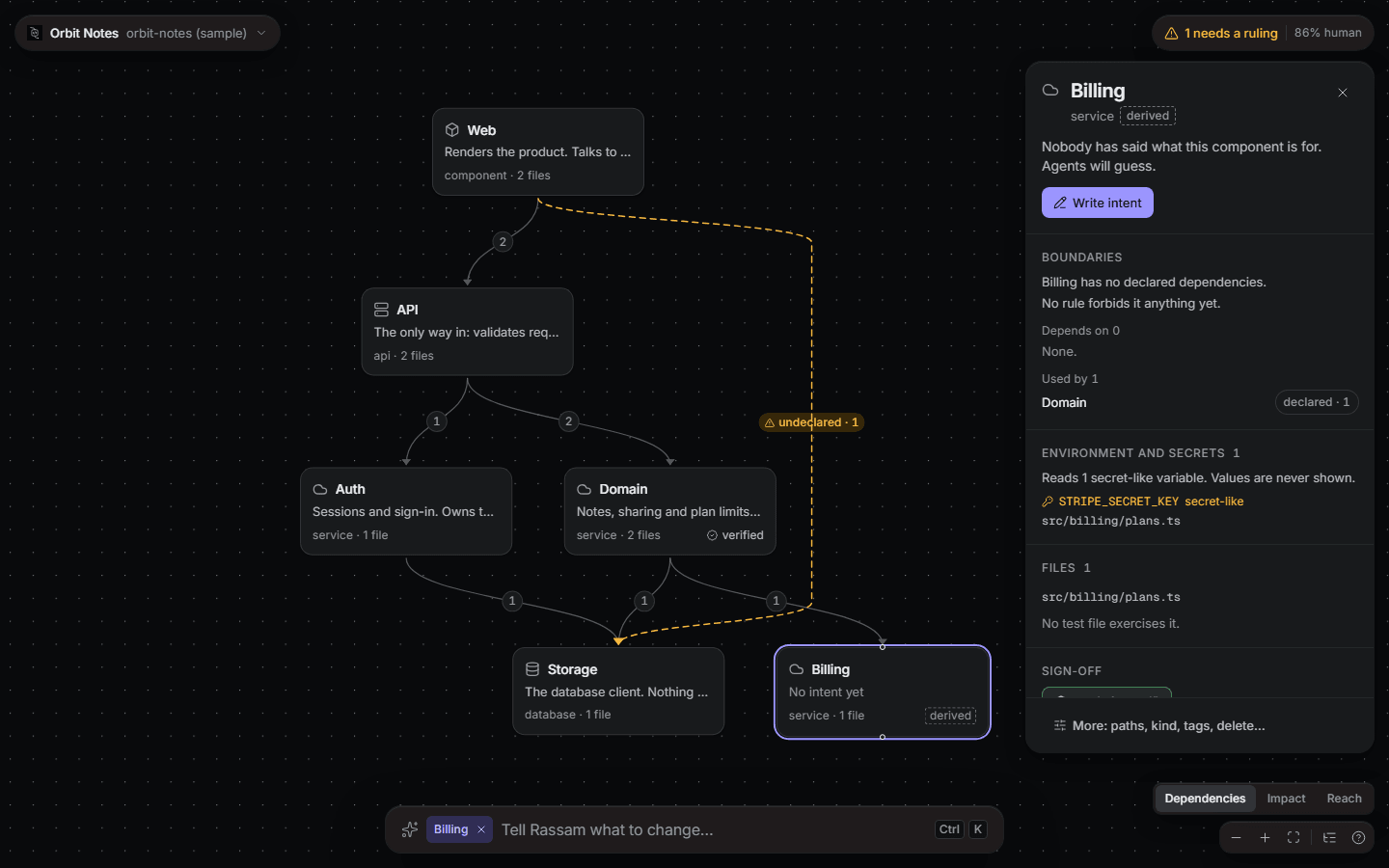
A web app for reading and editing the contract: paste a public GitHub URL or open a local folder (Chrome or Edge; it saves straight back into your repo). Type what you mean, see it on the canvas first, then hit Enter:
forbid web from importing storage because the UI must go through the API
add a component Payments for src/payments
only payments may read STRIPE_*
domain may only depend on util and shared
Nothing changes until you apply it, every change has an Undo, and loosening a rule always asks twice. The common commands work with no AI key; plug in a model in Settings for free-form requests.
| One health pill. "On track" or "2 need a ruling". Click it for a short, ranked list with the exact file and line. | Click any component to see what it is for, what it may depend on, and which secrets it reads. |
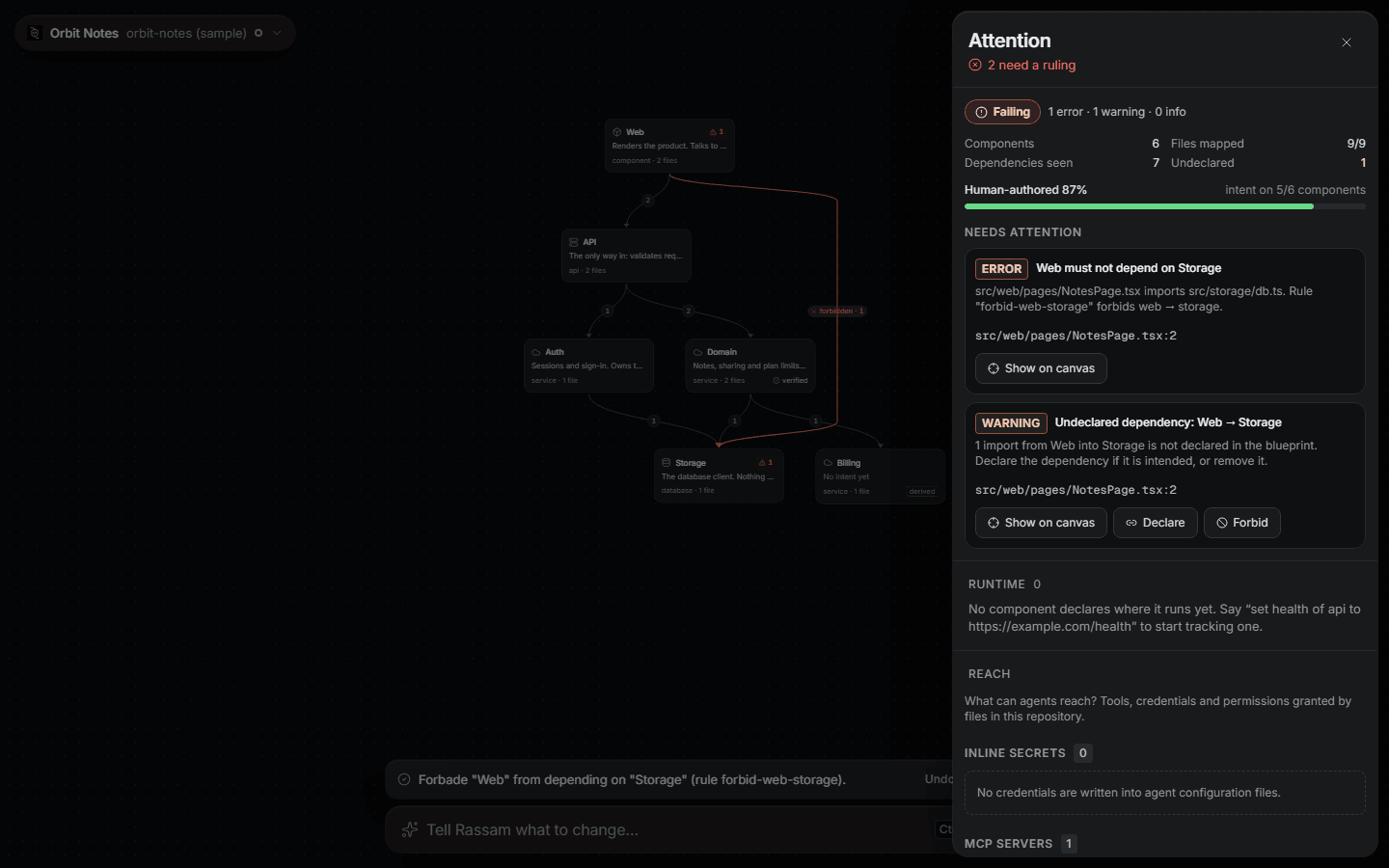 |
 |
Run it locally:
git clone https://github.com/V0ightt/Rassam && cd Rassam
npm install
npm run dev          # open http://localhost:3000 and click "Try the sample"
All the commands
| Command | In plain words |
|---|---|
rassam init |
Draft a blueprint from the code, then wire up agents and CI |
rassam check [--base main] |
Check everything, or just what your branch changed |
rassam instructions [--write] |
State the contract as rules in AGENTS.md |
rassam do "<sentence>" |
Change the blueprint by describing the change |
rassam explain <path> |
What governs this file? |
rassam impact <paths> |
What depends on these? |
rassam render [--readme] |
Draw the system diagram (and update the README block) |
rassam status |
Check what is running |
rassam sync |
Add what the code has that the blueprint lacks |
rassam verify <id> |
Sign off: "a human checked this" |
rassam reach |
What can agents touch? Tools, permissions, secrets |
rassam mcp |
Start the MCP server for agents |
rassam is npx @v0ightt/rassam, or plain npx rassam after npm install --save-dev @v0ightt/rassam.
Under the hood
| Folder | What lives there |
|---|---|
src/blueprint/ |
The engine: format, import analysis (TS/JS, Python, Go, Java, Kotlin, Rust, C/C++, Ruby), rules, gate, prose, diagram. Runs the same in the CLI, CI and the browser |
src/cli/ |
The rassam command and the MCP server |
packages/rassam/ |
The npm package: the single-file CLI bundle, nothing else |
action.yml, action/dist/ |
The GitHub Action |
src/components/studio/ |
The Studio |
.rassam/blueprint.json |
Rassam's own blueprint. Yes, it checks itself on every PR |
npm test             # 1,400+ tests
npm run typecheck && npm run lint
npm run build
npm run rassam -- check --base main
Why we built it this way, with sources: the research report. What we still need to prove: the evaluation plan. How releases are cut: docs/releasing.md.
Say hi
Discord v0ight_ · LinkedIn · [email protected]
License
Apache License 2.0. Use it at work, change it, ship it; keep the license and the notice with it.
Built with Claude. Thanks to the GitHub Student Developer Pack.
Yorumlar (0)
Yorum birakmak icin giris yap.
Yorum birakSonuc bulunamadi