opencode-rust
Health Uyari
- License — License: MIT
- Description — Repository has a description
- Active repo — Last push 0 days ago
- Low visibility — Only 8 GitHub stars
Code Basarisiz
- rm -rf — Recursive force deletion command in clean.sh
Permissions Gecti
- Permissions — No dangerous permissions requested
Bu listing icin henuz AI raporu yok.
The open source AI coding agent, in Rust. CLI, TUI and HTTP server for local AI agents — no Docker required.
opencode-rust
The open source AI coding agent, in Rust.
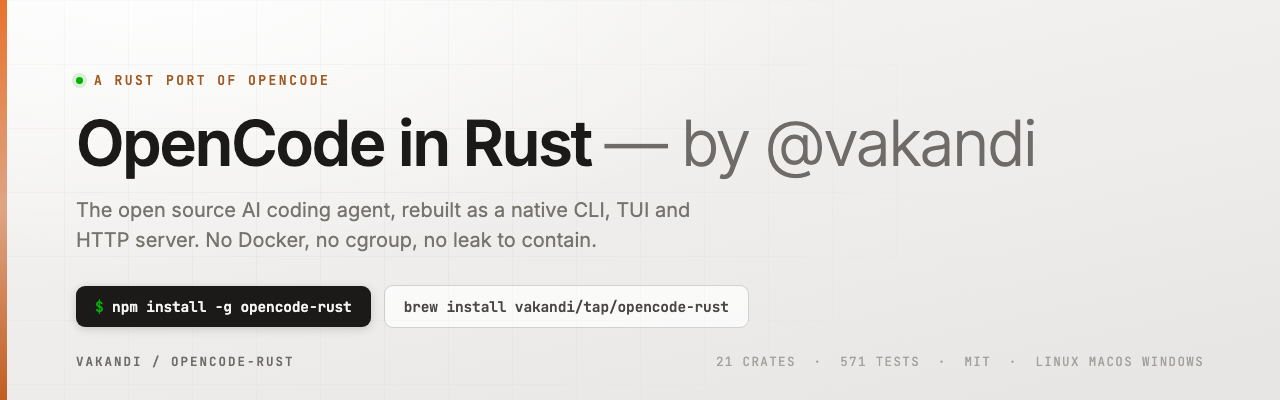





A Rust implementation of OpenCode — CLI, TUI and HTTP server for local AI agents. Sessions, tool execution, MCP, LSP and a TypeScript plugin bridge, with no container runtime.
Installation
Three supported surfaces. They install the same engine under the same opr command, but they are
not interchangeable — opr is a dispatcher in some and a symlink in others.
npm — Linux, macOS, Windows
npm install -g opencode-rust
The launcher is a Node script, which is what makes Windows work at all — install.sh writes a
bash case statement that Windows cannot execute.
Install never compiles. Prebuilt binaries arrive as separate packages, one per platform, and npm
pulls only the one your machine needs:
opencode-rust-darwin-arm64·opencode-rust-darwin-x64opencode-rust-linux-x64-gnu·opencode-rust-linux-arm64-gnu·opencode-rust-linux-x64-muslopencode-rust-win32-x64-msvc
If no binary matches your platform the installer prints the alternatives and exits cleanly, rather
than failing your install or forcing a Rust toolchain on you. Building from source is always an
explicit choice.
Homebrew — macOS and Linux
brew install vakandi/tap/opencode-rust
Installs opencode and links opr to it. This formula builds from source, so the first install
pulls a Rust toolchain as a build dependency — which is exactly the work npm refuses to do duringnpm install.
From source
git clone https://github.com/vakandi/opencode-rust.git
cd opencode-rust
./install.sh          # builds the release binary and installs `opr`
install.sh fingerprints every .rs file plus Cargo.toml/Cargo.lock. Re-running it when the
code is unchanged skips the rebuild entirely; --force rebuilds regardless.
opr                                   # interactive TUI
opr run "check this repo for risks"    # one prompt, runs to completion
opr serve --port 3000                 # HTTP server
oprbehaves slightly differently per install. Through npm it is a dispatching script, soopr --some-flagbecomesopencode tui --some-flag. Through Homebrew it is a plain symlink, so
the same command becomesopencode --some-flagand is rejected — name the subcommand instead
(opr tui --some-flag).
Named-agent shortcuts
install.sh also installs one shortcut per agent, each running a single prompt as that agent:
gilfoyle  "fix this failing test"     # --agent gilfoyle
setbon    "write 5 ad hooks"          # --agent setbon
googlebot "audit my meta tags"        # --agent googlebot
No prompt given → usage on stderr and exit 2.
Requirements
Node 18+. The engine spawns Node subprocesses for its plugin bridge and launches MCP servers
through npx, so Node is required regardless of how it was installed.
A provider key is needed before the first run:
export ANTHROPIC_API_KEY=sk-ant-...
Why Rust
OpenCode's engine was TypeScript. It held conversation history in RAM, re-derived the full tool
schema set on every LLM step, and kept per-directory instance state (MCP servers, LSP servers,
plugins) unbounded and never evicted. A Docker runtime existed to contain that.
It wasn't enough. Five teams of five agents pinned the CPU at 99% on a MacBook Pro M5 and the
machine became unusable. That was the limit, not the workload.
Rust replaces it. Conversation history spills to SQLite, request bodies stream, tool schemas are
cached per (model, tool-set), and instance state is pooled by config hash with LRU+TTL eviction.
No container, no cgroup, no leak to contain.
The TUI
The terminal UI is where most of the engineering went, and where the bugs were subtlest.
Messages stay inside their bubble
render_messages builds a single Paragraph across the whole messages area, so it depends on an
invariant nothing enforces: every line must already be at most content_width wide. Most branches
route through paint_block_lines, which wraps and pads to establish it. Two did not — system
notices, and tool calls, where render_tool_call had no width parameter at all and budgeted with a
hardcoded 96. A failed tool call rendered 107 columns into a 60-column bubble. Both now respect
the width they are given, and an assistant message carrying an API error renders that error instead
of parsing and discarding it.
The / popup is anchored and scrolls
It was handed frame.size(), so area.y was always 0 and its saturating_sub pinned the popup
to row 1 of the screen, far from the input. It also called render_widget, which builds a
throwaway ListState — so the list never scrolled while the highlight advanced, and a query
matching nothing hid the popup while still capturing every keystroke. It is now anchored to the
prompt rect, scrollable, shows the literal token you must type, and says "No matching commands"
instead of vanishing.
Streaming actually streams
The SSE listener existed and did nothing useful. Deltas arriving before their message was in the
local transcript were silently dropped; submitting a prompt never armed the fast sync lane; and
every surviving delta triggered a full transcript refetch that overwrote it — roughly fifteen full
fetches per second instead of streaming. Deltas are now buffered and replayed, the fast lane is
armed on submit, and an applied delta triggers a redraw rather than a refetch.
Agent models are the ones you configured
/agent dropped model and model_preference from the response, so the TUI fell back to a global
default and displayed a model no agent had asked for. On top of that, oh-my-opencode keeps its
agents in ~/.omo/omo.jsonc rather than opencode.json, and plugins register agents under display
names like Atlas - Plan Executor while config files key them by slug (atlas) — so an exact-key
lookup missed and the configured model never landed on the agent.
Agents are now matched by canonical slug, user config outranks a plugin config hook, and the
default agent is gilfoyle.
run does not abandon its work
The single most important behaviour in this engine.
run used to call AgentExecutor::execute_streaming — one provider call that never executed a
tool. A turn that spawned a subagent, a team, or a background task printed[Calling tool: …] and the process exited, taking that work with it. The TUI masked this because
the TUI never exits.
run now drives SessionPrompt, the same loop the HTTP server uses, so tools actually run and
awaited subagents complete. After the turn it holds the process open until the work it started is
genuinely finished:
| Stage | What it waits for |
|---|---|
| 1. The turn | prompt_with_update_hook returns — tools run, awaited subagents land, pending subtasks drain |
2. session.idle |
Fires the notification omo needs to release its background manager (the CLI never fired this before — a second, independent cause of the cut-off) |
| 3. Children | omo records each spawned subagent/team member as a real row in its own SQLite database; run streams their frames and waits for them to go quiet |
| 4. Ledger | .omo/run-continuation/<session>.json background-task state, with a staleness guard |
The drain fails open, never hangs: no database means no children, a missing ledger file means
idle, corrupt JSON means idle, and a stale active entry is treated as finished after the
staleness window. --wait-background-timeout <SECONDS> caps the wait (default 120 s).
MCP actually works
MCP was declared in config and silently dead. Three separate defects, each verified in isolation:
| Defect | Symptom | Cause |
|---|---|---|
| stdio framing | Every MCP server timed out at boot | The transport wrote Content-Length: N\r\n\r\n{…} — LSP framing. MCP stdio is newline-delimited JSON, so every server ignored our bytes |
| config deserialisation | Zero tools after a "successful" boot | McpServerConfig was an untagged enum whose toggle variant {enabled} matched a full local server first (it also carries enabled), so every definition was discarded. Replaced with an explicit Deserialize |
| sequential boot | Slowest server held up the rest | Servers started one after another with no bound; now started in parallel under a 90 s ceiling |
After the fix: 3 servers start in ~4 s and 77 tools are exposed to agents. Tools reach the
model and execute — the proxy registers into the same per-turn ToolRegistry that resolves the
call.
Plugin bridge
Plugins are Node subprocesses (kill_on_drop). team_create is a blocking JSON-RPC into that
subprocess. The reverse channel already exists — sendNotification on the TS side, correlated byparams.requestId on the Rust side — and is what lets a host observe in-flight progress.
Proxies
The engine ships a rotating residential proxy: a local HTTP/CONNECT forwarder on loopback that
re-selects the oldest-used upstream every 120 seconds, so long agent runs do not burn through a
single egress IP. Candidates are probe-gated — one must open a real CONNECT before it can become
the process egress — and a rejected one is quarantined rather than retried forever.
Where the pool file goes
<data-dir>/opencode/proxy-pool.txt
Concretely:
- macOS —
~/Library/Application Support/opencode/proxy-pool.txt - Linux —
~/.local/share/opencode/proxy-pool.txt - Windows —
%LOCALAPPDATA%\opencode\proxy-pool.txt
If OPENCODE_PATHS_ROOT is set, it wins over all of the above and the file is$OPENCODE_PATHS_ROOT/opencode/proxy-pool.txt — the same lever that moves the database and
credentials. Resolve the exact path at runtime with:
opr debug paths
Format
One proxy per line. Blank lines are skipped, and a malformed line is logged at debug level and
ignored rather than failing the whole pool.
198.51.100.10:8080
203.0.113.24:1080

# (host:port:user:pass)
198.51.100.31:3128:myuser:mypass

# (host:port plus metadata cells)
203.0.113.77:8000 | note:rotates hourly
The first two colon-separated fields are required — host and a port that parses above zero.
Optional user and pass follow, and pass may itself contain colons. Anything after a | separator is metadata parsed by key (last:, dur:), not by position, so a line
carrying |dur: without |last: keeps its duration.
There is no comment syntax — a line beginning with # is simply a line that fails to parse, so
it is dropped with a debug-level log line per occurrence. Keep the file to bare entries.
Using it
Proxy setup must happen through opencode_proxy::start() rather than by exporting the variables
yourself: reqwest snapshots the proxy environment when its client is constructed, so the export
has to land before the provider registry is built. With an empty or unreadable pool, start()
returns an error instead of binding a listener that would answer 502 for everything — you get a
clear reason rather than a generic connection error.
Sibling files live next to the pool and are managed automatically:
proxy-quarantine.json— candidates that failed their probeproxy-claims.json— which session currently owns which upstream
Agents
Built-in agents are switched with Tab:
- build — default, full-access agent for development work
- plan — read-only agent for analysis and code exploration
Additional agents are defined in your config. ~/.omo/omo.jsonc (the oh-my-opencode agent store)
is read alongside opencode.json, and a model configured there wins over a plugin default. The
active agent's model is what the TUI displays and what the next prompt sends.
Feature overview
- Interaction modes — TUI (default),
run, HTTP server, Web, ACP - Sessions — create, continue, fork, import/export, parent/child links
- Tool system — 22 built-in tools plus live MCP tools in one registry
- Permissions — per-path scoping; last matching rule wins
- Providers — multi-provider with routing, reasoning-effort control, streaming tool calls
- Extensibility — TypeScript plugin bridge, MCP stdio + HTTP, LSP
- Storage — SQLite (plural schema:
sessions,messages,parts)
CLI commands
tui      attach   run      serve    web      acp      models
session  stats     db       config   auth     agent    debug
mcp      export    import   github   pr       upgrade  uninstall
generate version
run flags:
--command  --continue  --session  --fork  --share  --agent  --format
--title    --attach    --dir      --port  --variant  --thinking
--wait-background-timeout <SECONDS>
Configuration
Merged from these paths, searched upward:
opencode.jsonc·opencode.json·.opencode/opencode.jsonc·.opencode/opencode.json
Global default: ~/.config/opencode/opencode.json[c].
Agent definitions are also read from ~/.omo/omo.jsonc and ~/.config/omo/omo.jsonc — the file
oh-my-opencode actually keeps them in. Resolve the data location at runtime with:
opr db path
Repository structure
crates/
  opencode-cli        CLI entrypoint (binary: opencode) + agent aliases
  opencode-server     HTTP/SSE/WebSocket server, MCP loader
  opencode-session    Session prompt loop, subtasks, status
  opencode-agent      Agent executor (looping + streaming variants)
  opencode-tool       22 built-in tools + registry + permission context
  opencode-provider   Provider adapters (OpenAI, Anthropic, …)
  opencode-mcp        MCP client + stdio/HTTP transports
  opencode-plugin     Plugin host bridge (subprocess)
  opencode-lsp        LSP clients
  opencode-storage    SQLite storage
  opencode-tui        Terminal UI
  opencode-permission opencode-config  opencode-core  opencode-types
opencode-paths      opencode-command opencode-grep opencode-proxy
  opencode-util       opencode-watcher
npm/                   npm packages: launcher, platform binaries, opr alias, homebrew formula
docs/                  per-crate documentation
Per-crate documentation lives in docs/.
Operations
| Script | Purpose |
|---|---|
install.sh |
Build + install opr and agent aliases. --force rebuilds |
clean.sh |
Refuses to clean while this repo's binary is running, warns before touching an opencode that is not ours, clears target/ |
Publishing
Releases go out through GitHub Actions on a v* tag, using npm trusted publishing — the
workflow exchanges a short-lived OIDC JWT for a publish credential. There is no long-lived token
in the repo and no 2FA code to type.
Trusted publishing must be configured once per package on npmjs.com under
Settings → Trusted Publisher, pointing at vakandi/opencode-rust and.github/workflows/publish.yml. Without that the workflow cannot authenticate.
To publish by hand instead:
cd npm/platform/opencode-rust-darwin-arm64 && npm publish --access public
cd npm                                   && npm publish --access public
Order matters: the binary package must be on the registry before the launcher, because the
launcher declares it as an optional dependency.
Development
cargo test --workspace          # 571 tests
cargo build --release --bin opencode
cargo clippy --workspace --all-targets
Known limitation
run is verified against a real bash tool through the real session engine. It has not been
exercised end-to-end against a funded provider: free OpenRouter models reject the tool schema and
paid ones return 402 without credits. The loop is provider-agnostic, but we publish what we
measured rather than a result we did not get.
License
MIT — see LICENSE.
A Rust implementation of OpenCode. Not affiliated with
the OpenCode team.
Yorumlar (0)
Yorum birakmak icin giris yap.
Yorum birakSonuc bulunamadi