slv
Health Gecti
- License — License: Apache-2.0
- Description — Repository has a description
- Active repo — Last push 0 days ago
- Community trust — 85 GitHub stars
Code Basarisiz
- rm -rf — Recursive force deletion command in .github/workflows/slv-remote-build.yml
- fs module — File system access in .husky/check-solana-keys-node.js
Permissions Gecti
- Permissions — No dangerous permissions requested
Bu listing icin henuz AI raporu yok.
The AI Agent Kit for Solana Devs


SLV — AI-Powered Solana Node Deployment
Deploy Solana validators, RPC nodes, and gRPC streaming infrastructure through natural conversation with AI agents.
SLV provides Ansible playbooks, Jinja2 templates, and AI agent skills that let you deploy and manage Solana nodes by simply describing what you need. No manual configuration files, no memorizing commands — just tell your AI agent what to do.

Quick Start — Deploy with AI
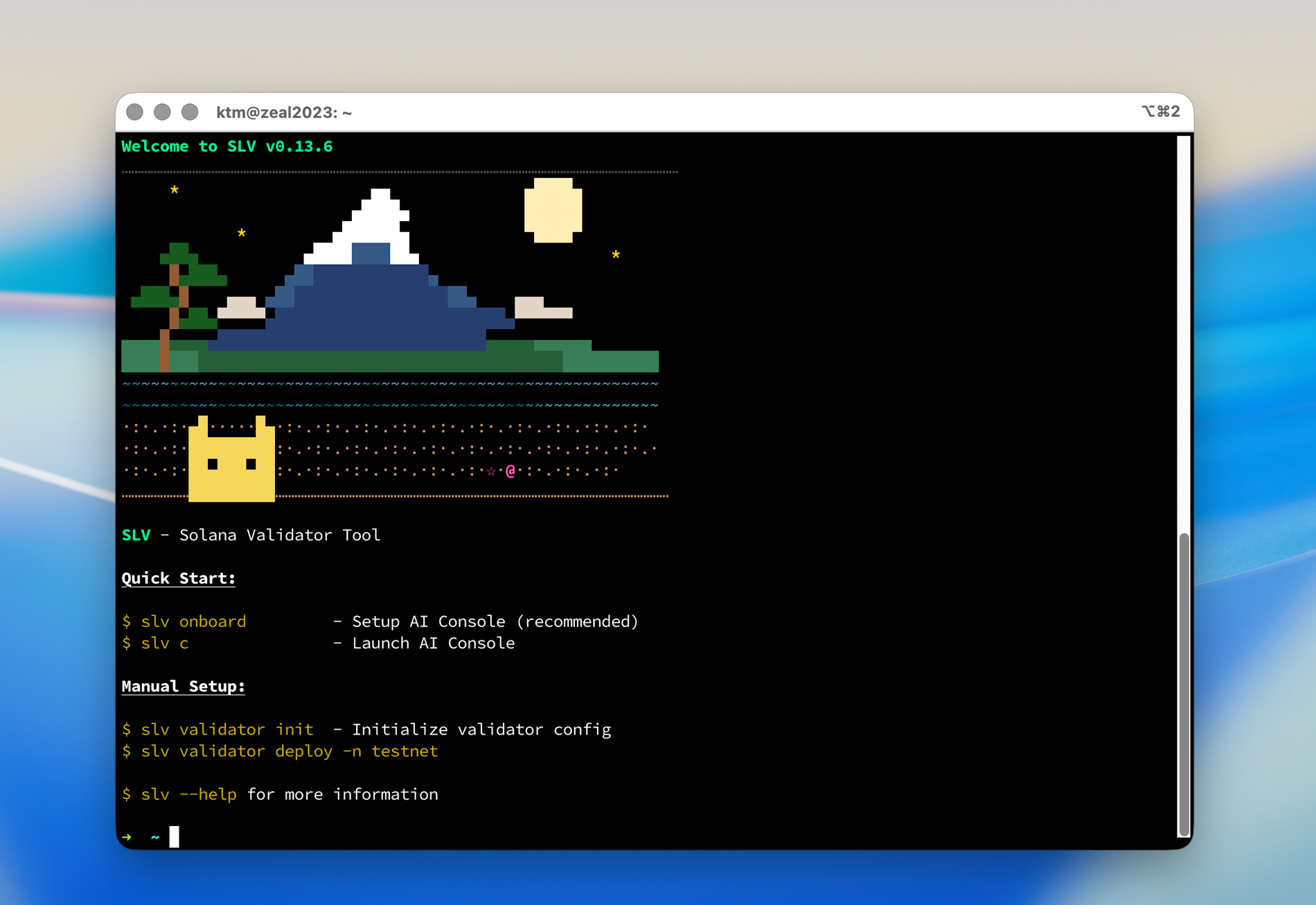
SLV CLI — The Fastest Way to Get Started
Install the CLI and launch the AI Console in 3 commands:
curl -fsSL https://storage.slv.dev/slv/install | sh
slv onboard    # Configure AI provider, API keys, and agent settings
slv c          # Launch AI Console — deploy nodes through conversation
The AI Console (slv c) gives you a rich terminal UI where specialist agents handle everything:
- Cecil — Validator deployments (Jito, Agave, Firedancer)
- Tina — RPC & gRPC Geyser deployments
- Figaro — Server procurement and pricing
- Setzer — Trading bots and Solana apps
Just describe what you need. The agent handles SSH setup, key generation, inventory creation, builds, snapshot download, and monitoring.
See slv.dev for full documentation.
ERPC Network Benefits
Servers purchased through erpc.global automatically get:
- Dedicated snapshot endpoints — 7 global regions for fast node bootstrapping
- Internal routing — dramatically lower bandwidth costs
- Auto-detection — SLV automatically finds the nearest snapshot server via ping
For Developers
# Clone and run locally
git clone https://github.com/ValidatorsDAO/slv.git
deno task dev --help

# Build
deno task build

# Test
deno test -A
🚀 Just want to deploy? Run
slv onboardthenslv c— see SLV CLI below.
Prerequisites
- ansible-core >= 2.15 (
pip install ansible-core) - SSH access to target servers (key-based authentication)
- solana-cli (optional, for local key generation)
Run the setup script to auto-install:
bash scripts/setup.sh
1. Install a Skill
SLV skills work with any AI coding agent — OpenClaw, Claude Code, Codex, Cursor, Windsurf, and more. Pick the method that fits your setup:
OpenClaw (via ClawHub)
npx clawhub install slv-validator
Claude Code
# Copy skill into your project
cp -r dist/oss-skills/slv-validator /your/project/.claude/skills/
Codex / Cursor / Other AI Agents
# Add SKILL.md to your agent's context
cp dist/oss-skills/slv-validator/SKILL.md /your/project/AGENTS.md
# Or reference it in your agent's config
Direct from GitHub
# Clone just the skill you need
git clone --depth 1 https://github.com/ValidatorsDAO/slv.git
cp -r slv/dist/oss-skills/slv-validator ./my-skill
Skills are just Markdown files (SKILL.md + AGENT.md) with Ansible playbooks — any AI that can read files and run commands can use them.
2. Talk to Your Agent
You: Deploy a mainnet Jito validator on 203.0.113.10

Agent: I'll set up a mainnet Jito validator. Let me walk you through the configuration:
       - Server IP: 203.0.113.10
       - What SSH user should I use? (default: solv)
       - Do you have existing validator identity and vote account keys,
         or should we generate new ones?
       ...
The AI agent guides you through the entire process interactively:
- Collects configuration — server details, validator type, keys, network settings
- Validates inputs — checks SSH connectivity, key formats, version compatibility
- Generates inventory — creates Ansible inventory from your responses
- Offers dry-run — shows what will happen before executing
- Deploys — runs the appropriate Ansible playbooks
- Monitors — tracks startup progress and slot sync
3. Manage Your Nodes
You: Restart the validator on 203.0.113.10
You: Update Solana to v3.1.8 on my RPC node
You: What's the slot sync status?
You: Switch validator identity with zero downtime
Available Skills
| Skill | ClawHub | What It Does |
|---|---|---|
| slv-validator | npx clawhub install slv-validator |
Deploy & manage mainnet/testnet validators (Jito, Agave, Firedancer) |
| slv-rpc | npx clawhub install slv-rpc |
Deploy & manage RPC nodes (Standard, Index, Geyser gRPC, Index+gRPC) |
| slv-grpc-geyser | npx clawhub install slv-grpc-geyser |
Deploy & manage gRPC Geyser streaming (Yellowstone, Richat) |
Each skill includes:
- SKILL.md — Complete playbook knowledge for the AI agent (works with any AI)
- AGENT.md — Interactive deployment flows and behavior rules
- scripts/setup.sh — Auto-install prerequisites (ansible-core, SSH, solana-cli)
- ansible/ — Ansible playbooks (can also be used standalone)
- examples/ — Sample inventory files
No lock-in. Skills are plain Markdown + Ansible. Use them with any AI agent, or run the playbooks directly without AI.
How It Works
SLV uses Ansible playbooks and Jinja2 templates to deploy Solana nodes. The AI agent skills wrap this infrastructure with conversational interfaces:
User request → AI Agent (SKILL.md knowledge) → Ansible playbooks → Target server
Key design principles:
- Remote-only — all configuration from your local machine, no direct node logins
- Dummy key start — validators always start with an unstaked identity, then switch
- Source builds — Solana binaries built from GitHub source (no pre-built downloads)
- Firewall-first — SSH IP restrictions and nftables configured during init
Using Without AI (Direct Ansible)
You can also use the playbooks directly:
cd dist/oss-skills/slv-validator/ansible/

# Deploy a mainnet Jito validator
ansible-playbook -i inventory.yml mainnet-validator/init.yml \
  -e '{"validator_type":"jito","solana_version":"v3.1.8-jito","snapshot_url":"https://..."}'

# Restart a validator
ansible-playbook -i inventory.yml mainnet-validator/restart_node.yml

# Build Solana from source
ansible-playbook -i inventory.yml cmn/build_solana.yml \
  -e '{"solana_version":"v3.1.8"}'
Community
Contributing
Bug reports and pull requests are welcome. This project follows the Contributor Covenant code of conduct.
License
Yorumlar (0)
Yorum birakmak icin giris yap.
Yorum birakSonuc bulunamadi