vast-admin-mcp
Health Uyari
- License — License: NOASSERTION
- Description — Repository has a description
- Active repo — Last push 0 days ago
- Low visibility — Only 9 GitHub stars
Code Basarisiz
- rm -rf — Recursive force deletion command in deploy/kubernetes/create-tls-secret.sh
- Hardcoded secret — Potential hardcoded credential in deploy/kubernetes/vast-admin-mcp.yaml
Permissions Gecti
- Permissions — No dangerous permissions requested
This tool is a Model Context Protocol (CP) server that allows AI assistants to interact with VAST Data clusters for monitoring, management, and diagnostics.
Security Assessment
Overall Risk: Medium. The server inherently handles sensitive data by requiring administrative credentials to manage your VAST Data cluster. During deployment, it makes network requests to communicate with cluster APIs. The automated security scan raised two significant code failures: a potential hardcoded secret was found in a Kubernetes deployment file, and a recursive force deletion (`rm -rf`) command was detected in a shell script. While it claims to offer secure credential storage via keyrings and supports token-based authentication, the underlying deployment templates require a manual code review before use.
Quality Assessment
The project is actively maintained, with its most recent code push occurring today. However, it currently has very low community visibility and engagement, sitting at only 9 GitHub stars. It does use a standard Apache-2.0 license as noted in the documentation, though the repository metadata scanner was unable to assert the license automatically. Because of the low community adoption, external auditing and public trust are currently minimal.
Verdict
Use with caution — thoroughly review the Kubernetes deployment files for hardcoded credentials and validate all shell scripts before integrating this into your environment.
MCP server for VAST Data cluster administration - monitoring, management, and diagnostics
VAST Admin MCP Server




VAST Admin MCP Server is a Model Context Protocol (MCP) server for VAST Data administration tasks. It provides AI assistants with tools to interact with VAST clusters for monitoring, listing, and management operations. It is supported both for Cluster and Tenant admins.
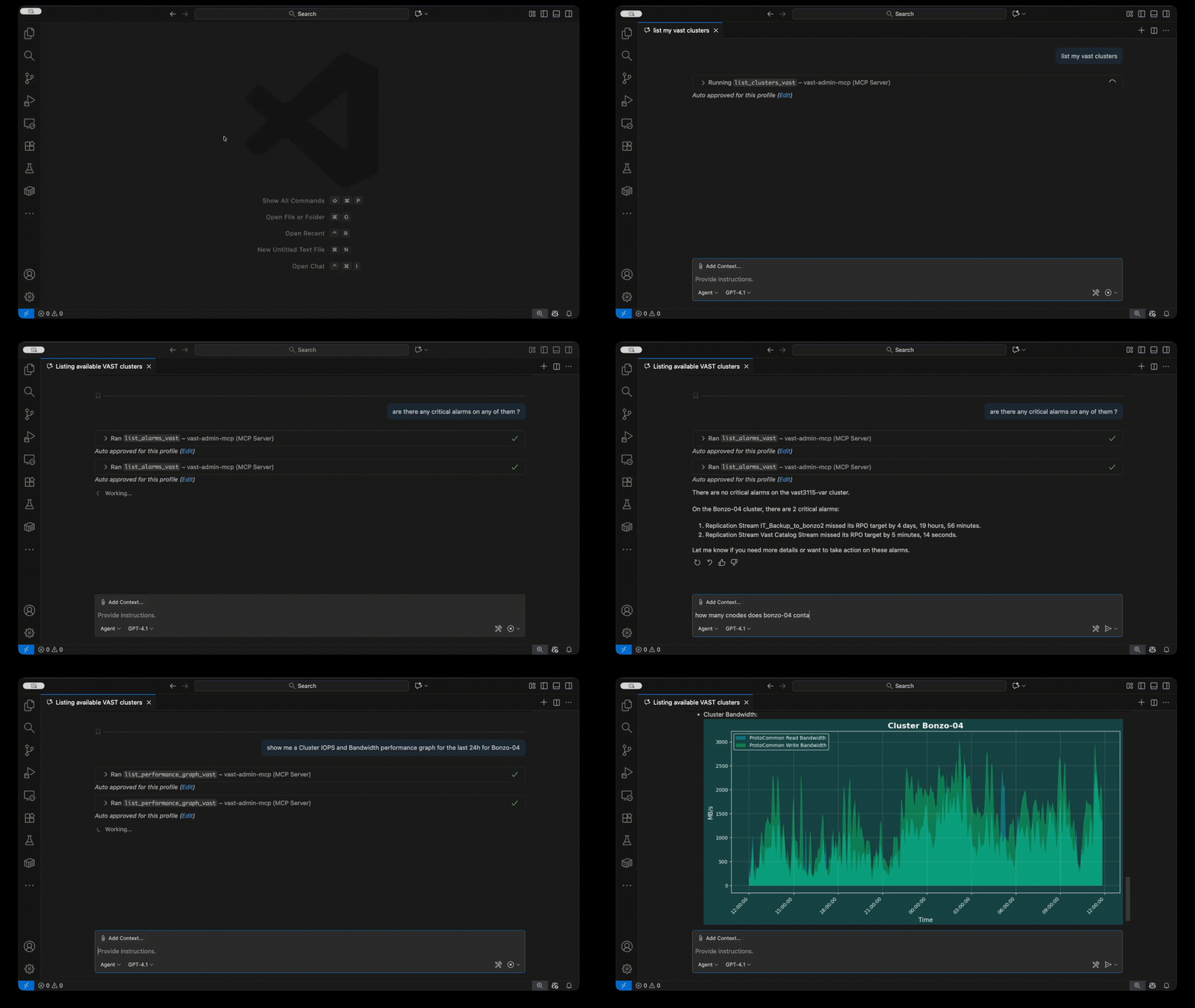
Features
- MCP Integration: Full MCP server implementation for AI assistant integration
- Network Deployment: HTTP transport for remote access, Kubernetes, and containerized deployments
- Cluster Management: List and monitor VAST clusters
- Performance Metrics: Retrieve performance data for cluster objects and graphs generation
- Dynamic List Functions: Automatically generate MCP functions from YAML templates for end user modifications
- Secure Credentials: Secure password storage using keyring, with K8s Secrets API support
- Authentication: Bearer token and OAuth/OIDC support for network deployments
- Read-only and Read-write Modes: Control access level (read-write mode for create operations)
Quick Start
1. Install
Install vast-admin-mcp:
# If installed via pip
pip install vast-admin-mcp
2. Initial Setup
Configure your VAST cluster connection:
# If installed via pip
vast-admin-mcp setup


This will prompt you for:
- Cluster address (IP, FQDN, or URL like `https://host:port`)
- Username and password
- Tenant (for tenant admins)
- Tenant (for super admins - which tenant context to use)
3. Configure MCP Server in you AI assistance
Use mcpsetup to get instructions for common AI assistance tools:
# create the syntax for popular ai assistances (currently has builtin support for cursor,claude-desktop,windsurf,vscode)
vast-admin-mcp mcpsetup vscode
🔧 Configuring MCP server for: vscode
   Detected command: vast-admin-mcp
   Detected args: ['mcp']

📋 VSCode Configuration Instructions
   Config file location: /Users/user/.vscode/mcp.json

    Create a new file if not exists, or add the VAST Admin MCP entry to the existing 'servers' section:
    {
        "servers": {
            "VAST Admin MCP": {
                "command": "vast-admin-mcp",
                "args": [
                    "mcp"
                ]
            }
        }
    }

📝 Next steps:
   1. Edit or create the config file at the location shown above
   2. Restart VSCode
   3. The MCP server should be available in VSCode's MCP tools
   4. Test by asking VSCode to list VAST clusters
** Add the --read-write flag as a 2nd argument to be able to make updates in VAST clusters
Prompt Examples
For Read-only mode
List all VAST clusters
List all views on cluster cluster1
Show me all tenants across all clusters
Create bandwidth and iops graph for cluster1 over the last hour
create dataflow diagram for cluster1 for /path view on the tenant3 tenant for the last hour
show me dataflow diagram for 172.21.224.139 on cluster1
Show me the hardware topology for cluster cluster1
Are there any issues with my configured data protection relationships ?
Create mini support bundle on cluster1 and name it bundle1. Timeframe should be yesterday at midnight for 4m. Generate it only for cnodes prefixed by cnode-128 and upload it to support without private data.
Find all users prefixed with "s3" on cluster cluster1 tenant tenant1
Are there any critical alerts on my clusters that were not acknoledged ?
List all snapshots for view path /data/app1 on cluster cluster1 tenant tenant1
Show me all quotas configured for tenant tenant1 on cluster cluster1
Get performance metrics for cnodes on cluster cluster1 over the last 7 day
Show me all view policies on cluster cluster1 that support S3
First, get all available clusters. Then compare views with path "/" across all clusters, showing capcity information
Show me all tenants on cluster cluster1, for each tenant show me the 5 views with the highest used capacity
Get performance metrics for cluster cluster1, then get metrics for all cnodes, and finally get metrics for top 3 views. Show me a summary of IOPS and bandwidth for each object type
Find all views where logical used capacity is greater than 1TB. For each of these views, get their performance metrics over the last 24 hours and show which views have the highest IOPS
For Read-write mode
Create a new NFS view on cluster cluster1 with path /data/newview in tenant tenant1
Create a view on cluster cluster1 with path /shared/data in tenant tenant1 that supports both NFS and S3 protocols
Create a snapshot named "backup-2024-01-15" for view path /data/app1 on cluster cluster1, tenant tenant1 and keep it for 24h
Create a clone from snapshot "backup-2024-01-15" of view /data/app1. The clone should be at path /data/app1-clone in tenant tenant1 on cluster cluster1
Set a hard quota of 10TB for view path /data/app1 on cluster cluster1, tenant tenant1
Create 3 new views for vmware based on template.
Create a indestructible snapshot named resrote-point_<view name> for all vmware views on cluster1
Refresh a clone from most recent snapshot of view /data/app1 at path /data/app1-clone in tenant tenant1 on cluster cluster1
Installation
Prerequisites
- Python 3.10+
- jq: Command-line JSON processor (required for field transformations in YAML templates)
Installing jq
macOS:
brew install jq
Linux (Ubuntu/Debian):
sudo apt-get install jq
Linux (RHEL/CentOS):
sudo yum install jq
Basic Installation
pip install vast-admin-mcp
Optional Dependencies
# HTTP server support (for network deployment)
pip install 'vast-admin-mcp[http]'

# Kubernetes secrets support
pip install 'vast-admin-mcp[k8s]'

# SOCKS proxy support
pip install 'vast-admin-mcp[socks]'

# All optional dependencies
pip install 'vast-admin-mcp[all]'
Docker Installation
Building the Docker Image
Quick Build (Recommended)
Use the provided build script that automatically handles versioning:
make build-docker
This will:
- Extract version from
src/vast_admin_mcp/__about__.py - Tag the image with both version number and
latest - Add metadata labels (version, build date, git commit)
Manual Build
# Simple build
docker build -t vast-admin-mcp:latest .

# Build with version tags
VERSION=$(grep -E '^__version__' src/vast_admin_mcp/__about__.py | sed 's/__version__\s*=\s*"\([^"]*\)"/\1/')
docker build \
  --build-arg VERSION="${VERSION}" \
  --build-arg BUILD_DATE="$(date -u +'%Y-%m-%dT%H:%M:%SZ')" \
  --build-arg VCS_REF="$(git rev-parse --short HEAD)" \
  -t vast-admin-mcp:${VERSION} \
  -t vast-admin-mcp:latest \
  .
Running CLI Commands in Docker
Option 1: Using the helper script (recommended)
# Run any CLI command
./vast-admin-mcp-docker.sh clusters
./vast-admin-mcp-docker.sh list views --cluster cluster1
./vast-admin-mcp-docker.sh setup
./vast-admin-mcp-docker.sh mcpsetup cursor
Option 2: Using docker run directly
# One-off command execution
docker run --rm -it \
  -v ~/.vast-admin-mcp:/root/.vast-admin-mcp \
  vast-admin-mcp:latest \
  vast-admin-mcp list clusters
Option 3: Using docker-compose
# Optional: Set version (defaults to 0.1.3)
export VERSION=0.2.1

# Start container in background
docker-compose up -d

# Execute commands in running container
docker-compose exec app vast-admin-mcp list clusters
docker-compose exec app vast-admin-mcp setup

# Stop container
docker-compose down
Volume Mounts
The Docker setup mounts the following directories/files:
Config Directory (
~/.vast-admin-mcp→/root/.vast-admin-mcp):config.json- Cluster configurationsmcp_list_template_modifications.yaml- User template customizationsvast_admin_mcp.log- Log file
Default Template File (built into image):
mcp_list_cmds_template.yamlis copied into the image during build- To override, mount a custom template file:
docker run --rm -it \
  -v ~/.vast-admin-mcp:/root/.vast-admin-mcp \
  -v /path/to/custom-template.yaml:/app/mcp_list_cmds_template.yaml:ro \
  vast-admin-mcp:latest \
  vast-admin-mcp list clusters
Volume Mounting Behavior:
docker run(used by helper script by default): Volumes are mounted each time you run a command. No persistent container needed.docker exec(with persistent containers): Volumes must be mounted when the container is created, not during exec. This is a Docker limitation -docker execruns in an existing container and cannot mount new volumes.
Using the helper script (vast-admin-mcp-docker.sh):
- By default, uses
docker runwhich mounts volumes automatically each time - Only uses
docker execifDOCKER_CONTAINER_NAMEenvironment variable is set - No persistent container needed for normal usage
Using docker-compose:
docker-compose.ymlautomatically mounts the config directory when the container is created- You can then use
docker-compose execto run commands in the persistent container
Creating a persistent container manually:
If you want to use docker exec with a persistent container, ensure volumes are mounted at creation:
docker run -d --name vast-admin-mcp \
  -v ~/.vast-admin-mcp:/root/.vast-admin-mcp \
  vast-admin-mcp:latest tail -f /dev/null
Configuring MCP Server for Desktop LLMs (Docker)
When running mcpsetup inside Docker, it will automatically detect Docker and generate appropriate docker run or docker exec commands:
# Inside Docker container
./vast-admin-mcp-docker.sh mcpsetup claude-desktop

# Or using docker-compose
docker-compose exec app vast-admin-mcp mcpsetup claude-desktop
The generated configuration will use Docker commands that the host can execute, with proper volume mounts for configuration files.
Environment Variables for Docker:
DOCKER_CONTAINER_NAME: Use existing container name (fordocker exec)DOCKER_IMAGE: Docker image name (fordocker run)DOCKER_CONFIG_MOUNT: Container path for config mount (default:/root/.vast-admin-mcp)DOCKER_TEMPLATE_FILE: Host path to custom template file (optional, for override)
Example:
# Set container name for docker exec mode
export DOCKER_CONTAINER_NAME=vast-admin-mcp
./vast-admin-mcp-docker.sh mcpsetup cursor

# Or set image for docker run mode
export DOCKER_IMAGE=vast-admin-mcp:latest
./vast-admin-mcp-docker.sh mcpsetup claude-desktop

# With custom template file
export DOCKER_TEMPLATE_FILE=/path/to/custom-template.yaml
./vast-admin-mcp-docker.sh list clusters
Network Deployment (HTTP)
By default, the MCP server uses stdio transport for desktop AI assistant integration. For network access (remote clients, Kubernetes, containerized deployments), you can run the server with HTTP transport.
Starting the HTTP Server
# Basic HTTP server on localhost
vast-admin-mcp mcp --transport http

# HTTP server accessible from network
vast-admin-mcp mcp --transport http --host 0.0.0.0 --port 8000

# With authentication (recommended)
export VAST_ADMIN_MCP_AUTH_TOKEN="your-secure-token"
vast-admin-mcp mcp --transport http --host 0.0.0.0

# With SSL/TLS
vast-admin-mcp mcp --transport http --host 0.0.0.0 \
    --ssl-cert /path/to/cert.pem \
    --ssl-key /path/to/key.pem
The server exposes:
- MCP endpoint:
http://hostname:8000/mcp/ - Health check:
http://hostname:8000/health
Authentication
Bearer Token (Simple)
Set the VAST_ADMIN_MCP_AUTH_TOKEN environment variable:
export VAST_ADMIN_MCP_AUTH_TOKEN="vamt_your-secure-token"
vast-admin-mcp mcp --transport http --host 0.0.0.0
Clients must include the header: Authorization: Bearer vamt_your-secure-token
OAuth/OIDC (Production)
Configure OAuth via the setup command:
vast-admin-mcp setup
# Select option 5: Configure HTTP server settings
# Select option 2 or 3 for OAuth configuration
Supports:
- Built-in providers: GitHub, Google, Azure AD
- Generic OAuth/OIDC: Okta, Keycloak, Auth0, or any OIDC-compliant provider
SSL/TLS
Generate Self-Signed Certificate
# Generate certificate (stored in ~/.vast-admin-mcp/ssl/)
vast-admin-mcp gencert

# With custom options
vast-admin-mcp gencert --cn mcp.example.com --days 365

# Add additional Subject Alternative Names
vast-admin-mcp gencert --san mcp.example.com --san 192.168.1.100
Use with HTTP Server
vast-admin-mcp mcp --transport http --host 0.0.0.0 \
    --ssl-cert ~/.vast-admin-mcp/ssl/cert.pem \
    --ssl-key ~/.vast-admin-mcp/ssl/key.pem
Docker HTTP Mode
# Start in HTTP mode
MCP_TRANSPORT=http docker-compose up -d

# With authentication
VAST_ADMIN_MCP_AUTH_TOKEN="your-token" MCP_TRANSPORT=http docker-compose up -d

# Server available at http://localhost:8000/mcp/
Kubernetes / OpenShift Deployment
Complete Kubernetes and OpenShift manifests are provided in deploy/kubernetes/.
See the Kubernetes Deployment Guide for detailed instructions.
Quick Start
# 1. Create namespace
kubectl create namespace vast-admin-mcp

# 2. Edit vast-admin-mcp.yaml with your credentials and cluster config

# 3. Deploy (HTTP)
kubectl apply -f deploy/kubernetes/vast-admin-mcp.yaml -n vast-admin-mcp

# For HTTPS: create TLS secret and enable HTTPS in the manifest (see comments)
./deploy/kubernetes/create-tls-secret.sh -n vast-admin-mcp
Available Manifests
| File | Description |
|---|---|
vast-admin-mcp.yaml |
Main deployment manifest (HTTP/HTTPS) |
openshift-route.yaml |
OpenShift Route configuration |
create-tls-secret.sh |
Helper script for TLS certificates |
Access Methods
| Method | URL | Use Case |
|---|---|---|
| NodePort | http(s)://<node-ip>:30800/mcp/ |
Simple external access |
| Ingress | https://mcp.example.com/mcp/ |
Domain-based access with TLS termination |
| OpenShift Route | https://mcp.apps.cluster.com/mcp/ |
OpenShift native |
| ClusterIP + Port Forward | http://localhost:8000/mcp/ |
Development/testing |
K8s Secrets Integration
The application reads credentials from Kubernetes Secrets using the pattern:
k8s:<namespace>/<secret-name>/<key>
Example in config.json:
{
  "clusters": [{
    "cluster": "vms1.example.com",
    "password": "k8s:vast-admin-mcp/vast-admin-mcp-secrets/vms1-password"
  }],
  "http_server": {
    "auth": {
      "type": "bearer",
      "token": "k8s:vast-admin-mcp/vast-admin-mcp-secrets/auth-token"
    }
  }
}
OpenShift
For OpenShift, use the Route for external access:
oc apply -f deploy/kubernetes/vast-admin-mcp.yaml -n vast-admin-mcp
oc apply -f deploy/kubernetes/openshift-route.yaml -n vast-admin-mcp
The Route supports edge (default), passthrough, and re-encrypt TLS termination modes.
Setup Menu for HTTP Configuration
Run vast-admin-mcp setup to interactively configure HTTP server settings:
VAST Admin MCP - Configuration Management
==========================================
HTTP Server: Disabled

Available options:
  5. Configure HTTP server settings
  6. Manage authentication token
Option 5 allows you to configure:
- Enable/disable HTTP server
- Host, port, and URL path
- Authentication (bearer token, OAuth, or none)
- SSL/TLS (existing certs, generate self-signed, or none)
Option 6 allows you to:
- Generate new authentication tokens
- View or export current token
- Rotate tokens
CLI
You can test functions:
List Available Commands
vast-admin-mcp list
# Or
./vast-admin-mcp.sh list
Execute a Dynamic Command
# List views
vast-admin-mcp list views --cluster vast3115-var

# List tenants with JSON output
vast-admin-mcp list tenants --format json

# List views with filters
vast-admin-mcp list views --cluster cluster1 --tenant mytenant

# Save output to file
vast-admin-mcp list views --cluster cluster1 --output views.csv --format csv
Static Commands
# List clusters
vast-admin-mcp clusters

# List performance metrics
vast-admin-mcp performance --object-name tenant --cluster vast3115-var

# Query users
vast-admin-mcp query-users --cluster vast3115-var --prefix user
Create Commands
# Create a view
vast-admin-mcp create view --cluster cluster1 --path /myview --protocols NFS

# Create a view from template
vast-admin-mcp create view-from-template --cluster cluster1 --template-name mytemplate

# Create a snapshot
vast-admin-mcp create snapshot --cluster cluster1 --path /myview --name mysnapshot

# Create a clone
vast-admin-mcp create clone --cluster cluster1 --source-path /myview --source-snapshot mysnapshot --destination-path /myclone

# Create or update quota
vast-admin-mcp create quota --cluster cluster1 --path /myview --hard-limit 10GB
Output Formats
table(default): Human-readable table formatjson: JSON outputcsv: CSV format
MCP Tools
Static List Tools
- list_clusters_vast: Retrieve information about VAST clusters, their status, capacity and usage
- list_performance_vast: Retrieve performance metrics for VAST cluster objects
- query_users_vast: Query user names from VAST cluster
Dynamic List Tools
Additional list tools are automatically registered from the YAML template file located at ~/.vast-admin-mcp/mcp_list_cmds_template.yaml. These tools follow the naming pattern list_{command_name}_vast.
Note: Commands with create_mcp_tool: false in the YAML template will not be registered as standalone MCP tools. They can still be used in merged commands and via CLI, but won't appear in the MCP tool list.
Create Tools
The following create tools are available when the MCP server is started with --read-write:
- create_view_vast: Create a new VAST view
- create_view_from_template_vast: Create views from a predefined template
- create_snapshot_vast: Create a snapshot for a VAST view
- create_clone_vast: Create a clone from a snapshot
- create_quota_vast: Create or update quota for a specific path and tenant
Note: Create tools are always registered (visible to LLMs) but will raise an error if called when the server is not in read-write mode.
Configuration
- Config File:
~/.vast-admin-mcp/config.json(cluster configurations, no env var override) - Default Template File:
mcp_list_cmds_template.yamlin project root (shipped template) - Template Modifications File:
~/.vast-admin-mcp/mcp_list_template_modifications.yaml(user customizations) - View Templates File:
~/.vast-admin-mcp/view_templates.json(for view template-based creation). This file can be modified based on the template exampleview_templates_example.yamlin project root (shipped template) - Log Files:
~/.vast-admin-mcp/vast_admin_mcp.log
Environment Variables
Authentication
VAST_ADMIN_MCP_AUTH_TOKEN: Bearer token for HTTP authentication
export VAST_ADMIN_MCP_AUTH_TOKEN="vamt_your-secure-token"
vast-admin-mcp mcp --transport http --host 0.0.0.0
Template File Paths
Template file paths can be overridden using environment variables:
VAST_ADMIN_MCP_DEFAULT_TEMPLATE_FILE: Override default template file pathVAST_ADMIN_MCP_TEMPLATE_MODIFICATIONS_FILE: Override template modifications file pathVAST_ADMIN_MCP_VIEW_TEMPLATE_FILE: Override view templates file path
Example:
export VAST_ADMIN_MCP_DEFAULT_TEMPLATE_FILE=/custom/path/default_template.yaml
export VAST_ADMIN_MCP_TEMPLATE_MODIFICATIONS_FILE=/custom/path/modifications.yaml
export VAST_ADMIN_MCP_VIEW_TEMPLATE_FILE=/custom/path/view_templates.json
vast-admin-mcp list views
Proxy Configuration
The server supports HTTP/HTTPS and SOCKS proxies for reaching VAST clusters through corporate or enterprise network environments. Proxies are configured via standard environment variables:
HTTPS_PROXYorhttps_proxy— highest precedence (recommended for VAST since the API uses HTTPS)HTTP_PROXYorhttp_proxy— fallbackALL_PROXYorall_proxy— catch-all, recommended for SOCKS proxies
Bypassing the proxy (NO_PROXY):
Use NO_PROXY (or no_proxy) to list hosts that should connect directly, without going through the proxy. Separate multiple entries with commas. A wildcard * bypasses the proxy for all hosts.
# Skip proxy for internal VAST clusters
export NO_PROXY=vast-cluster1.internal,10.0.0.5
HTTP/HTTPS proxy examples:
# Basic HTTP proxy
export HTTPS_PROXY=http://proxy.example.com:8080

# Proxy with authentication
export HTTPS_PROXY=http://username:[email protected]:8080

# Run commands as normal — proxy is picked up automatically
vast-admin-mcp clusters
vast-admin-mcp list views --cluster cluster1
SOCKS proxy support:
SOCKS proxies (SOCKS4, SOCKS4a, SOCKS5, SOCKS5h) are supported but require the optional PySocks library:
# Install PySocks for SOCKS proxy support
pip install 'vast-admin-mcp[socks]'
# — or directly —
pip install pysocks

# SOCKS5 proxy (client-side DNS resolution)
export ALL_PROXY=socks5://proxy.example.com:1080

# SOCKS5h proxy (remote DNS resolution — recommended for internal hostnames)
export ALL_PROXY=socks5h://proxy.example.com:1080

# SOCKS5 with authentication
export ALL_PROXY=socks5h://username:[email protected]:1080

# SOCKS4 proxy
export ALL_PROXY=socks4://proxy.example.com:1080
Proxy types at a glance:
| Type | Description | Env var | Dependency |
|---|---|---|---|
| HTTP/HTTPS | Standard corporate proxies | HTTPS_PROXY / HTTP_PROXY |
Built-in |
| SOCKS5 | SOCKS5 with client-side DNS | ALL_PROXY |
PySocks |
| SOCKS5h | SOCKS5 with remote DNS (recommended for privacy) | ALL_PROXY |
PySocks |
| SOCKS4 | Legacy SOCKS4 protocol | ALL_PROXY |
PySocks |
| SOCKS4a | SOCKS4 with remote DNS | ALL_PROXY |
PySocks |
Note: Any proxy env var will work with any proxy type, but using
ALL_PROXYfor SOCKS proxies follows standard conventions and keeps your configuration clear.
API Whitelist
The API whitelist provides security by restricting which VAST API endpoints and HTTP methods can be accessed. It is configured in the YAML template file's api_whitelist section.
Default Behavior
- Simple format (
- views): Defaults to GET only - With methods (
- views: [post]): Allows GET + specified methods- Example:
- views: [post]enables both GET and POST for the views endpoint - Example:
- quotas: [post, patch]enables GET, POST, and PATCH for the quotas endpoint
- Example:
Configuration
The whitelist is defined in the YAML template file:
api_whitelist:
  # Simple format - GET only
  - clusters
  - tenants

  # With methods - GET + specified methods
  - views: [post]  # GET + POST for create operations
  - snapshots: [post]  # GET + POST for create operations
  - quotas: [post, patch]  # GET + POST + PATCH for create/update operations
Security Model
- Restrictive by default: If an endpoint is not in the whitelist, it is denied
- Method validation: Only specified HTTP methods are allowed
- Sub-endpoint support: If a parent endpoint is whitelisted (e.g.,
monitors), all sub-endpoints are allowed (e.g.,monitors.ad_hoc_query)
Why This Matters
All API calls are validated against the whitelist. This ensures:
- Only approved endpoints can be accessed
- Only approved HTTP methods can be used
- Create operations require explicit whitelist configuration (e.g.,
- views: [post])
YAML Template Structure
The YAML template file defines dynamic list functions. See TEMPLATE_STRUCTURE.md for complete documentation.
Each command in the YAML file defines:
- api_endpoints: Which VAST API endpoints to call
- per_row_endpoints (optional): Endpoints called for each row in the base dataset, with query parameters derived from row data using
$field_namesyntax - fields: Output fields with transformations (jq, unit conversion, summaries)
- arguments: MCP tool parameters with validation
- description: Tool description for MCP context
See TEMPLATE_STRUCTURE.md for detailed examples and best practices.
Architecture
The server uses:
- fastmcp: MCP server framework
- vastpy: VAST API client
- template_parser: YAML template parsing
- command_executor: Dynamic command execution
- jq: System command-line tool for JSON transformations (required for jq expressions in YAML templates)
Create Functions
The server includes create functions for creating VAST objects. These functions are available when the MCP server is started with the --read-write flag:
- create_view_vast: Create a new VAST view
- create_view_from_template_vast: Create views from a predefined template
- create_snapshot_vast: Create a snapshot for a VAST view
- create_clone_vast: Create a clone from a snapshot
- create_quota_vast: Create or update quota for a specific path and tenant
Important: Create functions require the MCP server to be started with --read-write flag. If called in read-only mode, the LLM user will be notified that read-write mode is required.
Security: All create functions use API whitelisting to ensure only allowed endpoints and HTTP methods can be accessed. See API Whitelist section for details.
Community & Support
VAST Admin MCP Server welcomes questions, feedback, and feature requests. Join the conversation on https://community.vastdata.com/
License
Apache License 2.0
See LICENSE file for details.
Author
Haim Marko [email protected]
Yorumlar (0)
Yorum birakmak icin giris yap.
Yorum birakSonuc bulunamadi