taskPlane
Health Warn
- License — License: NOASSERTION
- Description — Repository has a description
- Active repo — Last push 0 days ago
- Low visibility — Only 5 GitHub stars
Code Pass
- Code scan — Scanned 12 files during light audit, no dangerous patterns found
Permissions Pass
- Permissions — No dangerous permissions requested
No AI report is available for this listing yet.
AI software-delivery control plane for Claude and Codex. Build and review with dependency-aware readiness, scoped execution, fingerprinted evidence, 25 engineering lenses, and human approval.
taskplane

Design, build, and review AI-generated software with evidence, not trust. taskplane
is the AI software-delivery control plane for people who ship and review code
with Claude or Codex every day. You ask it to design, build, review, or show status;
behind that simple request it checks whether the work is ready, keeps every
agent inside an approved scope, and requires current implementation, test, and
review evidence before anything can be called done.
taskplane is not another prompt collection, review bot, or project tracker. It
is the governed execution and assurance layer between your intent and
agent-generated changes. Requirements, dependencies, contracts, implementation,
and review stay connected from Definition of Ready through Definition of Done.
A 26-lens engineering review makes architecture, solution design, security, data, operability,
UX, and other technical consequences explicit for engineers, EMs, PMs, and
nontechnical decision-makers.
Simple for the user; strict for the agents. State the goal, review the
evidence, and make only the decisions that require human judgment. taskplane
keeps the machinery — scoped contracts, dependency depth, independent
submissions, lifecycle gates, durable memory, and the live dashboard — behind
that interaction without weakening it.
Four prompts are enough
taskplane design: design safe order cancellation before we build it
taskplane build: add CSV export to the monthly report
taskplane review: review this branch against main; do not change code
taskplane status
The taskplane skill routes those requests to the existing product, design,
build, engineering, status, and orchestration skills. You do not need to choose a
persona, remember loop commands, select review lenses, or set dependency
depth. taskplane reports a concise text summary after each material
transition and shows the richer dashboard when the host supports it.
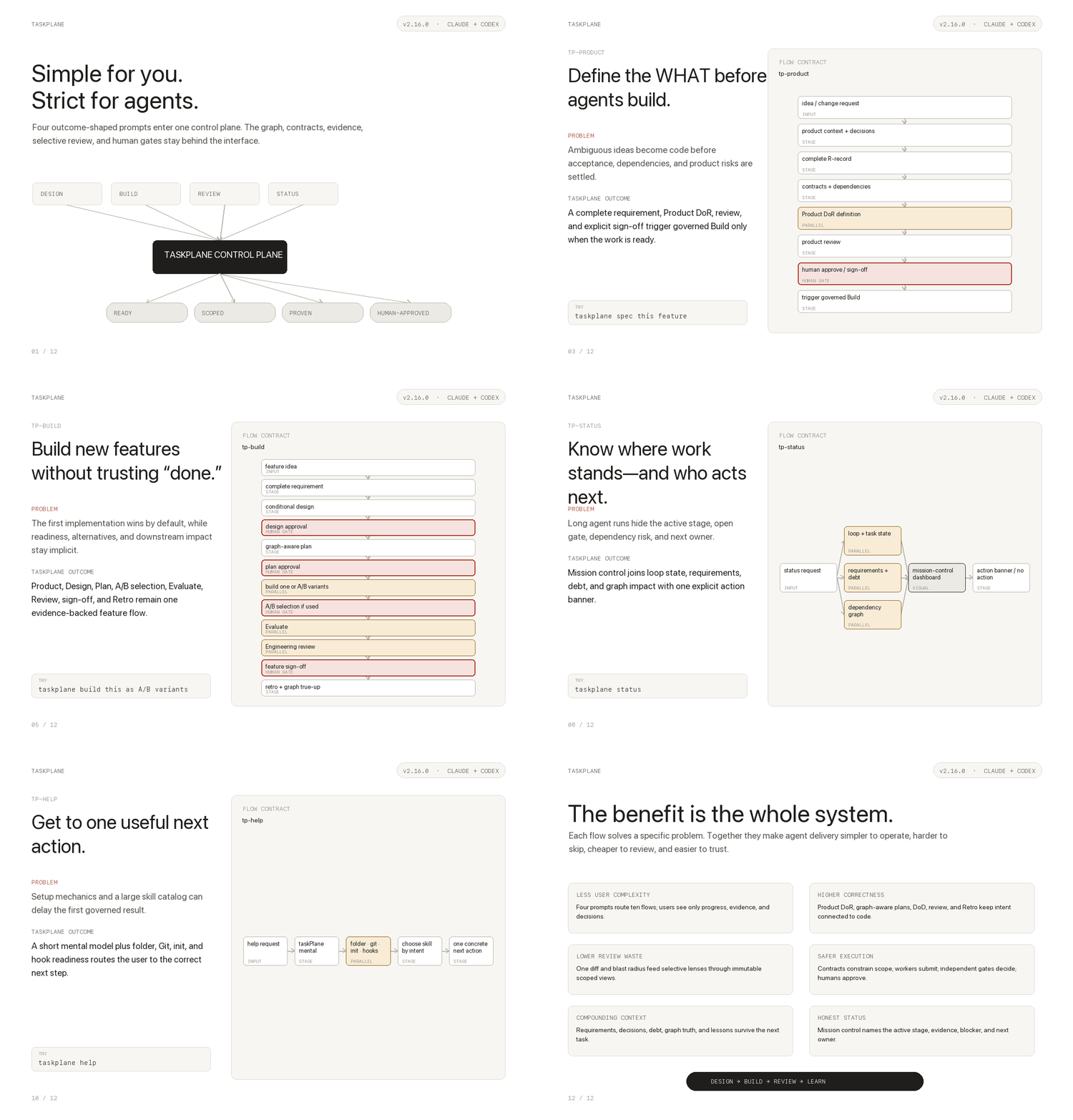
Ten flows, one control plane
| Flow | Problem it solves | Evidence-backed outcome |
|---|---|---|
taskplane |
Users should not have to learn personas, graph depth, lens routing, or loop commands. | One goal routes to Design, Build, Review, or Status while the strict harness stays internal. |
tp-product |
Ambiguous ideas become code before acceptance, dependencies, and product risks are settled. | A complete requirement, Product DoR, review, and explicit sign-off trigger Build only when ready. |
tp-design |
Architecture and contract choices otherwise emerge implicitly during implementation. | Alternatives, graph overlay, trade-offs, rollout, and validation are sealed in an approved Design Contract. |
tp-build |
The first implementation wins while readiness, alternatives, and downstream impact stay implicit. | Product, Design, Plan, optional A/B selection, Evaluate, Review, sign-off, and Retro stay connected. |
tp-go |
Agents drift scope, skip graph work, or report partial execution as done. | Scoped workers submit evidence; independent gates advance stages; humans retain approval and sign-off. |
tp-engineering |
Broad reviews reread the same repository and still miss dependencies outside the diff. | One diff and graph blast radius route only applicable lenses into one canonical review and human decision. |
tp-status |
Long runs hide the active stage, dependency risk, open gate, and next owner. | Mission control joins workflow, requirements, debt, and graph state with one explicit action banner. |
tp-northstar |
A locally sound idea can still consume time without serving product direction. | An advisory check exposes leverage, reversibility, opportunity cost, coherence, and the sharpest tension. |
tp-help |
Setup mechanics and a large skill catalog delay the first governed result. | Readiness checks and a short mental model lead to one concrete next action. |
tp-tag |
Team-chat decisions lose context, ownership, evidence, and durable state. | The conversation drives a repository-persisted loop with attributed approvals, dashboards, and resumable memory. |
Together these flows reduce user complexity without reducing agent discipline:
one dependency graph, one canonical review context, selective lenses, enforced
contracts, independent evidence, and explicit human gates from idea to retro.
This simplicity does not reduce agent work. A worker may only submit a
result; it cannot advance its own stage. The orchestrator independently runs
the engine gate, which recomputes source and review-artifact fingerprints and
rejects missing, stale, out-of-scope, under-tested, or under-reviewed work.
Human Design approval (when used), plan approval, and final sign-off remain
explicit.
What taskplane does
- The governed Evaluate-Loop. Optional design → human Design approval → plan →
human plan approval → build → evaluate → fix (≤2) → engineering review → human
sign-off; serial or parallel waves, one enforced contract per agent, and only the
orchestrator invokes the state-transition gate.
docs/loop-design.md, docs/authority-matrix.md. - Enforced contracts. Every agent runs inside a contract — file scope, action
budget, denied commands, read-only for reviewers — screened by the PreToolUse
hook before each tool call. Literal scope overrides carry provenance: only the
human-approved plan'splan_mintedmark authorizes them, never a CLI flag. docs/state-spec.md. - 26 lenses with intelligent routing v2. The lens catalog (generated:
docs/lens-catalog.md) is routed per stage profile (design
8 · build 5 · review 26) by a signal engine that scores each lens against the
actual diff and returnsdeep/light/n/a— everyn/acarries
machine-checkable negative evidence, the cap-8 budget demotes (never drops),
security floors hold on enforcement diffs, and engine failure fails open to the
full catalog. docs/routing-and-flows.md. - Graph decomposition.
tp graph scan --decomposederives a component layer
inside the dependency graph (directory convention + import cohesion + AST
clustering; floors overridable viacomponents.yaml) with fingerprint-cached
per-component lens maps. Reviews route the capped union of touched components'
maps,component_attributionnames which component proposed each routed lens, and
the fail-open ladder only ever widens (component → module → full catalog). Same doc. - Governed flows. The review wave and the execute/evaluate/fix waves each
dispatch as one journaled, resumable Dynamic Workflow on Claude; the Task-dispatch
path stays mandatory and byte-identical everywhere — it is the only Codex path —
and every human gate stays reachable with workflows off (TASKPLANE_WORKFLOWS).
On Codex, every brief carries a collision-safe nativetask_name, exact taskplane
role marker and instructions, model tier, optional model, and tier-derived
reasoning effort; execute waves register those identities before spawn so strict
dispatch can reject a renamed, mis-routed, or partial handoff. Same doc. - The regression gate. Each change is verified for actual regressions within its
dependency-graph blast radius at the DoD gate: Tier 1 blocks a was-green-now-red
test against the change's baseline; Tier 2 flags a changed enforcement/public
entry point with no covering test. docs/regression-gate-design.md. - Audit cadence + router audits. Every Nth review (
TASKPLANE_AUDIT_EVERY) a
full-catalog sweep diffs its findings against the routing; any finding from ann/a-routed lens is auto-filed as a router regression that blocks sign-off. - A knowledge base that compounds. Requirements (refinement-scored, with
dependencies and named contracts), decision records (ADRs with lifecycle and
supersede chains), and tracked debt (tp req debt) persist in a plan-aware
per-project store and are recalled by relevance at every step.
docs/requirements-core.md, docs/lenses-and-knowledge.md. - Dependency-graph DoR/DoD. Requirements declare dependencies and the
API/event/data/runtime contracts they provide, consume, or change; before plan
approval the refreshed graph checks depth, boundaries, and every new module, and
the DoD compares planned vs realized modules and rejects a stale graph fingerprint.
The moving parts: an enforcement kernel (contracts + lifecycle hook +
orchestrator-only gates + audit trace), the loop engine, the Design Contract phase,
26 read-only lens agents fanned out in parallel, the requirements/decisions/debt
knowledge base, a deterministic dependency graph with a zero-token blast-radius map,
and portable cheap/standard/deep model tiers routed per step, task, and lens —
mapped to models by env config, verifiable with tp loop verify-dispatch.
What's new
Recent releases. CHANGELOG.md is the
authoritative, complete history — if the two ever disagree, the CHANGELOG wins.
| Version | Highlights |
|---|---|
| v2.16.9 | Managed PR reviews now finish in the task that started them. Taskplane builds the immutable patch from the pinned merge-base, treats an explicitly bounded dependency traversal as complete under its declared policy, and does not degrade a high-confidence module graph merely because a body-only edit has no changed symbol. Exact leased result writes are authorized only inside validated managed run storage, receive host-observed provenance, and can be collected or signed off from the parent Codex workspace by sealed review-run ID. A workflow eval exercises the complete managed-checkout journey without freezing model wording or findings. |
| v2.16.8 | Large pull requests now acquire only the refs the review actually needs. Taskplane initializes its managed bare mirror locally, fetches only the target base branch and PR head, and makes one bounded HTTP/1.1 fallback for GitHub RPC/HTTP 400 transport failures instead of cloning every remote ref and misdiagnosing the failure as a credentials problem. A ready repository run is durable and idempotent: retrying or continuing reuses its pinned checkout without another GitHub transfer, while review still re-verifies the local head and diff before governance. The real Backstage PR 35183 now advances from its preserved failed run to a governed selective review with the exact three-file diff, six review slots, and no restart. |
| v2.16.7 | Codex PR review now continues in the task that requested it. Runtime hook receipts prove the active native or repository hook instead of inferring readiness from installed files, so a managed checkout does not trigger an endless “open a new task” loop. PR preflight materializes partial-clone blobs while authentication and network failures can still request user action; standalone review invalidates obsolete sparse runs, bounds large graph evidence by verified reference, and excludes taskplane-generated hook configuration from the reviewed diff. The real Backstage PR 35183 smoke reaches ready on its three-file immutable diff and selectively routes five review slots. |
Install
How you install taskplane depends on your account type, and the paths are
genuinely different — the most common one (an org member on a Team/Enterprise
plan) is also the most restricted. Start with the row that matches you. Install
facts are current per the Claude docs as of August 2026:
Use plugins in Claude
and Plugin marketplaces.
I'm on a Team or Enterprise account (not an org admin)
Honest first: you cannot add taskplane from GitHub yourself. On
Team/Enterprise accounts, plugins come from your organization's plugin catalog
(Customize → Plugins), which your org's owners curate; the personal
add-a-marketplace path is not available to you, and on Enterprise your admin may
restrict the catalog further (in Claude Code, managed settings can likewise block
marketplace adds — see managed marketplace restrictions).
Your two real paths:
- Ask an org admin to publish taskplane to your organization's marketplace —
send them the exact admin steps below. Once
published, taskplane appears in your org plugin catalog and you install it from
there in one click. - File upload, where your org allows it: download this repository as a ZIP
from GitHub (Code → Download ZIP), then in Claude (Customize → Plugins)
upload it as a custom plugin file. If no upload option is shown, your org has
disabled personal plugin uploads — path 1 is the way.
Fallback: taskplane also works on a personal Pro or Max account with the
direct GitHub path below, if you want to evaluate it before asking your admin.
I'm an org admin (Team/Enterprise)
Publish taskplane to your organization's marketplace from Organization
settings → Plugins (admin guide: Manage plugins for your organization):
- Upload a file: Add plugins → Upload a file → name the marketplace → drag
in the plugin file (under 50 MB) → Upload. Re-uploading under the same name
overwrites the previous version. - GitHub sync: organization sync only reads private or internal
repositories (through the Claude GitHub App), so mirrorvdemkiv/taskPlane
into a private repository in your org first, then connect it inowner/repo
form. The initial sync runs automatically; toggle Sync automatically to pick
up merged version bumps, or use Update for manual syncs.
Then set availability per plugin: Installed by default, Available for
install (listed in the catalog), Required (installed for everyone, not
removable), or Not available. Changes reach members on their next session or
plugin refresh. For org-managed Claude Code machines, allowlist the marketplace
via strictKnownMarketplaces / extraKnownMarketplaces in managed settings so
members' installs resolve without a blocked marketplace add
(settings reference).
Personal, Pro, or Max account
The direct GitHub marketplace path works as-is. Claude Desktop or claude.ai
(Chat / Cowork): Customize → Plugins → + in Personal plugins →
Add marketplace → "Add from a repository" → pastehttps://github.com/vdemkiv/taskPlane → taskplane appears → Install.
Claude Code (terminal) — same thing; the first command adds this repo as the source:
/plugin marketplace add vdemkiv/taskPlane
/plugin install taskplane@taskplane-marketplace
/reload-plugins
Codex (OpenAI)
Recommended — published plugin directory: in the ChatGPT desktop app,
select Codex, open Plugins, search for taskplane, choose + to
install it, then start a new Codex task in your repository. In Codex CLI, runcodex, open /plugins, install/enable taskplane from the marketplace tab,
and start a new CLI session. Newly installed skills load in new tasks/sessions.
Plugins are supported in ChatGPT desktop Codex and Codex CLI, not the Codex IDE
extension. See Codex plugins.
GitHub source — development or catalog fallback:
codex plugin marketplace add vdemkiv/taskPlane
codex plugin add taskplane
codex
# inside Codex: /plugins, verify taskplane is enabled, then start a new session
On first repository setup, taskplane installs a portable repo-local.codex/hooks.json and an ignored machine-local bridge, then asks you to start
one more task so Codex loads the lifecycle hooks. After that first load, the
bridge resolves the newest valid installed taskplane engine on every call, so
plugin version updates do not require a Codex restart for hook execution.
Codex still loads newly changed skill or MCP definitions at a task boundary.
Repository URLs, refs, and pull requests do not require opening a new task:
taskplane acquires them into a managed checkout, inherits the current host
session, and prompts in the same chat when GitHub authentication, a tool, or
storage authorization is needed.
Keep Codex's sandbox and approval controls enabled — taskplane's scope contract
is an additional guardrail, not a replacement.
Requires git in your workspace (the gates need a commit snapshot) and Python 3
(standard library only; python3 on macOS/Linux or the py launcher on
Windows). Nothing else to set up.
Quickstarts
Command-first, one per host. Each ends the same way: say "set up taskplane"
and onboarding takes it from there.
Quickstart: Claude Code (terminal)
# personal accounts (org members: install from your org's plugin catalog instead)
/plugin marketplace add vdemkiv/taskPlane
/plugin install taskplane@taskplane-marketplace
/reload-plugins
Open your project repository (it needs a git commit), then say "set up taskplane".
Quickstart: Cowork / Claude Desktop
- Install taskplane by your account path above — org plugin catalog on
Team/Enterprise, Personal plugins → Add marketplace on personal accounts. - Connect the folder / repository you want governed (Cowork: attach the folder).
- Say "set up taskplane".
Quickstart: Codex
codex
# inside Codex: /plugins → find taskplane → install and enable
# then start a NEW CLI session
cd to your project repository first (desktop: open it as a local environment),
then in the new task say "set up taskplane". Use the GitHub source commands
in the Install section only for local development or when the published catalog
is unavailable.
You can also start from a repository URL or pull request. Say what you want to
build or review; taskplane runs its repository precondition automatically,
keeps source under the managed checkout root (never under .em-review), and
continues in this task. A recoverable auth/tool/storage requirement appears as
one approval prompt rather than a failed review or terminal handoff.
Onboarding — the short version
Say "set up taskplane", or just state a goal — taskplane routes it and runs
onboarding for you on a fresh folder. tp onboard won't hand you to a governed run
until three checks are green: a real project folder to work in (an empty scratch
dir or the session root is refused), a git commit to diff against (the gates fail
closed without a snapshot), and tp init — which scaffolds the four context docs,
scans the dependency graph, and creates the knowledge base. On a brownfield
project, fill current-state.md first: it grounds every design review in as-built
reality, and reinventing an existing component is a blocker-class finding.
Onboarding then asks one question — keep taskplane knowledge private/local
(personal, ~/.taskplane/projects/<repository-key>/knowledge) or shared
in-repo (team/enterprise, .taskplane-kb/knowledge) — and reports the
resolved model-tier map. Source checkout, private run state, graph/evidence,
and artifacts use separate roots under ~/.taskplane; see
repository preconditions and hybrid storage.
Claude Code users
reload plugins after installation; Chat/Cowork and Codex users start a new
conversation/task only for the host's initial plugin/hook load. Managed
checkouts and later plugin patch versions continue in the same task. Full Claude
and Codex onboarding, sharing modes (tp share), model tiers, cost routing, and
context storage: docs/onboarding.md.
Honest about what the guardrails are
The scope/command guardrails are a real, mechanical help for the everyday failure —
an agent that drifts out of its lane or fires a destructive command by mistake. For
matched mutating tool routes the host exposes to plugin hooks, the PreToolUse screen
checks scope, denied commands, and the action budget before the call, resolves../absolute/symlink paths, treats destructive programs (rm, chmod, …) as
writes, and fails closed on a corrupt contract or screening error. Codex
subagent lifecycle hooks are deliberately advisory; optionalTASKPLANE_ENFORCE_DISPATCH=strict additionally fails closed unless a native spawn
matches an emitted task name, role marker, model, and reasoning effort. This is
keep-the-agent-on-topic, not a security sandbox: plugin hooks do not intercept tool
routes the host does not expose, arbitrary effects performed inside an allowed
process, or remote side effects. A task that grants Bash grants arbitrary code
execution, and no string-screen can fully contain a determined adversary — for a
hard boundary, keep Codex/Claude approvals and sandboxing enabled and add OS-level
isolation where needed (the token/$ budget is cooperative in the same way).
Likewise, "a worker cannot advance its own stage" is a
protocol + audit guarantee, not process isolation. What holds mechanically is
the evidence: a gate only advances on a submission whose fingerprints (changed
source plus the exact evaluator/engineering evidence bytes) still match the
workspace, so even a worker invoking the gate itself cannot pass unproven, stale,
or post-submission-edited work.
Layout
taskplane/
├── taskplane/              # the enforcement core (kernel + hook screener)
├── hooks/hooks.json        # PreToolUse → taskplane screen
├── agents/                 # product/designer/planner/executor/evaluator/fixer/engineering/orchestrator + tp-lens + tp-northstar
├── skills/                 # taskplane façade + tp-go/product/design/build/engineering/northstar/tag/status/help
├── lenses/                 # the 26-lens catalog
├── scripts/                # generators (e.g. the lens-catalog doc)
├── discipline/             # TDD, debugging, worktrees — the operating disciplines
├── docs/                   # state spec + design notes + feature deep-dives
# note: the knowledge base is NOT here — personal plans keep it in ~/.taskplane/projects/<key>/; Team/Enterprise keeps it in-repo at .taskplane-kb/
├── PRIVACY.md              # privacy policy (local-only, no telemetry)
└── LICENSE                 # Apache License 2.0
Going deeper
- docs/specialist-routes.md — the specialist skill
routes (tp-design,tp-engineering,tp-build,tp-go,tp-product,tp-northstar,tp-status,tp-help), what you'll see during a governed run,
and the CLI under the hood. Definition and judgment stay separate seats — the
grader never grades their own spec. - docs/onboarding.md — the full setup reference.
- docs/claude-tag.md — taskplane as your org's @Claude in
Slack channels via Claude Tag (beta), with thetp-tagskill. - docs/routing-and-flows.md — routing v2, component
decomposition, the review and stage waves with their mandatory byte-identical
Task fallback, the audit cadence, and evaluate's build-stage routing — each
with a dogfood example from this repository. - docs/configuration.md — every environment variable.
- docs/loop-design.md · docs/authority-matrix.md ·
docs/state-spec.md — engine design, who may do what at
every step, and the on-disk state.
License: free and open source under the Apache License 2.0 — use it
personally or at work, commercially or not, no strings. See LICENSE.
Privacy: taskplane runs locally, collects nothing, and sends nothing — no
telemetry, no accounts, no network calls of its own; all state stays on your disk,
in an external store (~/.taskplane, personal plan) or in-repo (.taskplane-kb/,
Team/Enterprise). See PRIVACY.md.
Reviews (0)
Sign in to leave a review.
Leave a reviewNo results found